What is Unconventional Machining?
Imagine you have a piece of wood. You can cut it with a saw. You can drill it with a metal bit. This is called Traditional Machining. It uses a sharp tool that is harder than the material you are cutting.
But what if you need to cut a metal that is harder than your saw? Or what if you need to drill a hole in a piece of glass without cracking it?
This is where Unconventional Machining comes in.
In these processes, we do not use a sharp knife or a drill bit. Instead, we use energy. We use things like lightning (electricity), sound waves, light (lasers), or chemicals to remove material.
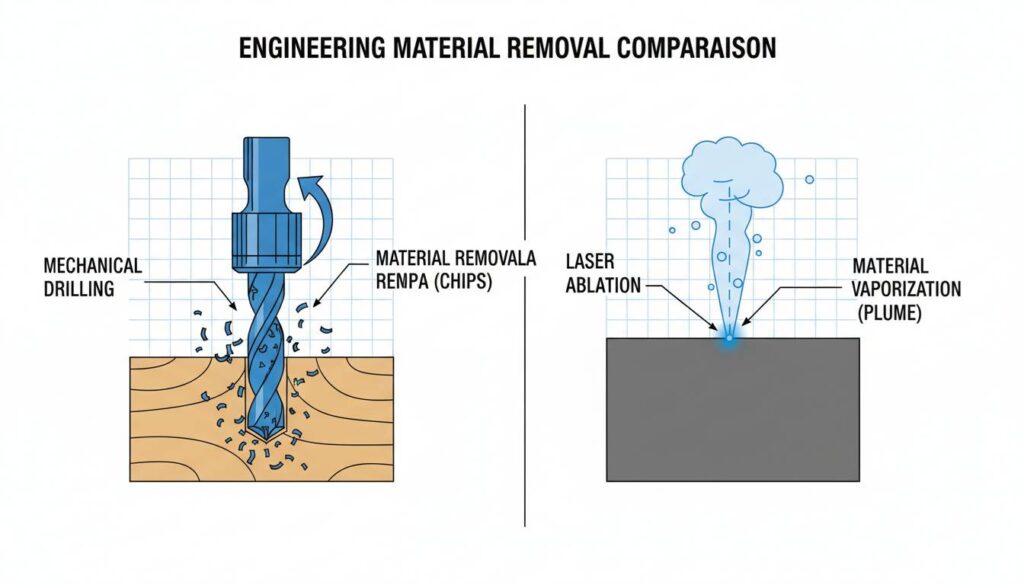
Diagram: A split-screen comparison illustration. On the left, a traditional drill bit cutting into a block of wood with chips flying. On the right, a laser beam hitting a metal block, vaporizing the material with smoke rising. Simple schematic style.
Why Do We Need Unconventional Machining Processes?
We use these special methods for three main reasons:
- Hardness: The material is too hard for regular tools (like Titanium or Superalloys).
- Complexity: The shape is too weird or tiny for a drill to reach.
- Delicacy: The part is too thin and a regular tool would bend or break it.
Think About It:
If you tried to drill a hole through a diamond using a steel drill bit, what would happen to the drill bit? Why?
Classification by Energy Type
Engineers group these processes by the type of energy used to do the cutting. Think of this as the “weapon of choice” to attack the material.
There are four main families:
- Mechanical Energy (Hitting it)
- Thermal Energy (Burning it)
- Electrochemical Energy (Dissolving it with electricity)
- Chemical Energy (Eating it away)
1. Mechanical Energy Processes
This method is like using a sandblaster. We do not touch the workpiece with a solid tool. Instead, we use high-speed streams of tiny particles or fluids to erode (wear away) the material.
Ultrasonic Machining (USM)
Here, a tool vibrates incredibly fast—faster than your ears can hear (ultrasonic). We pump a mix of water and hard sand (called slurry) between the tool and the metal. The vibrating tool hammers the sand into the metal, chipping it away.
- Action: Hammering / Impact.
- Best for: Hard, brittle materials like glass or ceramic.
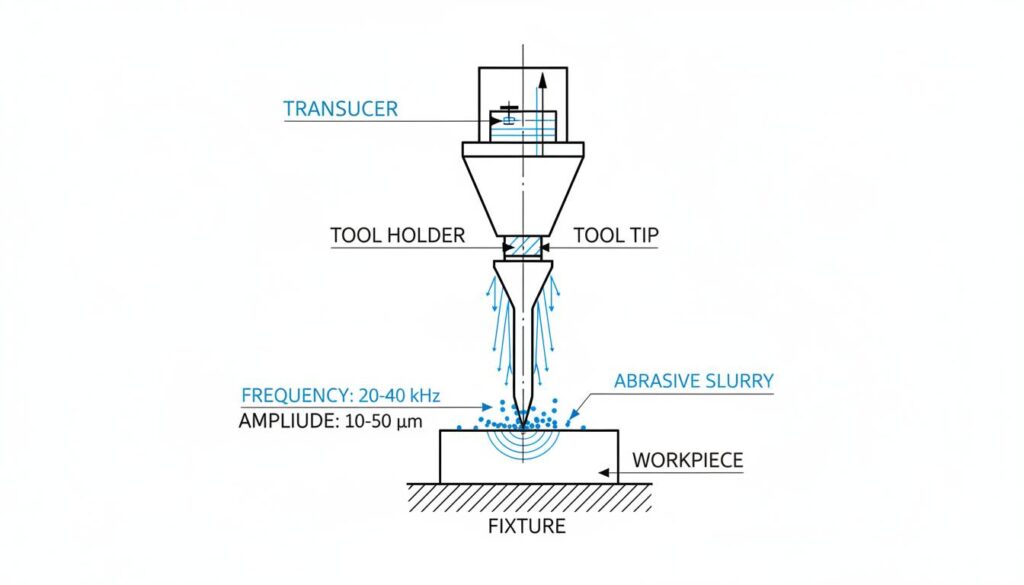
Technical Diagram: Technical schematic of Ultrasonic Machining. Shows a transducer at the top, a tool holder, and a tool tip vibrating against a workpiece. Small dots representing abrasive slurry are between the tool and the workpiece.
Abrasive Jet Machining (AJM)
Imagine a pressure washer, but instead of just water, it shoots air mixed with sharp sand. This high-speed stream cuts through the material.
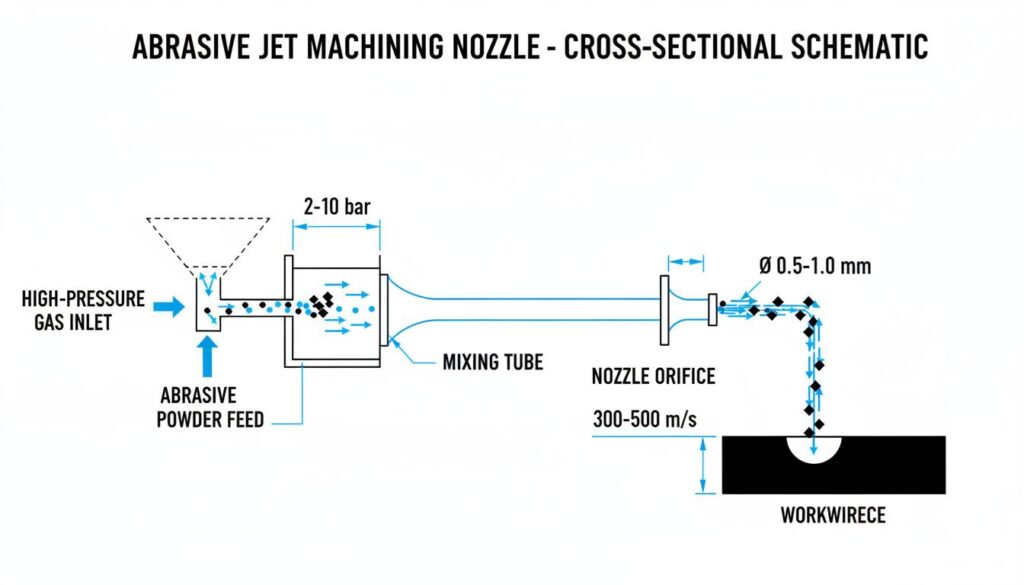
Technical Diagram: Cross-section diagram of an Abrasive Jet Machining nozzle. Shows high-pressure gas entering, mixing with abrasive powder, and exiting a narrow nozzle to hit a workpiece plate.
2. Thermal Energy Processes
“Thermal” means heat. These processes use extreme heat to melt or vaporize (turn into gas) the material. This is great for cutting very hard metals.
Laser Beam Machining (LBM)
We focus a powerful beam of light onto a tiny spot. It gets so hot, so fast, that the metal instantly turns into smoke.
- Action: Vaporization.
- Best for: Cutting tiny holes or complex shapes in any material.
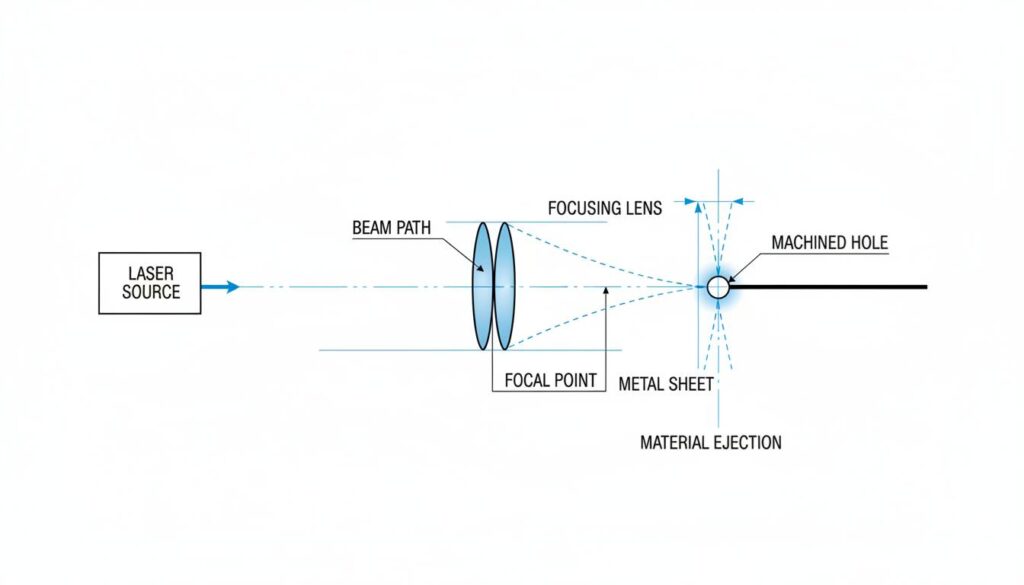
Technical Diagram: Schematic of Laser Beam Machining. Shows a laser source, a lens focusing the beam into an hourglass shape, and the focal point hitting a metal sheet, creating a hole.
Electrical Discharge Machining (EDM)
This is also called “Spark Machining.” We create thousands of tiny lightning bolts (sparks) between a tool and the workpiece. Each spark melts a tiny microscopic piece of metal.
- Action: Melting and Vaporization by sparks.
- Best for: Making molds and dies out of hardened steel.
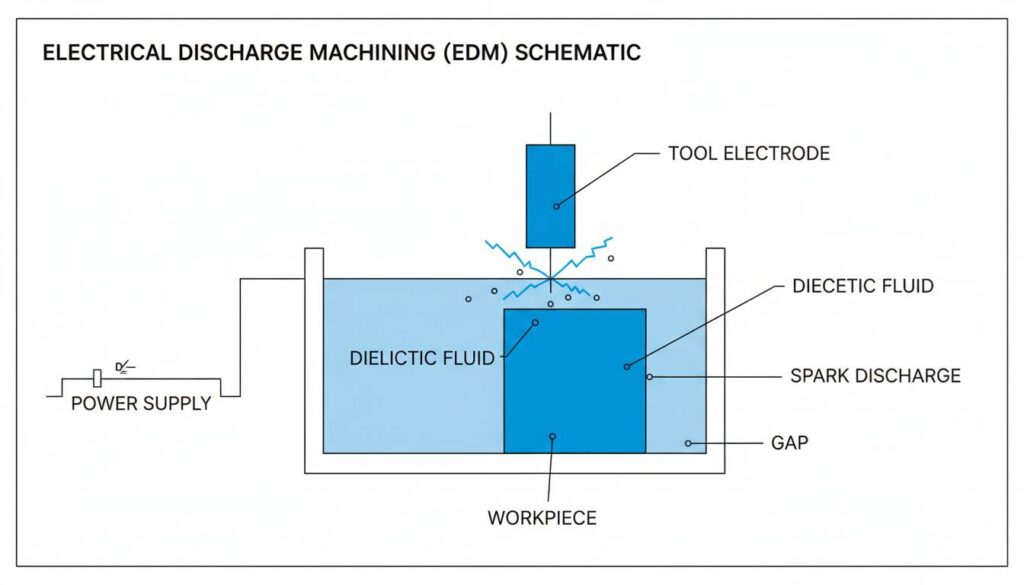
Technical Diagram: Technical diagram of Electrical Discharge Machining (EDM). Shows a tool electrode and a workpiece submerged in a tank of dielectric fluid. Sparks are shown jumping across the small gap between the tool and the work.
3. Electrochemical Energy Processes
This is the opposite of battery plating. In plating, you add metal. Here, we remove it.
Electrochemical Machining (ECM)
We place the metal in a saltwater-like solution (electrolyte) and turn on the electricity. The electricity pulls atoms off the metal surface, dissolving it into the water. The tool never touches the metal, so there is no wear on the tool.
- Action: Ion displacement (Dissolving).
- Best for: Super hard metals that cannot be stressed or heated.
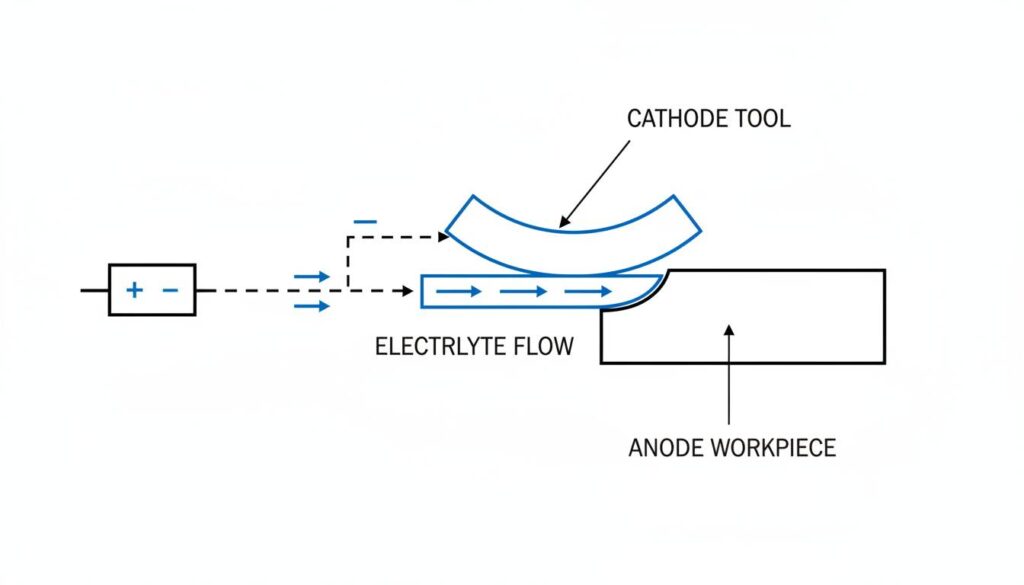
Technical Diagram: Schematic of Electrochemical Machining. Shows a cathode tool shaped like a curve and an anode workpiece. Electrolyte fluid flows between them. Power supply connects positive to workpiece and negative to tool.
Quick Check:
In Thermal machining, we use heat to remove material. In Electrochemical machining, the part stays cool. Why might keeping the part cool be important for building an airplane engine?
4. Chemical Energy Processes
This method uses no electricity and no physical force. It uses pure chemistry.
Chemical Milling
We cover the parts of the metal we want to keep with a protective mask (like tape). Then, we dip the whole thing into a strong acid bath. The acid eats away the exposed metal but leaves the protected parts alone.
- Action: Chemical etching (Corrosion).
- Best for: Making thin metal sheets lighter (often used in aircraft skins).
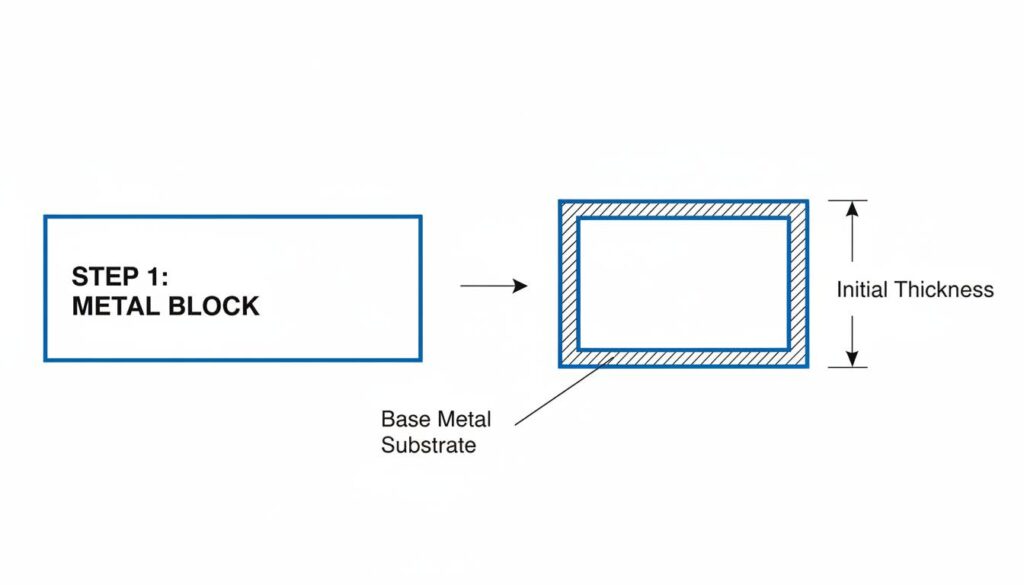
Technical Diagram: Step-by-step diagram of Chemical Milling. Step 1: Metal block. Step 2: Masking applied to specific areas. Step 3: Block submerged in a tank of acid (etchant). Step 4: Mask removed, showing material removed from unmasked areas.
Summary of Classification
Here is a simple way to remember the differences:
| Classification | Energy Source | How it Cuts | Analogy |
| Mechanical | Motion / Velocity | Erosion (Chipping) | Sandblasting a wall. |
| Thermal | Heat / Light | Melting / Vaporizing | Burning a leaf with a magnifying glass. |
| Electrochemical | Electricity + Liquid | Dissolving | An aspirin dissolving in water. |
| Chemical | Chemicals (Acid) | Etching | Rust eating a car fender. |
Final Challenge:
You need to cut a square hole into a piece of glass.
1. Can you use a laser? (Think: Does light go through glass?)
2. Can you use sparks (EDM)? (Think: Does glass conduct electricity?)
3. Which “Mechanical” method mentioned above would work best?
