
Introduction
The global transition toward clean energy systems has renewed interest in hydrogen-based power technologies. Among the earliest fuel cell technologies developed, alkaline fuel cells (AFCs) occupy a unique position due to their high efficiency and successful historical deployment.
This article provides a detailed and balanced discussion of alkaline fuel cell advantages and disadvantages, examining the key pros and cons of alkaline fuel cells from a technical and practical perspective. Emphasis is placed on performance characteristics, material requirements, and the factors that have limited their widespread commercialization.
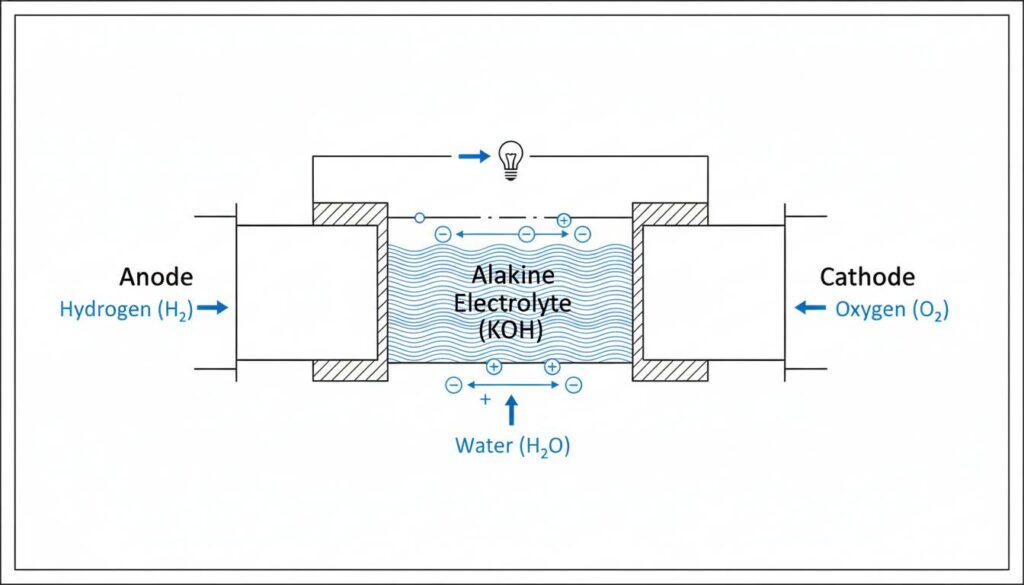
A simple 2D cross-section diagram of an Alkaline Fuel Cell. Label the left side ‘Anode’, the right side ‘Cathode’, and the center liquid ‘Alkaline Electrolyte (KOH)’. Show Hydrogen entering the left and Oxygen entering the right.
What is Alkaline Fuel Cells (AFCs)
An alkaline fuel cell is an electrochemical energy conversion device that generates electricity through the reaction of hydrogen and oxygen in the presence of an alkaline electrolyte, typically potassium hydroxide (KOH).
Unlike combustion-based systems, AFCs:
• Convert chemical energy directly into electrical energy
• Operate with high thermodynamic efficiency
• Produce water as the primary byproduct
Alkaline fuel cells hold significant historical importance, having been extensively used in early aerospace applications where reliability and efficiency were critical.
How AFCs Generate Power
Power generation in an alkaline fuel cell is achieved through two spatially separated electrochemical reactions:
• Anode reaction: hydrogen oxidation
• Cathode reaction: oxygen reduction
The alkaline electrolyte facilitates the transport of hydroxide ions between electrodes, while electrons flow through an external circuit to provide usable electrical power.
Key Components of an AFC System
An alkaline fuel cell system consists of:
• Anode – site of hydrogen oxidation
• Cathode – site of oxygen reduction
• Alkaline electrolyte – conducts hydroxide ions
• Fuel supply – high-purity hydrogen
• Oxidant supply – oxygen or purified air
Each component must be carefully engineered to ensure stable operation and high efficiency.

A schematic showing the flow of electrons in an AFC. Show electrons traveling through an external wire to light up a lightbulb. Show hydroxide ions (OH-) moving through the center liquid from right to left.
Alkaline Fuel Cell Advantages: The Pros of AFC Technology
Alkaline fuel cells offer several technical advantages that have made them attractive for specialized applications.
High Operating Efficiency
One of the most significant advantages of alkaline fuel cells is their high electrical efficiency.
• Rapid electrode kinetics in alkaline media
• Low activation and ohmic losses
• Efficient ion transport via hydroxide ions
Additionally, AFCs operate at relatively low temperatures, which further enhances conversion efficiency and reduces thermal stress on components.
Cost-Effective Catalyst Options
Unlike some modern fuel cell technologies, AFCs can employ:
• Non-precious metal catalysts, such as nickel
• Reduced or eliminated platinum usage
This capability lowers material costs and simplifies catalyst supply chains, representing a major economic advantage in controlled environments.
Clean Water as a Byproduct
A key benefit of AFC operation is the generation of high-purity water.
• Water is produced directly from the electrochemical reaction
• No harmful emissions are generated
This feature was especially valuable in space missions, where onboard water production supported crew life-support systems.
Quick Startup Time
Due to their low operating temperature range, alkaline fuel cells:
• Require minimal warm-up time
• Can reach operational output rapidly
This characteristic is beneficial in applications where fast system activation is required.

A comparison illustration. On the left, a pile of expensive platinum bars labeled ‘Other Fuel Cells’. On the right, a pile of nickel coins or metal labeled ‘Alkaline Fuel Cell’. Use a scale to show the cost difference.
Alkaline Fuel Cell Disadvantages: The Cons of AFC Technology
Despite their advantages, several technical limitations have restricted the widespread adoption of alkaline fuel cells.
Sensitivity to Carbon Dioxide (CO₂)
The most critical disadvantage of alkaline fuel cells is their extreme sensitivity to carbon dioxide.
• CO₂ reacts with the alkaline electrolyte
• Carbonate compounds are formed
• Electrolyte performance degrades
This reaction significantly reduces cell efficiency and operational lifespan.
Impact of Carbonate Formation
Carbonate accumulation leads to:
• Reduced ionic conductivity of the electrolyte
• Blockage of electrode pores
• Increased internal resistance
These effects directly impair electrochemical performance and power output.
Challenges of CO₂ Removal
To prevent degradation, AFC systems often require:
• CO₂ scrubbers or purification filters
• High-purity oxygen supplies
These requirements:
• Increase system complexity
• Add operational and maintenance costs
• Limit AFC use in open-air environments
Requirement for Pure Hydrogen Fuel
Alkaline fuel cells typically require high-purity hydrogen.
Challenges include:
• Hydrogen production infrastructure
• Storage and transportation difficulties
• Sensitivity to fuel contaminants
These factors contribute to higher system-level costs and logistical constraints.
Electrolyte Management Issues
The liquid alkaline electrolyte presents additional challenges:
• Corrosive chemical properties
• Risk of leakage
• Periodic electrolyte replacement
These issues increase maintenance requirements and limit long-term durability.
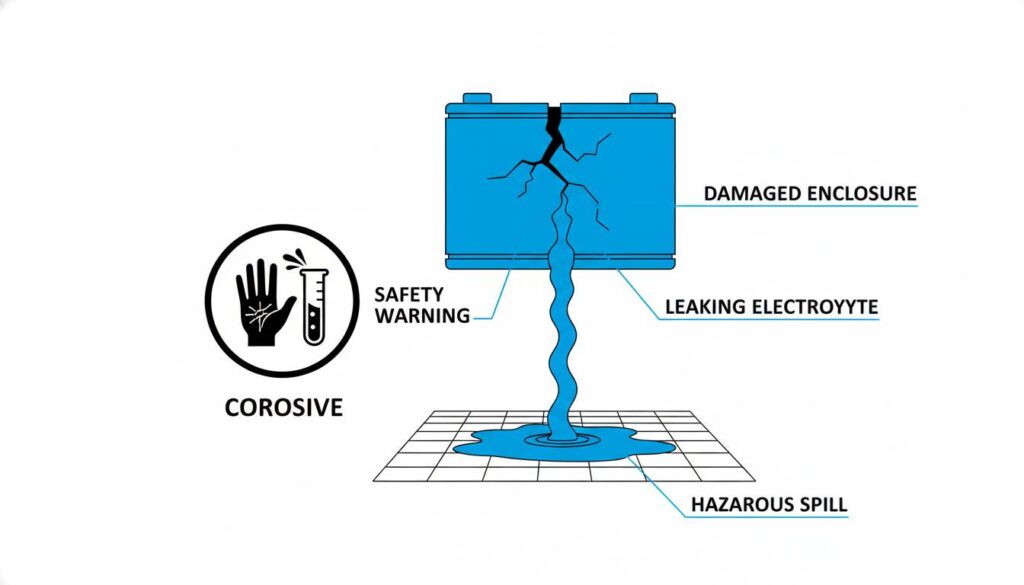
A safety diagram showing a leaking battery or fuel cell with a ‘Corrosive’ warning symbol (a hand and a test tube). This illustrates the danger of the liquid electrolyte.
Limited Application Scope
Due to the combined disadvantages, AFCs have largely been confined to:
• Aerospace systems
• Laboratory or controlled environments
Barriers such as CO₂ sensitivity and electrolyte handling have prevented large-scale commercial and industrial deployment.
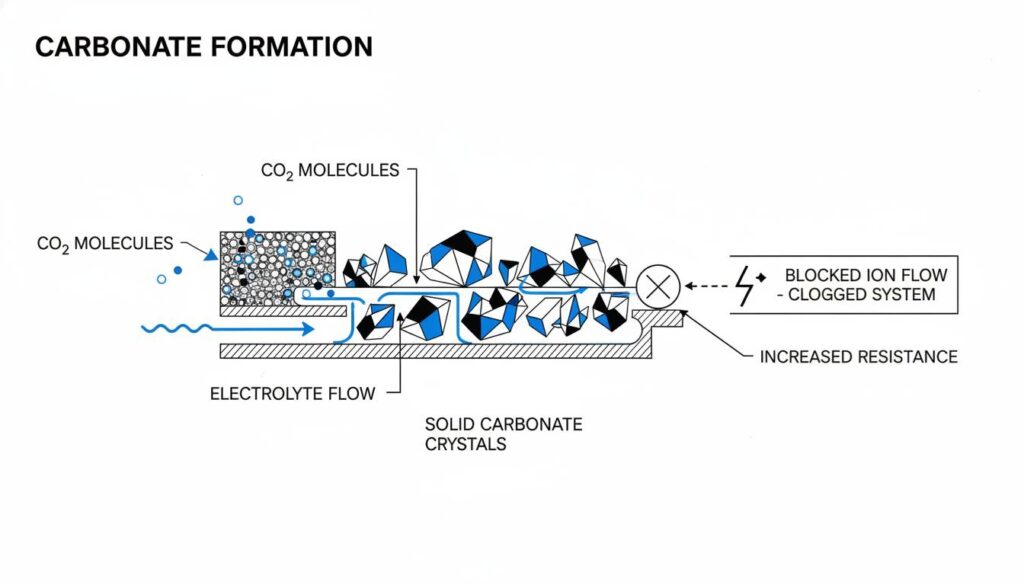
A technical diagram showing ‘Carbonate Formation’. Show CO2 molecules entering the electrolyte and forming solid crystals that block the flow of ions, representing a clogged system.
Comparing Alkaline Fuel Cells to Other Fuel Cell Types
AFC vs. Proton Exchange Membrane Fuel Cells (PEMFCs)
• Electrolyte: liquid alkaline vs. solid polymer membrane
• Operating temperature: lower for AFCs
• Catalyst materials: non-precious metals possible in AFCs
• CO₂ tolerance: significantly higher in PEMFCs
- AFC: Uses a liquid center. Cheap metal parts. Hates air.
- PEMFC: Uses a solid plastic sheet in the middle. Uses expensive Platinum. Loves air.
Because PEMFCs can breathe normal air, they are used in modern hydrogen cars and buses.
PEMFCs have gained wider adoption due to their robustness in ambient air.
AFC vs. Solid Oxide Fuel Cells (SOFCs)
• Operating temperature: low (AFC) vs. very high (SOFC)
• Fuel flexibility: limited for AFCs, broad for SOFCs
• Startup time: faster for AFCs
- AFC: Runs cool (below 100°C).
- SOFC: Runs extremely hot (up to 1,000°C).
SOFCs are used for big buildings, not small vehicles.
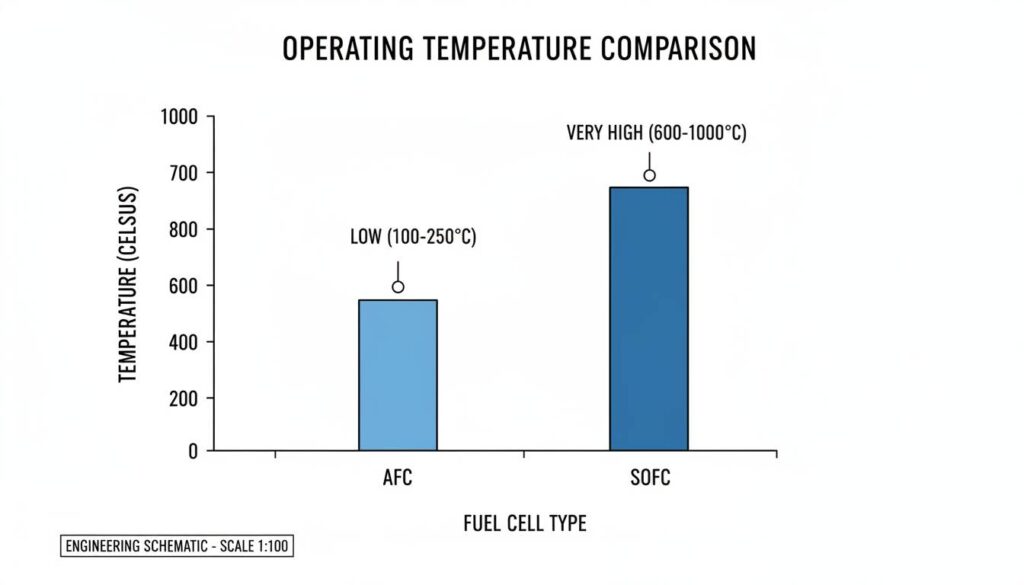
A bar chart comparing ‘Operating Temperature’. Bar 1: AFC (Low). Bar 2: SOFC (Very High). Label the Y-axis ‘Temperature (Celsius)’.SOFCs are better suited for large-scale stationary power generation.
The Future of AFCs
Are AFCs dead? No.
Scientists are working on new types of AFCs. They are trying to make solid membranes instead of messy liquids. They are also trying to make them tougher against  .
.
For now, AFCs are still great for:
- Submarines: Closed spaces where air is controlled.
- Space: Where you carry your own oxygen anyway.
- Stationary Generators: Where size and weight don’t matter as much.
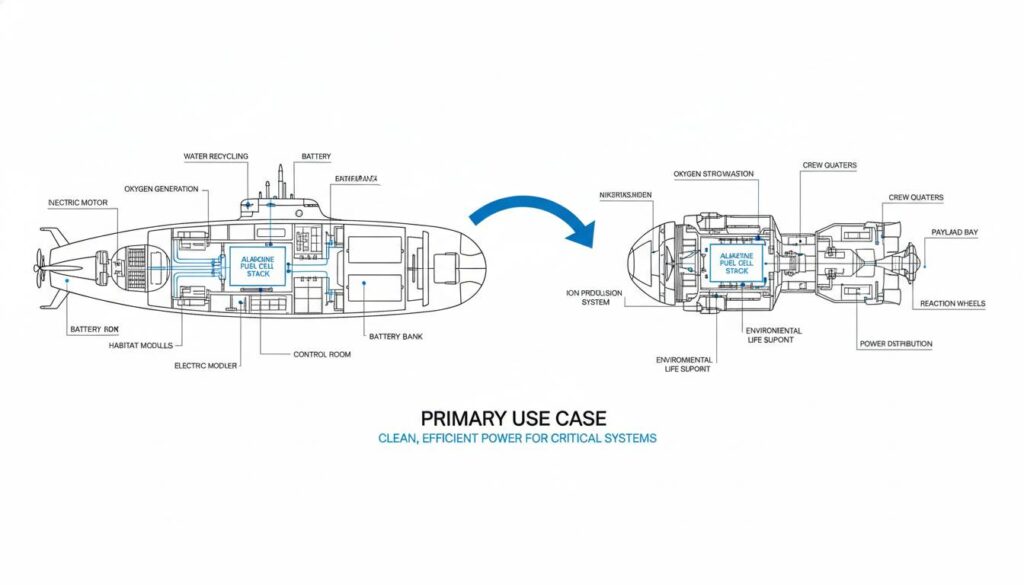
An illustration of a futuristic submarine and a spacecraft, highlighting them as the primary use cases for Alkaline Fuel Cells.
Summary
- What is it? A machine that turns Hydrogen and Oxygen into electricity.
- Pros: Very efficient, uses cheap metals (Nickel), makes drinkable water.
- Cons:
 in the air kills it (clogs it up), liquid can leak, needs pure fuel.
 - Best Use: Spacecraft and submarines.
Critical Reasoning:
If you were designing a power source for a base on Mars (where the atmosphere is mostly CO2), would you choose a standard Alkaline Fuel Cell? Why or why not?
The Future Outlook for Alkaline Fuel Cell Technology
Research and Development Directions
Current research focuses on:
• CO₂-tolerant alkaline electrolytes
• Advanced catalyst materials
• Improved electrolyte stability
Progress in these areas could mitigate key limitations.
Potential Areas for Growth
Alkaline fuel cells may still find relevance in:
• Small-scale stationary power systems
• Specialized or closed-environment vehicles
• Aerospace and defense applications
These niches benefit from controlled operating conditions.
Frequently Asked Questions (FAQ)
What is the primary advantage of alkaline fuel cells?
Their primary advantages are high efficiency, non-precious metal catalyst use, and clean water production.
Why are alkaline fuel cells not widely used commercially?
Their sensitivity to carbon dioxide necessitates complex gas purification systems, limiting practical deployment.
Do alkaline fuel cells require pure hydrogen?
Yes. High-purity hydrogen is generally required to prevent electrolyte contamination and performance degradation.
Conclusion
Alkaline fuel cells offer a compelling combination of high efficiency, low operating temperature, and cost-effective catalyst options. However, their sensitivity to carbon dioxide, electrolyte management challenges, and fuel purity requirements have constrained their widespread adoption.
Despite these limitations, AFCs remain an important technology with proven success in specialized applications. Continued research into electrolyte chemistry and system design may enable renewed relevance for alkaline fuel cells in future clean-energy systems.
Focus Keyword: Alkaline Fuel Cell Advantages and Disadvantages, AFC Pros and Cons
