Introduction
Understanding the different types of robotic arms is important for anyone interested in modern manufacturing and automation. These machines, also known as mechanical arms or robotic manipulators, perform many tasks, from delicate assembly to heavy-duty material handling. Knowing how each type works helps in choosing the right tool for a specific job.
What Is a Robotic Arm?
A robotic arm is a programmable machine designed to mimic the function of a human arm. It consists of robotic arm parts connected by joints that allow either rotational or linear movement. In the industry, what are robotic arms called? They are formally known as industrial manipulators. These systems are defined by their degrees of freedom (DOF), which determines their flexibility and reach within a work envelope.
Robotic arm Components and Structure
To understand robotic arm definition fully, you must know the parts:
Sensors: Devices that help the robot ‘feel’ or ‘see’ its environment.
Controller: The brain that gives instructions.
Joints: The axes that bend or rotate (providing the robotic arm joint types like revolute or prismatic).
End Effector: The ‘hand’ of the robot, used to grip, weld, or paint.
Links: The rigid sections connecting the joints.
This article explains the main types of robotic arms, their unique features, and common applications. We aim to provide clear, practical information for engineering students and professionals, covering everything from basic principles to real-world uses.
By the end of this guide, you will have a better grasp of:
- What makes each robotic arm type different.
- Where each type is commonly used in industry.
- How to identify the best robotic arm for various tasks.
Key Takeaways
- Articulated arms are multi-purpose, mimicking human movement for complex tasks.
- Cartesian robots offer precise linear motion for assembly and 3D printing.
- Delta robots provide high-speed, accurate pick-and-place capabilities.
- SCARA robots excel in selective compliance assembly with speed.
- Polar Robots use a spherical work envelope for reaching around
- Cylindrical Robots are compact and good for simple up-and-down tasks.
- Choosing the right robot arm type depends on reach, payload, precision, and application.
- Each type has unique strengths for specific industrial automation needs.
Types Of Robot Arms
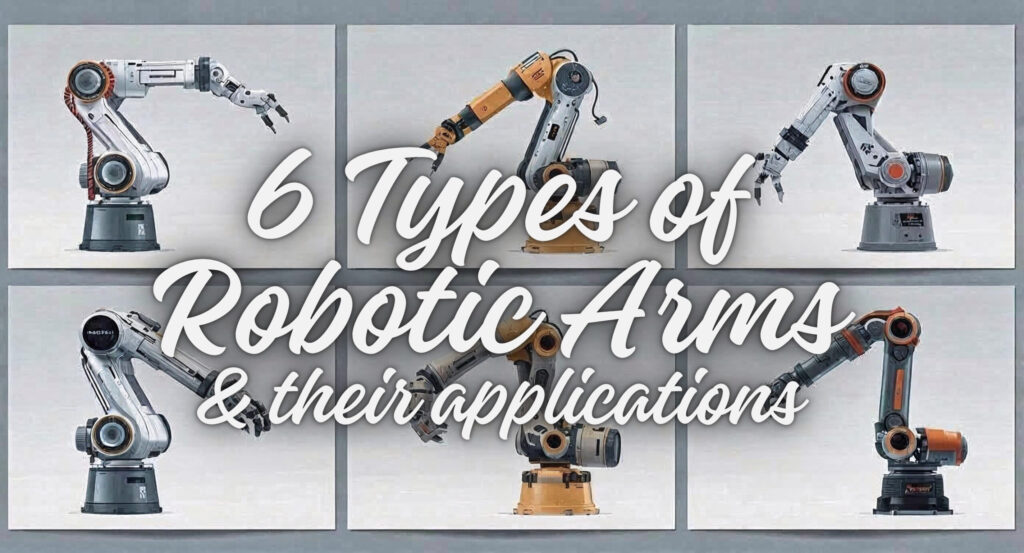
Robotic arms are often called ‘robotic manipulators.’ They are programmable and use joints or axes to move. Each type of robotic arm has specific strengths, making it suitable for certain tasks.
Here are some examples of different types of robotic arms:
- Articulated robot arms
- Cartesian robot arms
- Cylindrical robot arms
- Delta robot arms
- Polar or Spherical robot arms
- SCARA robot arms
- Collaborative Robots (COBOTs)
Understanding these classifications of robotic arms helps in selecting the right robot arm types for specific automation needs. Each configuration offers different advantages in terms of reach, payload, speed, and precision.
Key Characteristics of Robotic Arms:
- Movement: Articulated arms mimic human arms, offering rotational movement.
- Workspace: Some, like Cartesian robots, excel in large, linear workspaces.
- Speed & Precision: Delta robots are known for high speed and precision.
- Complexity: From simple two-axis robots to complex multi-axis systems.
7 Main Types Of Robotic Arms And Their Uses
Industry uses different types of robotic arms to make tasks easier, safer for workers, and more efficient. Many robot arm types also help reduce waste and operating costs. Here are the main industrial robot arm types:
Articulated Robot Arm
An articulated robot arm is very common in industrial automation. It looks like a human arm and has several rotating joints. This allows it to move in many ways. This configuration is often called a jointed arm.

Features of Articulated Robot Arms:
- It has a mechanical arm attached to a base with a twisting joint.
- It uses revolute joints, similar to elbows and shoulders.
- Most articulated robots have four to six axes (DOF), providing a wide range of motion.
Industrial Robotic Arm Applications:
These arms are versatile and can handle many tasks:
- Arc welding and spot welding
- Painting tasks
- Assembly operations
- Material removal, like grinding and deburring
- Material handling and machine tending
- Palletizing products for shipping
For example, industrial robotic arms for welding often use six-axis articulated designs because they need to reach many angles with precision. Many industrial robotic arm manufacturers produce these versatile robots.
Top Choice For Education
7DOF Robotic Arm Explorer
Are you looking for the best-reviewed robotic arms for academic pick and place tasks?

🤖 Yahboom 7DOF Robotic Arm Explorer
Interactive Capabilities Showcase
- Garbage Classification
- Color Recognition & Tracking
- Face Recognition & Tracking
- Color Block Sorting
- Label Recognition & Stacking
- Color Interaction
Select a Capability Above
Click on any feature to see how this **7DOF collaborative arm** applies computer vision and kinematics in educational and prototyping scenarios.
Detailed Product Specifications
| DOF | 7 DOF |
|---|---|
| Payload | 233g |
| Weight | About 2310g (Incl. main control board) |
| Working Radius (Max) | 374.5mm (with mold opening clamp) |
| Repeat Positioning Accuracy | ± 0.5mm |
| Gripper Range | 15.5mm to 50.5mm |
| Joint Rotation Angle | -153° to +153° |
| Power Supply | DC 12V 5A Power Adapter |
| Plug Type | DC 5.5mm x 2.1 |
| Focus Mode | Fixed Focal Length |
Yahboom Jetson Orin Nano Super 8GB 67Tops Robotic Arm
This is a perfect example of an articulated arm for students. It features computer vision for color tracking and face recognition.
- DOF: 7 Degrees of Freedom (High flexibility)
- Application: Robotic arm examples for education, Python programming, and AI learning.
- Why it wins: It mimics complex industrial arms at a student-friendly scale.
Cartesian Robot Arm
Cartesian robot arms are also called linear robots or gantry robots. They move in straight lines along three axes: X, Y, and Z. This setup uses the Cartesian coordinate system, which means they can move up and down, in and out, and side to side.

Advantages of Cartesian Robot Arms:
- High precision and heavy payload capacity
- Simple to program due to linear movement
- Scalable robot arm structure for larger areas
- They offer high flexibility in configuration.
- Users can adjust speed and precision.
- Stroke length and robot arm size can be customized.
- They often have heavy duty industrial robotic arms capabilities and payload capacity due to their rigid structure.
Typical Uses:
Cartesian robots are good for tasks needing precise linear movements:
- CNC machining operations
- 3D printing applications (Most 3D printers are Cartesian Robots)
- Pick and place tasks, especially for small items
- Loading and unloading parts
These robots are a good guide to robotic arm types for applications requiring high precision over a large, rectangular workspace. Many small industrial robotic arms and compact industrial robotic arms can also be Cartesian.
Cylindrical Robot Arm
Cylindrical robot arms have a unique movement style. They are designed around a single arm that can move up and down vertically. Cylindrical robot arms operate within a cylindrical work envelope. They have a rotating joint at the base and a sliding (prismatic) joint for the arm.
Movement Capabilities:
- A rotary joint at the base allows rotation.
- A prismatic joint connects links, enabling vertical movement.
- The arm can extend and retract horizontally.
Ideal Applications:
These robots are compact, making them good for smaller, simpler tasks:
- Assembly of small components
- Machine tending, particularly for simple loading/unloading where space is tight
- Diecasting applications
- Coating applications
- Handling parts within a cylindrical work envelope
Cylindrical robot arm vs articulated arms offer different workspace shapes, with cylindrical robots being better for tight vertical spaces. Where to buy industrial robotic arms online often lists these types for specific applications.
Delta Robot Arm
Delta robot arms are also known as ‘parallel robot arms’ or ‘spider robots’. They have three arms connected to a single base (universal joint), usually mounted above a workspace. These robot arms are known for their high speed.

Design and Movement:
- They have a distinct dome shape.
- Capable of delicate and precise movements.
- All three arms directly control the end effector, which enhances speed.
Applications in Industry:
Delta robots are excellent for tasks needing very fast and accurate movements:
- Food and beverage packaging
- Pharmaceutical handling and sorting
- Electronic component assembly
- High-speed pick and place tasks
- Sorting items on a fast conveyor belt
The delta robot arm advantages include impressive speed and accuracy, making them a best type of robotic arm for manufacturing where rapid sorting or packing is needed. A common question is ‘what is a delta robot used for?’ and the answer often involves high-speed packaging.
Polar or Spherical Robot Arm
Polar robots, sometimes called spherical robots, were among the first industrial robot categories. They have a base connected to an arm with two rotational joints and one linear joint.
Configuration and Workspace:
- The axes combine to create a polar coordinate system.
- They have a spherical work envelope, meaning they can reach objects in a sphere around them.
Common Industrial Uses:
Polar robots are used for heavy and larger-scale tasks:
- Die casting operations
- Injection molding processes
- Welding applications
- Material handling of heavy objects
- Handling Hot parts
These older yet still important types of robotic arms for manufacturing are a good example of how robot arm types have evolved. Polar robot arm characteristics make them suitable for strong, sweeping movements.
SCARA Robot Arm
SCARA stands for Selective Compliance Assembly Robot Arm. SCARA robots combine three-axis motion (X, Y, and Z) with rotational movement. It is rigid in the vertical axis but flexible horizontally.

Why use SCARA?
- Robotic arm advantages for SCARA include high speed and excellent repeatability.
- Ideal for assembly of small components and electronics.
- Commonly found in robotic arms for manufacturing computers and phones.
Key Features and Benefits:
- Better performance in lateral (side-to-side) motions compared to Cartesian robots.
- Move more quickly.
- Easier to integrate into existing systems.
- High repeatability, which means they can perform the same action precisely many times.
Specific Applications:
SCARA robots are widely used for precision assembly and related tasks:
- Biomedical applications, such as lab automation
- Palletizing smaller items
- Assembly of consumer electronics
- Screw driving and part insertion
SCARA robot arm applications highlight their value in tasks requiring horizontal precision. For small businesses, robot arm types for small businesses often include SCARA due to their balance of speed, precision, and cost-effectiveness. Learning about robotic arm categories helps in picking the right robotic arm type.
Collaborative Robots (Cobots)
A modern addition to the types of robots that use arms is the Cobot. Unlike traditional industrial arms that need safety cages, Cobots are designed to work safely alongside humans.
- Safety: Equipped with collision detection sensors.
- Uses: Machine tending, quality inspection, and medical assistance.
How to Choose the Right Robotic Arm?
When selecting a robot, engineers look at:
1. Payload: How much weight can it lift?
2. Reach: How far can it stretch? (work envelope)
3. Speed: How fast does it need to move?
4. Precision: Does it need to be exact (like for a watch) or rough (like stacking boxes)? Measured by repeatability (e.g., +/- 0.02mm).
Conclusion
Understanding the different types of robotic arms is key to improving industrial processes. Each type, from the versatile articulated robot to the high-speed delta arm, offers specific advantages for various tasks. By choosing the correct industrial robot arm, businesses can make worker lives easier, adapt to changing needs, and manage costs. Industrial automation robotic arms are a powerful tool to modernize operations and update old ways of working.
We help businesses get the most from their robotic arm investments. If you have questions about choosing, installing industrial robotic arms, or learning about industrial robotic arms, contact a specialist.
Frequently Asked Questions
What are the main types of robotic arms?
The main types of robotic arms are Articulated, Cartesian, Cylindrical, Delta, Polar (Spherical), and SCARA. Each type has a unique design and movement capabilities for different industrial tasks.
What is a robotic arm called in industry?
It is often called a robotic manipulator or an industrial robot arm.
What are industrial robotic arms used for?
Industrial robotic arms are used for a wide range of applications, including welding, assembly, material handling, painting, machine tending, pick and place, and packaging. What are industrial robotic arms used for depends on their configuration and the specific needs of the job.
How many types of robotic arms are there?
There are primarily six main types of robotic arms used in industrial settings: Articulated, Cartesian, Cylindrical, Delta, Polar, and SCARA. However, there are also variations and hybrid robotic arm systems.
What is the best type of robotic arm for manufacturing?
The ‘best’ type of robotic arm for manufacturing depends on the specific task. Articulated robots are versatile for many jobs, Delta robots are good for high-speed pick and place, and SCARA robots excel in precision assembly. Choosing the specific robotic arm types for automation is important.
What is a delta robot used for?
A delta robot is primarily used for high-speed pick and place, sorting, and packaging tasks, particularly in the food, pharmaceutical, and electronics industries. Its parallel arm structure allows for rapid, precise movements.
Which robot is best for assembly?
SCARA robots are excellent for assembly because they are fast and precise in vertical movements.
What are the big robot arms called?
Large, heavy-duty robots are typically articulated robotic arms with high payload capacities, often referred to simply as heavy-duty industrial robots.

I quite like looking through a post that can make people think.
Also, thank you for permitting me to comment!
Wonderful beat ! I would like to apprentice while you amend your website, how
could i subscribe for a blog site? The account helped me a acceptable deal.
I had been a little bit acquainted of this your broadcast offered bright clear idea