Introduction to Hydraulic Connections
Hydraulic systems use liquid under high pressure to move heavy things. Think of an excavator digging a hole. The “muscles” of that machine are hydraulic cylinders. To get the fluid (oil) from the pump to the cylinder, we need a path.
If you have a garden hose, you need a way to attach it to the tap. If you don’t attach it tightly, water sprays everywhere. In hydraulics, the pressure is much higher than a garden hose. If a connection fails, it is dangerous and messy.
We use two main types of joining parts:
- Connectors (Fittings): These join pipes and hoses so fluid can flow.
- Couplings: These join a motor to a pump so parts can spin together.

Technical Figure: A simple 3D cartoon illustration comparing a garden hose leaking water at the tap versus a secure, heavy-duty metal hydraulic connection that is dry and tight. Label the hydraulic part ‘High Pressure.
Hydraulic Connectors (Fittings)
Connectors are the “joints” of the system. They connect a hose to a pump, a valve, or a cylinder. They must be strong enough to hold the pressure without leaking.
Threaded Fittings
This is the most common type. It works like a screw or a bolt. You have a “male” end (threads on the outside) and a “female” end (threads on the inside).
- How it works: You twist them together.
- The Taper: Some threads are tapered. This means they get slightly wider at the back. As you screw them in, they get tighter and tighter, jamming together to stop leaks.
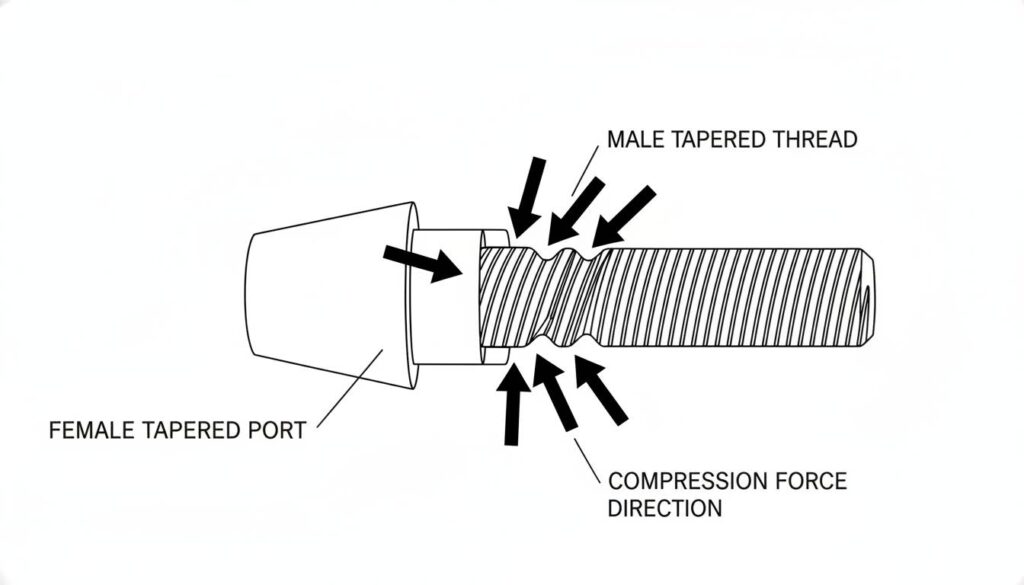
Technical Figure: Technical cutaway diagram showing a male tapered thread screwing into a female port. Use arrows to show how the threads squeeze together tighter as they go deeper.
Flared Fittings
Sometimes, just screwing threads together isn’t enough. A flared fitting uses a metal tube with a cone shape at the end.
- The Shape: The end of the tube is bent outward like a trumpet bell.
- The Nut: A nut slides over the tube and pushes this “trumpet” shape against a matching metal cone.
- The Seal: Metal pushes against metal very hard to create a seal.

Technical Figure: Exploded view diagram of a flared fitting assembly. Show the tube with the flared ‘trumpet’ end, the nut, and the connector body. Use color coding: Blue for the tube, Red for the nut, Grey for the connector.
Quick Disconnect Couplings
Imagine you have a tool that you need to change often. You do not want to use a wrench every time. Quick disconnects are like the snap-on connectors for garden hoses, but made of steel.
- Push-to-Connect: You just push the two ends together until they “click.”
- Check Valve: Inside, there is a tiny ball or spring. When you unplug the hose, this ball blocks the oil instantly. No oil spills out!

Technical Figure: Cross-section illustration of a Quick Disconnect coupling. Show the internal spring and ball mechanism (check valve) that closes when the two halves are separated to stop oil flow.
If you were designing a race car pit crew tool that runs on hydraulics, would you use a Threaded Fitting or a Quick Disconnect? Why? Think about how much time you have.
Sealing Elements (Stopping the Leaks)
Metal is hard. Even if you screw two metal parts together tightly, tiny microscopic gaps remain. Oil can squeeze through these gaps. We need something soft to fill the gaps.
The O-Ring
The O-Ring is the hero of hydraulics. It is a simple loop of rubber (or synthetic material) shaped like a donut.
- Placement: It sits in a groove.
- Action: When you tighten the connector, the rubber gets squished. It fills every tiny gap.
- Pressure: When oil pressure hits the O-ring, it pushes the rubber even harder against the wall, making the seal better.
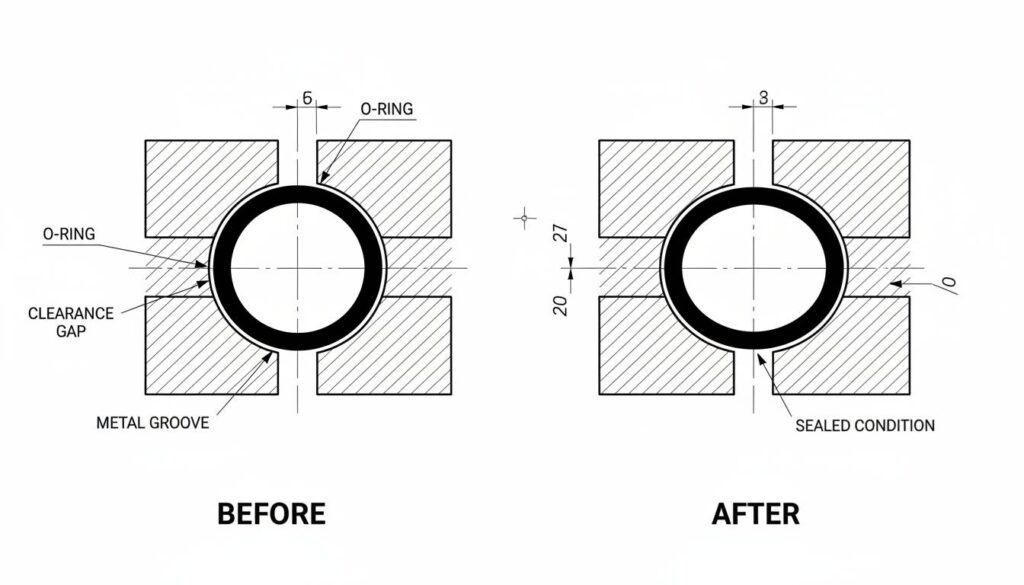
Technical Figure: Close-up zoom of a black rubber O-ring sitting in a metal groove. Show a ‘Before’ view (round shape) and an ‘After’ view (squished shape sealing the gap).
Mechanical Couplings (Spinning Shafts)
Now we move away from pipes. We need to look at the pump. A pump moves the oil, but an electric motor spins the pump.
The motor has a spinning metal stick (shaft). The pump has a spinning metal stick. We need to connect these two sticks so they spin together. This connector is called a Coupling.
Rigid Couplings
A rigid coupling is like a solid metal sleeve. It locks the two shafts together tightly.
- Pros: Very strong. Simple.
- Cons: Everything must be perfect. If the motor is slightly crooked compared to the pump, the rigid coupling will force them to bend. This can break the shaft or ruin the bearings.
Flexible Couplings
These are the most common. They connect the shafts but allow for a tiny bit of wiggle room.
- Jaw Coupling (The Spider): This has two metal hubs with “teeth” (jaws). Between the metal teeth, there is a rubber star-shaped insert (often called a spider).
- How it works: The motor turns the first metal hub. The metal hub pushes the rubber spider. The rubber spider pushes the second metal hub.
- Why it is good: If the motor vibrates or is slightly crooked, the rubber squishes to absorb the movement. It protects the machine.

Technical Figure: Exploded view of a Jaw Coupling. Show the two metal hubs with teeth on the outside, and the red or orange rubber ‘spider’ insert in the middle. Label the parts: Motor Hub, Spider Insert, Pump Hub.
Imagine holding hands with a friend while running. If you lock your elbows straight (Rigid), what happens if your friend trips? If you keep your elbows bent and loose (Flexible), is it easier to stay balanced? How does this apply to motors and pumps?
Hoses vs. Pipes
Finally, we need to choose what carries the fluid between these connectors.
Rigid Pipes (Tubing)
- Material: Steel or stainless steel.
- Use: Used when the machine parts do not move. For example, pipes running along the frame of a factory machine.
- Benefit: They handle heat well and don’t expand.
Flexible Hoses
- Material: Layers of rubber and braided steel wire.
- Use: Used on moving parts. Think of the arm of a digger. It moves up and down. A metal pipe would snap. A hose bends.
- Structure: It is like a sandwich. Rubber on the inside (to hold oil), steel wire in the middle (for strength), and rubber on the outside (for protection).

Technical Figure: Cutaway diagram of a hydraulic hose showing the layers. Inner tube, wire reinforcement mesh (braided), and outer cover. Label the layers clearly.
Why do hydraulic hoses need steel wire inside the rubber? Remember, the oil inside is pushing out with the force of a truck. What would happen to a plain rubber balloon if you filled it with that much pressure?

Hello,
I am interested in publishing an article on your website. Could you please let me know if you offer this option and what the terms are?
Thank you in advance for your response.
Kind regards,
Vincent
Hello http://mechanicalengineeringcourse.com,
If you’re looking to boost your website’s visibility, I can help you achieve top Google rankings.
I’ll prepare a complete SEO plan with actionable steps and potential growth insights for your products or services.
Once you share your target keywords and target market, I’ll send a full proposal.
Best Regards,
Asif
Hi there https://mechanicalengineeringcourse.com/,
I did a quick review of your website and found a few opportunities to improve your search rankings.
If you’re interested, please share your target keywords and target locations.
Should I send it?
Thank you,
Deepa
Hi https://mechanicalengineeringcourse.com/,
Do you want rank your website on the 1st page of Google?
We can help you in putting your website on Google top page and getting more customers.Would you like to optimize your site?
I will be happy to share with you our pricing and proposals.
May I send you SEO Packages/Cost?
Thank you,
Deepa
Hi,
I was checking your website, and saw you have a good design and it looks great, but it’s not ranking on Google and other major search engines.
With your permission : I would like to send you a SEO Proposal with prices showing you a few things to greatly improve these search results for you. These things are not difficult.
It will show you exactly what needs to be done to move you up in the rankings dramatically.
May I send you a best quote?
Thanks,
Sabia Khan
Greetings,
I recently came across http://mechanicalengineeringcourse.com and wanted to get in touch. Your website has good potential, and with the right SEO strategy, it could reach more customers through Google.
Our SEO services are customized to improve rankings, increase organic traffic, and help businesses generate consistent leads.
If this is something you’d be interested in, let me know, and I’ll send our SEO strategies along with our package details.
Best regards,
Anaya