
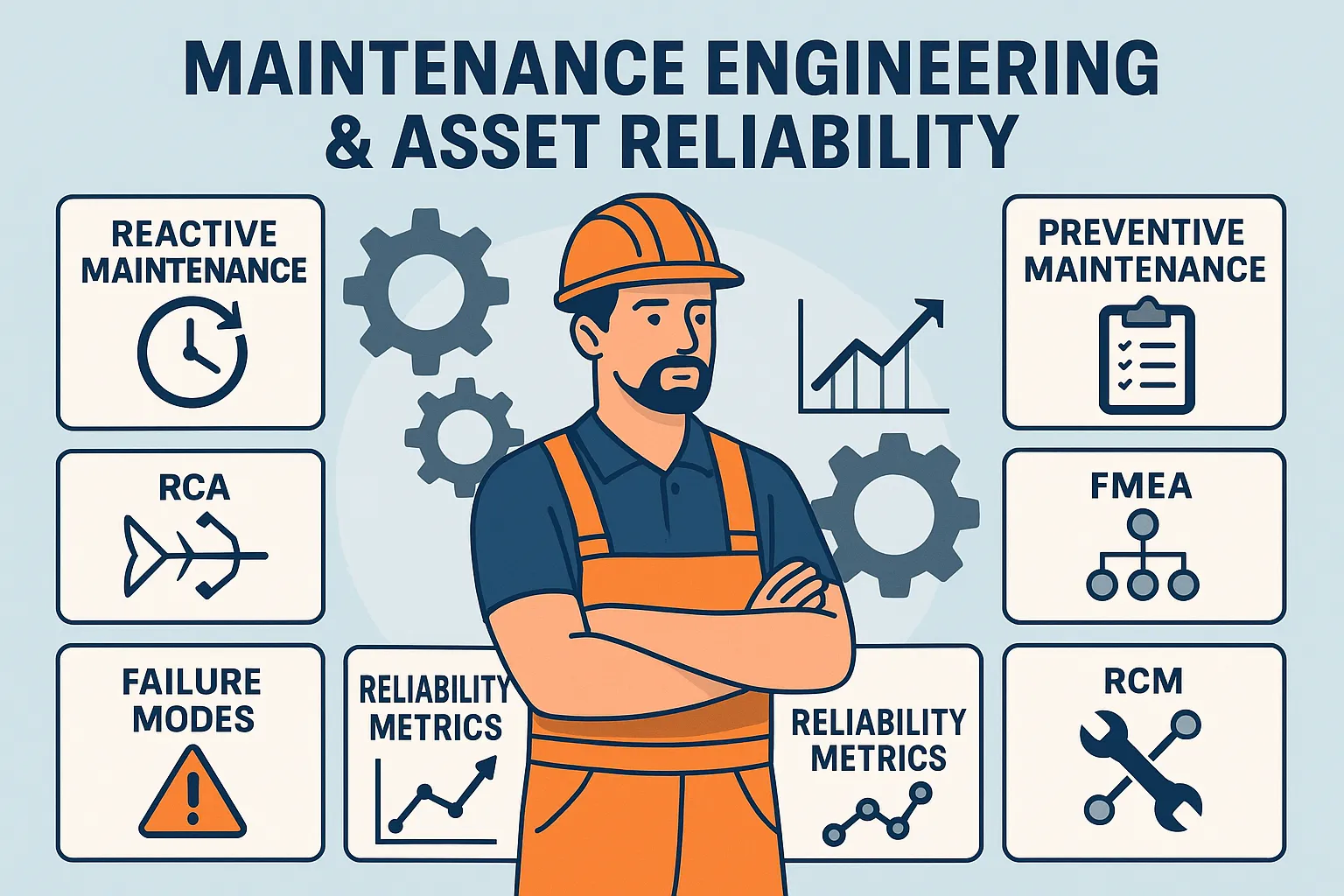
Maintenance engineering is the backbone of reliable industrial operations. From factories and power plants to oil refineries and manufacturing units, every industry depends on properly maintained machines to stay safe, productive, and efficient. This guide gives you a clear and simple explanation of all major maintenance strategies, reliability tools, and failure analysis techniques used worldwide.

Introduction to Maintenance Engineering
Maintenance engineering ensures that machines perform their intended functions without unexpected failures. It blends engineering principles with practical maintenance techniques to maximize asset life and minimize downtime.
Maintenance engineers focus on:
- Improving machine reliability
- Reducing breakdowns
- Ensuring safe operations
- Optimizing maintenance schedules
- Managing spare parts
- Lowering maintenance cost
Reliable machines → Smooth production → Higher profits.
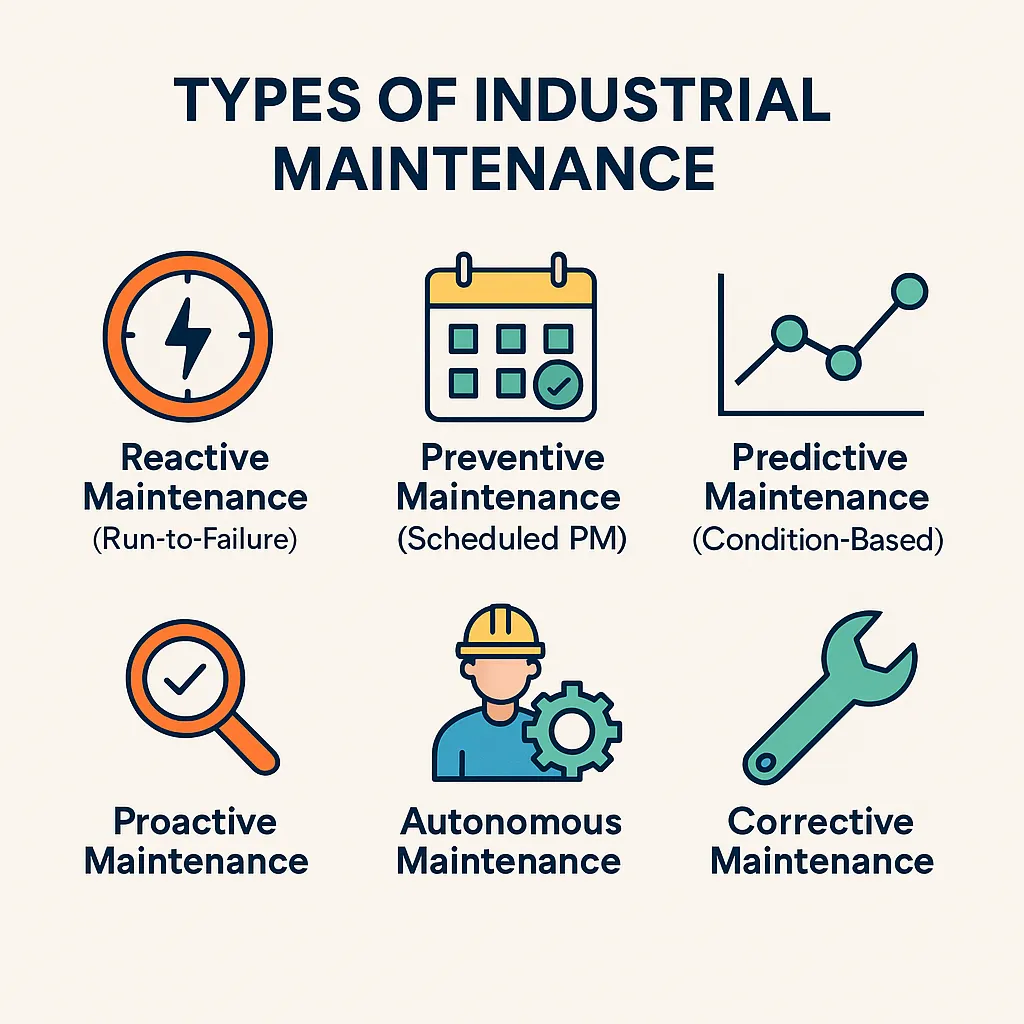
Types of Industrial Maintenance
Industries use multiple maintenance strategies depending on criticality, cost, and failure behavior.
Reactive Maintenance (Run-to-Failure)
Used when failure has minimal impact.
Repairs are performed only after equipment fails. Suitable for low-cost, non-critical assets.
Preventive Maintenance (Scheduled PM)
Tasks performed based on time or usage.
Scheduled at fixed intervals—weekly, monthly, or yearly. Helps avoid failures but may cause unnecessary servicing.
Predictive Maintenance (Condition-Based)
Uses sensors and data (vibration, oil tests, temperature) to detect early failure signs
Reduces breakdowns
Proactive Maintenance
Focuses on eliminating root causes.
Targets root causes such as misalignment, imbalance, poor lubrication, and contamination.
Autonomous Maintenance
Basic cleaning, inspection, tightening by machine operators.
Corrective Maintenance
Repairs identified during inspections.
Understanding Reliability Metrics
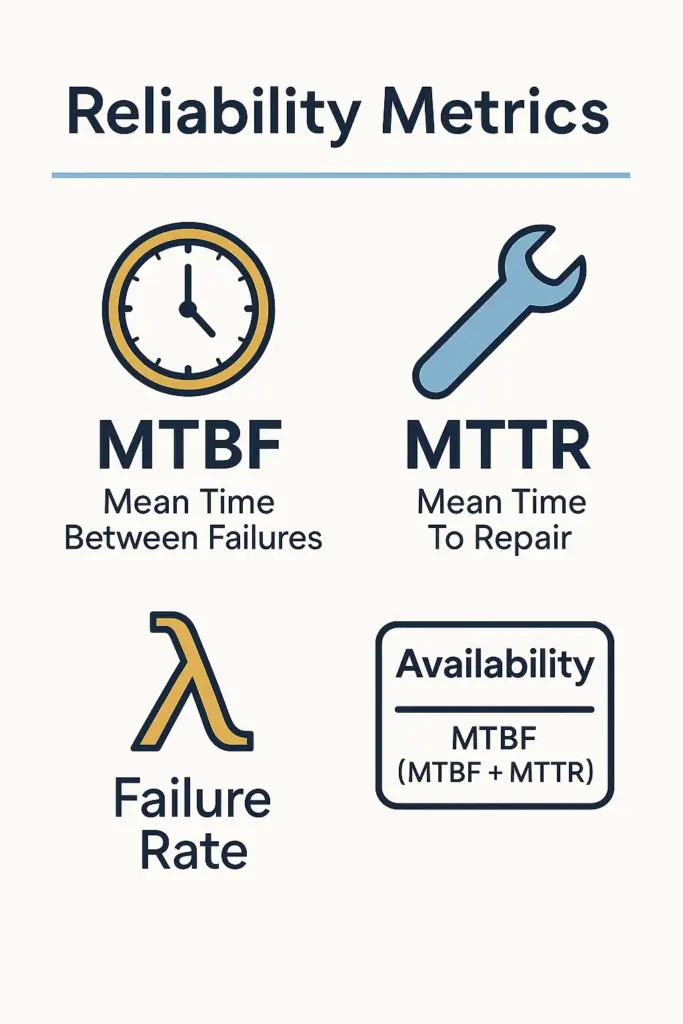
Reliability engineering helps measure and improve machine performance.
Key metrics include:
- MTBF – Mean Time Between Failures – Indicates reliability
- MTTR – Mean Time To Repair – Measures repair efficiency
- Availability = MTBF / (MTBF + MTTR)
- Failure Rate (λ)
- Maintainability
High MTBF + Low MTTR = Excellent reliability.
Machine Failure Patterns & Failure Causes
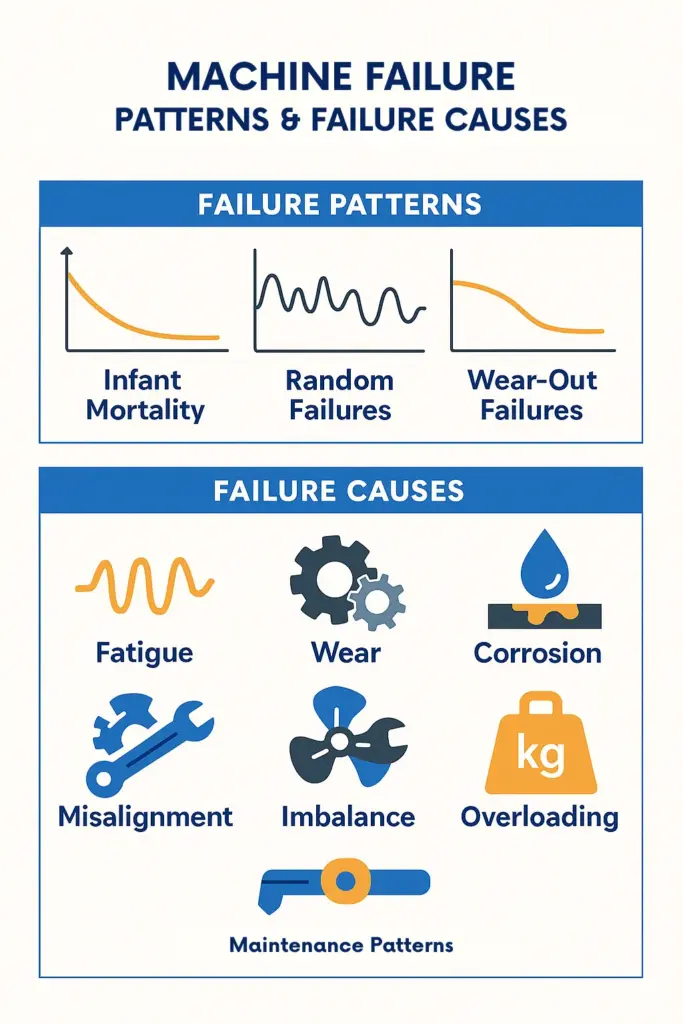
Machines typically follow three failure patterns:
- Infant mortality (early-life defects such as installation issues)
- Random failures (mid-life such as operational variability)
- Wear-out failures (end of life such as age-related deterioration)
Common causes:
- Fatigue
- Wear
- Corrosion
- Misalignment
- Imbalance
- Overloading
Failure Modes and Effects Analysis (FMEA)
FMEA helps identify:
- Failure modes
- Effects
- Causes
Factors:
- Severity
- Occurrence
- Detection
Each failure is scored on severity, occurance and detection.
RPN = S × O × D
High RPN = Higher priority.
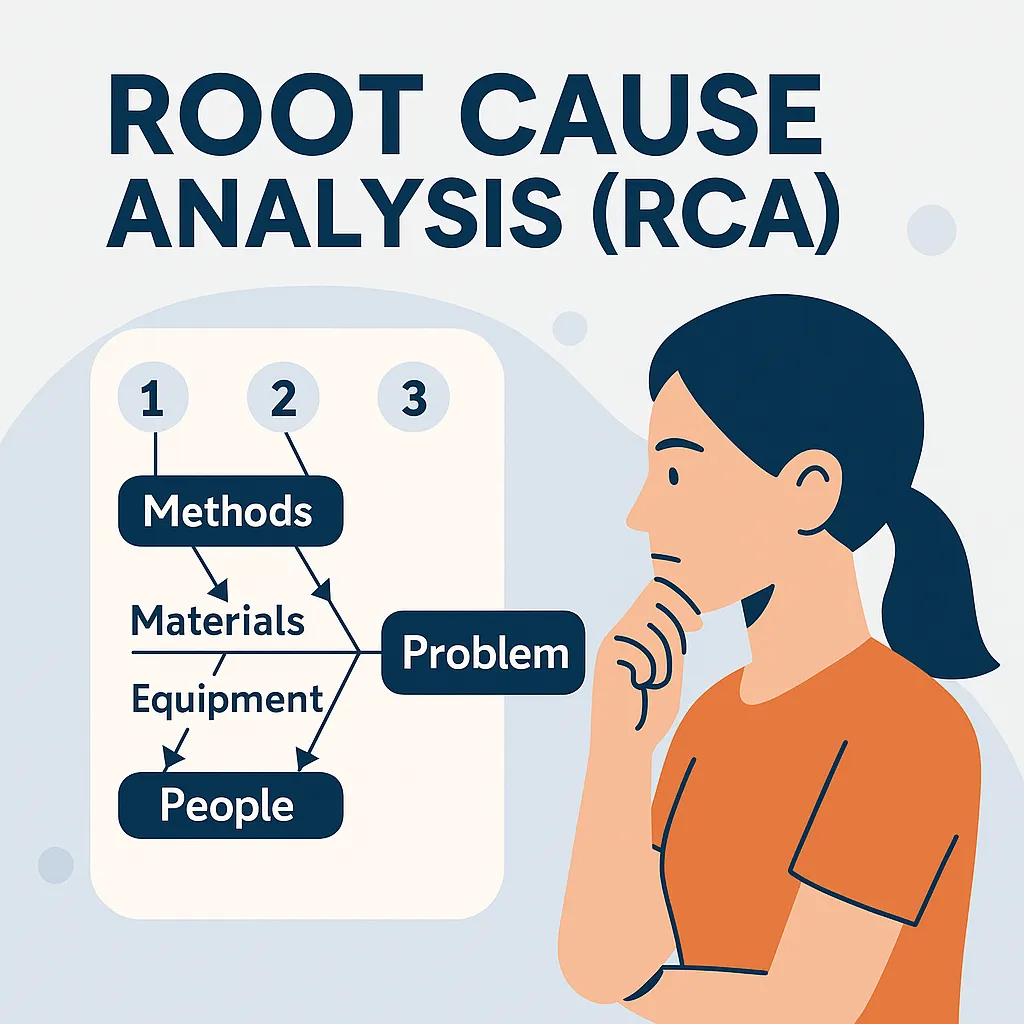
Root Cause Analysis (RCA)
RCA tools include:
- 5 Why
- Ishikawa (Fishbone) Diagram
- Fault Tree Analysis
- Pareto Charts
Fix the root cause → Failure won’t return.
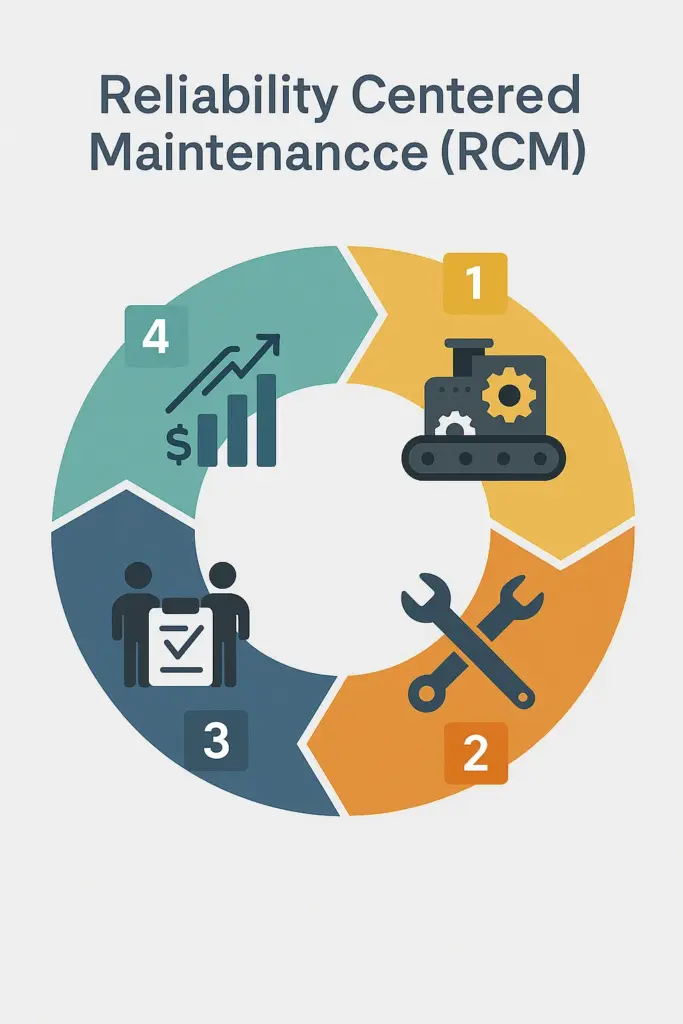
Reliability-Centered Maintenance (RCM)
RCM selects the best maintenance strategy using:
- Function
- Failure mode
- Effect
- Consequence
- Maintenance task
Ensures safety + reliability + cost efficiency.
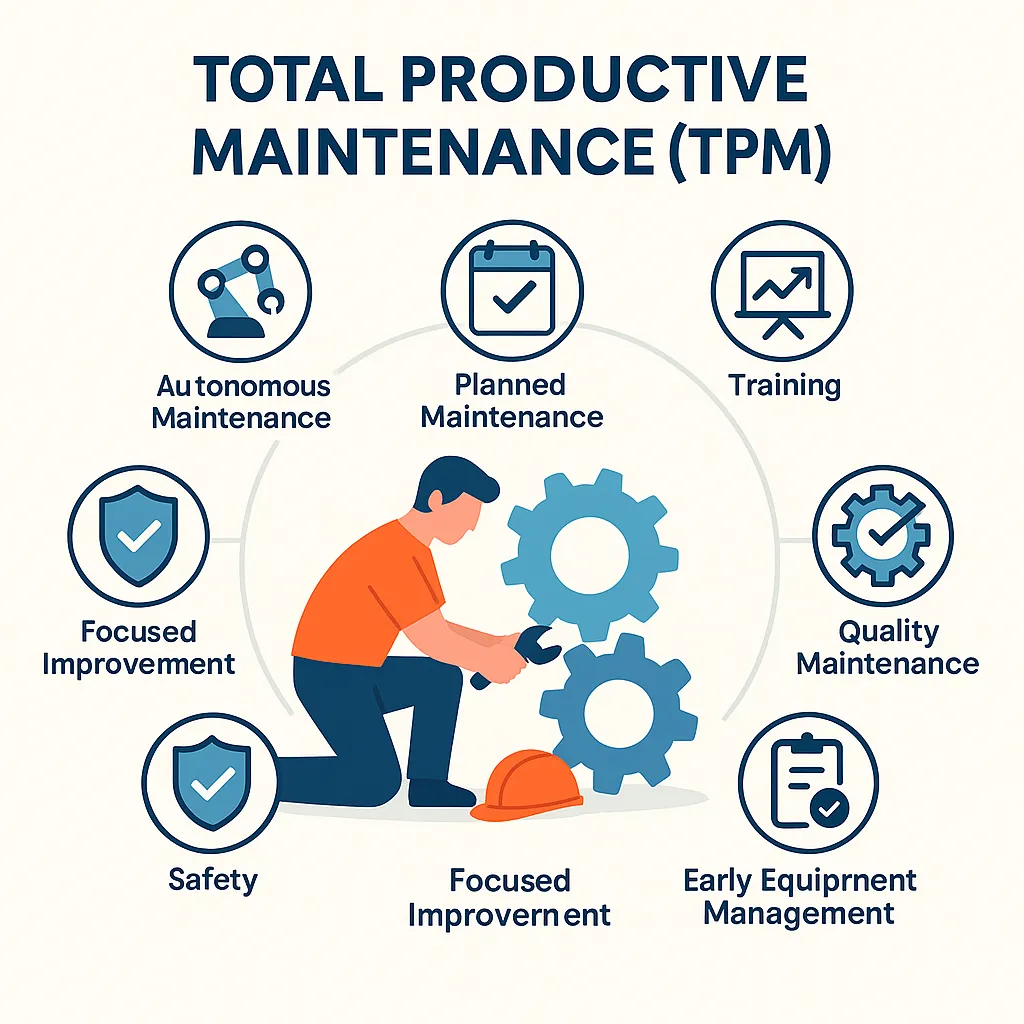
Total Productive Maintenance (TPM)
TPM aims for:
- Zero breakdowns
- Zero defects
- Zero accidents
Pillars include autonomous maintenance, planned maintenance, quality maintenance, Focused improvement, training, and early equipment management.
CMMS & Digital Maintenance Tools
CMMS helps manage:
- Work orders
- Spare parts
- Maintenance schedules
- Technician data
- Machine history
Digital transformation is reshaping maintenance.
Condition Monitoring Techniques
Techniques include:
- Vibration analysis
- Thermography
- Ultrasonic testing
- Oil analysis
- Motor current analysis
- Wear particle analysis
These detect failures early → preventing breakdowns.
Lubrication & Spare Parts Management
Good lubrication prevents wear and overheating.
Spare parts management uses:
- ABC criticality analysis
- Criticality ranking
- Minimum stock levels
- Lead time planning
- Warranty Spares
- Critical Spares Planning

Shutdowns & Turnarounds
Major inspections done yearly or during long shutdowns.
Safety in Industrial Maintenance
Safety protocols include:
- LOTO
- PPE
- Permit-to-work
- Confined space procedures
Safety first → Always.
Maintenance in Key Industries
Applications:
- Manufacturing
- Power plants
- Oil & gas
- Transport
- Mining
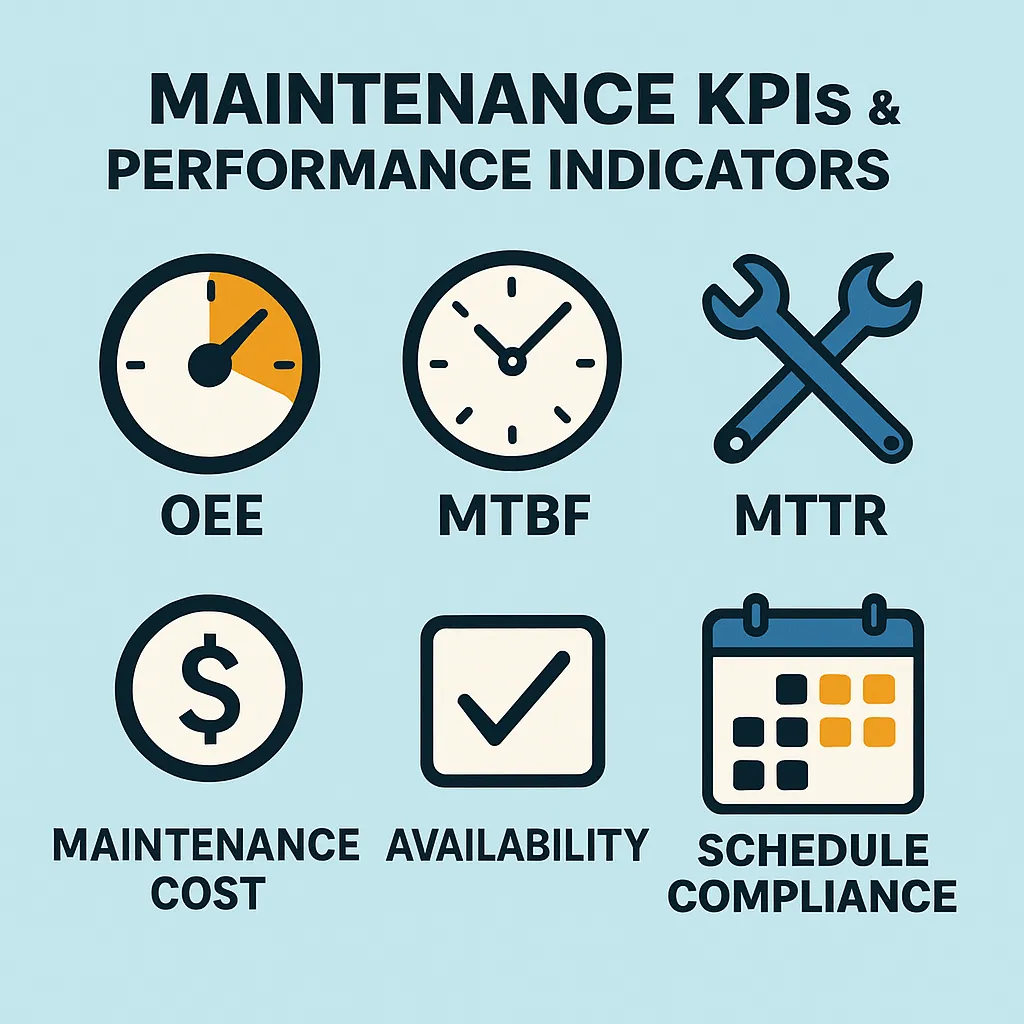
Maintenance KPIs & Performance Indicators
KPIs include:
- OEE (Overall Equipement Effectiveness)
- MTBF
- MTTR
- Maintenance cost
- Schedule compliance
Modern Trends in Maintenance Engineering
Future trends:
- IoT sensors
- Digital twins
- Predictive analytics
- Smart lubrication
- AI health monitoring
- Wireless vibration sensors
- Cloud based CMMS

Frequently Asked Questions (FAQs)
To ensure equipment reliability, safety, and performance.
A mix of preventive + predictive + RCM.
Mean Time To Repair — average time to fix a failure.
A maintenance philosophy focusing on zero breakdowns.
To identify and prioritize failure risks.
It detects early signs of failure.
Conclusion
Maintenance engineering ensures that modern industries remain safe, productive, and reliable. Using techniques like FMEA, RCA, TPM, RCM, and predictive tools, companies can significantly reduce downtime and improve asset performance.