
The Early Days: Not a New Idea
Many people think electric cars are a brand-new invention. They are not. Electric vehicles (EVs) were actually invented before gasoline cars.
In the early 1800s, inventors in Hungary, the Netherlands, and the United States began playing with the idea of a battery-powered vehicle. They didn’t have fancy lithium batteries like we do today. They used crude, heavy batteries that could not hold much energy.
The First Sparks
Around 1832, a Scottish inventor named Robert Anderson built the first crude electric carriage. It wasn’t very fast. It didn’t go very far. But it moved without a horse and without burning coal.
Think of these early EVs like a wind-up toy. They worked for a short time, but once the energy was gone, they were just heavy wagons.
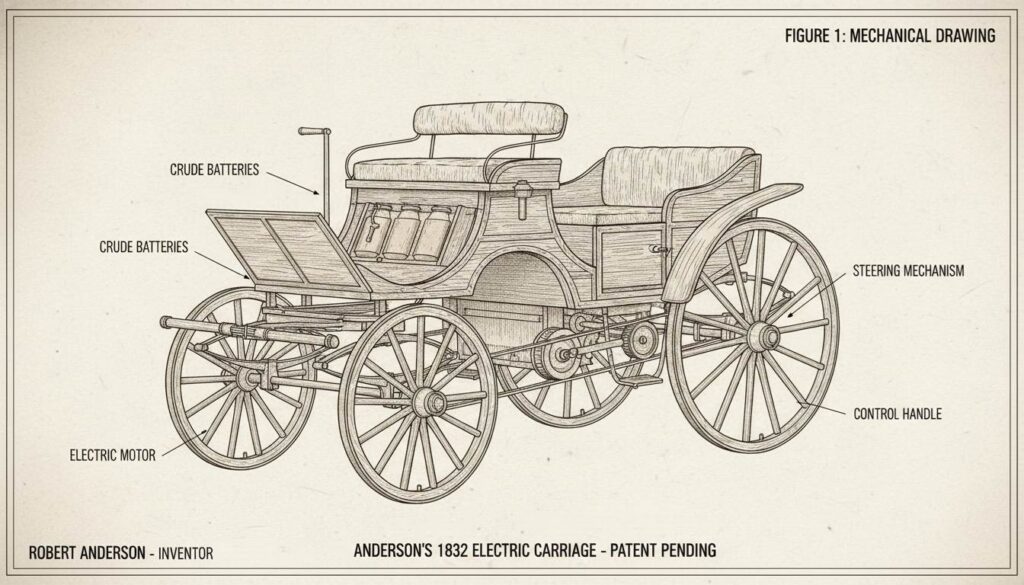
Technical Figure: A sketch of Robert Anderson’s 1832 electric carriage. It looks like a wooden horse carriage but without the horse. It has large wooden wheels and a boxy structure underneath the seat representing crude batteries. Sepia tone style.
If you lived in the 1830s, why would a carriage that moves by itself be more exciting than a horse? Think about what horses need (food, water, rest) compared to a machine.
The Golden Age of Electricity (1890s – 1910s)
By the turn of the 20th century, cars were becoming popular. You had three choices for power:
- Steam: Powered by burning coal (like a train).
- Gasoline: Powered by explosions inside an engine.
- Electricity: Powered by batteries.
For a while, electricity was the winner.
Why People Loved Electric Cars
Gasoline cars back then were loud, smelly, and vibrated terribly. Starting a gas car was dangerous. You had to stand outside the car and spin a heavy metal handle called a “hand crank.” If the engine kicked back, the handle could snap your arm.
Electric cars were different. They were quiet. They didn’t smell. To start one, you just flipped a switch. It was as easy as turning on a light.
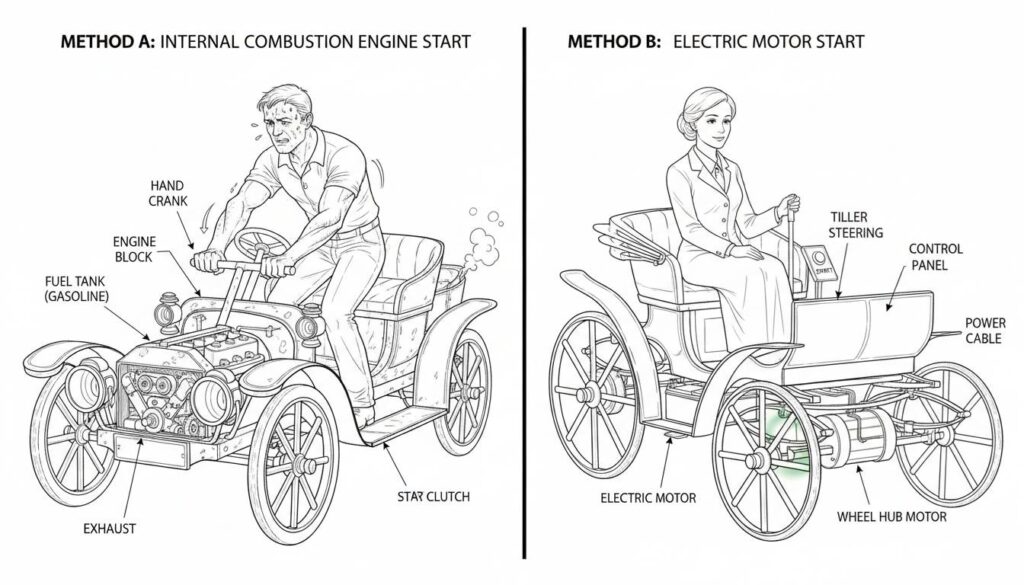
Technical Figure: A split comparison diagram. On the left, a man struggling and sweating while turning a hand crank on a dirty gasoline car. On the right, a woman calmly sitting in a clean, open-top electric carriage holding a tiller (steering stick), looking comfortable.
The City Car
Because early batteries ran out of power quickly, EVs were perfect for cities. Doctors used them to visit patients. Delivery drivers used them for short trips. At one point, a third of all cars on the road in the United States were electric.
Electric cars were quiet and clean, but they couldn’t go far. Why was this okay for people living in big cities in 1900, but a problem for farmers in the countryside?
The Fall of the Electric Car
If EVs were so good, why did they disappear for nearly 100 years? Two main things happened that killed the electric car.
Henry Ford and the Assembly Line
In 1908, Henry Ford introduced the Model T. It was a gas-powered car. Ford built them on an assembly line, which made them incredibly cheap.
- Cost of an Electric Car:

- Cost of a Gas Model T:
- 650 (affordable)
The Electric Starter
In 1912, Charles Kettering invented the electric starter motor. This was a small electric motor that started the gas engine for you. You no longer had to risk breaking your arm with a hand crank.
Suddenly, gas cars were easy to start, could drive hundreds of miles, and gas was cheap and found everywhere. Electric cars couldn’t compete. By 1935, they were almost extinct.
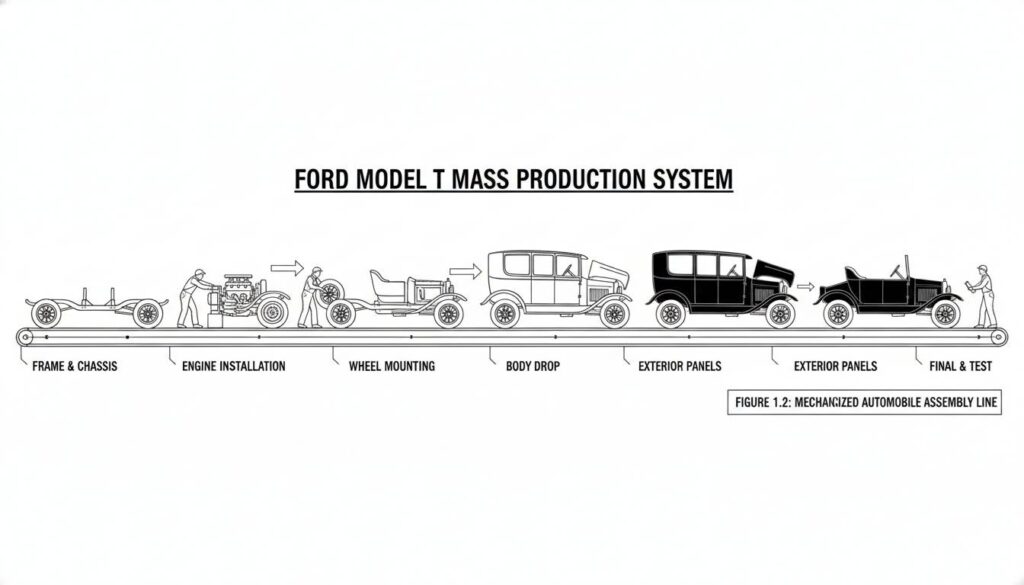
Technical Figure: A black and white photo-realistic image of a Ford Model T assembly line. Dozens of identical black cars are lined up on a conveyor belt with workers adding parts. This illustrates mass production.
Imagine you are buying a video game console. Console A has better graphics but costs 1000. Console B is okay but costs 300. Which one do most people buy? How does this relate to the Model T vs. Electric Cars?
The Dark Ages and the Rebirth (1970s – 1990s)
For decades, EVs were only used for niche jobs, like milk delivery trucks or forklifts. But in the 1970s, the price of gasoline skyrocketed. People started worrying about pollution.
The Lunar Rover
One cool moment for EVs happened on the Moon! In 1971, NASA’s Lunar Rover became the first manned vehicle to drive on the moon. It was 100% electric. There is no air on the moon, so a gas engine (which needs oxygen to burn fuel) would not work. This proved electric motors were tough and reliable.
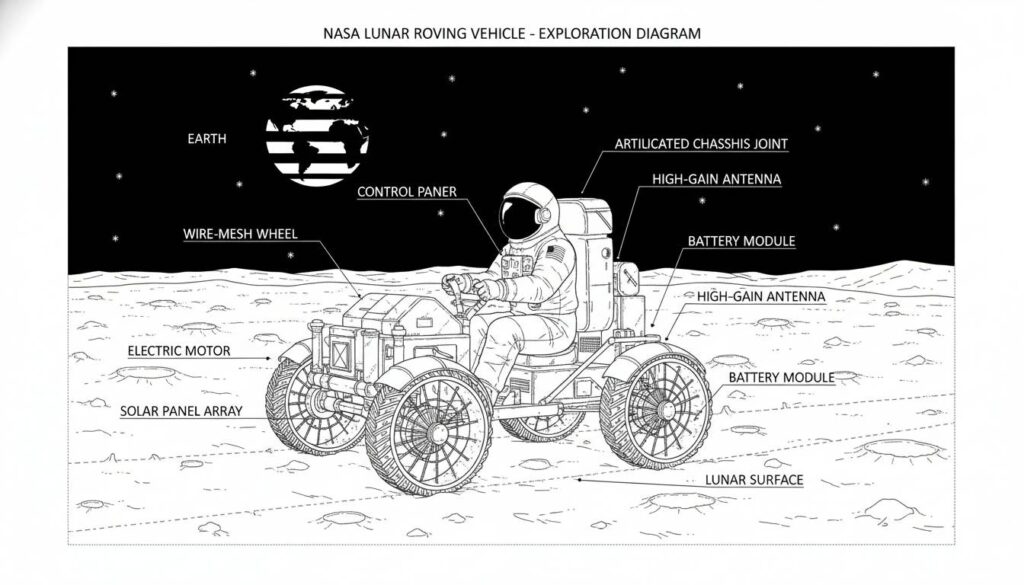
Technical Figure: The NASA Lunar Rover driving on the grey surface of the moon. An astronaut in a white space suit is driving. Earth is visible in the black sky background. The rover has wire-mesh wheels.
The GM EV1
In the 1990s, California passed new laws to reduce smog. General Motors (GM) built a futuristic car called the EV1. It looked like a spaceship. It was fast and smooth. However, the batteries were still heavy lead-acid types (like the battery in a regular car today). They didn’t hold enough charge. GM eventually crushed most of these cars, which upset many fans.
The Modern Era: Lithium and Tesla
The real game-changer wasn’t the car; it was the battery.
The Lithium-Ion Revolution
Old batteries were made of lead and acid. They were heavy and weak. Then, scientists improved Lithium-Ion batteries. These are the same batteries inside your laptop or smartphone. They are light and hold a lot of energy.
Think of a lead-acid battery like a heavy clay brick that holds a cup of water. Think of a lithium-ion battery like a plastic bottle that holds a gallon of water. It’s lighter but carries more “fuel.”
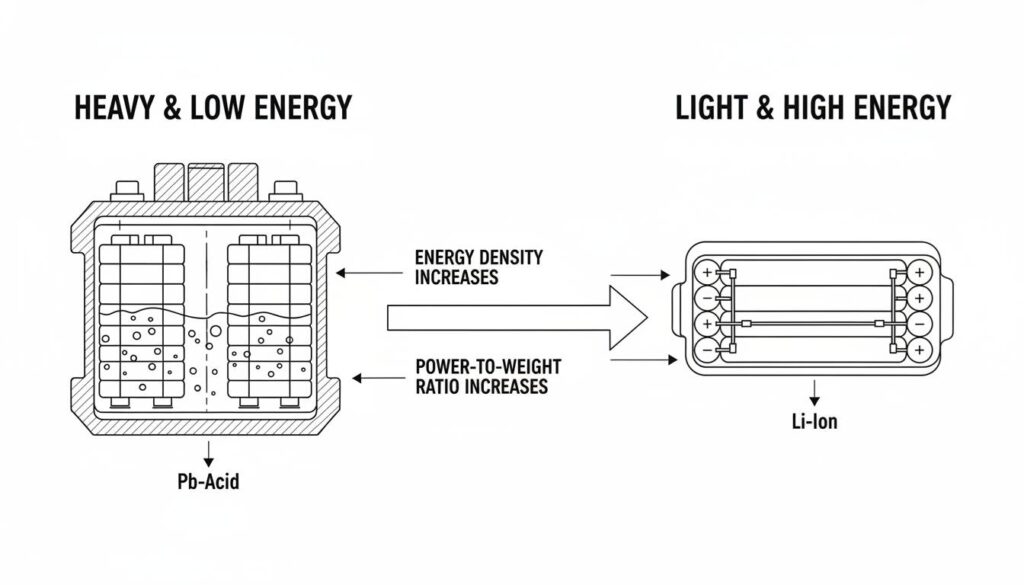
Technical Figure: A technical cross-section comparison. On the left, a bulky, blocky lead-acid battery labeled “Heavy & Low Energy.” On the right, a sleek pack of cylindrical lithium-ion cells labeled “Light & High Energy.” Arrows show energy density.
The Hybrid Bridge
Before pure EVs took over, the Toyota Prius became famous. It was a “Hybrid.” It had both a gas engine and an electric motor. They worked together to save gas. This got people used to the idea of electric power again.
Tesla Changes the Image
In 2008, a company called Tesla released the Roadster. Before this, people thought EVs were slow and boring, like golf carts. The Roadster was a sports car. It was fast, looked cool, and could drive over 200 miles on a single charge.
Tesla used thousands of small lithium laptop batteries connected together to power the car. This proved EVs could be cool and practical.
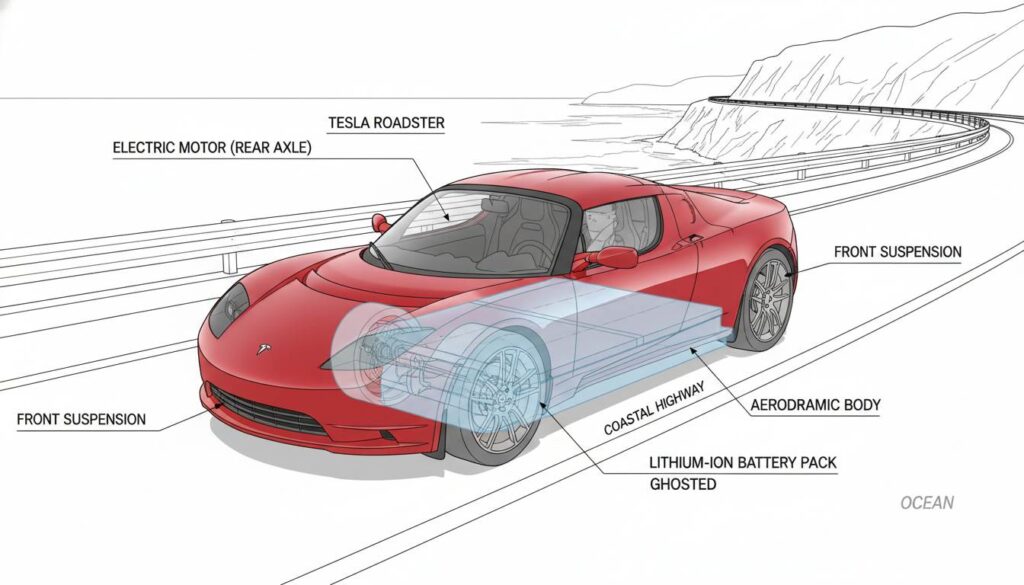
Technical Figure: A bright red Tesla Roadster driving on a coastal highway. The car looks sleek and sporty. A ghosted overlay shows the battery pack located at the bottom of the car chassis.
How an EV Works (Simplified)
To understand why EVs are winning today, you need to know how simple they are.
The “Skateboard” Design
Most modern EVs look like a skateboard.
- The Deck: The battery pack is flat and sits at the bottom of the car. This makes the car stable so it doesn’t tip over.
- The Wheels: Electric motors are placed right next to the wheels (or between them).
There is no giant engine in the front, no gas tank in the back, and no muffler underneath.
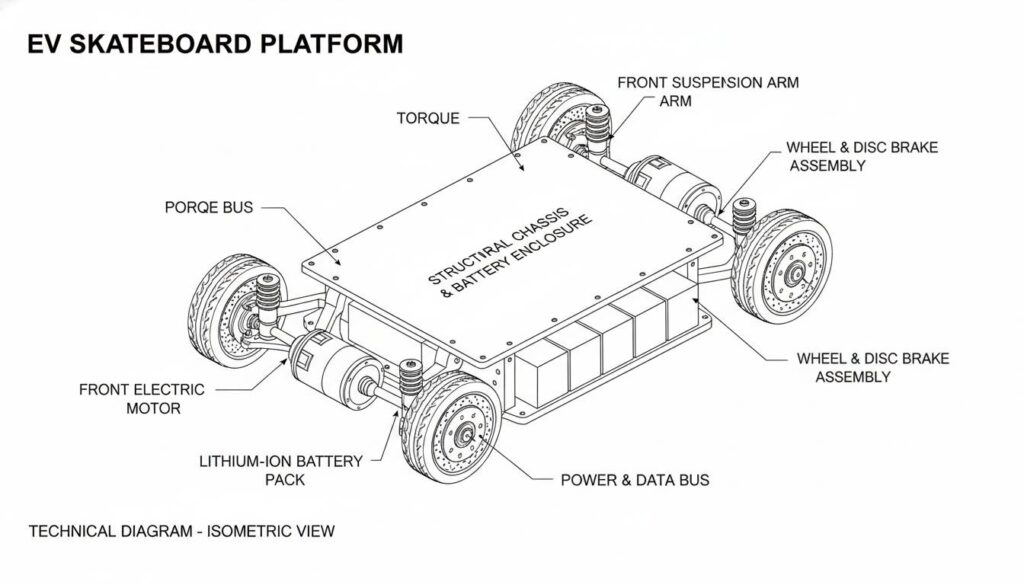
Technical Figure: A 3D diagram of an “EV Skateboard Platform.” It shows a flat chassis with a battery pack floor. There are electric motors on the front and rear axles. The wheels are attached, but there is no car body on top, showing the simplicity.
Gas cars have thousands of moving parts (pistons, valves, gears). Electric motors have very few moving parts (mostly just a spinning rotor). Which one do you think breaks down less often? Why?
