
Introduction to Ultrasonic Machining (USM)
Imagine trying to cut a square hole in a piece of glass. You can’t use a drill because the glass will shatter. You can’t use a knife because the glass is too hard. So, how do engineers do it?
They use sound.
Well, not exactly sound you can hear. They use Ultrasonic Machining (USM). This method uses vibrations that are so fast, your ears cannot detect them. It acts like a microscopic jackhammer to chip away hard materials like glass, ceramic, or diamond.
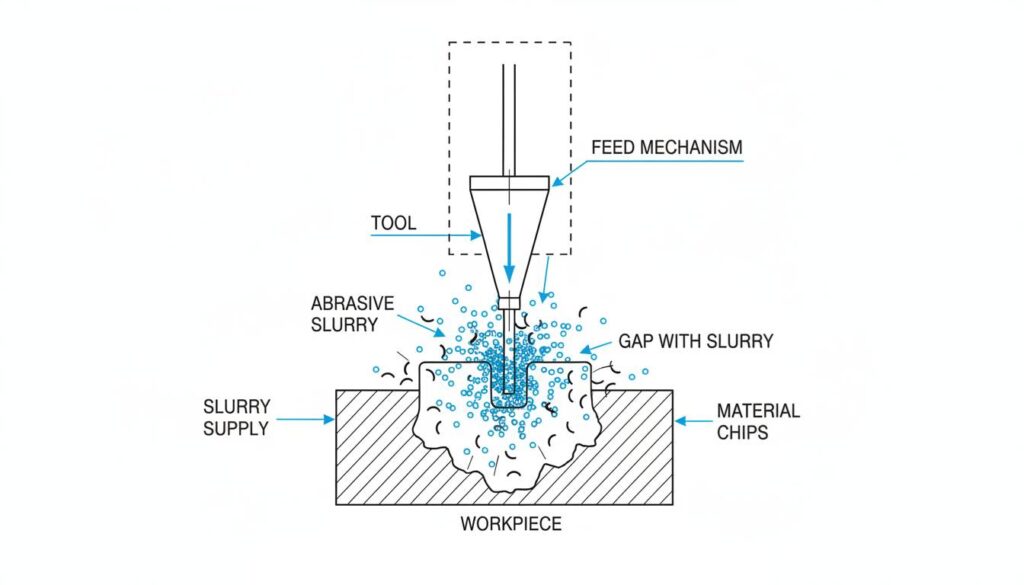
Technical Diagram: A simple 2D schematic diagram showing the basic concept of Ultrasonic Machining. It should show a tool vibrating vertically, abrasive slurry particles between the tool and a workpiece, and small chips being removed from the workpiece.
The Core Principle: The “Cookie Cutter” Analogy
To understand USM, think of a cookie cutter, a piece of hard rock, and some sand.
- The Setup: You place a layer of wet sand (abrasive slurry) on top of the rock.
- The Action: You take the cookie cutter and tap it up and down on the sand very, very fast.
- The Result: The cookie cutter never actually touches the rock. Instead, it hammers the sand grains into the rock. The sand grains chip away the rock in the exact shape of the cookie cutter.
In USM, the tool vibrates 20,000 times per second. This vibration hammers tiny abrasive grains into the workpiece, slowly creating a hole.
The Equipment: Parts of the Machine
To make this happen, we need a specific machine setup. It looks like a drill press, but it works very differently.
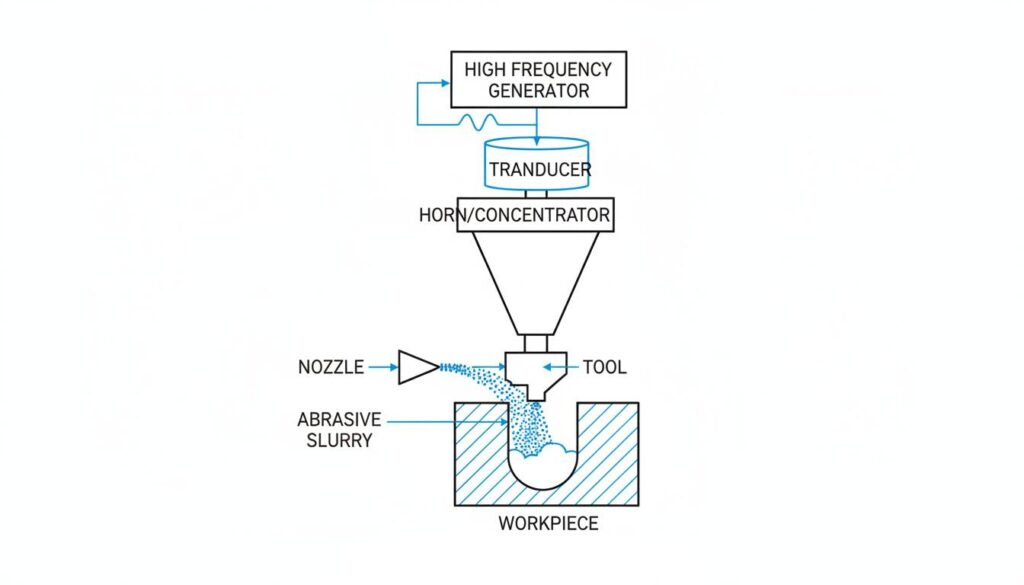
Technical Diagram: A labeled block diagram of an Ultrasonic Machining setup. Labels should point to: High Frequency Generator, Transducer, Horn/Concentrator, Tool, Nozzle, Abrasive Slurry, and Workpiece.
1. The High-Frequency Generator (The Battery)
This is the power source. It takes normal electricity from the wall (which moves slowly, at 50-60 Hz) and turns it into high-frequency electricity (20,000 Hz or more).
2. The Transducer (The Muscle)
This part takes that high-speed electricity and turns it into physical vibration. It works like a speaker. When you play loud music, the speaker cone moves back and forth. The transducer does the same thing, but it vibrates a metal rod instead of air.
3. The Horn (The Booster)
The vibration from the transducer is very small. We need it to be bigger to cut effectively. The horn is a tapered piece of metal. It acts like a funnel. It takes the vibration and squeezes it so that the tip moves a greater distance.
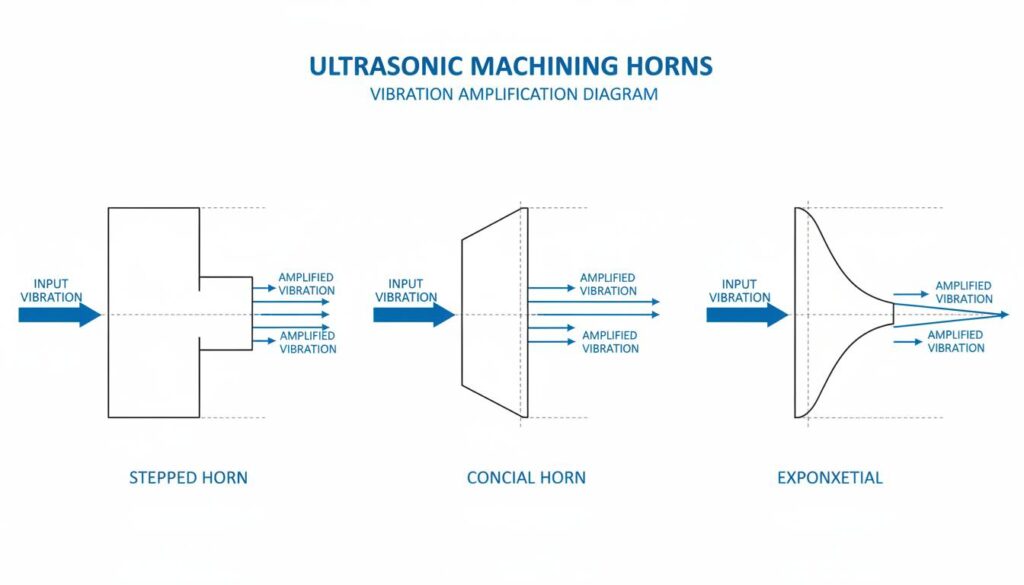
Technical Diagram: A technical drawing of different shapes of horns used in ultrasonic machining: Stepped, Conical, and Exponential. Show how the vibration amplitude increases at the narrow end.
4. The Tool (The Hammer)
This is the part that determines the shape of the hole. It is made of a tough but soft material (like soft steel). Why soft? Because we want the abrasive grains to stick into the tool slightly so they can hammer the hard workpiece effectively.
5. The Abrasive Slurry (The Teeth)
This is a mixture of water and hard grains (like Boron Carbide or Silicon Carbide). The water carries the grains to the cutting zone and washes away the debris.
Think About It:
If the tool is made of soft steel and the workpiece is hard glass, why doesn’t the tool wear out instantly?
Hint: Think about a hammer hitting a nail. The hammer is hard, but if you put a pillow between the hammer and the nail, the pillow takes the impact. In USM, the “slurry” is doing the cutting, not the tool itself.
Factors Influencing Metal Removal Rate (MRR)
Metal Removal Rate (MRR) is just a fancy way of saying “How fast are we cutting?” Several things change the speed.
1. Amplitude of Vibration (How big is the jump?)
Amplitude is how far the tool moves up and down.
- Higher Amplitude: The tool hits the grains harder. This means faster cutting.
- Too High: If it moves too far, the slurry splashes away, and cutting slows down.
2. Frequency (How fast is the jump?)
Frequency is how many times the tool hits per second.
- Higher Frequency: More hits per second = faster cutting.
3. Grain Size (How big are the rocks?)
- Big Grains: They take big bites out of the material. This cuts fast, but leaves a rough surface.
- Small Grains: They take tiny bites. This cuts slower, but leaves a very smooth surface.
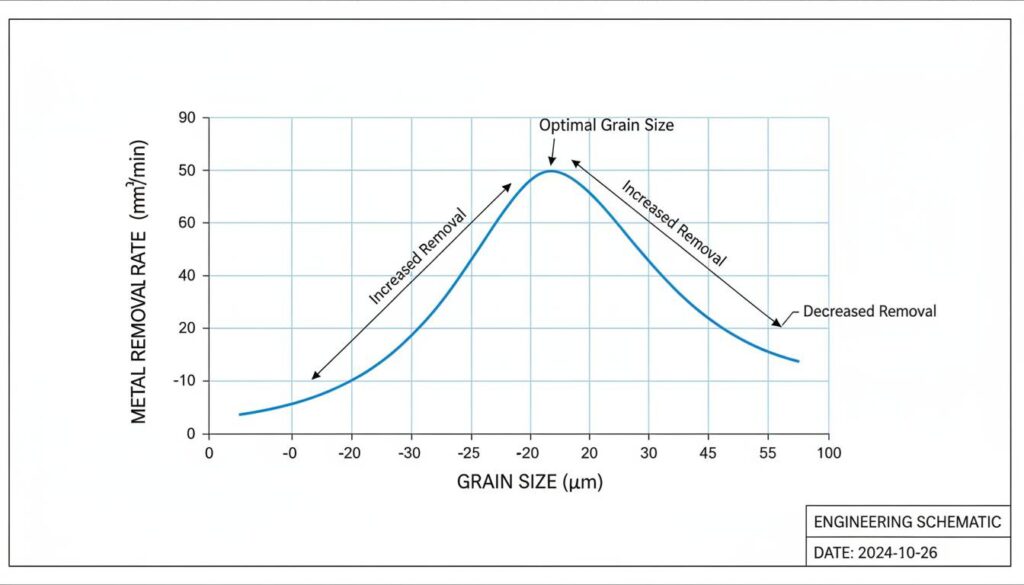
Technical Diagram: A line graph showing “Metal Removal Rate” on the Y-axis and “Grain Size” on the X-axis. The line goes up as grain size increases, reaches a peak, and then drops slightly.
4. Slurry Concentration (Water to Sand Ratio)
You need the right mix.
- Too much water: Not enough cutting grains.
- Too much sand: The mix is too thick and can’t flow under the tool.
Critical Thinking:
If you wanted to cut a rough hole very quickly, what combination of grain size and amplitude would you choose?
Comparison: USM vs. Abrasive Jet Machining (AJM)
Both of these methods use “abrasives” (grit) to cut, but they use them differently. Let’s compare Ultrasonic Machining (USM) with Abrasive Jet Machining (AJM).
What is Abrasive Jet Machining (AJM)?
AJM is like a sandblaster. It uses high-pressure air to shoot dry sand at the workpiece. The sand acts like a bullet to chip away material.
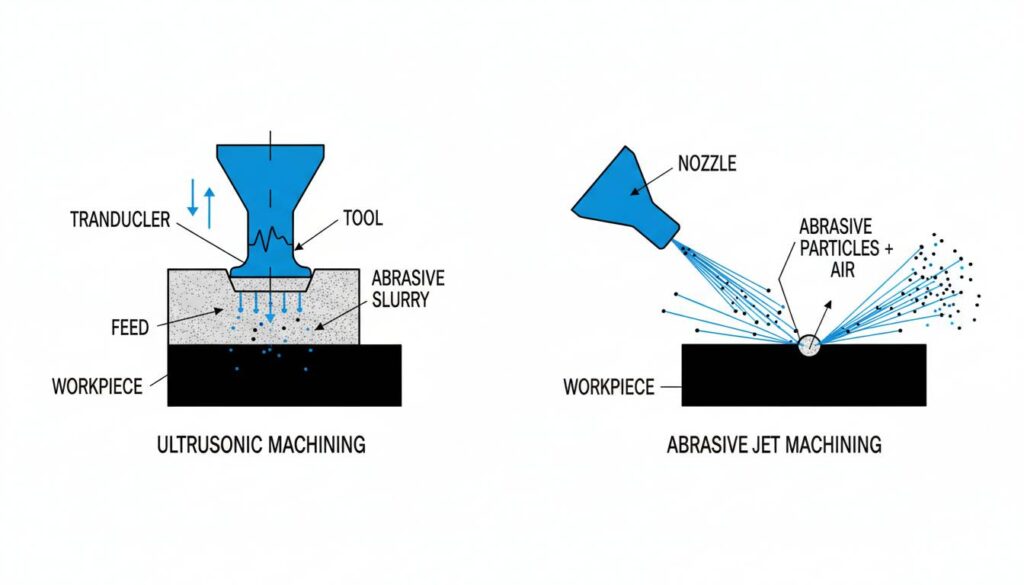
Technical Diagram: A split-screen illustration. Left side: Ultrasonic Machining showing a vibrating tool hammering slurry. Right side: Abrasive Jet Machining showing a nozzle spraying dry powder with air against a plate.
The Comparison Table
| Feature | Ultrasonic Machining (USM) | Abrasive Jet Machining (AJM) |
| The Mechanism | Hammering: The tool vibrates and hammers the grains. | Impact: High-speed air shoots grains like bullets. |
| The Carrier | Liquid Contact | Tool Contact |
| Best For | Making precise, shaped holes (square, star, etc.). | Cleaning surfaces or cutting thin glass sheets. |
| Accuracy | Very High accuracy. | Lower accuracy (the spray spreads out). |
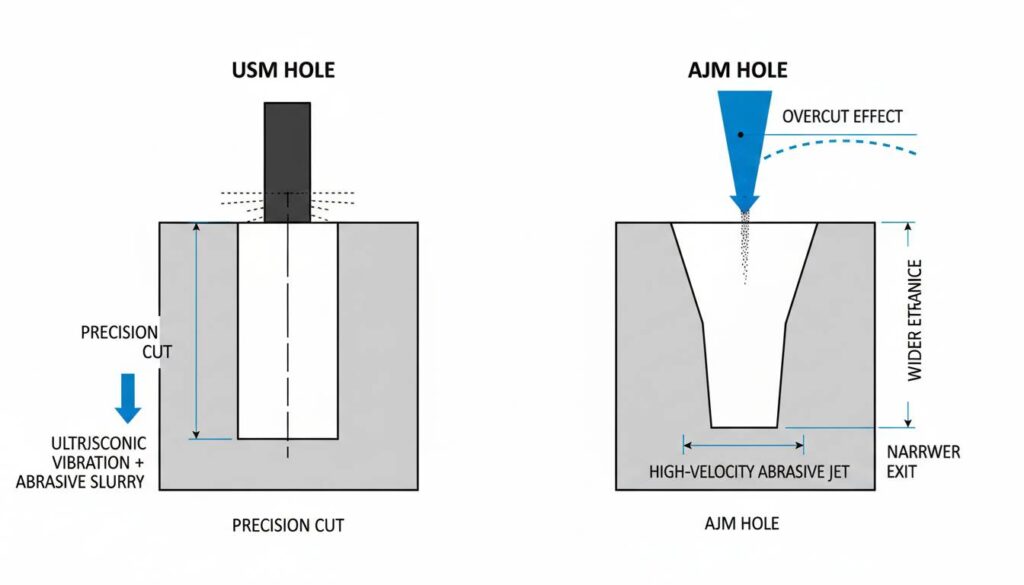
Technical Diagram: A close-up technical diagram showing the “Overcut” effect. Show a USM hole being very straight and precise, while an AJM hole has tapered/slanted edges due to the spreading jet.
Summary of Differences
- USM is for when you need a specific shape (like a hexagonal hole) in a hard material.
- AJM is for when you need to clean a surface or cut a simple line in a thin sheet.
Critical Reasoning:
You have a piece of expensive diamond that needs a star-shaped hole in the center. Would you use USM or AJM? Why?
Answer: USM. AJM would just blast a messy round crater. USM can use a star-shaped tool to hammer the pattern perfectly.
