Introduction
Imagine a garden hose. If you put your thumb over the opening, the water sprays out faster and harder. Now, imagine a machine that does that, but a million times stronger.
That is Water Jet Machining (WJM). It uses a stream of water at incredibly high pressure to cut through materials. It can slice through soft things like foam or cake. If we add special sand to the water, it can even cut through thick steel and stone!
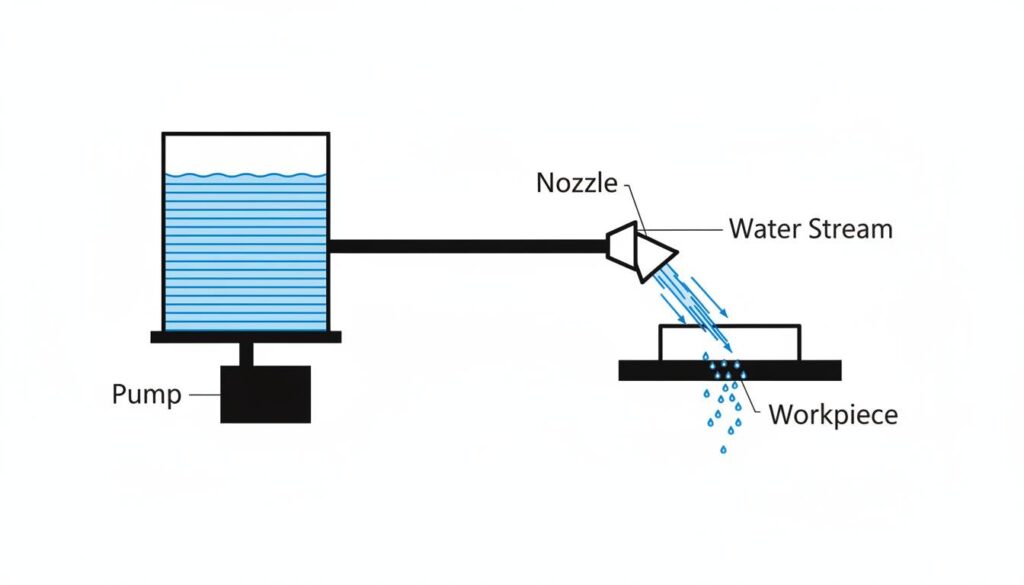
Technical Diagram: A simple 2D schematic diagram of a Water Jet Machining system. Show a water tank, a high-pressure pump, a tube leading to a nozzle, and a high-speed water stream hitting a workpiece. Label the parts clearly: Pump, Nozzle, Water Stream, Workpiece.
How Does It Work?
The concept is simple: Pressure turns into Speed.
- The Pump: A giant pump squeezes water to extreme pressures (up to 90,000 PSI). That is 3,000 times higher than the air pressure in a car tire.
- The Nozzle: This high-pressure water is forced through a tiny hole made of diamond or sapphire. The hole is as small as a human hair.
- The Beam: The water shoots out at supersonic speeds (faster than sound). This beam acts like a solid cutting tool.
Types of Water Jets
There are two main ways we use this tool:
- Pure Water Jet: Just plain water. We use this for soft stuff like paper, food, or plastic.
- Abrasive Water Jet: We mix garnet (a very hard, red sand) into the water stream. The water acts like a carrier, and the sand acts like “liquid sandpaper” to erode hard metals.

Technical Diagram: A split comparison diagram. Left side labeled ‘Pure Water Jet’ showing clear water cutting a soft foam block. Right side labeled ‘Abrasive Water Jet’ showing a mixing chamber where red sand enters the water stream, cutting through a grey metal plate.
Think About It:If you tried to cut a diamond with a water jet, would you use Pure Water or Abrasive Water? Why?
(Hint: Diamond is the hardest material on Earth. Would sand be hard enough to scratch it?)
Advantages of Water Jet Machining
Why do engineers love this process? Here are the main benefits.
1. No Heat (Cold Cutting)
This is the biggest advantage. Lasers and plasma cutters burn through metal, which makes the edges hot and weak. Water jets cut with erosion, not heat.
- Result: The material does not melt, warp, or change color. You can pick up the part immediately after cutting—it won’t burn your hand.
2. Versatility (Cuts Almost Anything)
A water jet is a “Jack of all trades.”
- It can cut thin plastic.
- It can cut 10-inch thick steel.
- It can cut glass without shattering it.
- It can cut sandwiches without squishing them.
3. Environmentally Friendly
There are no toxic fumes or smoke. It creates no dust (the water traps the dust). The waste is just water and sand, which is safe to throw away.
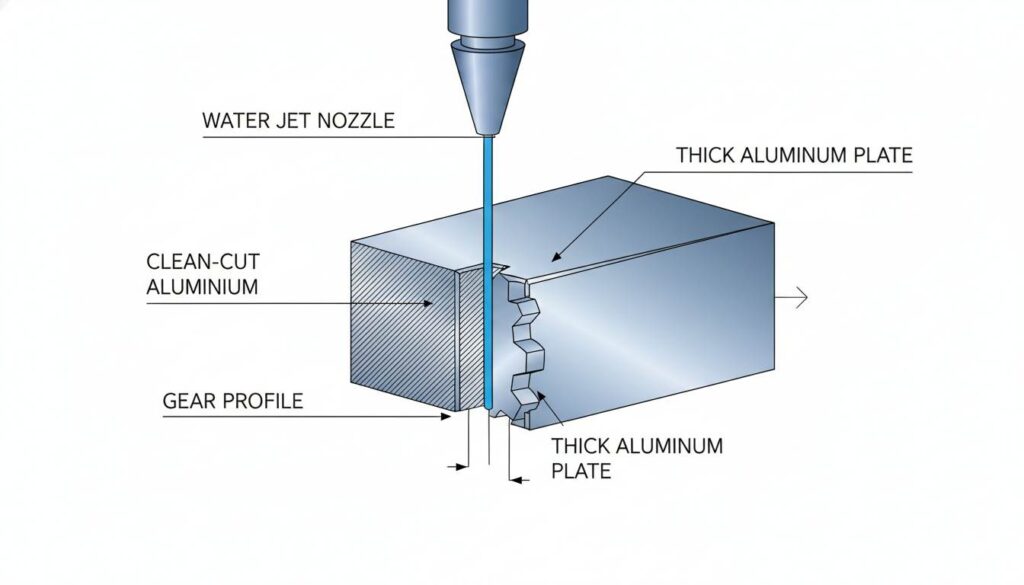
Technical Diagram: A close-up photo-realistic illustration of a water jet nozzle cutting a complex gear shape out of a thick aluminum plate. Show the clean edge of the cut with no burn marks or black edges.
Trivia Question:
Why is “Cold Cutting” important for aerospace parts (like airplane wings)?
(Hint: If you heat up metal too much, does it stay strong or get brittle?)
Disadvantages of Water Jet Machining
Nothing is perfect. Here is why we don’t use water jets for everything.
1. Speed (It Can Be Slow)
For thin metal, a laser cutter is much faster. A water jet takes its time to erode the material. If you rush it, the cut looks rough and ugly.
2. High Cost
The equipment is expensive.
- The pumps use a lot of electricity.
- The nozzles wear out quickly because the high-pressure water destroys them over time.
- The abrasive sand is not cheap, and you cannot easily reuse it once it is crushed.
3. It is Noisy
Imagine the sound of a jet engine taking off. Water leaving the nozzle faster than the speed of sound creates a loud screech. Operators must wear heavy-duty ear protection.
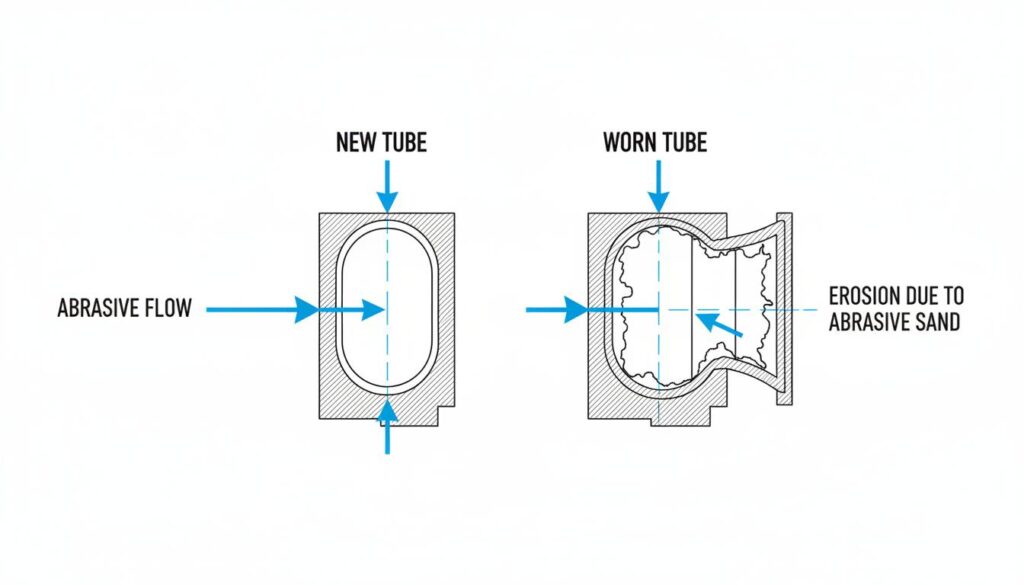
Technical Diagram: An illustration of a worn-out mixing tube nozzle cut in half. Show how the inside of the tube has been eroded and widened by the abrasive sand over time compared to a new tube.
Applications (Where Do We Use It?)
Food Industry
Water jets are very sanitary. Bakeries use pure water jets to cut cakes, candy bars, and frozen fish.
- Why? A metal knife carries bacteria from one slice to the next. A water stream is always fresh and clean.
Aerospace and Mining
- Aerospace: Cutting titanium for jet engines because it doesn’t weaken the metal with heat.
- Mining: Cutting rocks safely in coal mines where a spark from a metal saw could cause an explosion.
Art and Architecture
Artists use it to cut beautiful, complex shapes into floor tiles, marble, and glass for fancy hotel lobbies.
Technical Diagram: A scene inside a food factory. A robotic arm with a pure water jet nozzle is slicing a large rectangular cake into perfect square pieces without squashing the frosting.
Discussion Point:
Why is a water jet better than a knife for cutting a sticky candy bar?
Recent Developments
Engineers are always making the technology better. Here is what is new.
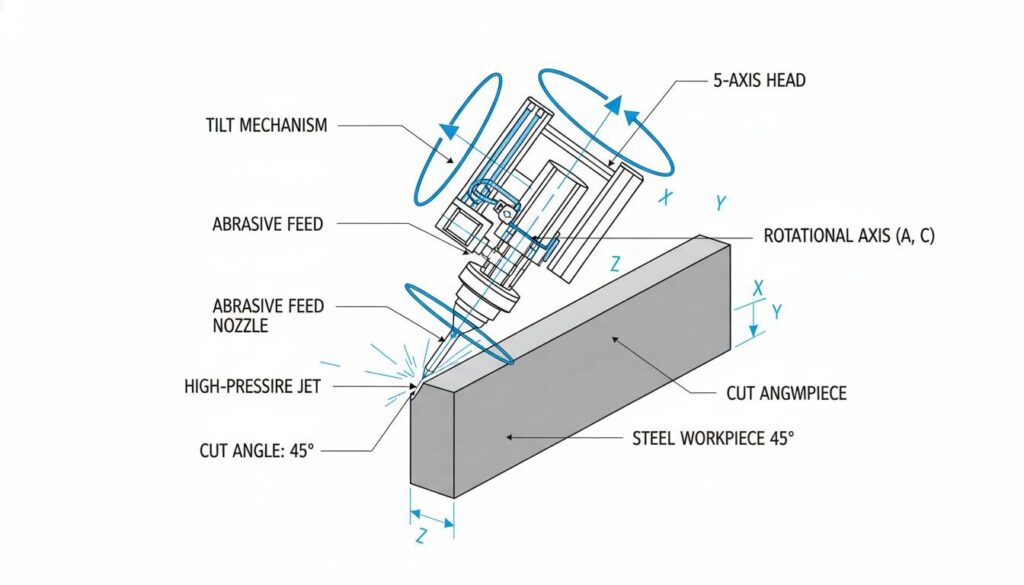
1. 5-Axis Cutting (3D Cutting)
Old machines could only cut flat sheets (X and Y axis). New machines have heads that can tilt and rotate.
- Benefit: We can now cut beveled edges (slanted edges) and 3D shapes, not just flat cutouts.
2. Micro-Water Jets
These use nozzles thinner than a human hair.
- Benefit: They can cut tiny parts for medical devices, like heart stents or electronics.
3. Abrasive Recycling
Since the sand is expensive, new machines are being built to “catch” the used sand, wash it, and sort out the pieces that are still big enough to use again. This saves money and helps the planet.
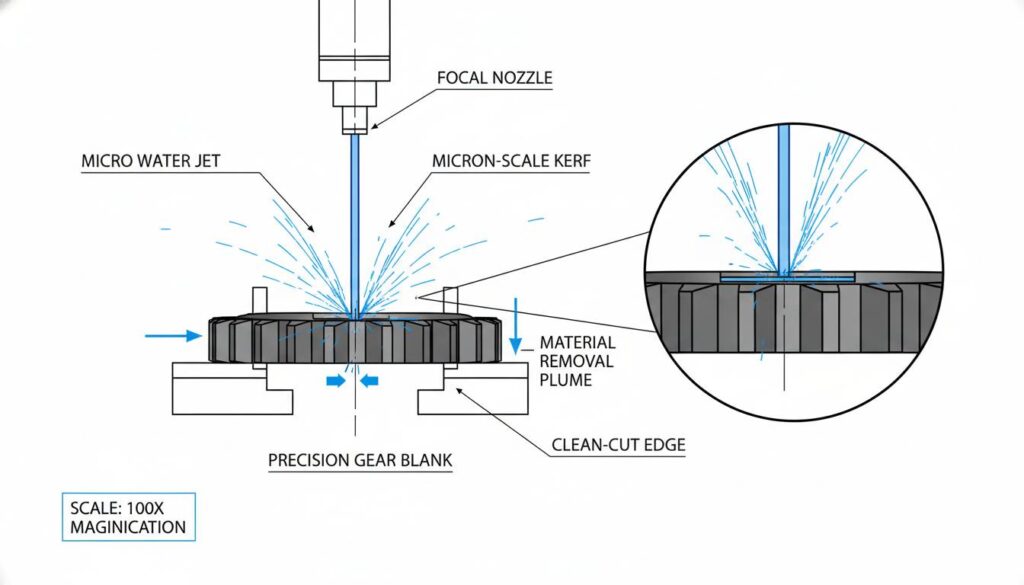
Technical Diagram: A magnified view of a ‘Micro Water Jet’ cut. Show a tiny gear smaller than a penny being cut, highlighting the extreme precision.
Summary
Water Jet Machining is like using a liquid laser. It is powerful, clean, and does not burn the material. While it can be loud and slow, it is the best choice when you need to cut thick materials or keep things cool. From cutting the cake at a factory to building parts for a spaceship, water jets are everywhere!
