
Imagine trying to drill a square hole in a piece of glass. If you use a normal drill, the glass shatters. If you use a laser, it might melt or crack. So, how do engineers cut hard, brittle things?
They use sound.
Well, not just sound. They use Ultrasonic Machining (USM). This lesson explains the parts of the machine that make this possible.
1. The Heart of the Machine: Transducers
The most important part of the USM machine is the Transducer.
What is a Transducer?
Think of a speaker. You send electricity into it, and it vibrates to make sound. A transducer in USM does the exact same thing, but much more powerfully.
It takes Electrical Energy (from the wall outlet) and turns it into Mechanical Energy (physical vibration).
Types of Transducers
There are two main ways to make these vibrations.
A. Piezoelectric Transducers (The Crystal Method)
This uses special crystals (like quartz or ceramics).
- How it works: When you send electricity through these crystals, they change shape instantly. They expand and shrink.
- The Result: If you switch the electricity on and off 20,000 times a second, the crystal vibrates 20,000 times a second.
- Pros: Very efficient and popular.
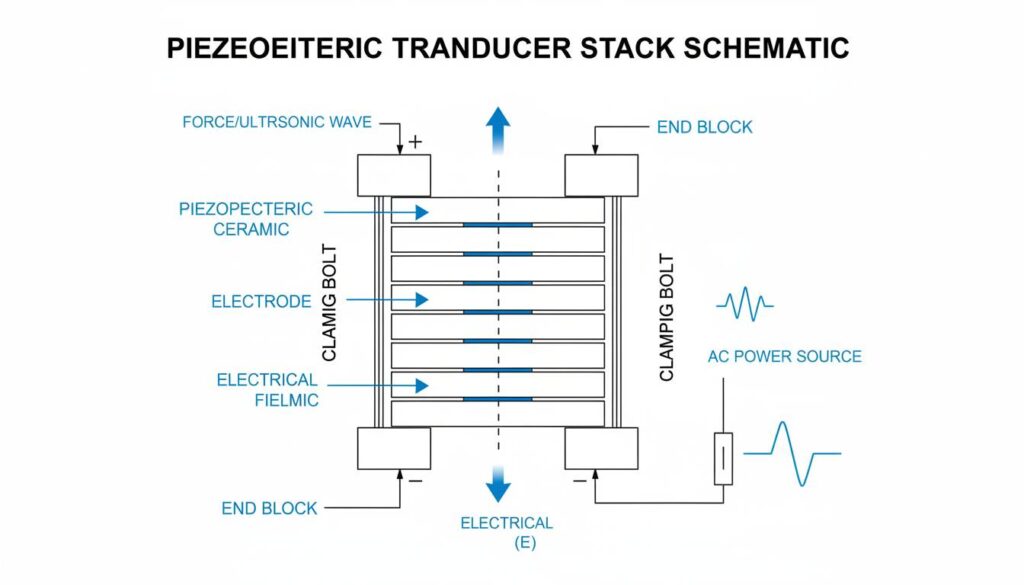
Technical Diagram: Schematic diagram of a piezoelectric transducer stack. Show layers of ceramic disks clamped together with electrodes in between, connected to a power source.
B. Magnetostrictive Transducers (The Magnetic Metal Method)
This uses a core made of magnetic metals (like nickel).
- How it works: When you put a magnet near nickel, the metal physically shrinks a tiny bit. When you take the magnet away, it snaps back.
- The Result: By using a magnetic field that turns on and off rapidly, the metal core vibrates.
- Pros: Very strong and rugged, but generates a lot of heat.
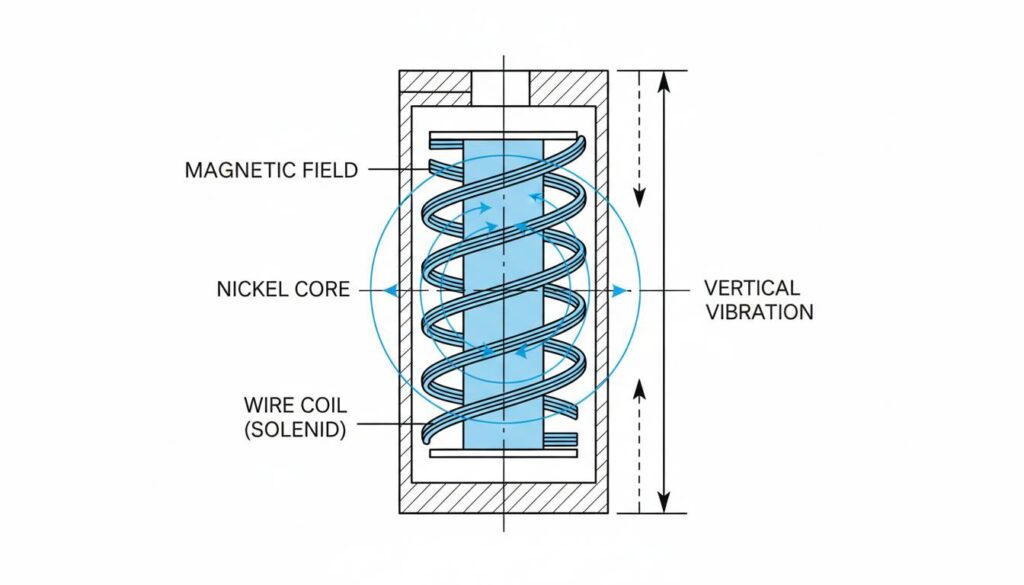
Technical Diagram: Cross-section diagram of a magnetostrictive transducer. Show a nickel core wrapped in a wire coil (solenoid) creating a magnetic field, indicating vertical vibration.
Functions of the Transducer
- Generate Vibration: It creates the up-and-down movement.
- High Frequency: It vibrates at “Ultrasonic” speeds (usually 20,000 Hz). This is too high for human ears to hear.
Think About It:If the transducer vibrates 20,000 times per second, but only moves a tiny distance (less than a hair’s width), why is it powerful enough to cut stone?
Hint: Think about a woodpecker pecking a tree.
2. The Amplifier: Acoustic Horns
The transducer vibrates fast, but the movement is tiny. It is too small to do any cutting. We need to make that movement bigger.
What is a Horn?
The Horn (sometimes called a Concentrator) acts like a funnel for vibrations. It connects the transducer to the cutting tool.
How it Works
Think of a whip. When you move the handle a little bit, the tip of the whip moves a lot. The horn does this for the machine. It takes the small vibration from the transducer and amplifies it at the tool tip.
Types of Horn Shapes
The shape changes how much the vibration grows.
- Cylindrical: Same width top to bottom. (Low amplification).
- Conical: Looks like an ice cream cone. (Medium amplification).
- Exponential: Curved sides like a trumpet. (Highest amplification).
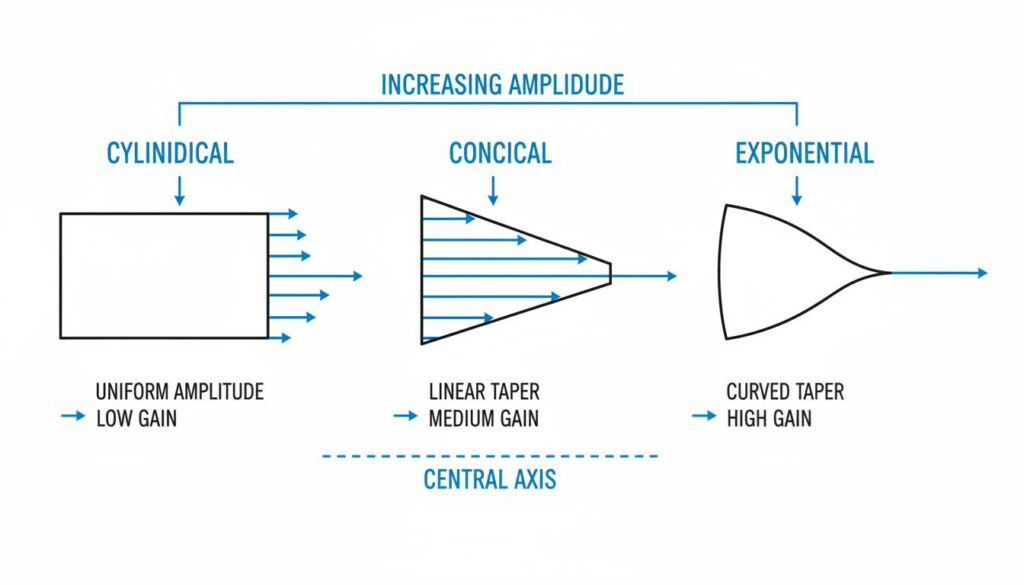
Technical Diagram: Technical illustration showing three side-by-side profiles of ultrasonic horns: Cylindrical (straight), Conical (tapered straight), and Exponential (curved taper). Arrows show vibration amplitude increasing at the tip.
Check Your Understanding:
Why do you think the horn needs to be made of very strong metal like Titanium or Monel? What would happen if it were made of plastic?
3. The Push: Feed Mechanisms
The tool vibrates up and down. But to cut a hole, we must push the tool into the workpiece. This push is called the Feed.
How it Works
We cannot push too hard, or the tool will stop vibrating (stalling). We cannot push too soft, or it won’t cut. It must be perfect.
Types of Feed Mechanisms
- Gravity Feed: We use weights and pulleys. Gravity pulls the tool down gently.
- Spring Feed: A spring pushes the tool down.
- Pneumatic/Hydraulic: Uses air pressure or oil pressure for a very smooth push.
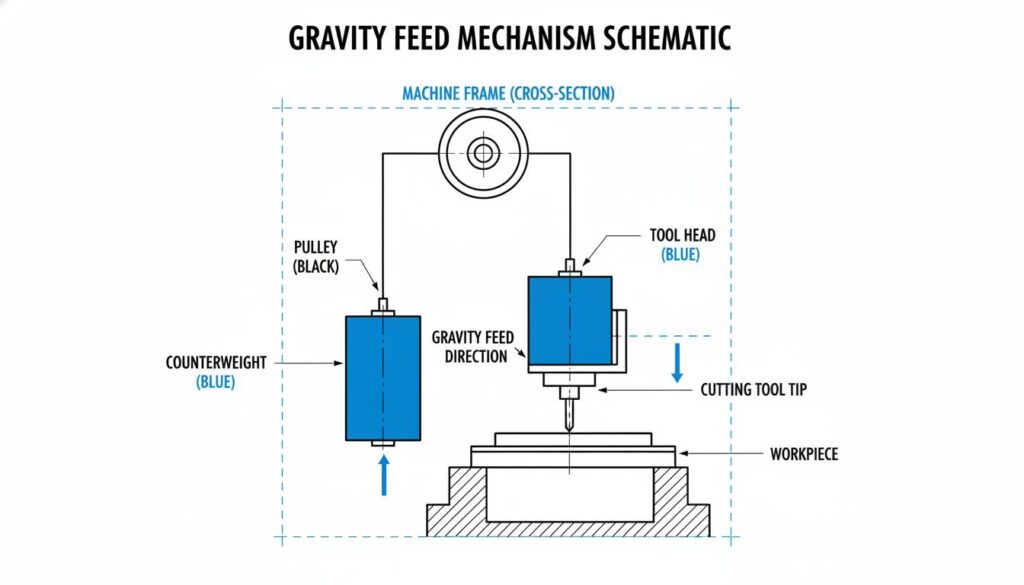
Technical Diagram: Simple schematic of a gravity feed mechanism in a machine tool. Show a counterweight connected by a pulley to the tool head, lowering it onto a workpiece.
4. The Cutting Teeth: Abrasives
Here is the secret: The tool does not touch the workpiece.
If the tool touched the glass, it would crack. Instead, we pour a liquid mix called Slurry between the tool and the glass.
What is Slurry?
It is a mix of water and Abrasive Grains (hard sand).
How it Cuts
- The tool vibrates down and hits the sand grains.
- The sand grains fly into the glass at high speed.
- The sand chips away tiny pieces of glass.
- The water washes the chips away.
Common Abrasive Materials
- Boron Carbide: The hardest and most expensive. Used for cutting diamonds or very hard gems.
- Silicon Carbide: Very common. Used for glass and ceramics.
- Aluminum Oxide: Softer. Used for cleaning or dulling surfaces.
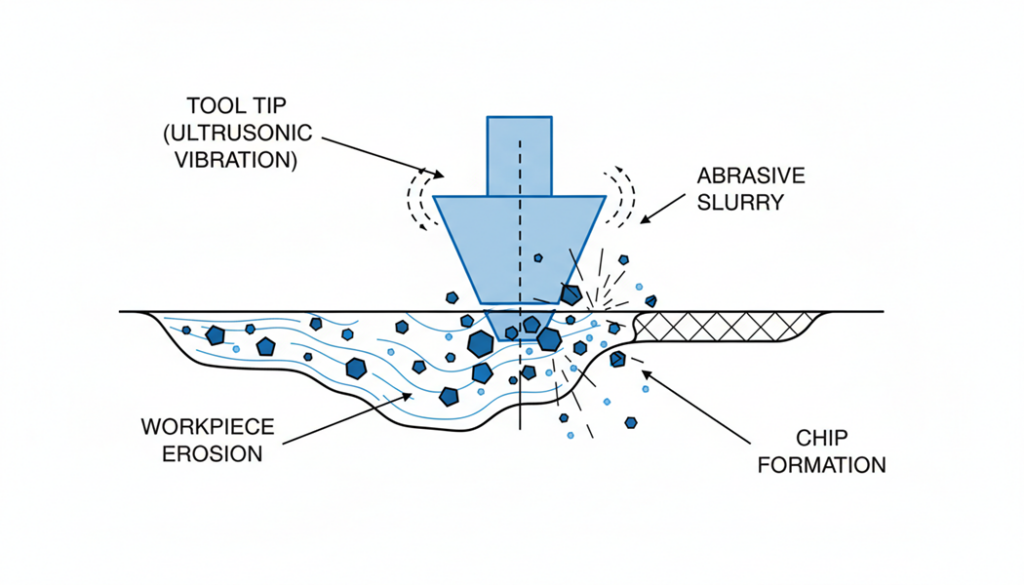
Technical Diagram: Close-up zoom diagram of the cutting zone. Show the tool tip vibrating, abrasive grains suspended in liquid (slurry), and the grains chipping away the workpiece surface.
5. The Hammer: Tool Materials
The tool is the part that hits the sand. You might think the tool needs to be super hard, but it is actually made of soft metal.
Why Soft Metal?
If the tool is brittle (like hard steel), it will crack when it hits the sand. If the tool is soft (ductile), the sand grains embed slightly into it, helping them hammer the workpiece effectively.
List of Tool Materials
- Soft Steels: Cheap and easy to shape.
- Stainless Steel: Resists rust from the water slurry.
- Brass or Copper: Sometimes used for specialized cuts.
The Paradox:
We use a *soft* tool to cut *hard* glass. Why doesn’t the tool wear out instantly?
(Actually, it does wear out! We have to replace the tool often in USM.)
6. Typical Applications (What can we make?)
Ultrasonic Machining is not for wood or soft metal. It is for materials that are Hard and Brittle.
Common Uses
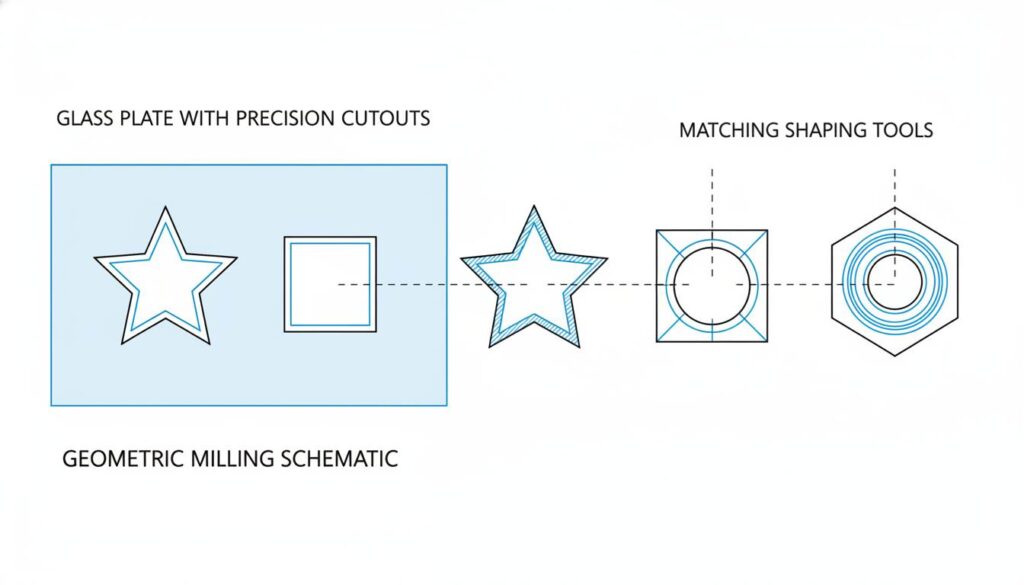
- Square Holes: You cannot drill a square hole with a spinning drill bit. With USM, if you make a square tool, you get a square hole.
- Glass and Ceramics: Drilling holes in lenses or mirrors without cracking them.
- Dentistry: Some dental tools use ultrasonics to clean or shape teeth.
- Semiconductors: Cutting silicon wafers for computer chips.
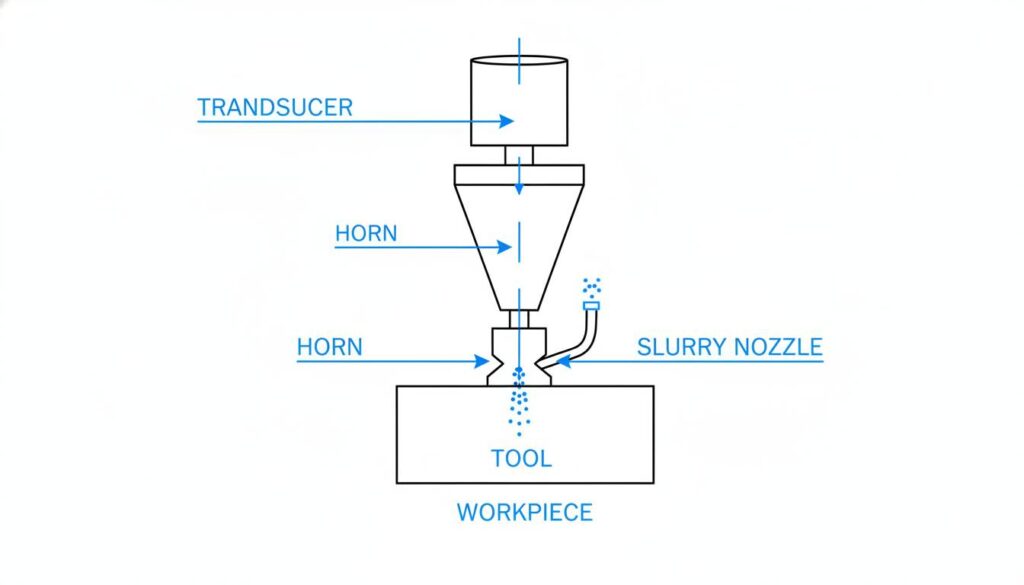
Technical Diagram: Technical diagram of the full Ultrasonic Machining setup. Label the Transducer, Horn, Tool, Slurry nozzle, and Workpiece.
