
What is Bulk Modulus?
Imagine you are holding a sponge in one hand and a rock in the other. If you squeeze the sponge, it shrinks easily. If you squeeze the rock, it does not change size.
Bulk Modulus is a number that tells us how “rock-like” or “sponge-like” a material is. It measures stiffness.
- High Bulk Modulus: The material is stiff (like the rock). It resists being squished.
- Low Bulk Modulus: The material is squishy (like the sponge). It compresses easily.
In engineering, we use the letter K or B for Bulk Modulus.
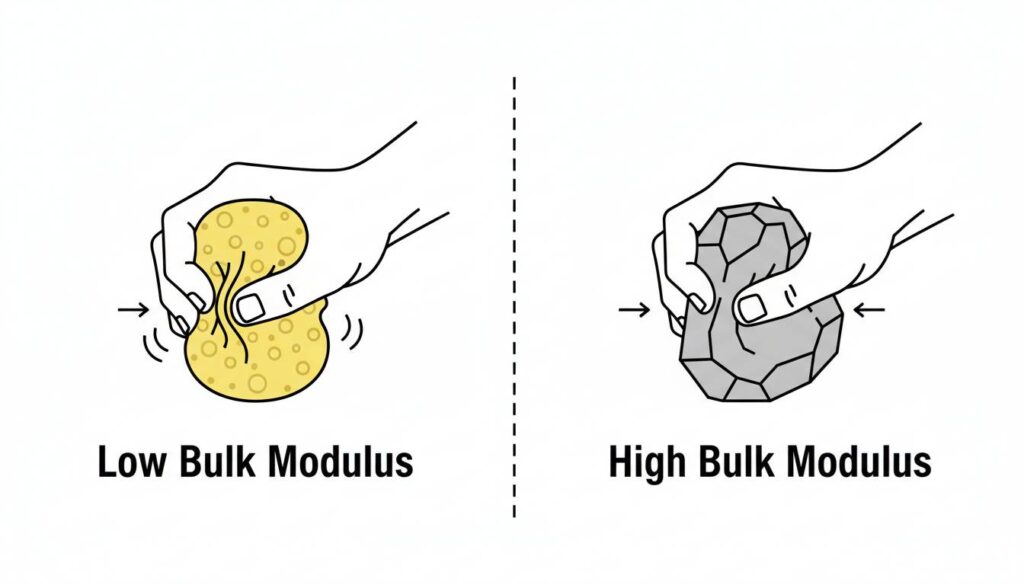
Technical Figure: A split-screen illustration. On the left, a hand squeezing a soft yellow sponge that compresses significantly. On the right, a hand squeezing a grey rock that does not change shape. Labels ‘Low Bulk Modulus’ under the sponge and ‘High Bulk Modulus’ under the rock.
The Formula for Stiffness
We don’t just guess; we measure. The Bulk Modulus ( ) is calculated by looking at how much pressure you apply versus how much the volume shrinks.

Think of it this way:
- You push on a fluid (Pressure increases).
- The fluid shrinks (Volume decreases).
- If you push hard but the volume barely changes, K is huge.
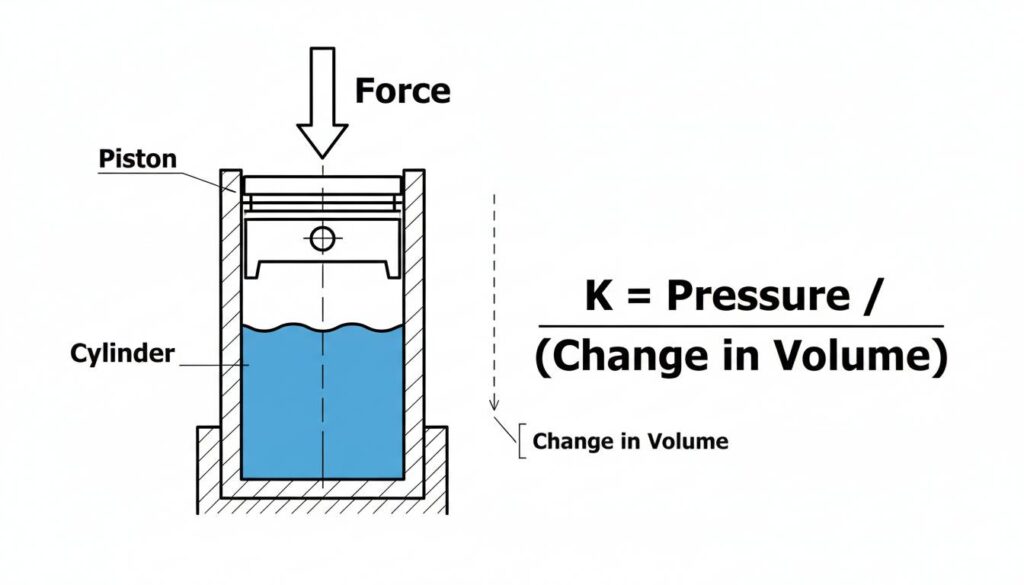
Technical Figure: A simple diagram of a piston inside a cylinder filled with blue liquid. An arrow points down showing ‘Force’. The liquid level drops slightly, labeled ‘Change in Volume’. The formula K = Pressure / (Change in Volume) is written next to it in bold text.
If you have a water gun, you want the water to shoot out instantly when you pull the trigger. Do you want the water to have a High Bulk Modulus or a Low Bulk Modulus? Why?
Oil vs. Air: The Battle of Stiffness
In machines like excavators or car brakes, we use hydraulic oil. We use oil because it is very stiff. It acts like a liquid steel rod. When you push one end, the other end moves instantly.
Air is different. Air is a gas. The molecules in gas are far apart. When you push on air, the molecules just move closer together. Air is very “spongy.”
- Oil Bulk Modulus: Very High (approx. 1.5 GPa). Hard to squish.
- Air Bulk Modulus: Very Low (approx. 0.0001 GPa). Easy to squish.

Technical Figure: A microscopic view comparison. Left circle shows ‘Oil’ with blue molecules packed tightly together touching each other. Right circle shows ‘Air’ with grey molecules floating far apart with lots of empty space.
The Problem: Air Bubbles in Oil
Sometimes, air gets trapped inside the oil. This is bad. This creates an Oil-Air Mixture.
Imagine a steel pipe (the oil) with a section made of rubber (the air bubble). If you push on the pipe, the rubber section will squish first before the other end moves. The system becomes “mushy.”
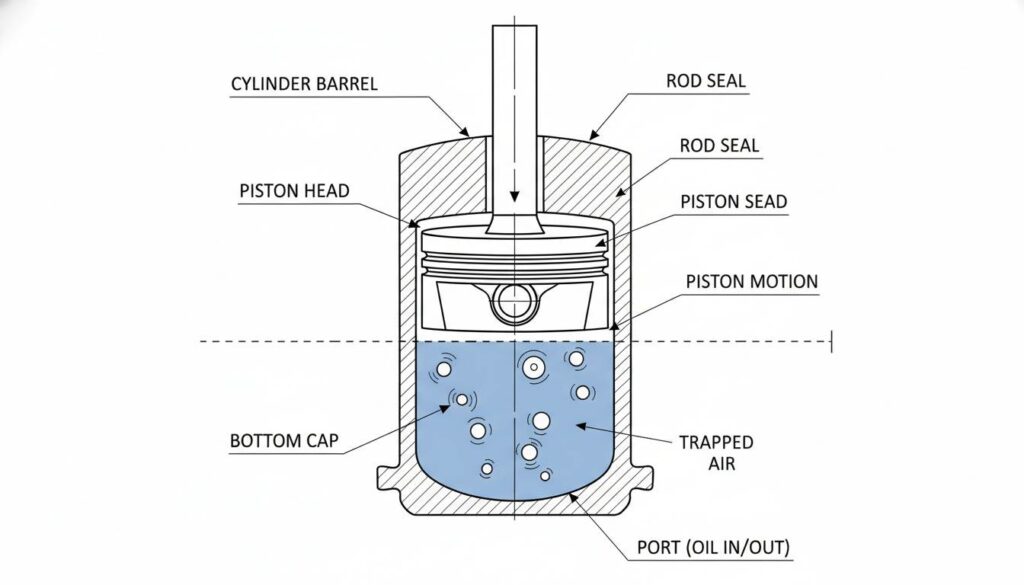
Technical Figure: A hydraulic cylinder cutaway view. Inside the blue oil, there are several distinct white bubbles representing trapped air. The piston is pushing down, and the bubbles are shown compressing smaller, while the oil level stays mostly the same.
Have you ever ridden a bicycle where the brakes felt “squishy” and didn’t stop the bike well? That usually means air got into the brake lines. Why does the air make the brakes feel weak?
Deriving the Equivalent Bulk Modulus
We need to find the Equivalent Bulk Modulus ( ). This is the stiffness of the dirty, bubbly mixture.
We are not using calculus. We will use simple logic.
Step 1: Total Volume
The total volume ( ) is simply the oil plus the air.

Step 2: Total Squish (Change in Volume)
When we apply pressure, both the oil and the air shrink. The total shrinkage ( ) is the sum of the oil shrinking and the air shrinking.

Technical Figure: A visual math equation. A large blue square (Oil Volume) + a small white square (Air Volume) = A Combined Rectangle (Total Volume). Arrows show both squares shrinking under pressure.
Step 3: Using the Definition of K
Remember our first formula? We can rearrange it.
If  , then:

Now, let’s swap the “Change in Volume” in Step 2 with this new math.
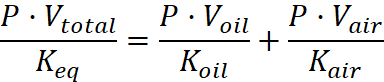
Note:  is the pressure we apply. It is the same for everything, so we can cross it out!
Step 4: The Final Formula
After crossing out , we get the final rule for the mixture:
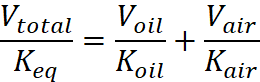
This formula tells us that the weakest link rules the chain. Even a tiny amount of air (low  ) makes the fraction
  huge. This drags the total stiffness () down drastically.
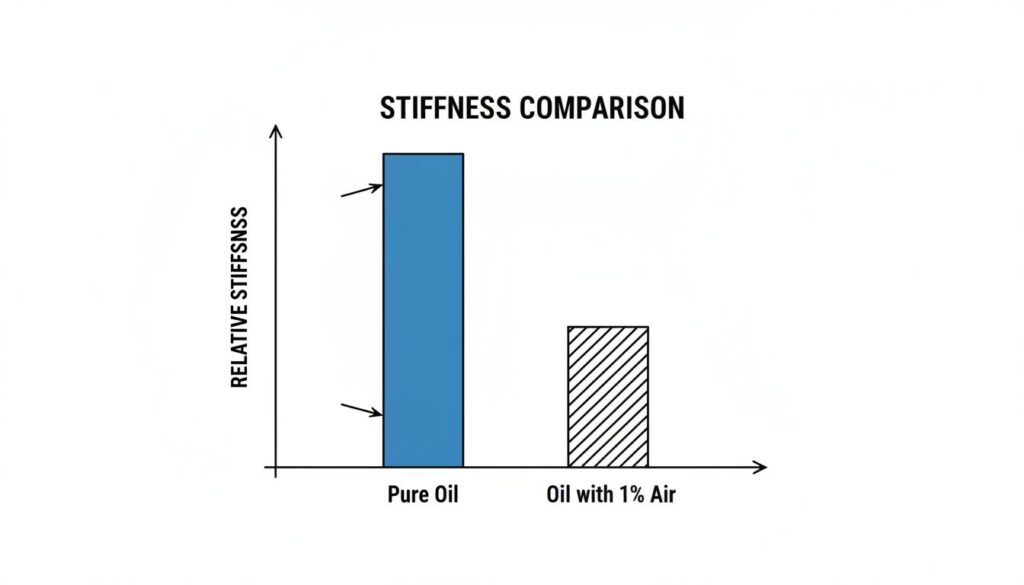
Technical Figure: A bar chart comparing stiffness. Bar 1 is tall and blue labeled ‘Pure Oil’. Bar 2 is very short and striped labeled ‘Oil with 1% Air’. This visually demonstrates the drastic drop in performance.
Why This Matters
If you have just 1% air in your hydraulic oil, the stiffness can drop by 70% or more. The machine becomes bouncy and inaccurate. This is why mechanics “bleed” the brakes—to get the air out so the fluid becomes stiff again.
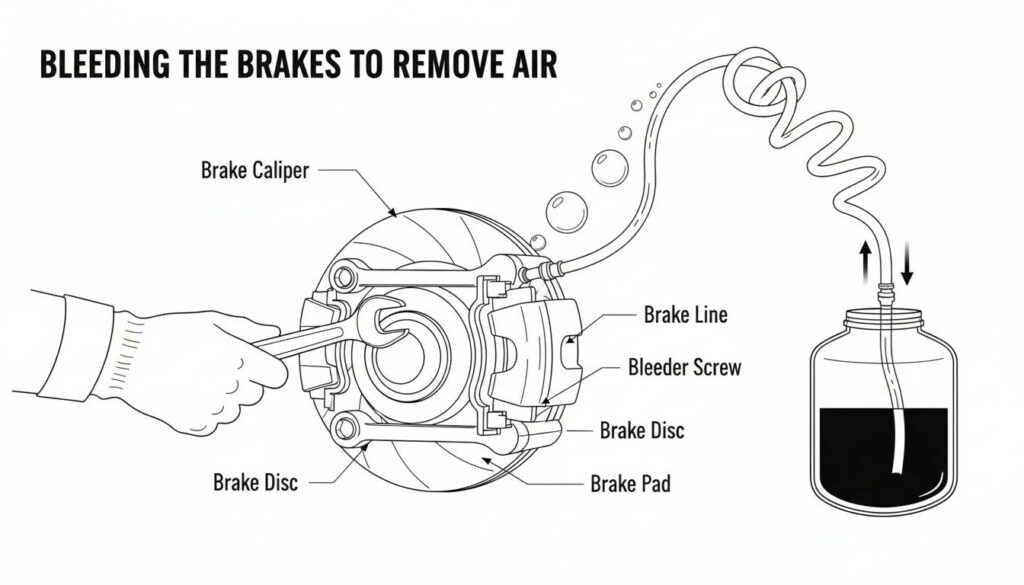
Technical Figure: A mechanic working on a car brake caliper. A clear tube is connected to the brake, and bubbles are seen moving out of the tube. Label: ‘Bleeding the Brakes to remove air’.
Look at the formula in Step 4. If is a very small number, what happens to the value of ? Does it get very big or very small? How does that affect the total stiffness?
