
Introduction: The Sandblaster on Steroids
Imagine you have a garden hose. If you spray water at a mud pie, the mud washes away. Now, imagine using a fire hose. It cuts deeper. Finally, imagine mixing sharp sand into that high-speed air stream. Now you can cut glass, ceramics, or hard metal.
This is Abrasive Jet Machining (AJM). It uses gas and abrasive powder (like sand) to chip away material.
But how do we control how fast it cuts or how smooth the finish is? We adjust the Process Parameters. Think of these as the knobs and dials on the machine.
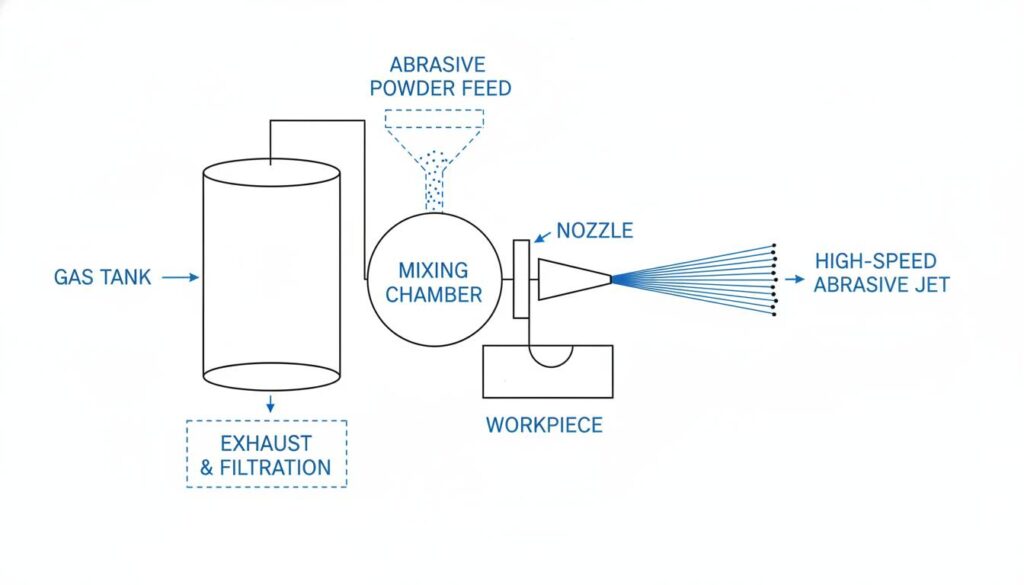
Technical Diagram: A simple 2D schematic diagram of an Abrasive Jet Machining setup. Show a gas tank, a mixing chamber where sand enters, a nozzle, and a high-speed jet hitting a workpiece.
1. The Abrasive Parameters (The “Bullets”)
The “bullets” in this process are the tiny grains of sand (abrasives). Changing the bullets changes the cut.
A. Grain Size
Think of sandpaper. You have rough sandpaper and smooth sandpaper.
- Large Grains (Coarse): These are like throwing rocks. They remove material very fast. However, they leave a rough, bumpy surface.
- Small Grains (Fine): These are like throwing dust. They cut slower, but the surface is very smooth and polished.
Rule: Bigger grains = Faster cut, rougher finish.
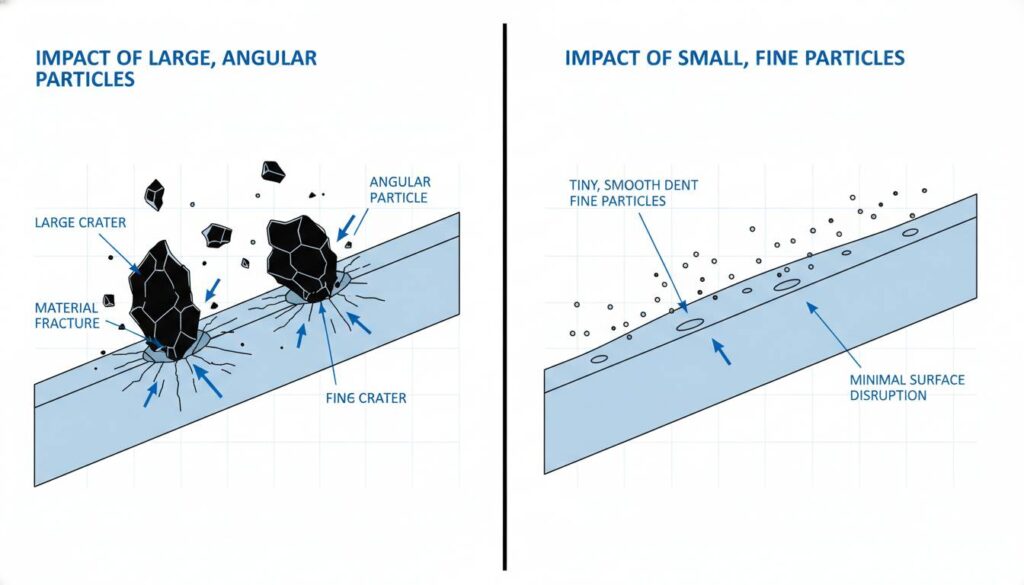
Technical Diagram: A split-screen comparison illustration. Left side: Large jagged particles hitting a surface creating deep craters. Right side: Small fine particles hitting a surface creating tiny, smooth dents.
B. Abrasive Flow Rate (AFR)
This is how much sand you mix into the air every second.
- Low Flow: Not enough bullets. The cutting is slow.
- Medium Flow: This is the “Sweet Spot.” The cutting is fastest here.
- High Flow: Too much sand! The particles crowd each other. They bump into each other instead of the target. The speed actually drops.
Rule: More sand helps, but only up to a point. After that, it clogs the traffic.
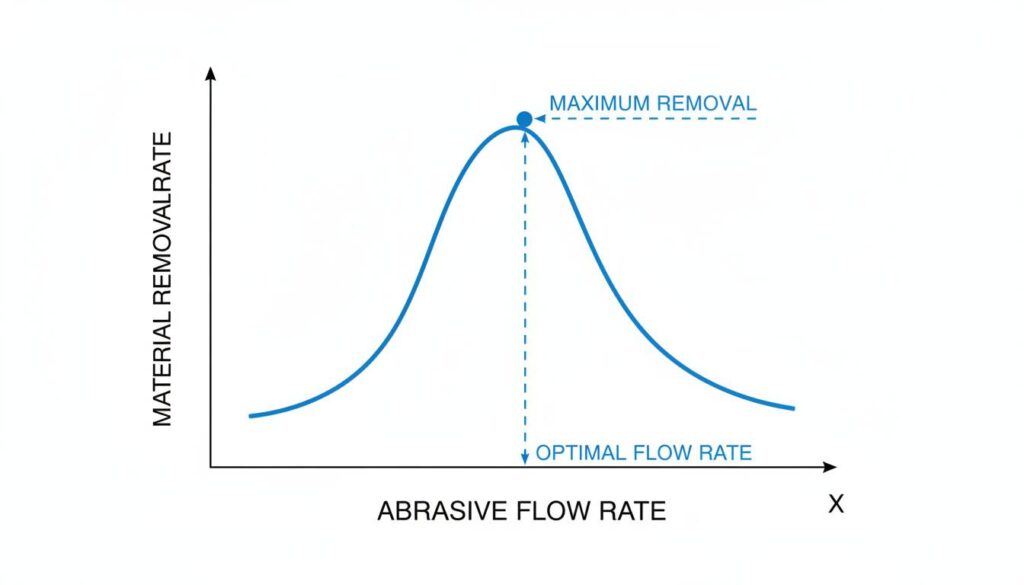
Technical Diagram: A simple line graph. The X-axis is ‘Abrasive Flow Rate’. The Y-axis is ‘Material Removal Rate’. The line goes up, reaches a peak (hill top), and then starts to go down.
If you were trying to polish a delicate glass lens, would you choose large grains or small grains? Why?
2. The Gas Parameters (The “Muscle”)
The gas (usually air, nitrogen, or CO2) provides the push.
A. Gas Pressure
This is how hard the machine blows.
- Higher Pressure: The particles fly faster. They hit with more energy. This cuts faster.
- Lower Pressure: The particles are lazy. They bounce off without cutting much.
Rule: Higher pressure = Faster cutting.
B. Nozzle Pressure
Even if the tank pressure is high, we must make sure the pressure at the nozzle tip is high too. If the hose is too long or twisted, we lose power before we hit the target.
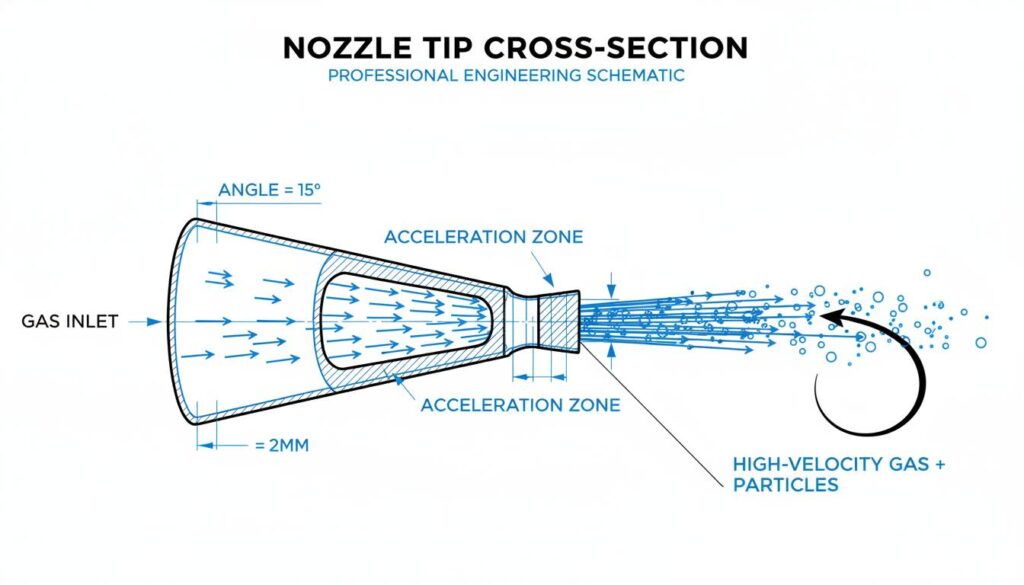
Technical Diagram: A cross-section technical drawing of a nozzle tip. Show arrows representing gas velocity increasing as the nozzle narrows, blasting particles out.
3. The Nozzle Parameters (The “Aim”)
How we hold the tool matters just as much as the tool itself.
A. Stand-Off Distance (SOD)
This is the distance between the tip of the nozzle and the piece you are cutting. This is the most important parameter for accuracy.
- Close Distance (Low SOD): The stream is tight and focused. The cut is narrow and deep. It is like a laser beam.
- Far Distance (High SOD): The stream spreads out like a flashlight beam. The cut becomes wide and shallow. The edges become rounded (tapered).
The Trap: If you get too close, the bouncing sand hits the nozzle and damages it!
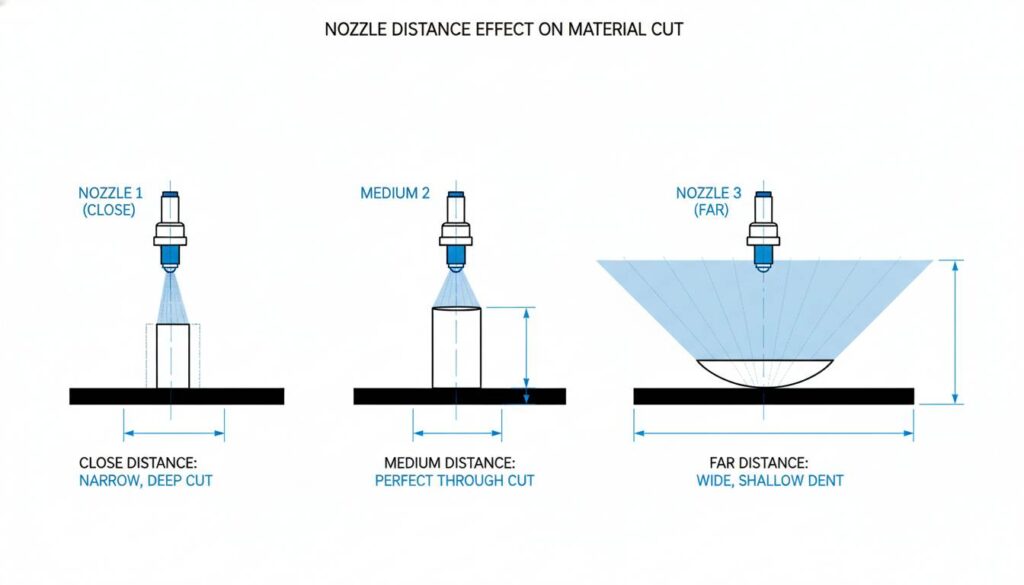
Technical Diagram: A diagram showing three nozzles at different distances from a flat plate. Nozzle 1 is close (narrow deep hole). Nozzle 2 is medium (perfect cut). Nozzle 3 is far (wide shallow dent). Show the spray cone widening.
B. Nozzle Material
The sand is trying to cut the workpiece, but it rubs against the nozzle too. The nozzle must be made of super-hard material (like Tungsten Carbide or Sapphire) so it doesn’t wear out instantly.
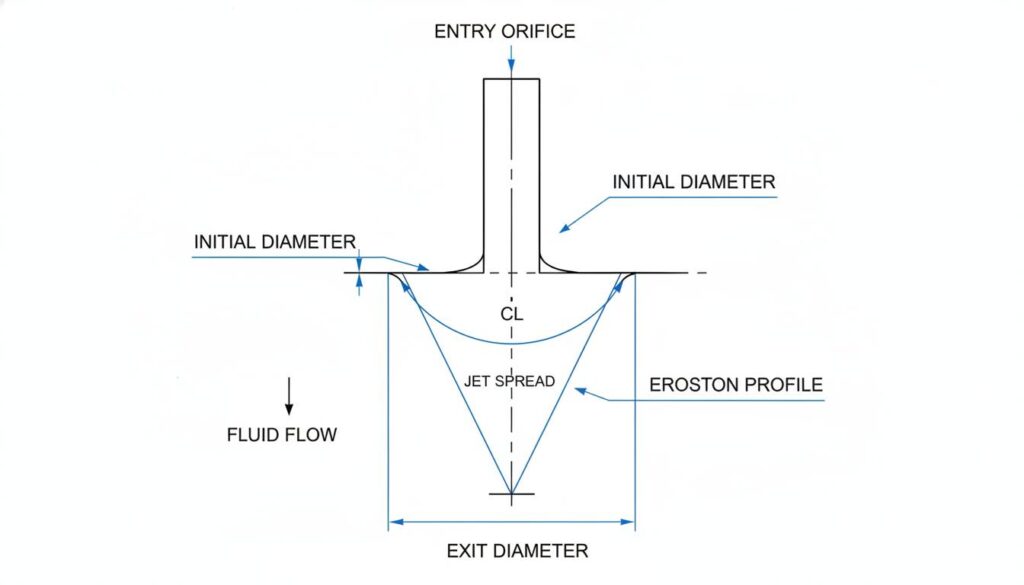
Technical Diagram: A close-up engineering drawing of a cut profile (cross-section of a hole). Show how the hole is straight at the top but gets wider at the bottom due to the jet spreading out.
Imagine holding a spray paint can. What happens to the paint circle on the wall if you take two steps back? How is this similar to Stand-Off Distance in AJM?
4. Mixing Ratio (The Recipe)
This is the ratio of Sand to Gas.
- Lean Mixture: Lots of air, little sand. Good for cleaning or light polishing.
- Rich Mixture: Lots of sand, less air. Good for heavy cutting.
However, just like the Flow Rate, if the mixture is too rich, the air cannot carry the heavy load. The velocity (speed) drops, and the cutting power fails.
Technical Diagram: A schematic of the mixing chamber. Show gas entering from one side and powder vibrating in from a hopper above. Use arrows to show them swirling together before exiting.
Summary Checklist
Remember these relationships:
- Grain Size: Bigger = Faster cut, rougher look.
- Gas Pressure: Higher = Faster cut.
- Stand-Off Distance:
- Small distance = Sharp, straight cut.
- Large distance = Wide, rounded cut.
- Flow Rate: Increases cutting speed initially, then drops if you add too much.
Why do you think we cannot use Abrasive Jet Machining to cut soft rubber?
(Hint: Think about what happens if you throw a rock at a tire vs. a glass window).
