
A Continuously Variable Transmission (CVT) is an advanced automatic transmission system that seamlessly changes through an infinite number of effective gear ratios between maximum and minimum values. Unlike standard automatic transmissions that rely on a fixed set of gears (like 1st, 2nd, or 3rd gear), a CVT utilizes a pulley-and-belt system to keep the engine running at its most efficient RPM (Revolutions Per Minute) regardless of the vehicle’s speed.
The Concept: Stairs vs. The Ramp
To understand how a CVT works, we must first look at how a traditional car moves. Imagine you are climbing a hill.
The Traditional Transmission (The Staircase)
In a manual or standard automatic car, changing speed is like walking up a staircase. Each step represents a “gear.” When you step up, there is a distinct jolt or pause. You are either on step 1 or step 2; you cannot be in between. The engine has to work hard to get to the next step, then it relaxes, then works hard again.
The CVT Solution (The Ramp)
A CVT is like a wheelchair ramp. There are no steps. You can stop or move at any height along the ramp smoothly. The transition from the bottom (low speed) to the top (high speed) is one continuous motion without any jolts, shifts, or pauses.
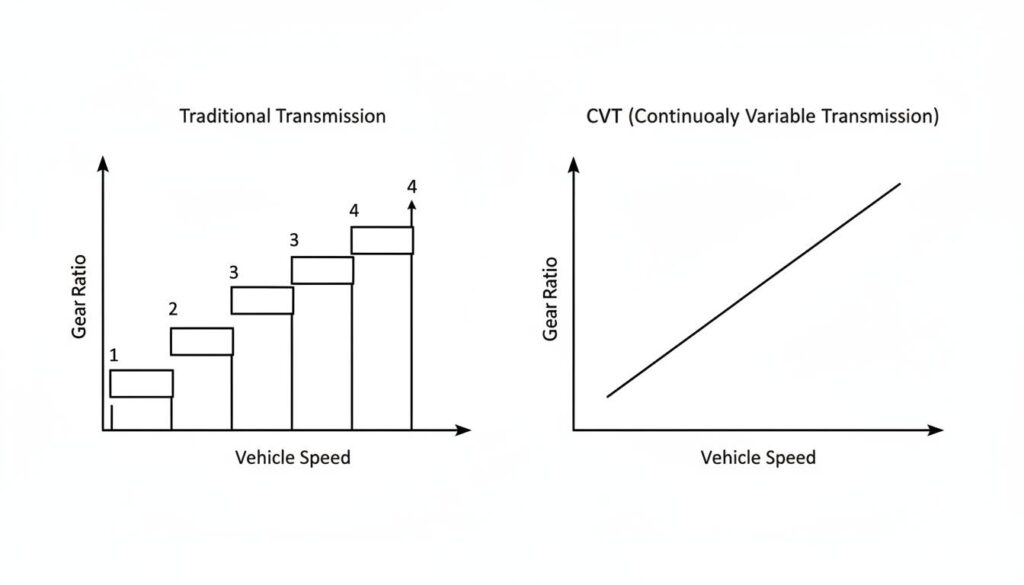
Technical Diagram: A split-screen illustration. On the left, a jagged line graph labeled ‘Traditional Transmission’ resembling a staircase. On the right, a smooth, straight diagonal line graph labeled ‘CVT’ resembling a ramp. Both graphs plot ‘Vehicle Speed’ on the X-axis against ‘Gear Ratio’ on the Y-axis.
If you were riding a bicycle up a steep hill, would you prefer a bike that only has 3 specific gears (Hard, Medium, Easy), or a “magic” bike that could perfectly adjust the pedal difficulty to exactly match the steepness of the hill at every second? Why?
Anatomy of a Continuously Variable Transmission CVT
The construction of a CVT is surprisingly simple compared to the complex gears found in traditional transmissions. It relies on three main components.
1. The Driver Pulley (Input)
This pulley is connected directly to the engine. It spins whenever the engine is running. This pulley is special because it can change its width. It is made of two cone-shaped halves that can move closer together or further apart.
2. The Driven Pulley (Output)
This pulley is connected to the wheels (via the driveshaft). It also consists of two cone-shaped halves that can change width. It reacts to what the Driver Pulley is doing.
3. The Belt
Connecting the two pulleys is a heavy-duty V-shaped belt. In modern cars, this is usually a high-strength steel belt, though scooters may use rubber belts. This belt transmits the power from the engine to the wheels.
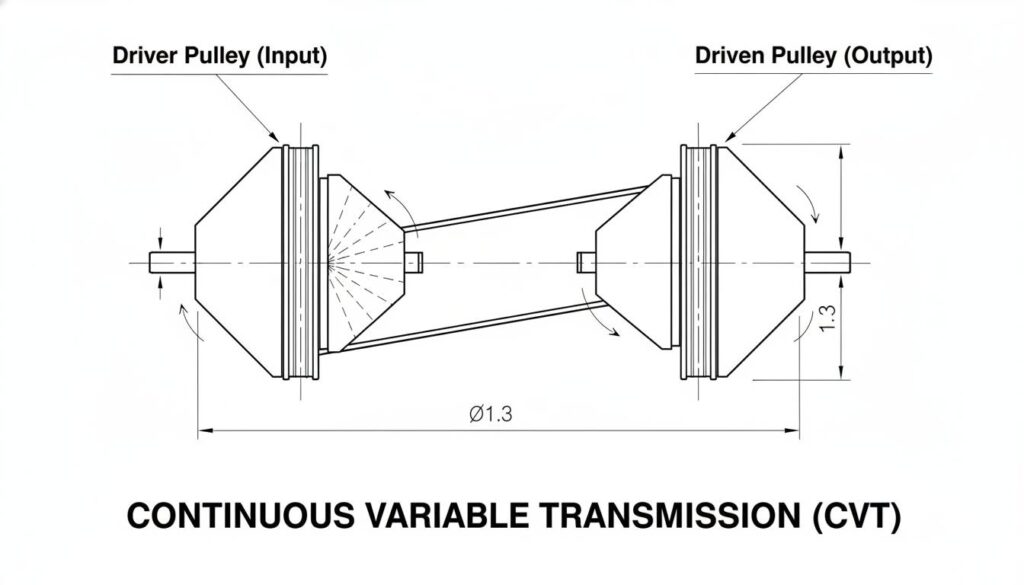
Technical Diagram: A technical diagram showing the three main components of a CVT: The Input Pulley (labeled ‘Driver’), the Output Pulley (labeled ‘Driven’), and a V-belt connecting them. The pulleys should be shown as two facing cones.
Working Principle: The Variable Diameter
The “magic” of the CVT happens through the changing diameters of the pulleys. Because the belt has a fixed length, if one pulley gets wider, the other must get narrower to keep the belt tight.
Low Gear (Acceleration)
When the car starts moving or climbing a hill, it needs power (torque), not speed.
- Driver Pulley: The cones move apart. The belt drops deep into the groove, creating a small diameter.
- Driven Pulley: The cones move together. The belt rides high on the edge, creating a large diameter.
- Result: The engine spins fast, but the wheels turn slowly with lots of strength. This is like the small sprocket on the front of a mountain bike.
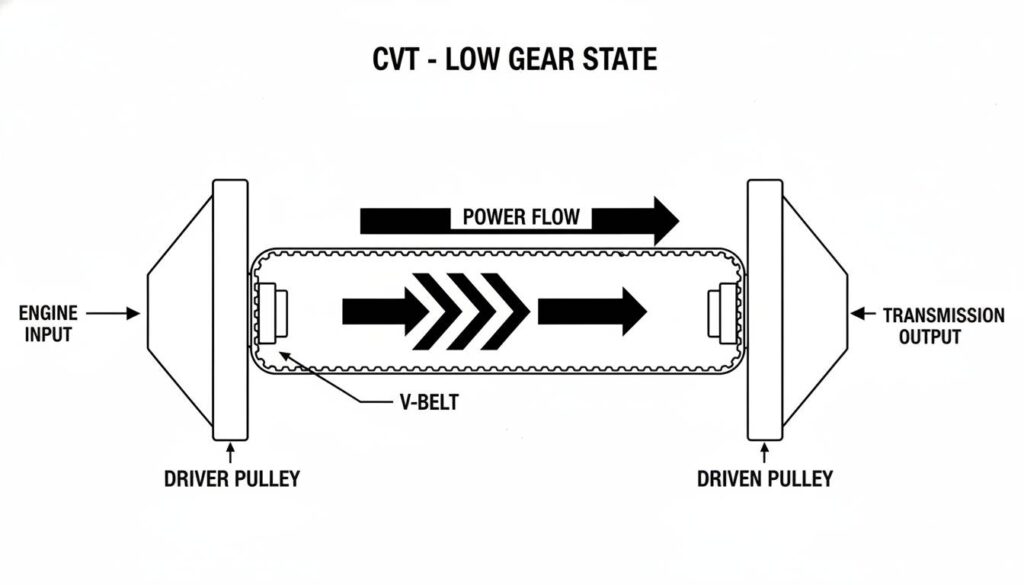
Technical Diagram: A diagram of a CVT in ‘Low Gear’ state. The Driver Pulley (left) has the belt riding very close to the center shaft (small diameter). The Driven Pulley (right) has the belt riding on the outer rim (large diameter). Arrows indicate power flow.
High Gear (Cruising)
When the car is on the highway, it needs speed, not raw power.
- Driver Pulley: The cones squeeze together. The belt is pushed to the outer rim, creating a large diameter.
- Driven Pulley: The cones pull apart. The belt sinks to the center, creating a small diameter.
- Result: The engine spins slowly and quietly, but the wheels turn very fast. This saves gas.
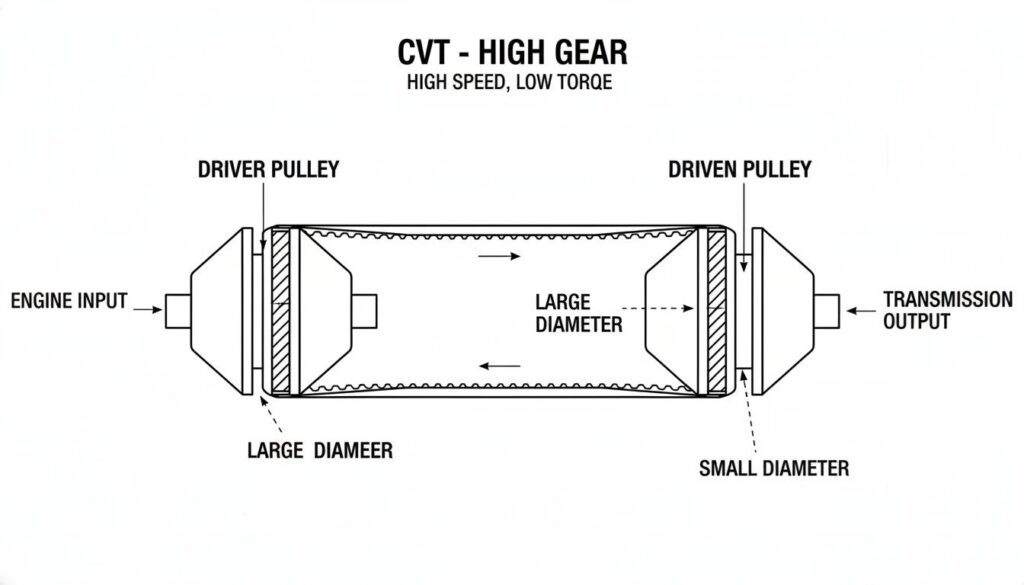
Technical Diagram: A diagram of a CVT in ‘High Gear’ state. The Driver Pulley (left) has the belt riding on the outer rim (large diameter). The Driven Pulley (right) has the belt riding close to the center shaft (small diameter). Think about a balloon. If you squeeze one end of a long balloon, the air rushes to the other end, making it expand. How is this similar to the way the two pulleys in a CVT interact with the belt?
Types of CVTs
While the pulley-and-belt system is the most common, engineers have developed different ways to achieve this “gearless” drive.
Pulley-Based CVT
This is the type described above, used in most passenger cars like the Honda Civic or Nissan Altima. It uses hydraulic pressure to squeeze the pulley cones.
Toroidal CVT
Instead of belts and pulleys, this system uses discs and power rollers.
- Imagine two mushrooms facing each other.
- Rollers sit between the mushroom caps.
- By tilting the rollers, the contact point changes, altering the speed ratio.
- This is used in higher-power vehicles because it can handle more stress than a belt.
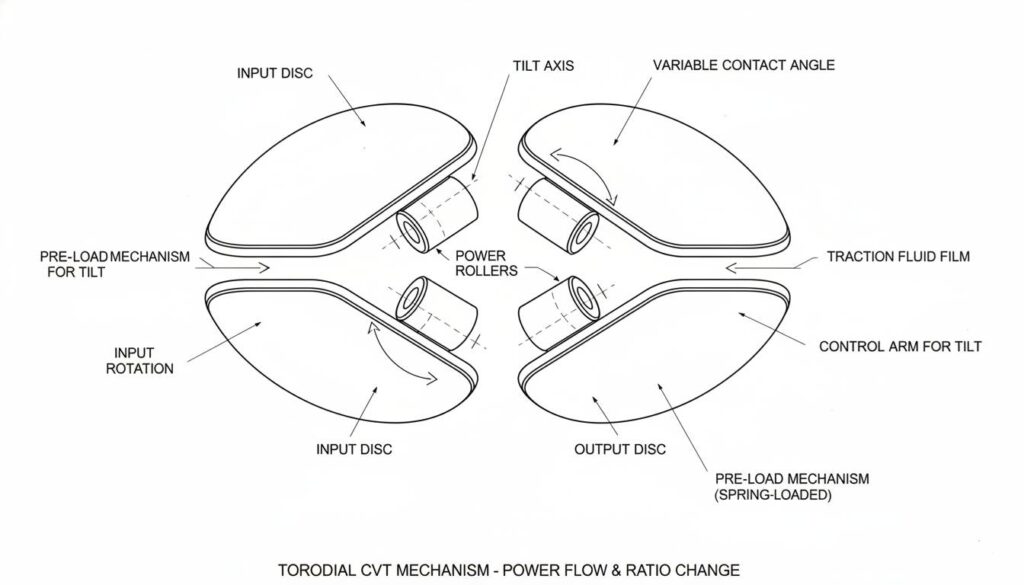
Technical Diagram: A 3D diagram of a Toroidal CVT. It shows two concave discs (input and output) facing each other with two rollers sandwiched in between. Arrows show the rollers tilting to change the contact angle.
Advantages and Disadvantages
Why do some manufacturers love CVTs while some drivers dislike them?
The Benefits (Pros)
- Fuel Efficiency: The engine can always stay in its “sweet spot” (the most efficient RPM). It doesn’t waste gas revving up and down between gears.
- Smoothness: There is no “shift shock.” The ride is incredibly smooth because the car never actually changes gears.
- Uphill Driving: A CVT can find the exact ratio needed to climb a hill without “hunting” for the right gear.
The Drawbacks (Cons)
- The “Rubber Band” Effect: When you step on the gas, the engine revs up immediately (making noise), but the car takes a second to catch up. It feels like stretching a rubber band.
- Noise (The Drone): Because the engine stays at one speed while the car accelerates, it can sound like a vacuum cleaner or a droning noise, which some drivers find annoying.
- Torque Limits: CVTs rely on friction between the belt and pulley. If the engine is too powerful (like in a race car), the belt might slip.
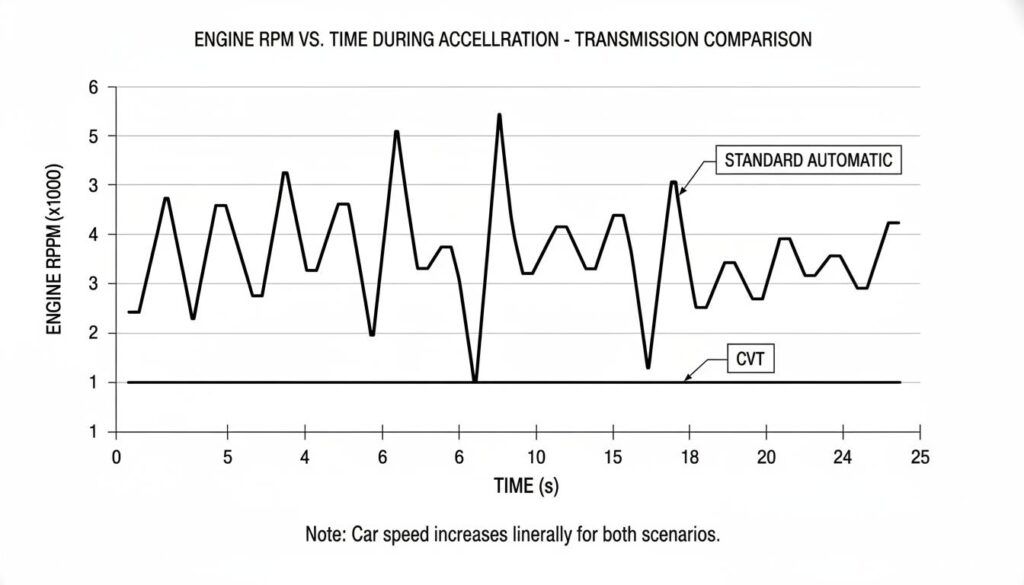
Technical Diagram: A comparison graph of Engine RPM vs. Time during acceleration. The ‘Standard Automatic’ line looks like a sawtooth wave (rev up, drop, rev up, drop). The ‘CVT’ line is a flat horizontal line that stays constant while the car speed increases. If you were designing a heavy-duty truck meant for towing massive trailers, would you choose a CVT or a traditional gear transmission? Consider the “Torque Limits” mentioned above in your answer.
Summary
The Continuously Variable Transmission represents a shift from mechanical steps to fluid motion. By utilizing variable-diameter pulleys, the CVT allows a vehicle to accelerate without shifting, providing superior fuel economy and a smoother ride for daily commuting. While it may lack the sporty feel of a manual gearbox, it is a cornerstone of modern, eco-friendly automobile engineering.
