
To understand Proton Exchange Membrane Fuel Cells (PEMFC), we must explore how hydrogen fuel, the anode, the cathode, and the electrolyte membrane work together to create clean energy and electricity.
What is a Fuel Cell?
Imagine a battery that never runs out of power, as long as you keep feeding it fuel. That is a fuel cell.
Most cars today use a gasoline engine. They burn gas to move pistons. This makes smoke and pollution. Batteries in electric cars store energy, but they take a long time to recharge.
A PEM Fuel Cell is the best of both worlds. It uses hydrogen gas (like a fuel tank) but creates electricity (like a battery). The only thing that comes out of the tailpipe is pure water. You could drink it!
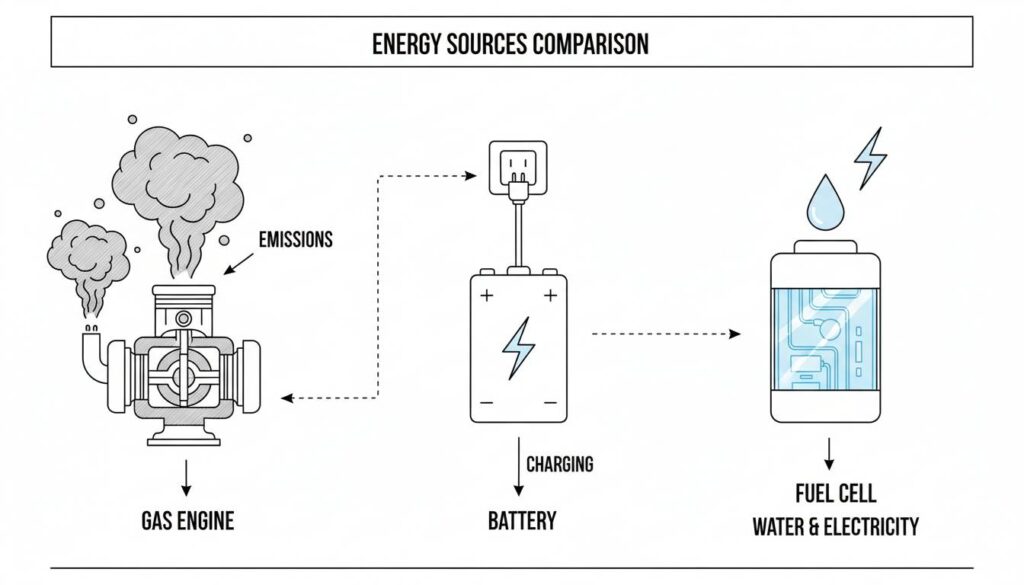
Technical Figure: A simple 3D cartoon comparison. On the left, a gas engine emitting grey smoke. In the middle, a battery with a charging cable. On the right, a futuristic fuel cell box emitting a drop of blue water and a lightning bolt.
The “Sandwich” Structure
A single fuel cell looks like a sandwich. It is very thin. To make enough power for a car, we stack hundreds of these sandwiches together. We call this a Fuel Cell Stack.
The “sandwich” has three main layers:
- The Anode: The negative side.
- The Membrane: The filling in the middle.
- The Cathode: The positive side.

Technical Figure: An exploded view diagram of a single fuel cell. It shows the Anode plate on the left, the Cathode plate on the right, and a thin polymer membrane sheet in the very center. Labels point to each layer.
If one fuel cell is like a single battery (about 0.7 volts), why do you think we need to stack hundreds of them together to run a car?
How It Works: The Science of the Detour
The magic of a fuel cell is that it forces electrons to take a detour. When electrons move, we get electricity. Here is the step-by-step process.
Step 1: The Break Up (At the Anode)
Hydrogen gas (H2) enters the fuel cell on the Anode side. The Anode is coated with a special metal called Platinum.
Platinum acts as a catalyst. A catalyst is a helper that makes chemical reactions happen faster. When the hydrogen hits the platinum, it splits apart.
- Before: One Hydrogen Molecule (H2)
- After: Two Protons (H+)) and Two Electrons (e-)

Technical Figure: A close-up diagram at the molecular level. A Hydrogen molecule (two joined red spheres) hits a grey surface (platinum). It splits into two separate red spheres (protons) and two tiny yellow sparks (electrons).
Step 2: The Bouncer (The Membrane)
This is the most important part. The Proton Exchange Membrane (PEM) is like a very strict security guard or a bouncer at a club.
- The Rule: The membrane only allows Protons (H+) to pass through it.
- The Block: The membrane stops Electrons (e-). They are not allowed inside.
The protons swim right through the membrane to the other side. But the electrons are stuck. They want to get to the other side to meet up with the protons, but the door is locked.

Technical Figure: A cross-section of the membrane. Red spheres (protons) are passing through a barrier easily. Yellow sparks (electrons) are bouncing off the barrier, looking for another way around.
Step 3: The Detour (Creating Electricity)
Since the electrons cannot go through the membrane, they have to go around it. We give them a wire to travel on.
When electrons flow through a wire, that is electricity.
We put a motor or a lightbulb on that wire. As the electrons run through the wire to get to the other side, they power the motor. This turns the wheels of the car.
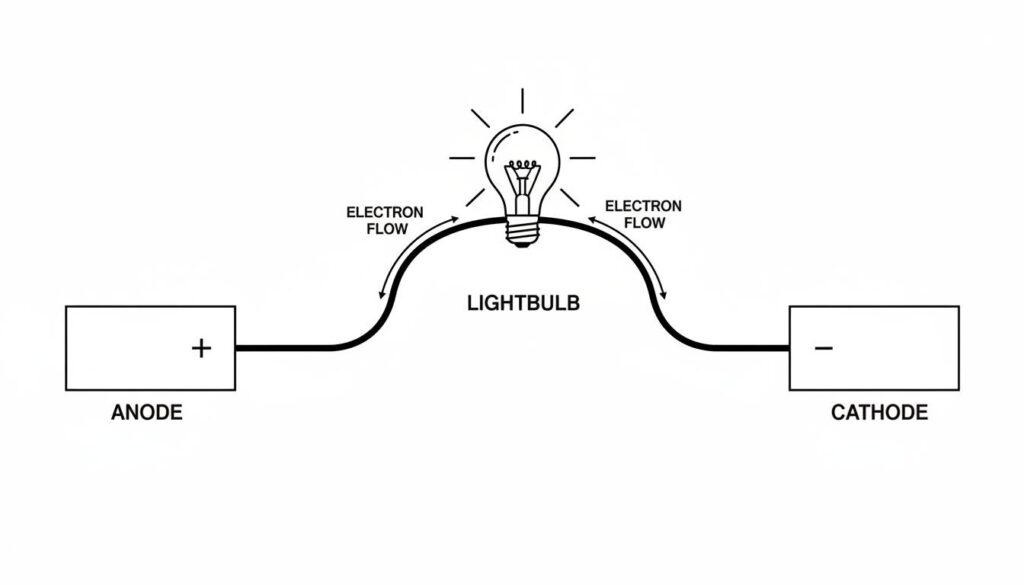
Technical Figure: A diagram showing the external circuit. A wire connects the left side (anode) to the right side (cathode). Electrons flow through the wire, lighting up a bright lightbulb in the middle of the wire.
Step 4: The Reunion (At the Cathode)
Now, everyone meets up on the other side (the Cathode).
- The Protons come through the membrane.
- The Electrons arrive from the wire (after doing their work).
- Oxygen (from the air outside) enters the Cathode.
When Hydrogen protons, electrons, and Oxygen meet, they combine.

This creates Water. The water drips out of the exhaust pipe.
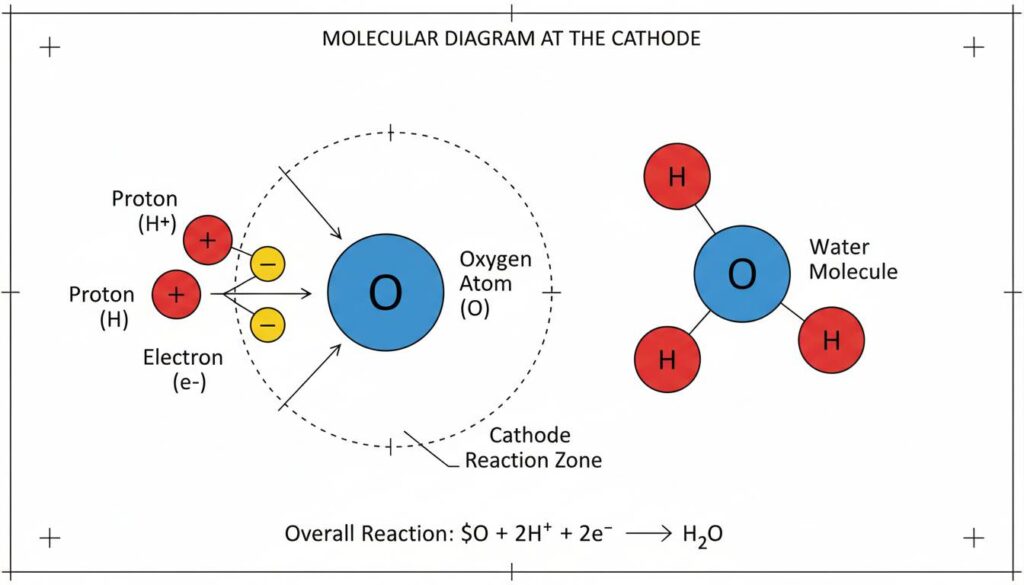
Technical Figure: Molecular diagram at the Cathode. Red protons and yellow electrons arrive and join with a large blue Oxygen atom. They merge to form a Mickey-Mouse-shaped water molecule ($H_2O$).
Think about the “Bouncer” (Membrane). What would happen to the electricity if the membrane ripped and let the electrons go straight through the middle instead of the wire?
Why Do We Like PEM Fuel Cells?
The Advantages
- Zero Pollution: The only exhaust is water vapor. No smog.
- Quiet: There are no explosions inside, unlike a gas engine. It is very silent.
- Fast Refueling: You can fill a hydrogen tank in 5 minutes. Electric batteries can take hours to charge.
The Challenges
- Expensive: The platinum used for the catalyst is a precious metal. It costs a lot of money.
- Storage: Hydrogen is a gas. It takes up a lot of space. We have to squeeze it into strong tanks under high pressure to fit it in a car.
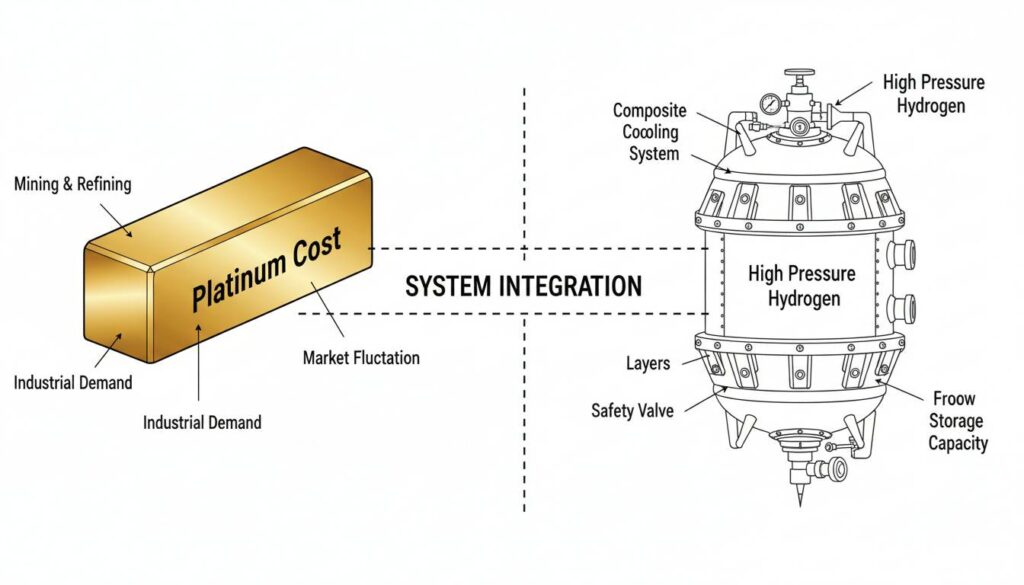
Technical Figure: A split screen illustration. On one side, a gold bar labeled “Platinum Cost”. On the other side, a high-tech, reinforced tank labeled “High Pressure Hydrogen”.
Summary of the Flow
To remember how a PEM fuel cell works, just remember the path of the electron:
- Hydrogen enters.
- Platinum splits it.
- Membrane blocks the electron.
- Electron travels the wire (Power!).
- Oxygen meets them at the end to make Water.
Batteries store energy. Fuel cells make energy. If you were designing a submarine that needs to stay underwater for months, would you choose a battery or a fuel cell? Why?
