
What is a Fuel Cell?
Before we look at the history, we must understand the machine. A fuel cell is like a battery. But there is one big difference. A battery runs out of power and needs recharging. A fuel cell keeps making power as long as you feed it fuel.
Think of a fuel cell like a car engine, but without the burning. It takes Hydrogen and mixes it with Oxygen from the air. This mix creates electricity.
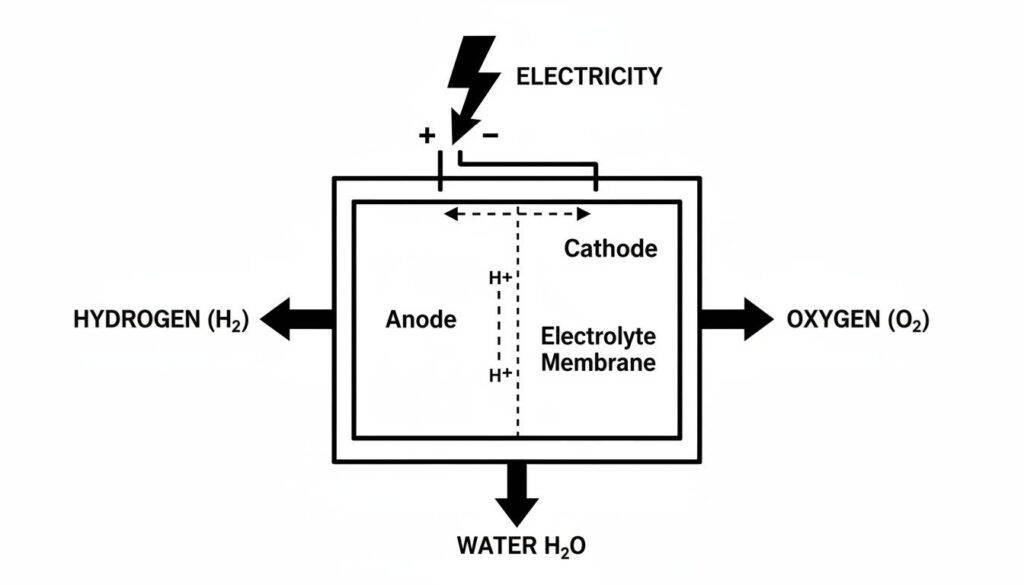
Technical Figure: A simple 2D diagram showing a fuel cell. On the left, an arrow labeled ‘Hydrogen’ enters. On the right, an arrow labeled ‘Oxygen’ enters. An arrow coming out the bottom is labeled ‘Water’. A lightning bolt symbol shows electricity coming out the top.
The “Reverse” Water Trick
You might know that if you put electricity into water, it splits into Hydrogen and Oxygen gases. A fuel cell does the exact opposite. It puts the gases together to make electricity and water.
If a fuel cell only produces water as exhaust, why is that better for the environment than a normal gasoline car?
The Early Days (1800s)
Sir William Grove’s “Gas Battery”
The story starts a long time ago. In 1839, a scientist named Sir William Grove invented the first fuel cell. He lived in Wales.
He did not call it a “fuel cell.” He called it a “gas battery.” He used platinum strips and sulfuric acid. He proved that mixing hydrogen and oxygen could create an electric current.
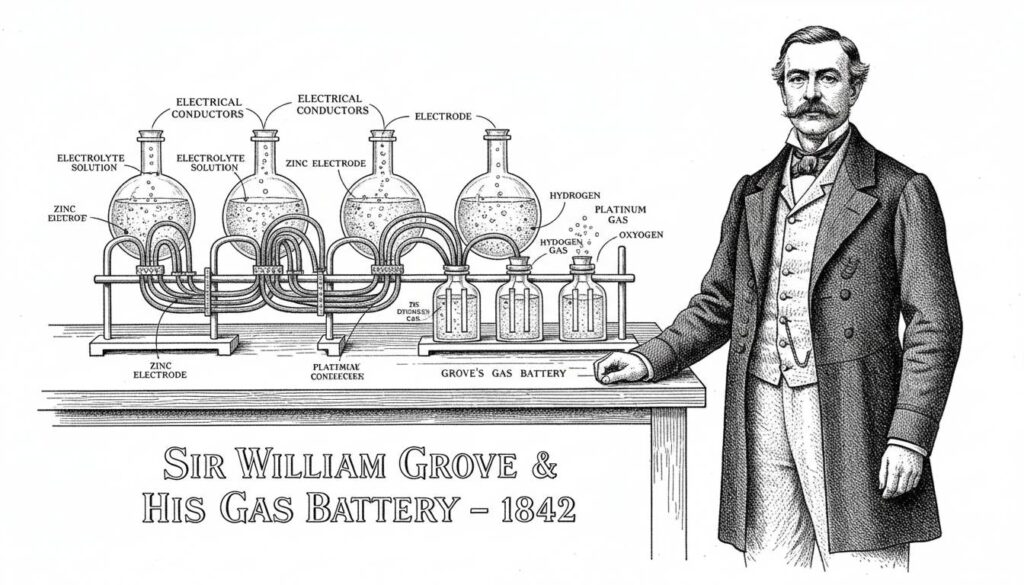
Technical Figure: An illustration of Sir William Grove in a 19th-century laboratory, standing next to a table with glass beakers, wires, and primitive batteries.
However, Grove did not build a car. In 1839, cars did not exist yet! His invention was just a science experiment. It was too big and expensive to be useful at the time.
The Space Age (1950s – 1960s)
For over 100 years, the fuel cell sat on the shelf. Nobody used it. Then, humans decided to go to space.
NASA Needs Power
NASA had a problem.
- Batteries are very heavy.
- Gasoline engines need air to work (there is no air in space).
- Solar panels were not very strong yet.
NASA remembered the fuel cell. It was perfect for the Gemini and Apollo space missions.
Two Birds with One Stone
The fuel cell solved two problems at once for astronauts:
- It provided electricity for the spaceship.
- The “exhaust” was pure water. The astronauts could drink it!

Technical Figure: A realistic drawing of the Apollo Service Module with a cutaway view showing the hydrogen and oxygen tanks and the fuel cell stack inside.
Why is weight such a big problem when launching a rocket into space? How did fuel cells help reduce weight compared to carrying huge batteries?
The First Hydrogen Car (1966)
After NASA used them, car companies got interested. General Motors (GM) decided to build the first fuel cell vehicle.
The GM Electrovan
In 1966, GM built the Electrovan. It was the first road vehicle powered by hydrogen fuel cells.
It was not a sports car. It was a GMC Handivan. Why a van? Because the fuel cell system was massive.
- The Problem: The fuel cell and the tanks took up the whole back of the van. There was only room for a driver and one passenger.
- The Weight: It weighed over 7,000 pounds (twice as heavy as a normal car).
- The Range: It could drive about 120 miles.
- Safety: It was dangerous. It carried tanks of liquid hydrogen and liquid oxygen. If they crashed, it could explode.
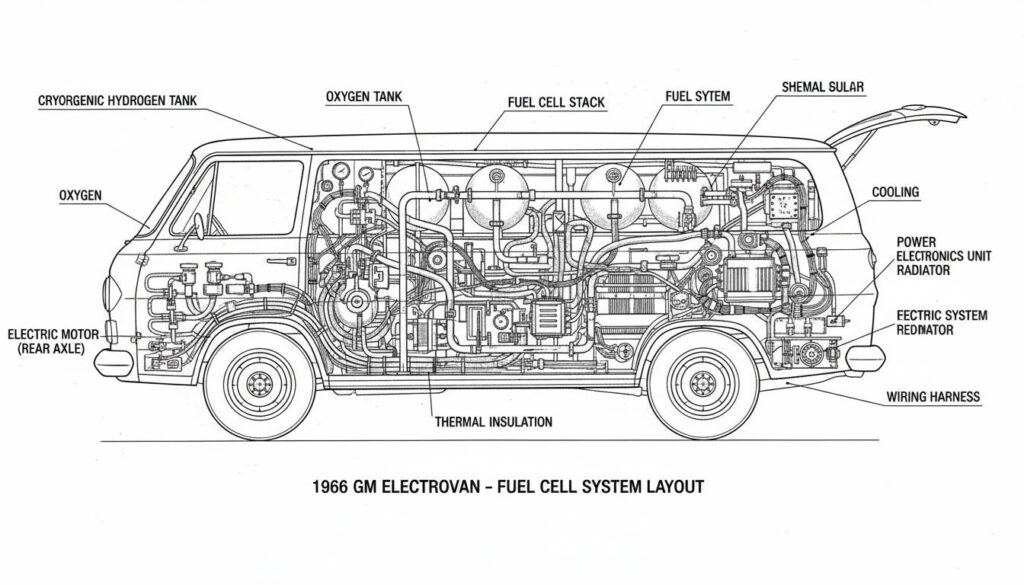
Technical Figure: A black and white photo-style image of the 1966 GM Electrovan. The back doors are open, revealing a massive, complex mess of pipes, tanks, and wires filling the entire cargo space.
Because it was so heavy and expensive, GM only built one. It was strictly a test.
The Modern Era (1990s – Today)
For a long time, fuel cells were too expensive. They used expensive metals like platinum. But engineers kept working. They wanted to make the engine smaller and cheaper.
The Toyota Mirai and Honda Clarity
In the 2000s and 2010s, technology improved. Car companies figured out how to shrink the fuel cell stack.
- Toyota Mirai: Launched in 2014. It was the first hydrogen car sold to normal people in large numbers.
- Honda Clarity: Another popular hydrogen car.
These cars look like normal sedans. The tanks are hidden underneath the seats. You don’t lose any trunk space.
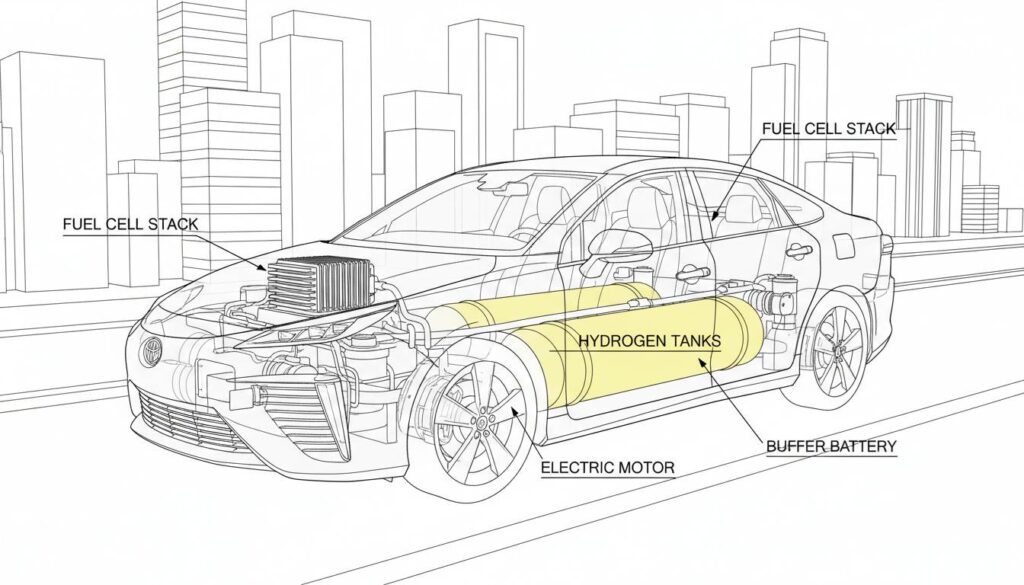
Technical Figure: A modern Toyota Mirai driving on a clean city street. The car is partially transparent (ghost view) to show the yellow hydrogen tanks underneath the floor and the fuel cell stack under the hood.
Hydrogen Buses
Today, fuel cells are very popular in big vehicles like city buses.
- Buses drive all day.
- They return to the same garage at night to refuel.
- They have plenty of roof space for hydrogen tanks.
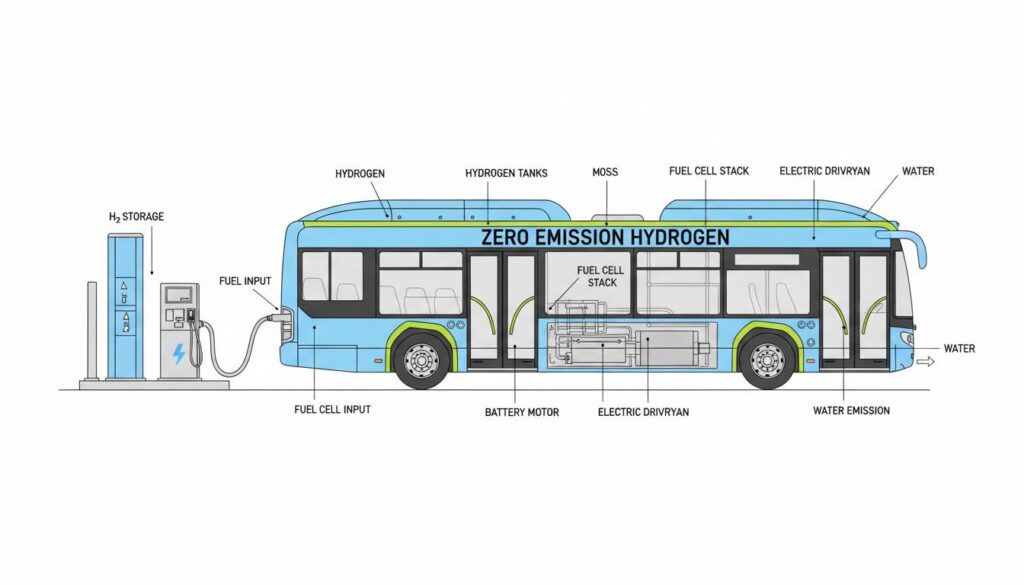
Technical Figure: A modern city bus painted blue and green. The text “Zero Emission Hydrogen” is on the side. The bus is at a refueling station with a hose connected to the side.
How a Modern Fuel Cell Works (The Sandwich)
To understand why these cars are special, we look at the “stack.” A fuel cell stack is like a loaf of sliced bread. It has many layers.
The PEM Sandwich
Imagine a sandwich:
- Bread (Anode): Hydrogen gas hits this side. The bread breaks the hydrogen apart.
- Cheese (Electrolyte): This is a special plastic sheet. It only lets protons pass through. It blocks electrons.
- Bread (Cathode): Oxygen hits this side.
The Electron Detour
The electrons want to get to the other side to meet the oxygen. But the “Cheese” won’t let them through. They are forced to travel through a wire that goes around the sandwich.
That moving flow of electrons in the wire is electricity. It powers the car’s electric motor.
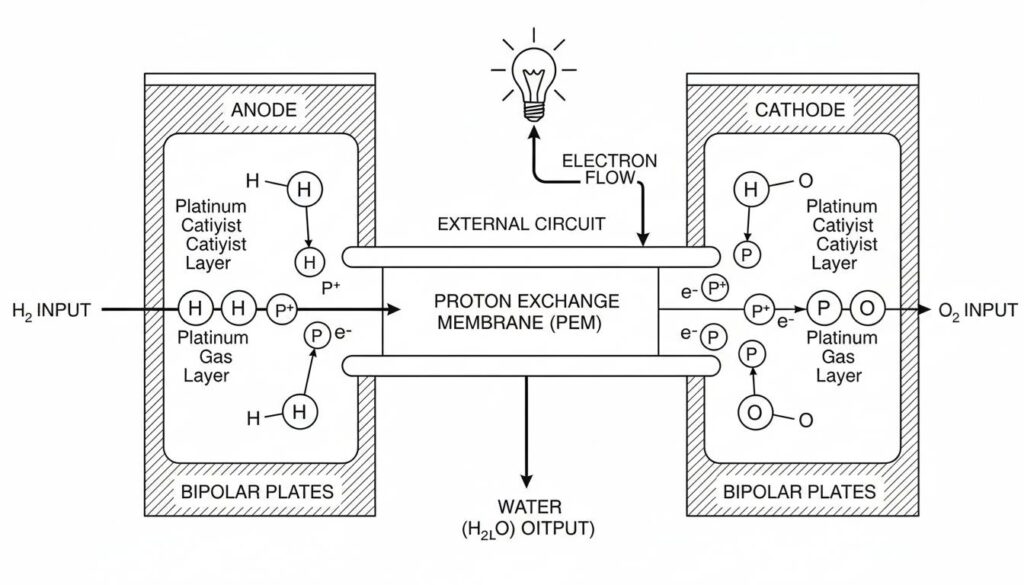
Technical Figure: A close-up diagram of a Proton Exchange Membrane (PEM) fuel cell. It shows hydrogen atoms splitting into protons and electrons. The protons go through the center membrane. The electrons travel up through a wire, lighting a lightbulb, and then come back down to the other side to form water.
If the “Cheese” (Electrolyte) broke and let the electrons go straight through the middle, would the car move? Why or why not?
