
What is an Alkaline Fuel Cell?
Think of a battery. You use it, it dies, and you throw it away or recharge it. Now, imagine a battery that never dies as long as you keep feeding it fuel. That is a Fuel Cell.
An Alkaline Fuel Cell (AFC) is one of the oldest and simplest types of fuel cells. It takes chemical energy (from hydrogen) and turns it directly into electrical energy. It does not burn anything. There is no fire. There is no smoke.
The Sandwich Analogy
To understand an AFC, picture a sandwich.
- The Top Bread (Anode): This is the negative side. We feed Hydrogen gas here.
- The Bottom Bread (Cathode): This is the positive side. We feed Oxygen (or air) here.
- The Filling (Electrolyte): This is the liquid in the middle. In an AFC, this liquid is Potassium Hydroxide. This is an alkaline liquid, which gives the cell its name.
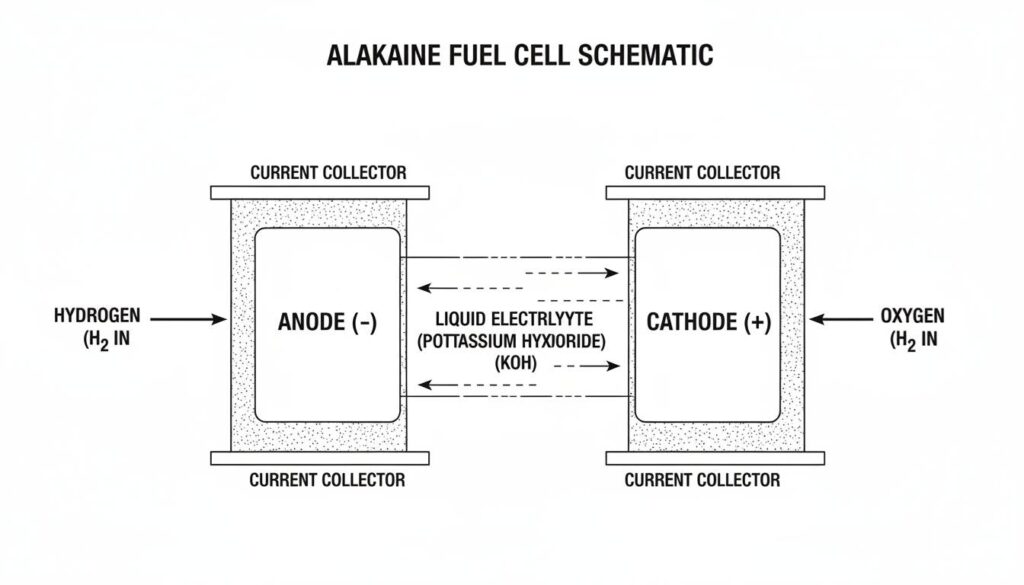
Technical Figure: A simple 2D cross-section diagram of an Alkaline Fuel Cell. It looks like a sandwich. The left side is labeled ‘Anode (-)’, the right side is labeled ‘Cathode (+)’, and the center is labeled ‘Liquid Electrolyte (Potassium Hydroxide)’. Arrows show Hydrogen entering the left and Oxygen entering the right.
If we removed the “filling” (the electrolyte) and let the two sides touch, what do you think would happen to the electricity? Would it still flow through the wire?
How It Works: The Electron Detour
Electricity is just moving electrons. To get power, we need to force electrons to move through a wire. Here is the step-by-step process inside the cell.
Step 1: The Break Up (At the Anode)
Hydrogen gas (H2) enters the Anode. Inside the cell, the Hydrogen meets ions from the liquid filling. The Hydrogen wants to react, but to do so, it must split up. It separates into electrons and water.
Step 2: The Roadblock
The electrons want to get to the other side (the Cathode). But they have a problem. They cannot swim through the liquid electrolyte. The liquid acts like a wall to electrons.
Step 3: The Detour (Creating Electricity)
Since the electrons cannot go through the middle, they have to find another way. We give them a path: a wire.
The electrons travel through the wire from the Anode to the Cathode. When they move through this wire, they power your lightbulb, your motor, or your phone.
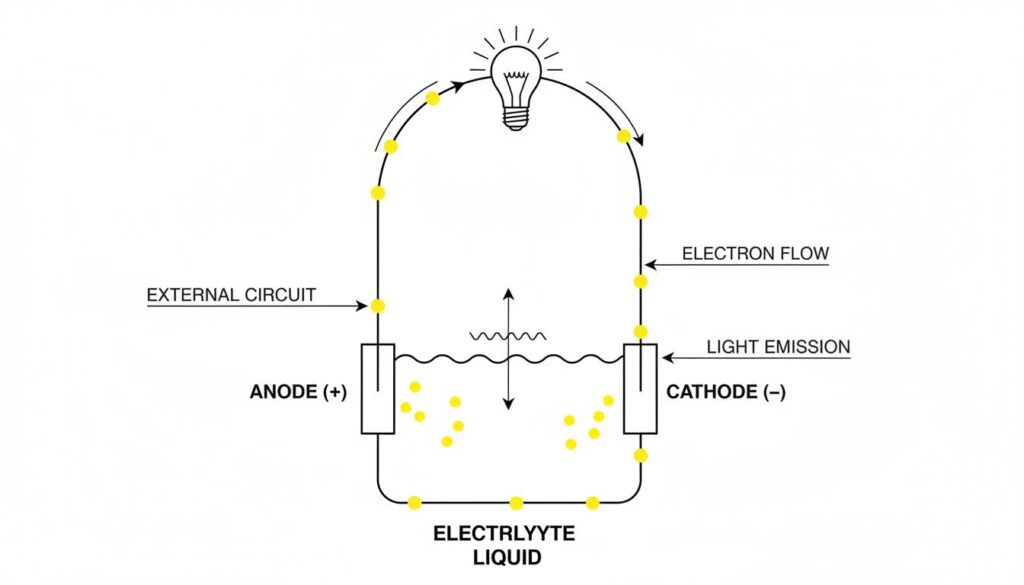
Technical Figure: A diagram showing the flow of electrons. Bright yellow dots (electrons) are blocked by the center liquid. They travel up and over through an external wire, lighting up a lightbulb, before landing on the other side.
Step 4: The Reunion (At the Cathode)
The electrons arrive at the Cathode. Here, they meet Oxygen gas and water. They all combine to form new ions (OH-). These ions can swim through the liquid back to the Anode to keep the cycle going.
The Only Waste Product
When you burn gasoline in a car, you get smoke and bad gases. When an Alkaline Fuel Cell works, the only thing that comes out of the pipe is pure water and some heat.

Technical Figure: A visual comparison. On the left, a car exhaust pipe coughing out black smoke. On the right, a fuel cell exhaust pipe dripping clean blue water droplets into a glass.
Since the only waste product is water, how could this be useful for astronauts on a long space journey?
The Chemistry Made Simple
We don’t need complex math here. We just need to look at the ingredients.
The Input
- Fuel: Hydrogen (H2)
- Oxidizer: Oxygen (O2)
The Output
- Electricity: Power for machines.
- By-product: Water (H2O).
- Heat: The cell gets warm.
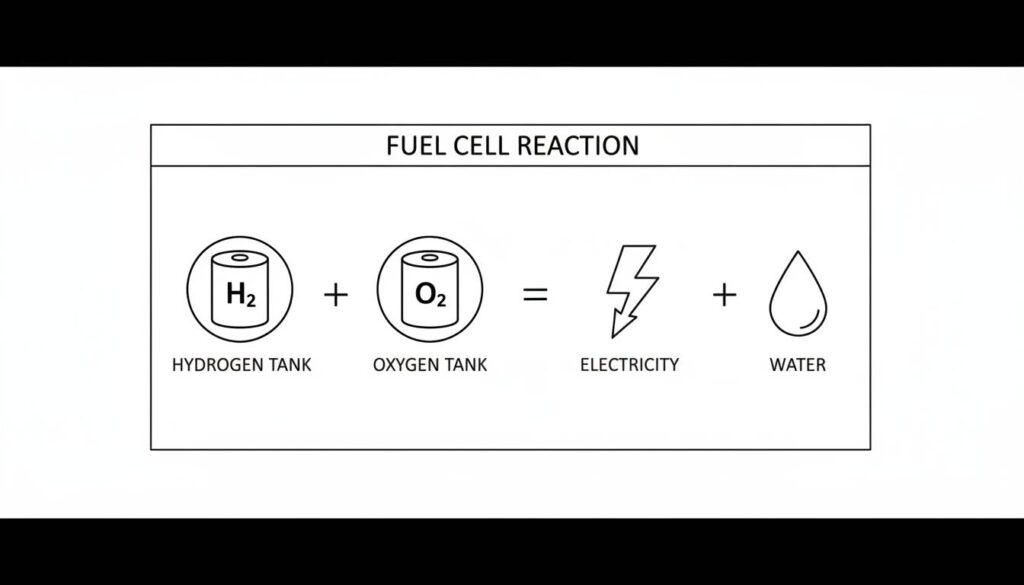
Technical Figure: An infographic showing an equation using icons. Icon of Hydrogen Tank + Icon of Oxygen Tank = Icon of Lightning Bolt (Electricity) + Icon of Water Drop.
Why Use Alkaline Fuel Cells?
The NASA Connection
AFCs are famous because NASA used them. In the Apollo missions (the ones that went to the Moon), they used Alkaline Fuel Cells.
Why? Because they are very efficient. Also, the astronauts could drink the water that the fuel cell produced. It solved two problems at once: making power and making drinking water.

Technical Figure: An illustration of the Apollo spacecraft in space. A cutaway view shows the fuel cell tanks onboard, with a tube leading to a water dispenser for an astronaut.
The “Poison” Problem
There is one big weakness with AFCs. They are very sensitive to Carbon Dioxide (Co2).
CO2 is in the air all around us. If CO2 gets into the liquid filling (Potassium Hydroxide), it turns the liquid into a solid crust (Carbonate). This clogs the cell. It stops working.
Because of this, AFCs usually need pure oxygen tanks. They cannot just breathe normal air unless we clean the air first.
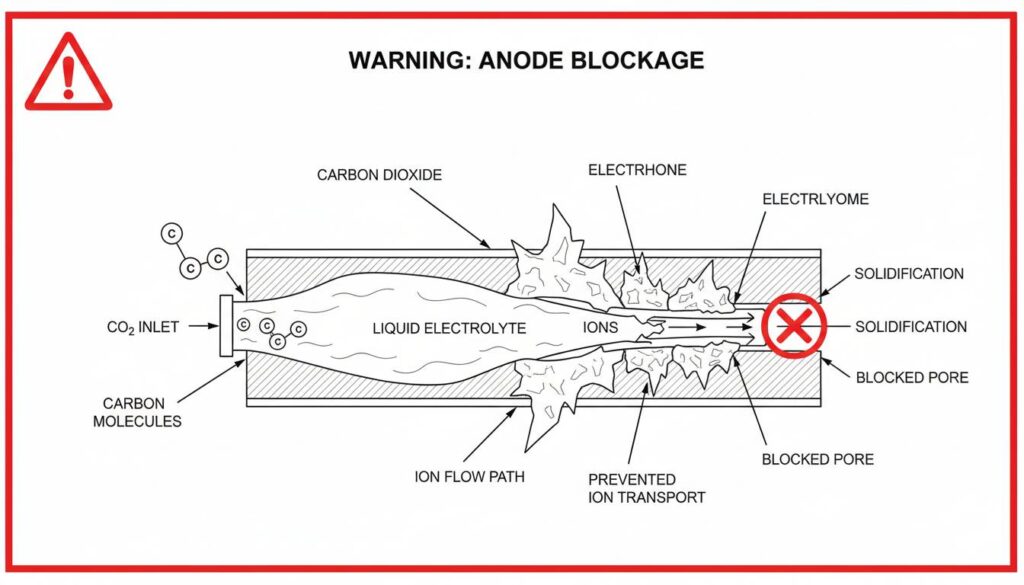
Technical Figure: A “Warning” style diagram. It shows a CO2 molecule attacking the liquid electrolyte, turning it into white solid rocks, blocking the flow of ions.
If AFCs require pure oxygen tanks instead of just using outside air, does that make them heavier or lighter to carry around? How does that affect using them in a normal car?
Summary of Key Features
Efficiency
AFCs are some of the most efficient fuel cells. They turn a lot of the chemical energy directly into power. They perform very well (up to 60% efficiency).
Cost
The materials inside are relatively cheap compared to other fuel cells. We can use silver or nickel instead of expensive platinum for the electrodes.
Temperature
They operate at low temperatures (about 60°C to 90°C). This is roughly the temperature of a hot cup of coffee. They start up quickly because they don’t need to get super hot first.
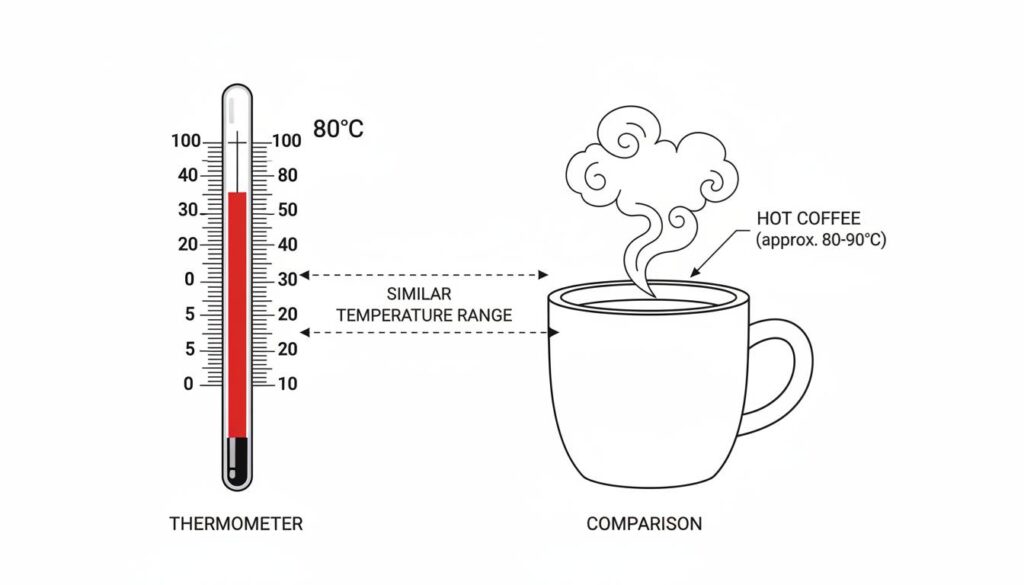
Technical Figure: A thermometer showing the temperature range. The red bar is at 80°C. Next to it is a steaming cup of coffee to show the comparison.
