
What is a Power System?
A power system is a group of parts working together. Its job is to take energy from one place and move it to another place to do work. Think of it like a delivery service. The “package” is energy. The “truck” is the system. The “destination” is the machine that needs to move.
Focus Keyword: Classification of Power Systems, Renewable vs Non-Renewable Energy, Mechanical and Hydraulic Systems
Every power system has three main steps:
- Generation: Making or collecting the power.
- Transmission: Moving the power.
- Consumption: Using the power.
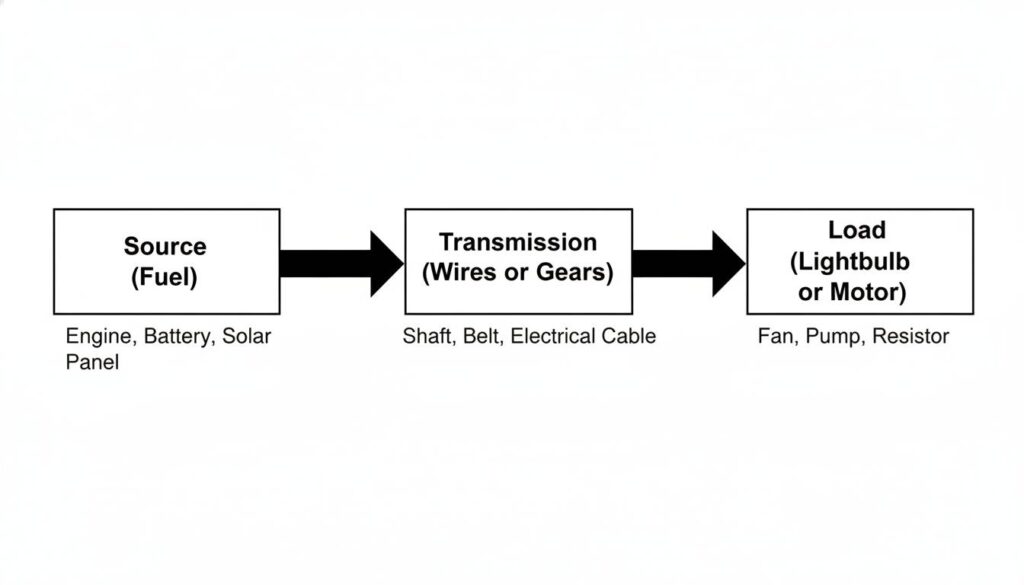
Technical Figure: A simple block diagram with three boxes connected by arrows. Box 1 says ‘Source (Fuel)’, Box 2 says ‘Transmission (Wires or Gears)’, Box 3 says ‘Load (Lightbulb or Motor)’. The background is white and clean.
Why Do We Need Them?
Without power systems, energy stays stuck in one place. Coal sitting in the ground does nothing. But if we burn the coal, turn it into electricity, and send it through wires, we can light up a house.
Think about your bicycle. Your legs provide the energy. What part of the bike acts as the “transmission” to move that energy to the back wheel?
Classification by Energy Source
The first way we group power systems is by where the energy comes from. We ask: “Will this fuel run out?”
Non-Renewable Power Systems
These systems use fuel that we dig out of the ground. Once we use it, it is gone forever. It is like a juice box. Once you drink the juice, the box is empty. You cannot refill it.
- Fossil Fuels: Coal, oil, and natural gas.
- Nuclear: Uranium.
These are usually very strong and reliable, but they create pollution.
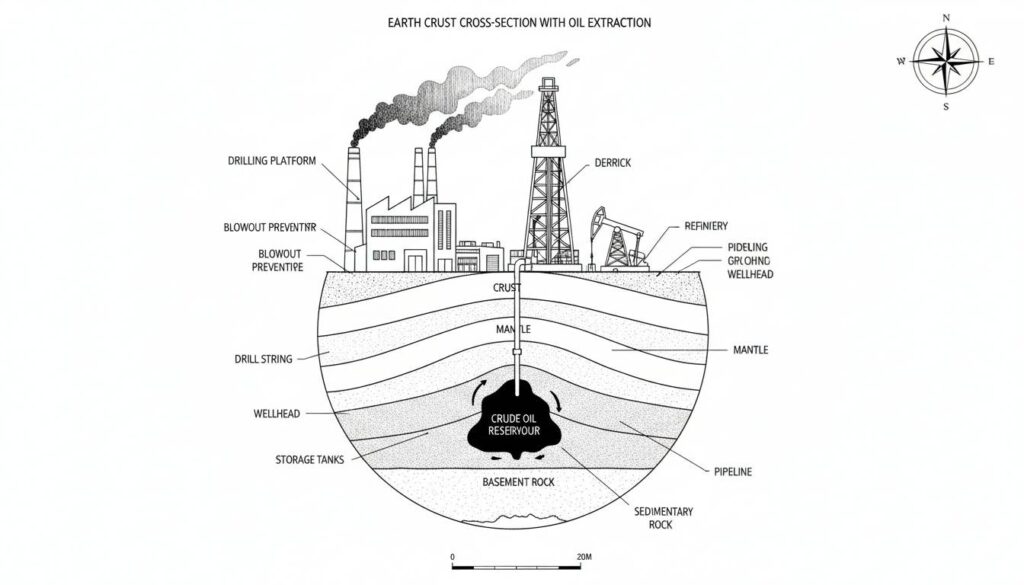
Technical Figure: A cross-section illustration of the earth showing an oil rig drilling down into a black pocket of oil. Above ground, there is a factory with smoke coming out.
Renewable Power Systems
These systems use energy that nature refills automatically. It is like a bucket sitting in the rain. Even if you take water out, the rain fills it back up.
- Solar: Energy from the sun.
- Wind: Energy from moving air.
- Hydro: Energy from moving water.
These are clean, but they depend on the weather.
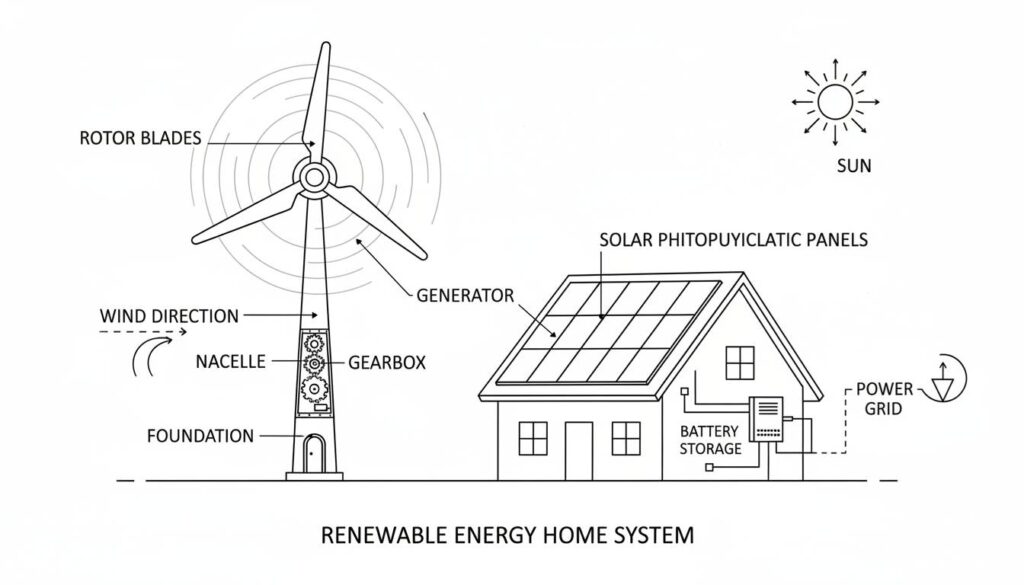
Technical Figure: A bright landscape showing a wind turbine spinning next to a house with solar panels on the roof. The sun is shining brightly in the corner.
If the wind stops blowing, a wind turbine stops making power. How do you think engineers solve this problem so people still have lights at night?
Classification by Transmission (How Power Moves)
This is very important for mechanical engineers. Once we have energy, how do we push it around? We classify systems by what “stuff” carries the push.
Mechanical Power Systems
These systems use solid parts to move energy. They use gears, belts, chains, and shafts.
- Example: A car engine spinning a driveshaft to turn the wheels.
- Pros: Very direct and strong.
- Cons: Parts rub together (friction) and wear out.
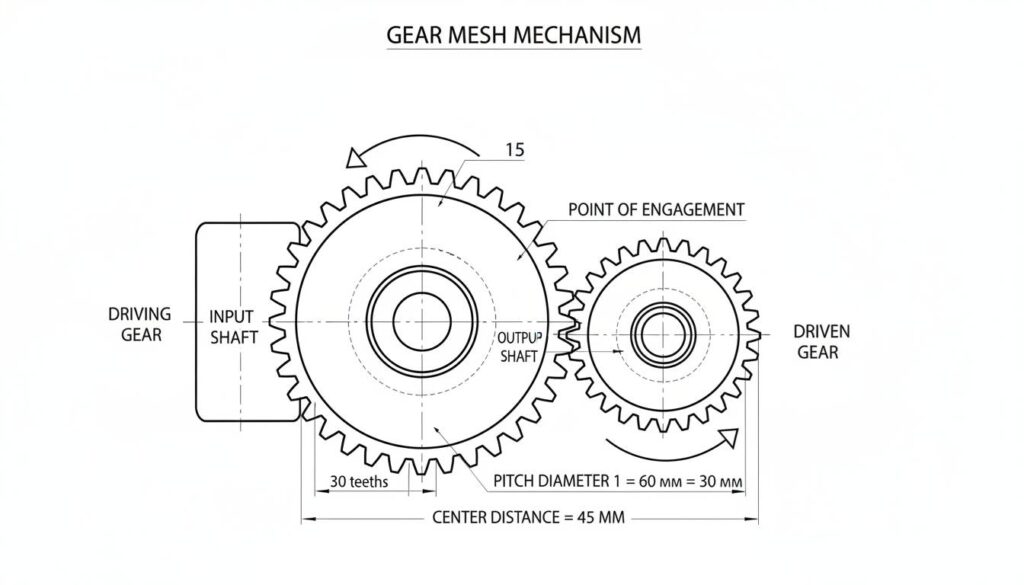
Technical Figure: A close-up technical drawing of two metal gears meshing together. One gear is turning the other. Arrows indicate the direction of rotation.
Electrical Power Systems
These systems use wires to move electrons. This is electricity.
- Example: Power lines running from a dam to your house.
- Pros: Can travel very long distances instantly.
- Cons: Can be dangerous (shock hazard) and hard to store.
Fluid Power Systems
These systems use a liquid or a gas to push things. We split this into two smaller groups.
Hydraulic Systems (Liquids)
Hydraulics use liquid, usually oil. You cannot squish a liquid. If you push oil in one end of a pipe, it pushes out the other end immediately with great force.
- Analogy: Think of a water gun. When you push the trigger, the water shoots out.
- Use: Heavy construction machines like excavators and bulldozers.
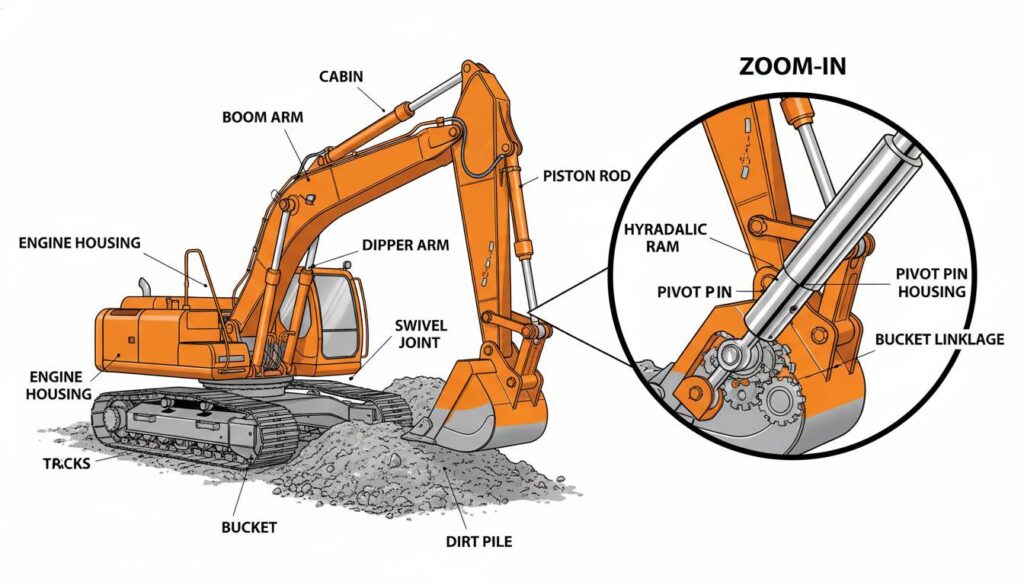
Technical Figure: An orange excavator digging dirt. A zoom-in bubble shows the shiny metal cylinder (hydraulic ram) on the arm extending to push the bucket.
Pneumatic Systems (Gas)
Pneumatics use gas, usually air. You can squish air. It acts like a spring.
- Analogy: Think of a bicycle pump. When you push down, the air squishes a bit before it goes into the tire.
- Use: Drills at the dentist or air brakes on a bus.
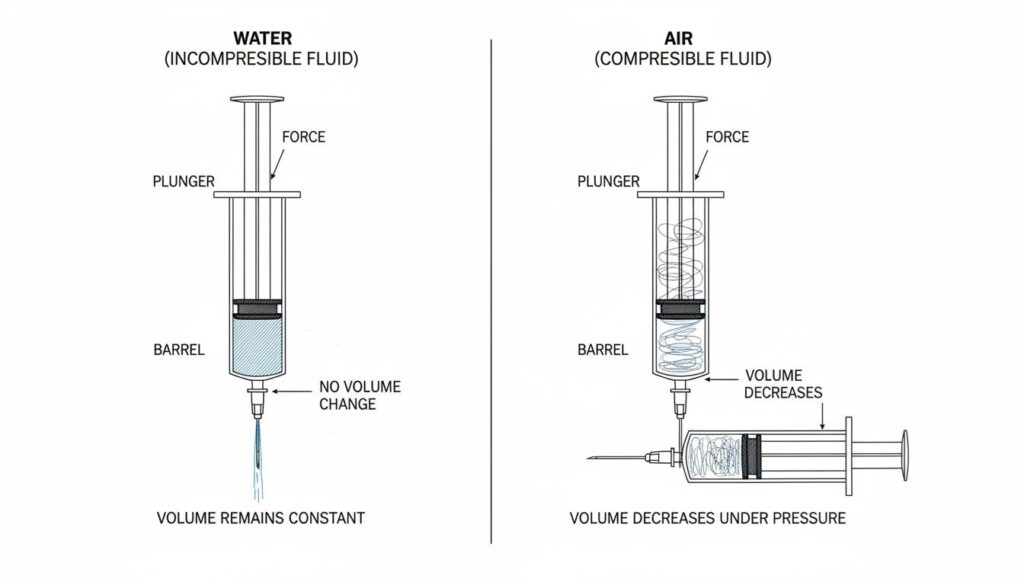
Technical Figure: A diagram comparing a syringe filled with water vs a syringe filled with air. The water syringe shows no compression. The air syringe shows the air being squeezed into a smaller space.
If you needed to lift a heavy car, would you use air (Pneumatics) or oil (Hydraulics)? Remember, air is “bouncy” and oil is solid.
Classification by Connection
Finally, we look at how the system connects to the world.
Grid-Connected Systems
This is the “Big Web.” Power plants all over the country connect to huge wires. Your house plugs into this web. If one power plant breaks, another one takes over.
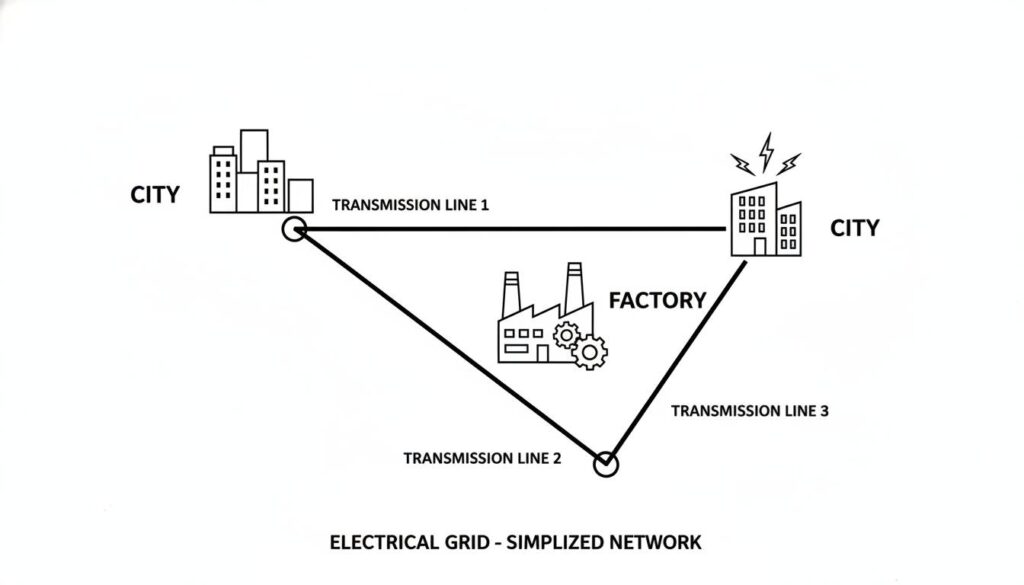
Technical Figure: A simplified map view showing lines connecting a city, a factory, and a power plant. This represents the electrical grid.
Standalone (Off-Grid) Systems
These are lonely systems. They are not connected to the big web. They make their own power and use it right there.
- Example: A calculator with a solar chip.
- Example: A generator on a camping trip.
Why might a hospital have a “Standalone” generator in the basement, even if they are already connected to the “Grid”?
