What is Unconventional Machining?
Before we look at the “needs,” we must understand the difference between the old way and the new way.
Conventional Machining is like whittling wood with a knife. You use a sharp tool that is harder than the material you are cutting. You use physical force to peel away chips of material. Examples are drilling, turning (on a lathe), and milling.
Unconventional Machining is different. It does not use a sharp knife. It uses energy. This energy can be:
- Thermal: Heat (Lasers).
- Chemical: Dissolving the metal (Acids).
- Electrical: Sparks (EDM).
- Mechanical: High-speed water (Waterjets).
Think of it like cutting a piece of paper.
- Conventional: Using scissors.
- Unconventional: Using a magnifying glass and the sun to burn a line.
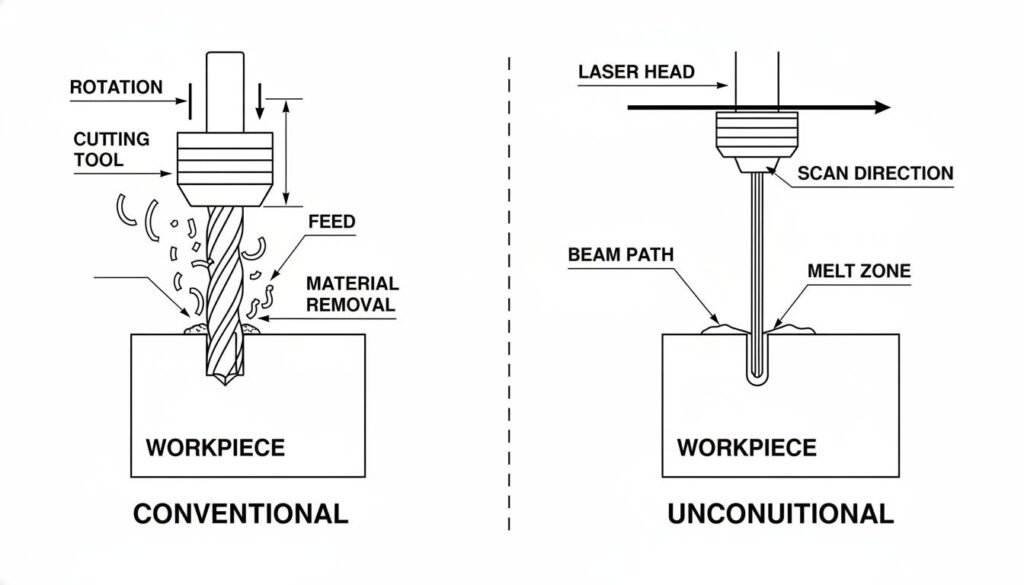
Technical Figure: A split comparison illustration. Left side: A metal drill bit cutting into a block with chips flying off (labeled ‘Conventional’). Right side: A laser beam melting a precise line into a block with no physical contact (labeled ‘Unconventional’).
The Problem with Traditional Tools
Traditional tools (drills, saws, lathes) have limits. As technology advances, we are building things like spaceships, jet engines, and microchips. Old tools simply cannot handle these new jobs.
Here are the specific reasons (needs) why we use Unconventional Machining Processes.
1. Cutting Super Hard Materials
In the past, we mostly used mild steel. It is easy to cut. Today, engineers use “Superalloys” and Titanium. These metals are used in jet engines because they don’t melt easily.
However, they are very hard.
- The Rule: To cut something, your tool must be harder than the material.
- The Problem: If the material is as hard as the tool, the tool breaks.
Unconventional machining does not care how hard the metal is. A laser beam or an electric spark can cut through the hardest diamond or titanium just as easily as it cuts through butter.
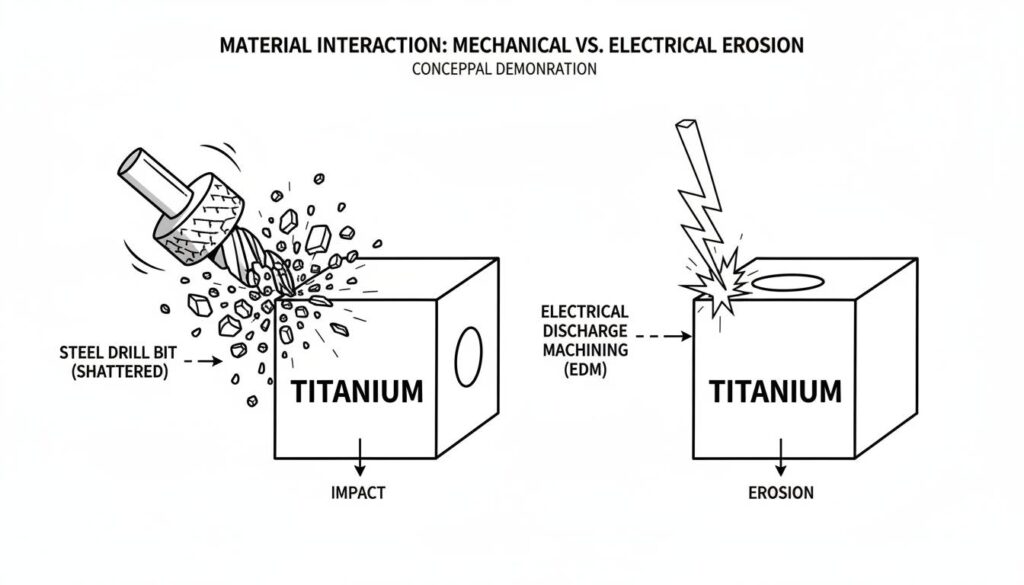
Technical Figure: A cartoon-style illustration showing a steel drill bit shattering against a block labeled ‘Titanium’, while next to it, a glowing electrical spark easily eats a hole into the same block.
Imagine you are trying to scratch a glass window. Can you do it with a plastic spoon? No. You need a diamond cutter. But what if you used a super-hot flame instead? Would the hardness of the glass stop the flame from melting it?
2. Making Complex Shapes
Traditional tools move in straight lines or circles. A drill makes a round hole. A saw makes a straight cut.
But what if you need a square hole? Or a hole shaped like a star? Or a curved tunnel inside a block of metal?
A spinning round drill cannot make a square corner. It always leaves a rounded edge. Unconventional machining, like Electrical Discharge Machining (EDM), uses a shaped electrode. If the electrode is square, it sinks into the metal and creates a perfect square hole.
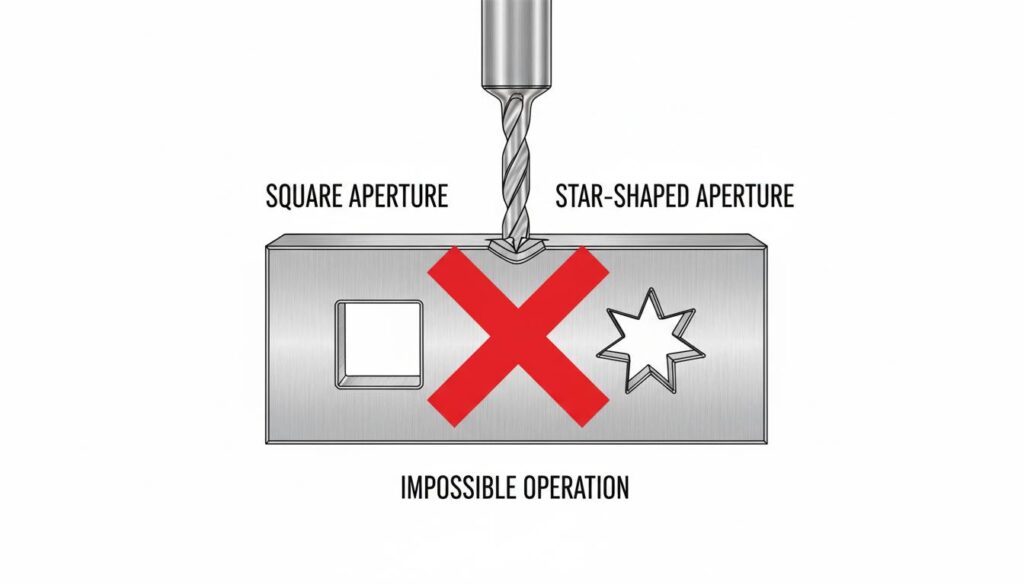
Technical Figure: A close-up technical diagram of a metal block with a perfect square hole and a star-shaped hole. Next to it, a standard drill bit hovering over the holes with a red ‘X’ indicating it cannot do this.
3. Machining Delicate Parts
Imagine you need to cut a pattern into a very thin sheet of metal, like the foil used in electronics.
If you use a saw or a drill, you have to push against the metal. This pressure is called cutting force.
- If you push on a thin sheet, it bends or crinkles.
- It is like trying to write on a soap bubble with a sharp pencil.
Unconventional machining is often non-contact. A laser or an electron beam touches the metal only with light or energy. There is no heavy tool pushing down. This allows us to machine very thin, fragile parts without damaging them.
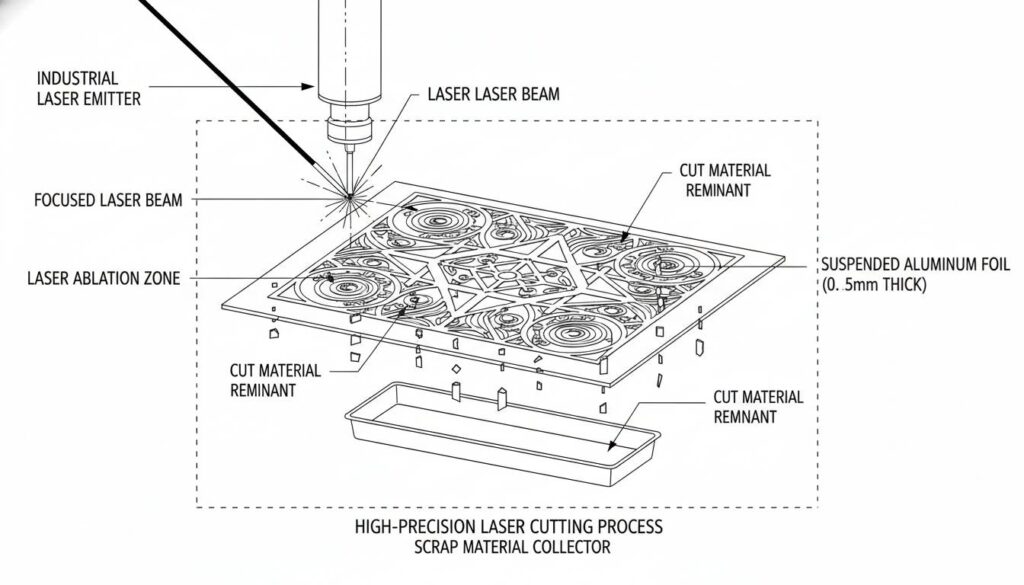
Technical Figure: Illustration of a laser beam cutting a complex pattern into a piece of aluminum foil that is suspended in the air. The foil remains perfectly flat and unbent.
If you wanted to cut a shape out of a piece of Jell-O without squishing it, would you use a knife or a stream of hot water? Why?
4. High Precision and Tiny Sizes
We are making things smaller every day. Medical devices (like stents for hearts) and computer chips have features that are microscopic.
- A standard drill bit is huge compared to a microchip.
- Traditional tools vibrate. This vibration ruins tiny details.
Unconventional processes can be focused to a tiny point. An electron beam can draw lines that are thinner than a human hair. This is essential for nanotechnology.
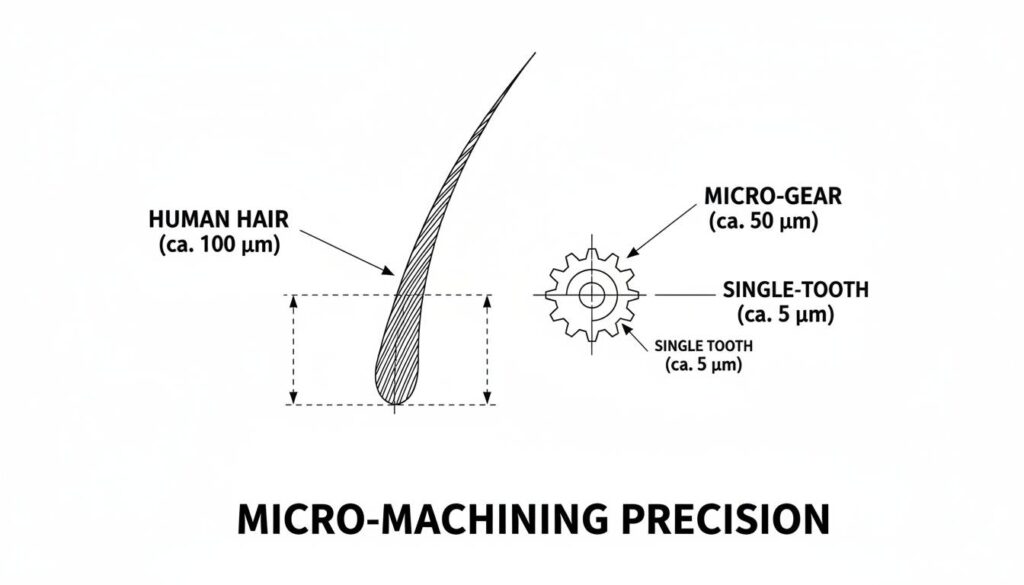
Technical Figure: A magnified view of a human hair next to a micro-machined gear. The gear is smaller than the width of the hair. Label the image ‘Micro-machining Precision’.
5. Better Surface Finish
When a saw cuts metal, it leaves rough marks. These are called “burrs” or scratches. If you are building a high-speed engine, these scratches cause friction and heat.
Usually, after sawing, you have to spend extra time sanding and polishing the part.
Unconventional machining, like Electrochemical Machining (ECM), dissolves the metal atom by atom. It leaves a surface that is smooth like a mirror. No extra polishing is needed.
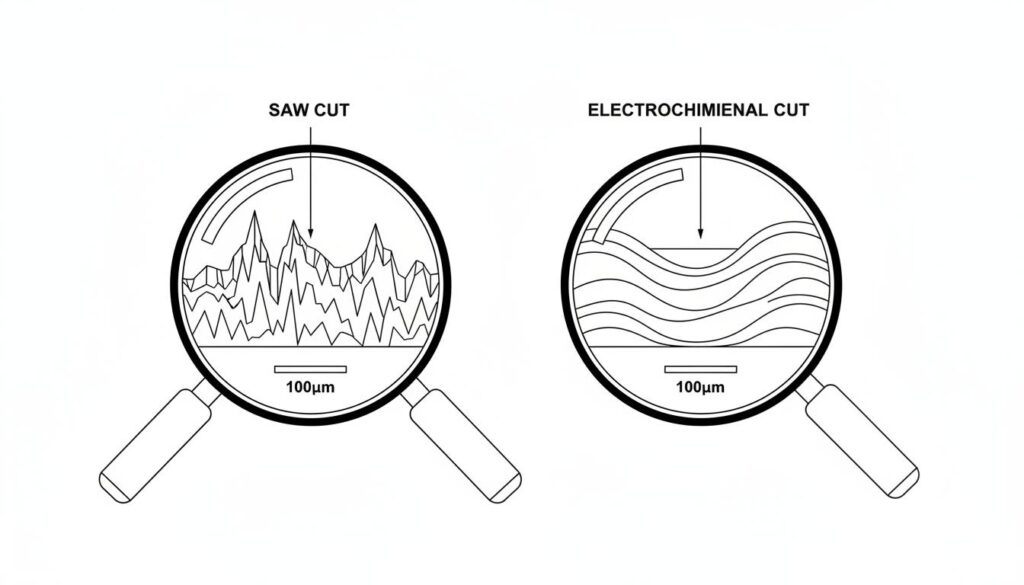
Technical Figure: A side-by-side comparison of two metal surfaces under a magnifying glass. Left: Rough, jagged surface labeled ‘Saw Cut’. Right: Smooth, wavy surface labeled ‘Electrochemical Cut’.
Why do you think a mirror-smooth surface is important for parts inside a race car engine? Think about what happens when two rough surfaces rub together very fast.
Summary of Needs
To wrap up, we need Unconventional Machining when:
- The material is too hard for saws.
- The shape is too complex for drills.
- The part is too thin and bends easily.
- The details are too small (microscopic).
- We need a perfectly smooth finish immediately.
