Introduction: Cutting with Lightning
Imagine you have a piece of metal that is so hard, a normal drill or saw would break if you tried to cut it. How do you shape it?
You use lightning.
Electrical Discharge Machining (EDM) is a way to cut metal using tiny, controlled electric sparks. It is like using a million tiny lightning bolts to chip away at a piece of metal until it is the perfect shape.
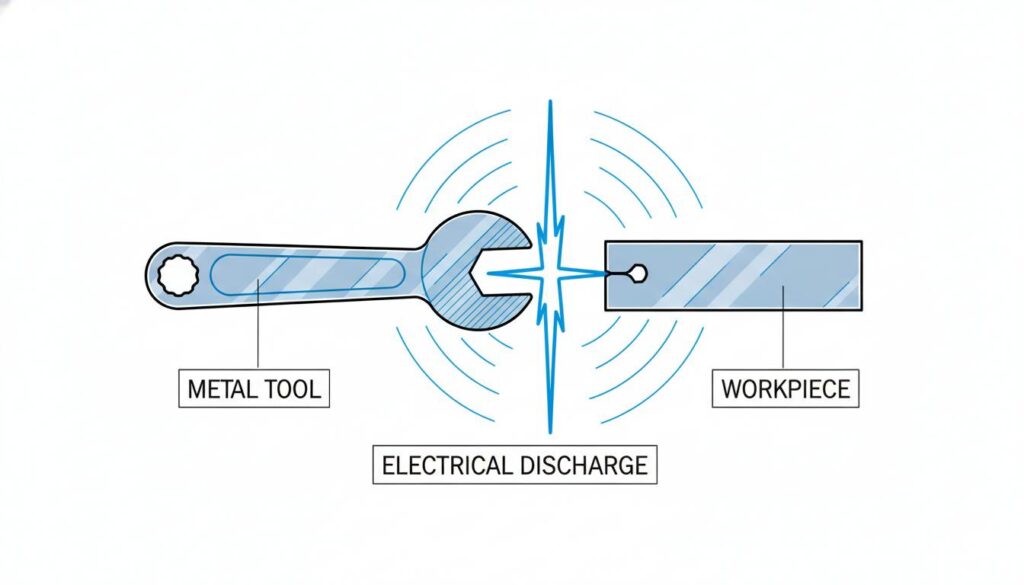
Technical Diagram: A simple, colorful illustration showing a glowing blue electric spark jumping between a metal tool and a metal block. The background should be dark to highlight the spark.
The Basic Idea
In normal machining (like drilling), the tool touches the metal and scrapes it away. In EDM, the tool never touches the metal.
Instead, we leave a tiny gap. We shoot electricity across that gap. The electricity is so hot that it melts and vaporizes the metal instantly.
The “Spark Erosion” Concept
Think of a jackhammer breaking concrete. Now, imagine a “jackhammer” made of pure heat and electricity. Each spark takes a tiny bite out of the metal. If you do this thousands of times per second, you can cut through almost anything.
Think About It:
If the tool never touches the workpiece, do you think the metal needs to be soft or hard? Does hardness matter if we are melting it with heat?
The Main Parts of an EDM Machine
To make these sparks work for us, we need four main parts.
1. The Electrode (The Tool)
This is our “cutter.” It is usually made of copper or graphite. We shape this tool into the shape we want to make in the metal. It is connected to the negative (-) side of the power supply.
2. The Workpiece (The Target)
This is the metal we want to cut. It must be able to conduct electricity (like steel or titanium). It is connected to the positive (+) side.
3. The Dielectric Fluid (The Bath)
The tool and the workpiece are submerged in a tank of special liquid (usually oil or deionized water). This liquid does two jobs:
- It acts as an insulator (stops electricity from jumping too early).
- It flushes away the burnt metal dust.
4. The Power Supply (The Battery)
This unit controls how much electricity goes into the spark and how fast the sparks happen.
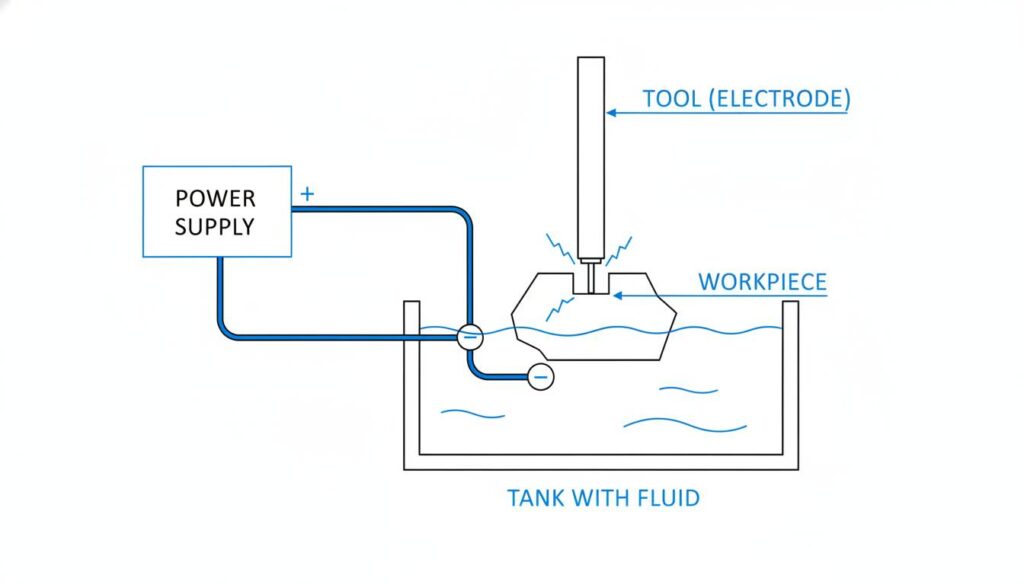
Technical Diagram: A schematic diagram of an EDM setup. Label four parts clearly: 1. Tool (Electrode), 2. Workpiece, 3. Tank with Fluid, 4. Power Supply box. Show wires connecting the power supply to the tool and workpiece.
Step-by-Step: How the Process Works
Step 1: The Standoff
The machine lowers the tool towards the workpiece. It gets very close, about the thickness of a human hair. But remember, it does not touch.
Step 2: The Buildup
The power supply turns on. Electricity wants to jump across the gap, but the dielectric fluid stops it. The voltage (pressure) builds up.
Step 3: The Spark (Discharge)
Suddenly, the voltage gets strong enough to punch through the fluid. ZAP! A spark jumps from the tool to the workpiece.
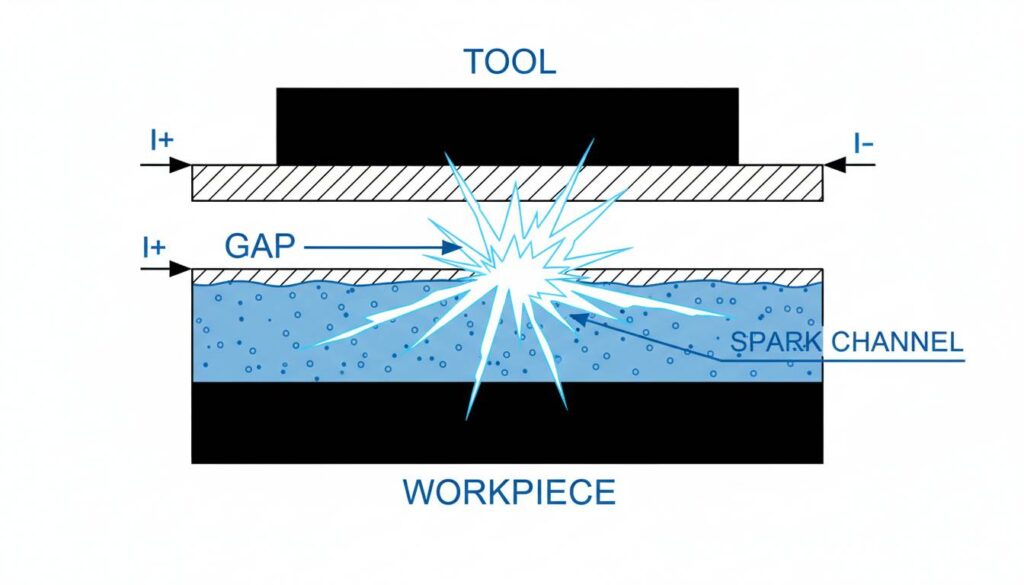
Technical Diagram: A close-up cross-section diagram showing the ‘Gap’. Show the Tool on top, Workpiece on bottom. In the middle, draw a bright, jagged spark channel breaking through the liquid.
Step 4: The Heat
This spark is incredibly hot. It can reach temperatures of 8,000°C to 12,000°C. This is hotter than the surface of the sun!
- A tiny spot on the workpiece melts instantly.
- Some of it turns into gas (vaporizes).
Step 5: The Collapse and Flush
The power supply turns off the electricity for a split second. The spark disappears. The sudden cooling causes the melted metal to explode off the surface. The flowing liquid washes this debris away.
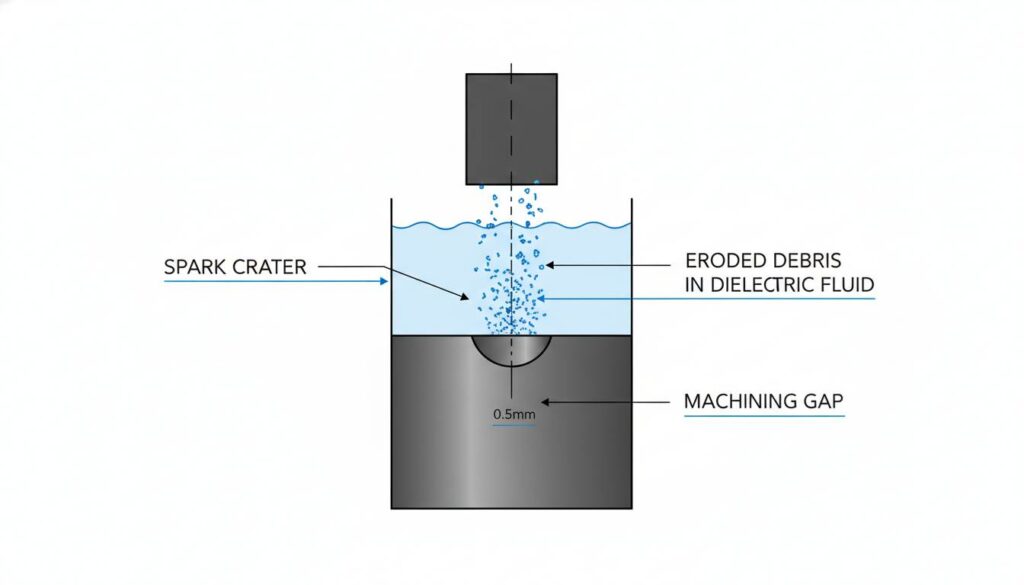
Technical Diagram: A technical illustration showing the aftermath of the spark. Show a tiny crater left on the workpiece surface. Show small particles (debris) floating away in the fluid.
Check Your Understanding:
Why do we need to turn the electricity OFF between sparks? What would happen if the spark just stayed on continuously like a welding torch? (Hint: We want a clean shape, not a melted blob!)
The Role of the Dielectric Fluid
The fluid is the unsung hero of EDM. Without it, the process fails.
Why is it an Insulator?
Imagine a dam holding back water. The fluid acts like a dam. It holds back the electricity until the pressure is high enough. When the “dam breaks” (the spark happens), it releases a lot of energy at once. This makes the cut powerful.
The Cleaning Crew
Every spark creates a tiny piece of dust (debris). If this dust stays in the gap, it will cause a short circuit. The fluid flows through the gap to wash the dust away so the next spark has a clean path.
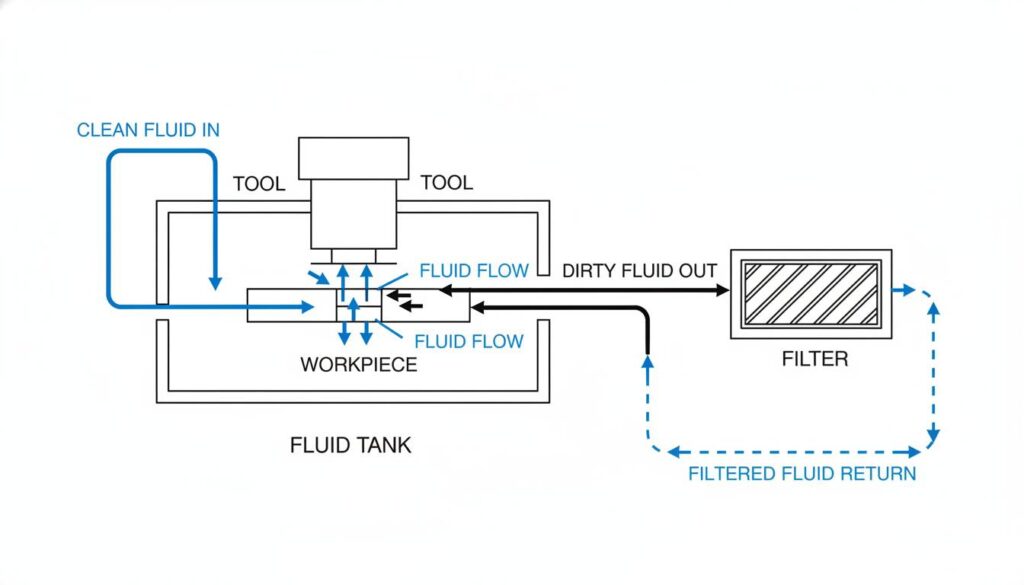
Technical Diagram: A diagram showing fluid circulation. Arrows show clean fluid entering the tank, flowing through the gap between tool and workpiece, and dirty fluid carrying particles leaving the tank to a filter.
Types of EDM
There are two main ways we use this technology.
1. Die Sinker EDM (Ram EDM)
- The Tool: A 3D shape (like a mold for a toy car).
- The Action: The tool sinks into the metal, leaving a negative impression of its shape.
- Use: Making molds for plastic parts.
2. Wire EDM
- The Tool: A thin wire (like a cheese cutter).
- The Action: The wire moves through the metal to cut complex outlines.
- Use: Cutting thick steel plates with extreme precision.
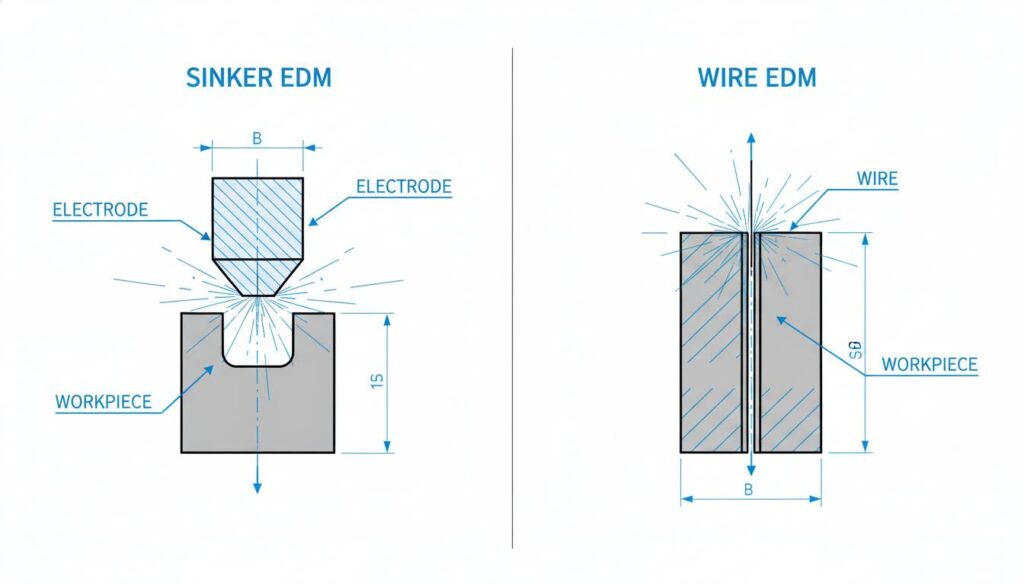
Technical Diagram: Split image. Left side: ‘Sinker EDM’ showing a shaped block sinking into metal. Right side: ‘Wire EDM’ showing a thin wire cutting a vertical slot through a metal plate.
Advantages and Disadvantages
Why use EDM? (Pros)
- Hardness doesn’t matter: It can cut the hardest steel as easily as butter.
- Complex shapes: It can make shapes that drills cannot (like square holes with sharp corners).
- No force: Since the tool doesn’t touch the metal, delicate parts don’t get bent.
Why not use EDM? (Cons)
- It is slow: Removing metal spark-by-spark takes time.
- Electricity cost: It uses a lot of power.
- Conductive materials only: You cannot cut wood, plastic, or glass with EDM. They don’t conduct electricity.
Final Thought:
If you needed to cut a hole in a rubber tire, could you use EDM? Why or why not? Refer back to the “Main Parts” section regarding the workpiece.
