What is Abrasive Jet Machining?
Imagine you have a very dirty driveway. You might use a pressure washer to clean it. The water hits the dirt hard and blasts it away.
Abrasive Jet Machining (AJM) is like a super-powered pressure washer. But instead of water, it uses gas (like air). And instead of just air, it mixes in sharp grains of sand (abrasives).
When this mix hits a material, it doesn’t just clean it—it cuts right through it!
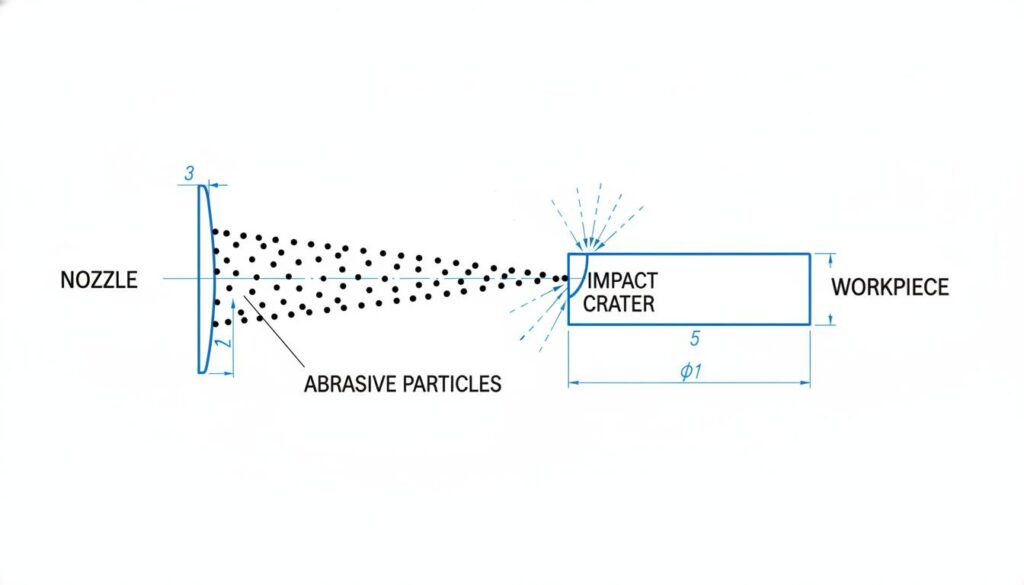
Technical Diagram: A simple 2D cartoon-style diagram showing a nozzle shooting a stream of dots (sand) against a flat block (workpiece), creating a small dent or hole.
The Principle: How It Works
The main scientific principle here is Erosion.
Think about the Grand Canyon. Over millions of years, the river carried sand and rocks that scraped against the ground, carving a deep canyon. AJM does the same thing, but it happens in seconds, not millions of years.
The Physics of the Hit
- High Speed: We speed up gas to about 300 meters per second (that is almost the speed of sound!).
- Kinetic Energy: Because the sand is moving so fast, it has a lot of energy.
- Impact: When the sand hits the workpiece (the thing we are cutting), it acts like a million tiny hammers.
- Chipping: Each grain of sand chips away a microscopic piece of the material.
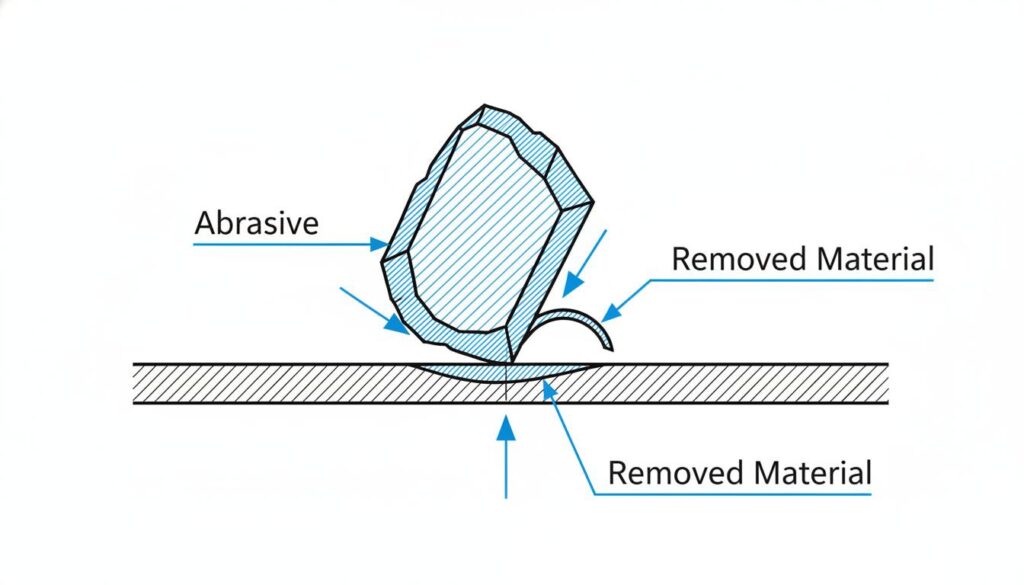
Technical Diagram: A close-up schematic view of a single abrasive particle hitting a surface and chipping off a tiny piece of material. Label the particle ‘Abrasive’ and the chip ‘Removed Material’.
Think About It:
If you throw a handful of sand at a glass window, nothing happens. But if you shoot that same sand out of a cannon, the glass breaks. Why?
Hint: It has to do with how fast the sand is moving (Velocity).
The Equipment: The Parts of the Machine
To make this work, we need specific tools. We cannot just blow into a straw with sand in our mouth! Here are the main parts of an AJM machine.
1. Gas Supply Unit
This is the “muscle” of the machine. We need a gas to carry the sand.
- What we use: Usually Air, Nitrogen, or Carbon Dioxide (CO2).
- The Compressor: This machine squeezes the air to make it high pressure.
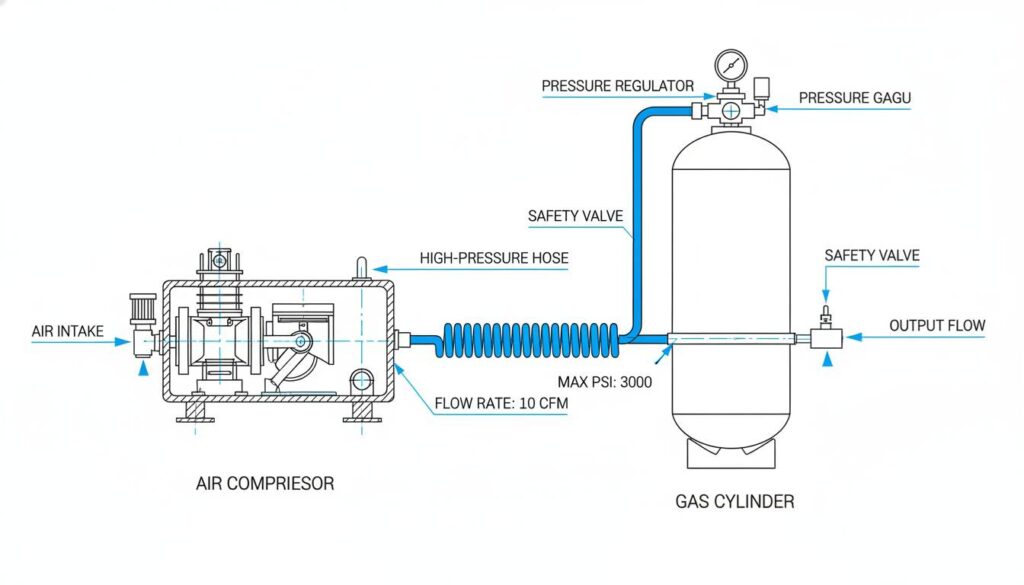
Technical Diagram: A technical diagram of an air compressor connected to a gas cylinder. Simple lines, clear labels.
2. Filter and Regulator
The air coming from the compressor must be clean.
- The Filter: Removes oil and water. This is very important! If the air is wet, the sand will clump together like a wet sandcastle. We need the sand to be dry and loose.
- The Regulator: Controls how much pressure goes into the machine.
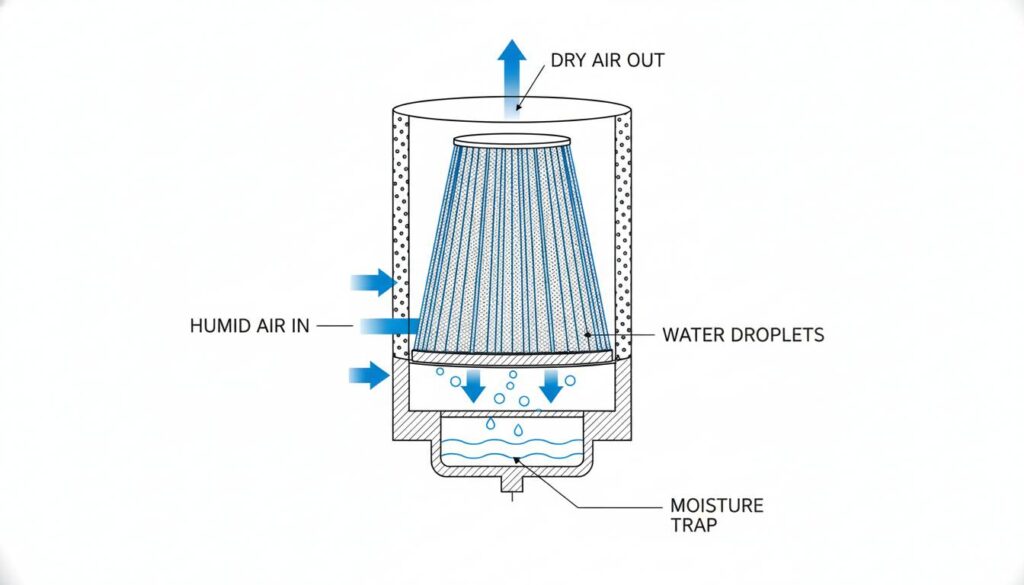
Technical Diagram: A cross-section diagram of an air filter showing moisture being trapped at the bottom and dry air moving out the top.
3. Mixing Chamber (The Hopper)
This is where the magic happens.
- The Hopper: A funnel that holds the abrasive powder (Aluminum Oxide or Silicon Carbide).
- Vibration: The hopper shakes (vibrates). This shaking helps the sand fall smoothly into the air stream without getting stuck.
- The Mix: The high-pressure air picks up the sand particles here.
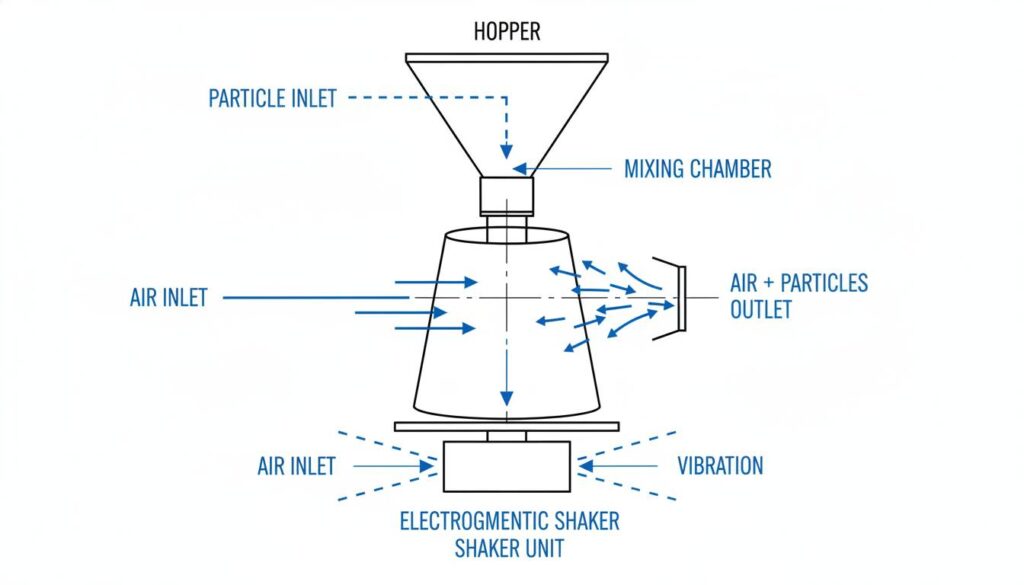
Technical Diagram: A schematic of a mixing chamber. Show a funnel shape (hopper) on top, an electromagnetic shaker at the bottom, and air flowing through to pick up particles.
4. The Nozzle
The nozzle is the “gun barrel.” It aims the sand at the target.
- Shape: It is a narrow tube. As the air goes into this narrow tube, it speeds up massively.
- Material: The nozzle has to be super tough. Since the sand is trying to cut everything, it tries to cut the nozzle too! We make nozzles out of Tungsten Carbide or Sapphire (very hard stones) so they last longer.
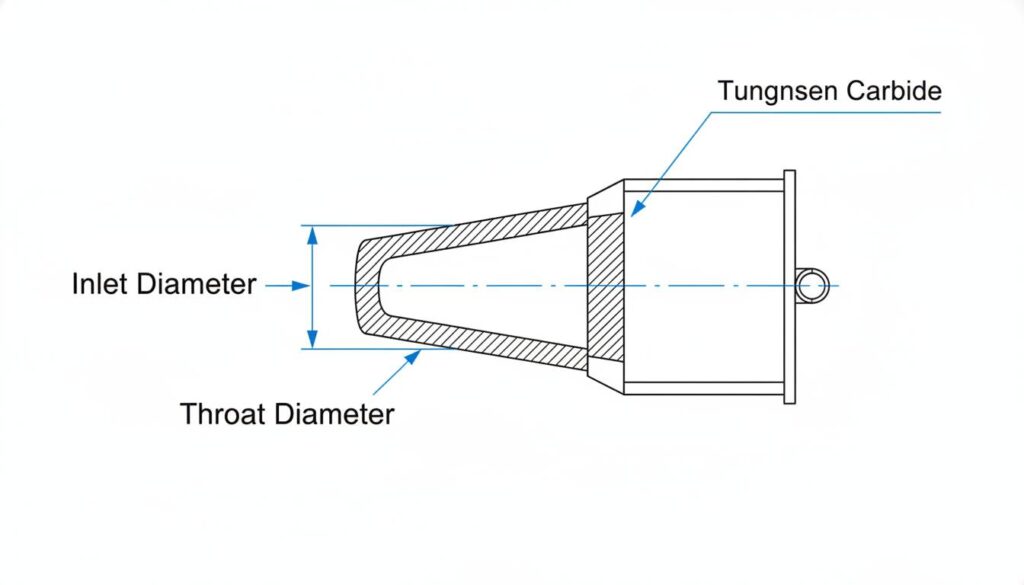
Technical Diagram: A cross-section technical drawing of a nozzle. Show the internal cone shape narrowing down to a small exit hole. Label the material ‘Tungsten Carbide’.
5. The Hood (Machining Chamber)
You cannot do this on your kitchen table. It is messy and dangerous.
- The Box: The cutting happens inside a closed glass or metal box.
- Vacuum: A vacuum cleaner pulls the used sand and dust out of the box so the operator doesn’t breathe it in.
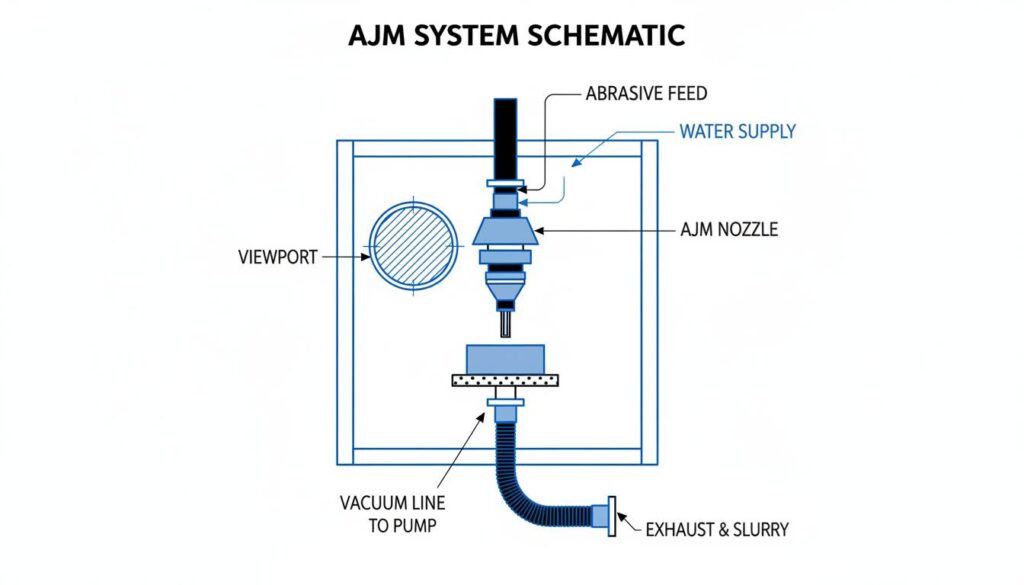
Technical Diagram: A diagram of the full AJM setup. Show the nozzle inside a sealed box with a glass window, and a vacuum hose attached to the bottom.
Review Question:
Why do we need to vibrate the hopper (the sand container)?
A. To make the sand hotter.
B. To stop the sand from clogging or sticking together.
C. To break the sand into smaller pieces.
(Answer: B. Just like a salt shaker, shaking it helps the flow!)
Step-by-Step Process Summary
- Compress: The gas is squeezed to high pressure.
- Dry: The filter removes all water.
- Mix: The gas enters the mixing chamber. The hopper shakes sand into the gas stream.
- Accelerate: The mixture goes through the nozzle and speeds up to 300 m/s.
- Cut: The sand hits the workpiece and chips away material.
Why Use AJM? (Pros and Cons)
Advantages
- Cool Cutting: It does not create heat. This is great for delicate materials that might burn or melt.
- Hard Materials: It can cut glass, ceramics, and hard stones easily.
- Fine Detail: It can cut very thin letters or shapes.
Disadvantages
- Slow: It takes a long time to cut deep holes.
- Nozzle Wear: Even sapphire nozzles wear out and need replacing often.
- Soft Materials: It is bad at cutting soft things like rubber (the sand just bounces off!).
Final Challenge:
If you wanted to cut a piece of soft rubber for a shoe sole, would you use Abrasive Jet Machining?
Hint: Think about bouncing a ball against a wall versus throwing a rock at a wall.
