
Introduction
Alkaline anion-exchange membrane (AAEM) fuel cells have emerged as a promising alternative to conventional proton-conducting fuel cell technologies. Over the past decade, significant progress in hydroxide-ion conductive membranes has renewed interest in alkaline fuel cell systems that combine the advantages of solid membranes with alkaline electrochemistry.
Despite these advances, the performance of AAEM fuel cells still lags behind that of Proton Exchange Membrane Fuel Cells. While membrane conductivity and chemical stability remain critical, increasing evidence suggests that electrocatalysis and interfacial charge-transfer phenomena are the dominant factors limiting AAEM fuel cell efficiency.
Think of “Alkaline” like soap or baking soda. It is the opposite of acid (like lemon juice). Scientists are excited about AAEMs because they might be cheaper to build. However, they are a bit slower than the acid version. We need to understand why.

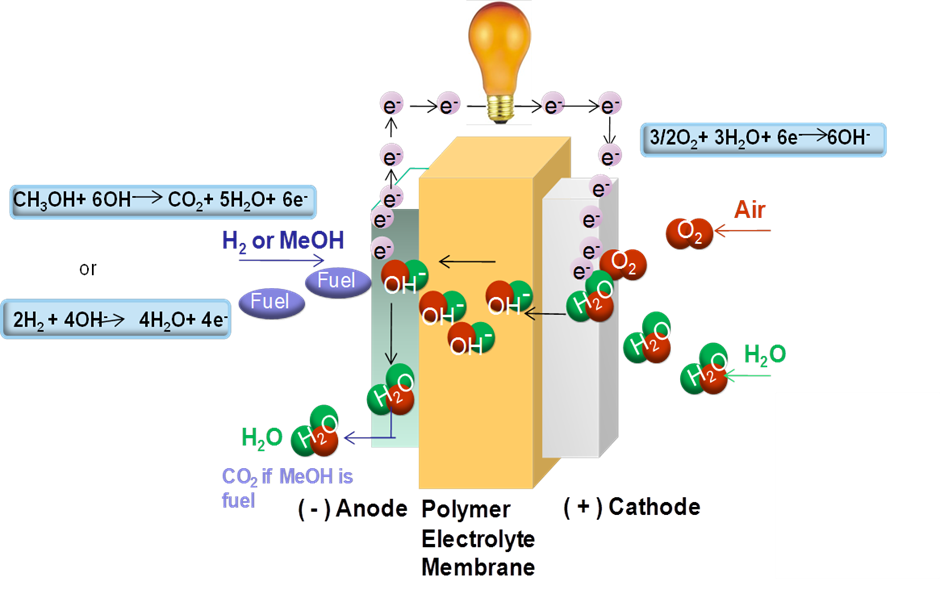
A simplified 2D schematic diagram of an AAEM fuel cell. Show an Anode on the left, a Cathode on the right, and a membrane in the middle. Label ‘Hydrogen In’ on the left and ‘Air In’ on the right. Show ‘OH-‘ ions moving from right to left through the membrane.
Overview of Alkaline Anion-Exchange Membrane Fuel Cells
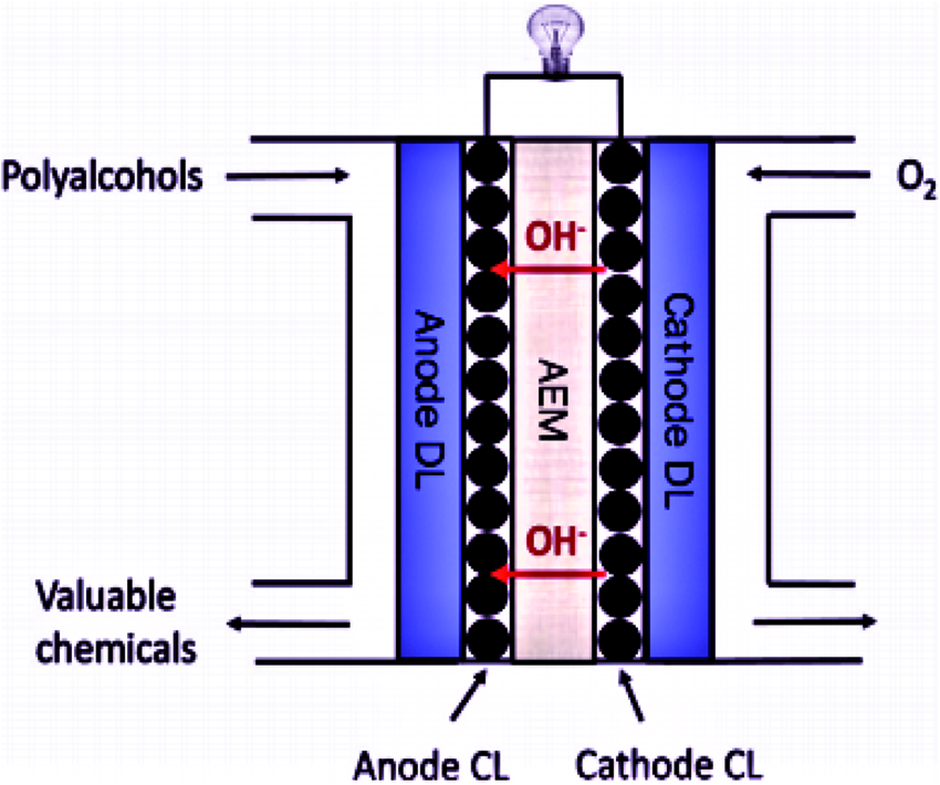
AAEM fuel cells employ a solid polymer membrane capable of conducting hydroxide ions (OH⁻) rather than protons. This configuration enables operation under alkaline conditions while retaining the compact and mechanically robust architecture of membrane-based fuel cells.
Key characteristics of AAEM fuel cells include:
• Hydroxide-ion conduction through anion-exchange membranes
• Potential use of non-precious metal catalysts
• Compatibility with a wider range of fuel oxidation chemistries
How It Works: The Reverse Traffic
To make electricity, we need to move charged particles. In a standard acid fuel cell, positive particles (Protons) move from the fuel side to the air side.
In an AAEM fuel cell, the traffic flows the other way.
The Hydroxide Ion (OH⁻)
Instead of protons, AAEMs use Hydroxide ions. These are oxygen and hydrogen bonded together with a negative charge.
- Oxygen enters the cathode (one side).
- It grabs water and electrons to make Hydroxide (OH⁻).
- The OH⁻ travels through the membrane to the anode (the other side).
- There, it meets Hydrogen to make water and electricity.
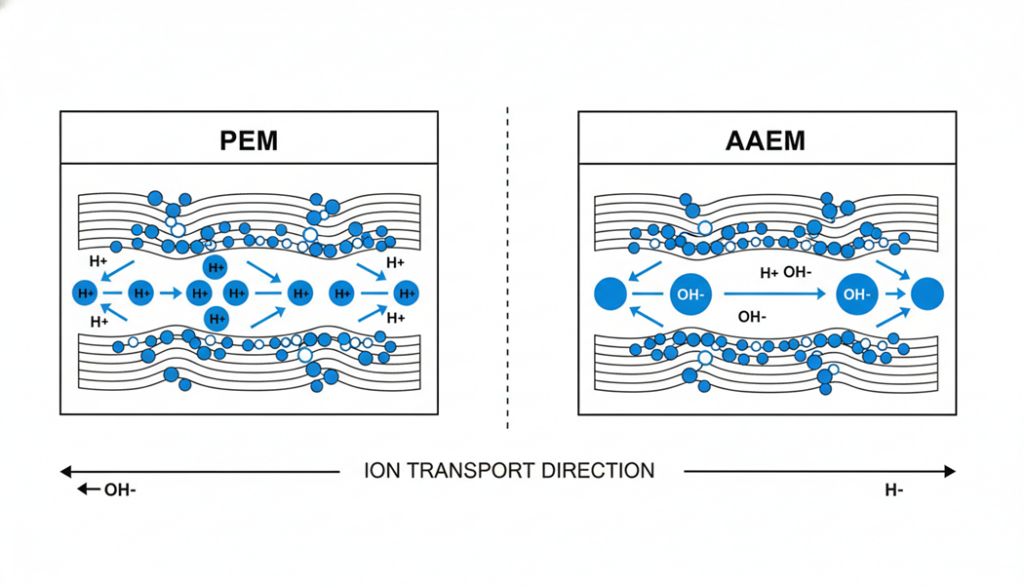
A close-up diagram comparing two membranes. Left side labeled ‘PEM’: shows small H+ spheres moving left to right. Right side labeled ‘AAEM’: shows larger OH- spheres moving right to left. Use arrows to show direction.
The Big Advantage: Cheaper Materials
Why do we want to use Alkaline (soap-like) chemistry? The answer is money.
The Platinum Problem
Acid is harsh. It eats metal. To survive inside an acid fuel cell, we must use Platinum. Platinum is a precious metal. It is very expensive. It costs as much as gold jewelry.
The Alkaline Solution
Alkaline environments are gentler. They don’t eat metal as fast. This means we can use cheaper metals like:
- Nickel (used in coins)
- Silver
- Iron
If we can use Nickel instead of Platinum, the price of fuel cells drops instantly.
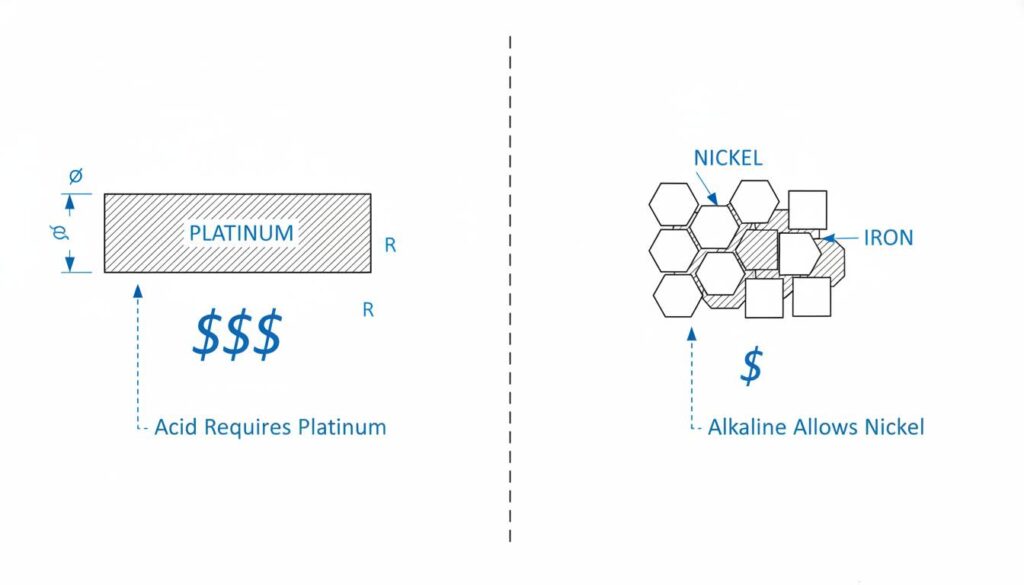
A visual comparison chart. On the left, a bar of Platinum with a high price tag ($$$). On the right, a pile of Nickel and Iron with a low price tag ($). Label ‘Acid Requires Platinum’ and ‘Alkaline Allows Nickel’.
Comparison with Proton Exchange Membrane Fuel Cells
Although AAEM fuel cells share structural similarities with PEM fuel cells, their electrochemical environments differ fundamentally.
Key contrasts include:
• Charge carrier: hydroxide ions (AAEM) vs. protons (PEM)
• Electrolyte chemistry: alkaline vs. acidic
• Catalyst stability requirements
• Reaction mechanisms at electrode interfaces
While alkaline conditions theoretically favor faster oxygen reduction kinetics and reduced precious-metal dependency, experimentally observed overpotentials remain higher in AAEM systems.
Sources of Overpotential in AAEM Fuel Cells
Even though AAEMs are cheaper, they aren’t perfect. They have “overpotential.” This is a fancy word for wasted energy. The reactions are sluggish.
The voltage losses in AAEM fuel cells arise from a combination of kinetic, ohmic, and mass-transport limitations. Among these, electrode overpotentials dominate, particularly at the anode.
Hydrogen Oxidation Reaction (HOR) in Alkaline Media: The Lazy Hydrogen
One of the most fundamental challenges in AAEM fuel cells is the sluggish kinetics of the hydrogen oxidation reaction under alkaline conditions.
Key contributing factors include:
• Altered reaction pathways compared to acidic media
• Weaker hydrogen adsorption energetics on catalyst surfaces
• Dependence on water-mediated proton–hydroxide exchange
As a result, catalysts that perform exceptionally well in PEM fuel cells often exhibit significantly reduced activity in alkaline environments.

A cartoon-style diagram of a catalyst surface. Show a Hydrogen molecule (H2) bouncing off the surface without breaking, representing ‘Sluggish Kinetics’. Contrast this with a second panel showing H2 breaking apart easily.
Oxygen Reduction Reaction (ORR) Mechanisms: The Oxygen Obstacle
The Oxygen Reduction Reaction (ORR) is how we turn oxygen into hydroxide. In alkaline systems, this is complicated. It involves many steps. If the surface of the metal isn’t perfect, the reaction slows down.
Critical Reasoning:
Imagine trying to run a race through water (Alkaline) versus running through air (Acid). Even if you are the same runner, why is one slower?
The oxygen reduction reaction in alkaline media follows more complex mechanistic pathways than in acidic systems.
Key challenges include:
• Multiple reaction intermediates
• Sensitivity to catalyst surface structure
• Strong dependence on ionomer–catalyst interfacial properties
While alkaline ORR theoretically enables faster kinetics, practical limitations related to interfacial charge transfer reduce achievable performance.
Carbonate Anion Poisoning
A defining challenge in AAEM fuel cells is carbonate formation due to carbon dioxide contamination.
• CO₂ reacts with hydroxide ions to form carbonate (CO₃²⁻)
• Carbonate anions reduce ionic conductivity
• Active catalyst sites become blocked
Carbonate poisoning leads to:
• Increased ohmic resistance
• Reduced catalytic activity
• Gradual performance degradation
This issue persists even with trace levels of CO₂ in feed gases.
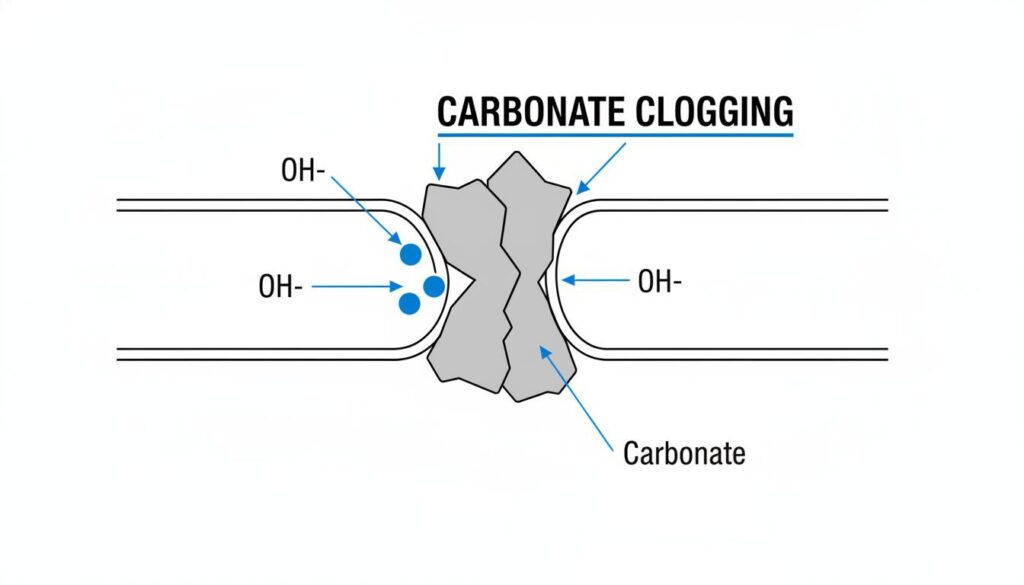
A technical cross-section of a membrane pore. Show small blue spheres (OH-) moving easily. Show large, jagged grey shapes (Carbonate) getting stuck and blocking the path. Label ‘Carbonate Clogging’.
The “Sticky” Glue Problem
Inside the fuel cell, we use a special glue called an Ionomer. This glue holds the catalyst powder together so it can conduct electricity.
Blocking the Door
In AAEMs, this glue has a bad habit. It sticks too well to the catalyst.
Imagine the catalyst is a keyhole, and the hydrogen is the key. The ionomer acts like a piece of tape stuck over the keyhole. The key can’t get in. This stops the reaction from happening. This is called Interfacial Charge-Transfer Resistance.
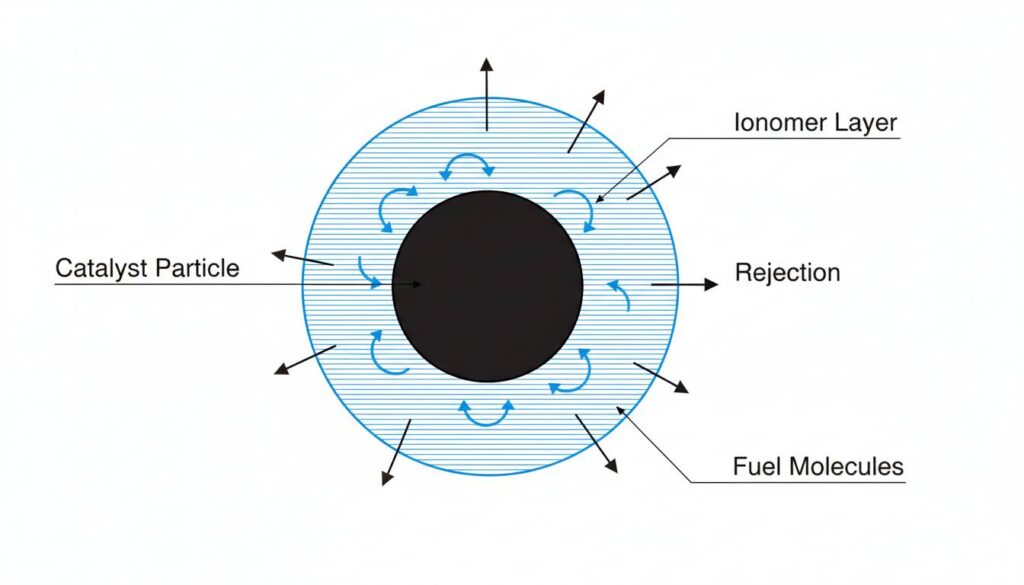
Ionomer–Catalyst Interfacial Interactions
A unique challenge in AAEM fuel cells arises from the specific adsorption of alkaline ionomer cationic head groups onto catalyst surfaces.
These interactions can:
• Block active catalytic sites
• Alter surface electronic properties
• Impede interfacial charge transfer
Unlike proton-conducting ionomers, alkaline ionomers introduce additional complexity at the electrode–electrolyte interface, making catalyst–ionomer compatibility a critical design parameter.
Electrocatalyst Materials: Precious vs. Non-Precious Metals
AAEM fuel cells offer the potential to utilize both:
• Precious metal catalysts (Pt, Pd-based)
• Non-precious metal catalysts (Ni, Co, Fe-based systems)
However, catalyst performance is governed not only by intrinsic activity but also by:
• Interfacial charge-transfer resistance
• Surface adsorption phenomena
• Electrolyte–catalyst interactions
Understanding these effects is essential for rational catalyst design.
Alternative Small-Molecule Fuel Oxidation
Beyond hydrogen, AAEM fuel cells enable exploration of alternative fuels, such as:
• Alcohols
• Hydrazine
• Ammonia
Alkaline environments reduce poisoning effects commonly observed in acidic systems. However, challenges remain in:
• Catalyst selectivity
• Reaction kinetics
• Membrane compatibility
These systems represent promising but still underdeveloped research pathways.
Interfacial Charge Transfer as a Central Limitation
Across all reaction pathways, interfacial charge transfer emerges as a unifying bottleneck in AAEM fuel cell performance.
Critical interfacial factors include:
• Ionomer distribution within catalyst layers
• Water management at electrode interfaces
• Electrochemical double-layer structure
Addressing these issues requires integration of electrochemistry, materials science, and surface physics.
Research Roadmap for Improving AAEM Fuel Cell Performance
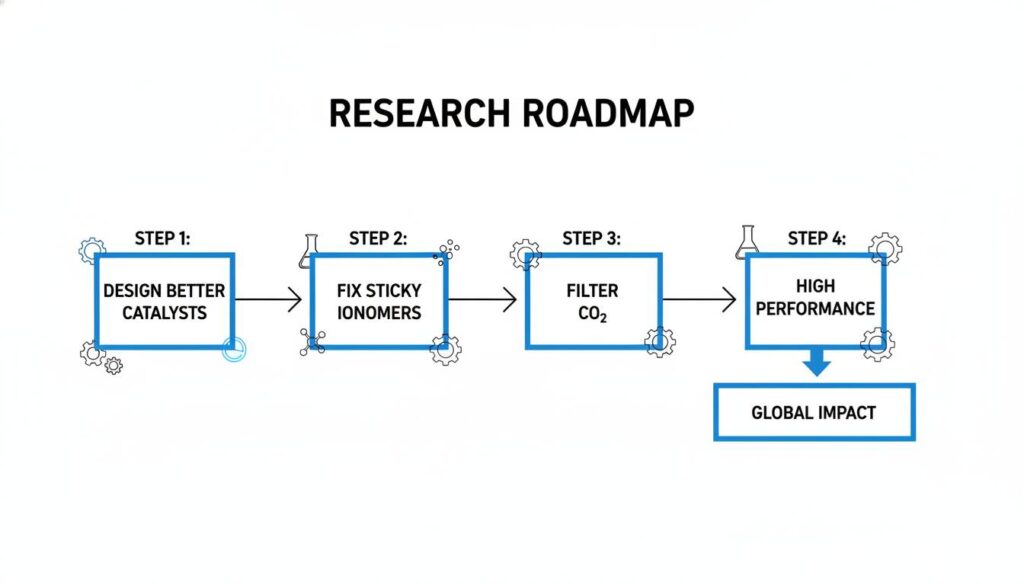
Future advancements in AAEM fuel cells should prioritize:
• Design of catalysts optimized for alkaline HOR and ORR
• Development of ionomers with reduced catalyst adsorption
• Improved CO₂ management strategies
• Tailored electrode architectures to minimize charge-transfer resistance
Progress in these areas is essential to close the performance gap with PEM fuel cells.
Conclusion
Alkaline anion-exchange membrane fuel cells represent a compelling pathway toward cost-effective and versatile electrochemical energy conversion. While advances in membrane conductivity and stability are necessary, electrocatalysis and interfacial charge-transfer phenomena remain the dominant performance-limiting factors.
A deeper mechanistic understanding of reaction pathways, ionomer–catalyst interactions, and carbonate poisoning is essential for the rational design of next-generation AAEM fuel cell systems. Continued interdisciplinary research will determine whether AAEM fuel cells can achieve performance parity with established proton-exchange technologies.
The Future of AAEM
Engineers are working hard to fix these problems.
The Roadmap
- Better Catalysts: We need to find metals that make Hydrogen less “lazy” in alkaline conditions.
- Better Glue: We need ionomers that hold things together without blocking the active spots.
- CO₂ Filters: We need to keep the “villain” out of the system.
- New Fuels: Since we are alkaline, we might be able to use Ammonia or Alcohols instead of just Hydrogen.
Critical Reasoning:
If we solve the “Lazy Hydrogen” problem and the “Carbonate” problem, do you think AAEMs will replace the batteries in your phone or car? Why or why not?
