
Introduction: The “Donut” Pipe Problem
Imagine you are holding a heavy metal water pipe. It is not a solid stick; it is hollow so water can flow through it.
In engineering, we often know how big the pipe is on the outside and how tall it is. But sometimes, we need to figure out how thick the metal wall is without cutting the pipe open.
Today, we will use a real-world math puzzle to find the thickness of a metal cylinder.
Problem: The total surface area of a hollow metal cylinder, open on both ends of external radius 8 cm and height 10 cm is 338 * Pi cm2. Taking ‘r’ to be the inner radius, obtain an equation in r and use it to obtain the thickness of the metal in cylinder

Technical Diagram: A realistic 3D rendering of a hollow metal cylinder standing upright. The metal is shiny steel. The top rim is visible, showing the thickness of the wall. The background is a clean white engineering grid.
Understanding the Shape
Before we do any math, we must understand what surfaces we are touching. The problem says the cylinder is “open on both ends.” This means it is like a straw or a tunnel.
However, the metal has thickness. If you were to dip this entire object into a bucket of paint, three distinct parts would get wet:
- The Outer Wall: The big curved surface on the outside.
- The Inner Wall: The curved tunnel inside.
- The Rims: The flat rings at the very top and the very bottom.
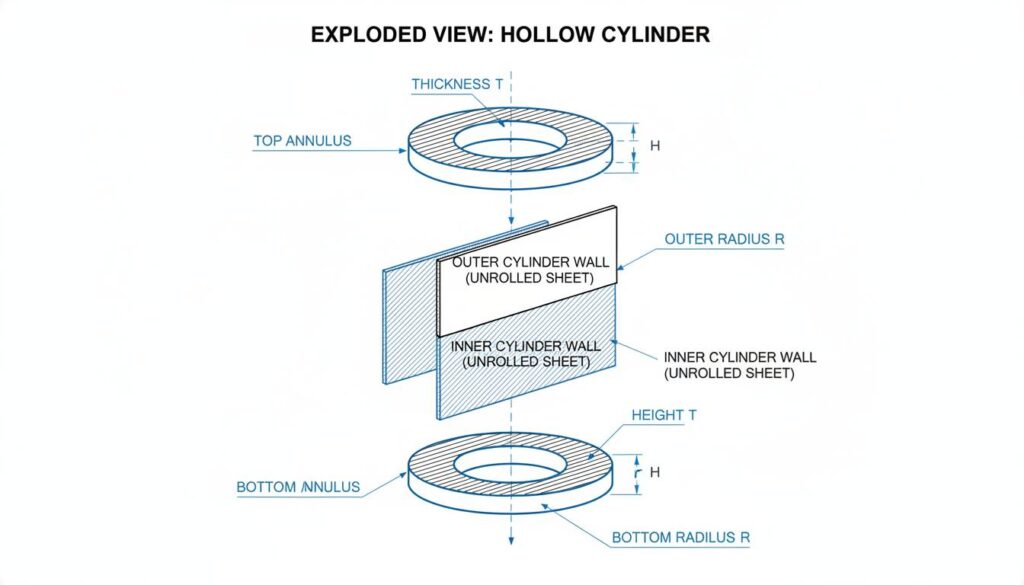
Technical Diagram: An exploded view diagram of a hollow cylinder. The image separates the cylinder into three parts: the outer rectangular sheet, the inner rectangular sheet, and the two flat ring-shaped disks (annuli) at the top and bottom.
The Variables (Our Ingredients)
Let’s list what we know from the problem statement.
- Height (
 ): 10 cm.
 - External Radius (
 ): 8 cm (Distance from the center to the outside edge).
 - Total Surface Area (
 ):
):  cm² (The total area of all painted surfaces).
 - Inner Radius (
 ): Unknown. We need to find this.
Think About It:
Why do we use the symbol  (Pi) here?
Because cylinders are based on circles! Anytime you measure a circle or a curve, helps relate the diameter to the circumference.
Building the Equation
We need to create a math recipe (an equation) that adds up all the painted surfaces to equal  .
.
Step 1: The Curved Walls
Imagine unrolling the curved walls like a label on a soup can. They become rectangles.
- Outer Area:

- Inner Area:

Step 2: The Flat Rims (The Donuts)
The top and bottom are rings. To find the area of a ring, we calculate the area of the big circle and subtract the hole in the middle.
- Area of one ring:

- Since there are two rings (top and bottom):

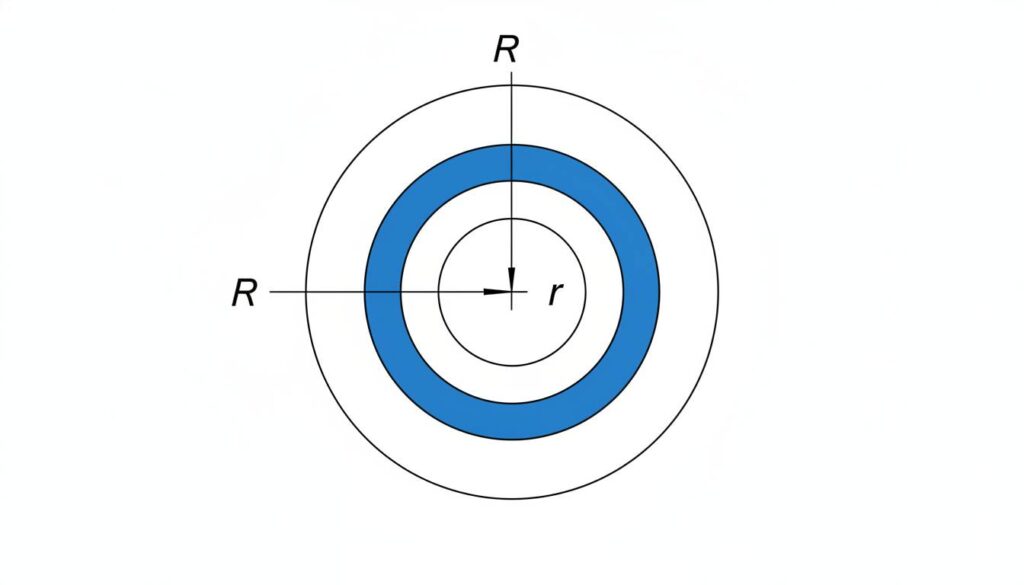
Technical Diagram: A 2D technical drawing of a ring (annulus). The outer circle is labeled ‘R’ and the inner hole is labeled ‘r’. The area between the two circles is shaded blue to represent the metal rim.
Step 3: The Total Equation
Now, we add them all together to equal the Total Surface Area ( ).
).


Quick Check:
Why did we multiply the ring area by 2?
Because the pipe has a top rim AND a bottom rim! If we forgot one, our answer would be wrong.
Solving for ‘r’ (The Inner Radius)
Now we plug in our numbers.



Simplifying the Math
First, let’s make life easy. Every single term has a  in it. We can divide the entire equation by to remove them.

Now, do the multiplication:

Combine the plain numbers ( ):
):

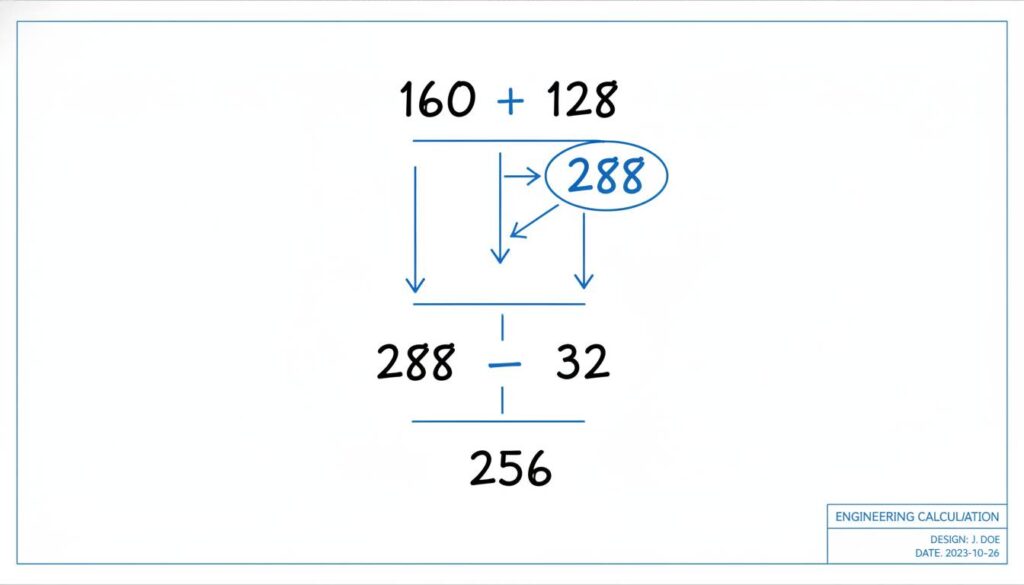
Technical Diagram: A whiteboard style graphic showing the algebraic simplification steps. The numbers are written in clear, handwritten-style font. Arrows show 160 and 128 combining to make 288.
Finding the Value of r
We want to solve for  . Let’s move everything to one side to make the equation equal zero. We will move the terms to the left side to make the
  positive.
- Add
 to both sides.
 - Subtract
 from both sides.
 - Subtract
 from .


This looks like a classic quadratic equation! To make it even simpler, divide everything by 2:

Now, we ask: What number, when subtracted from itself, equals zero?
We can factor this equation:
Therefore:

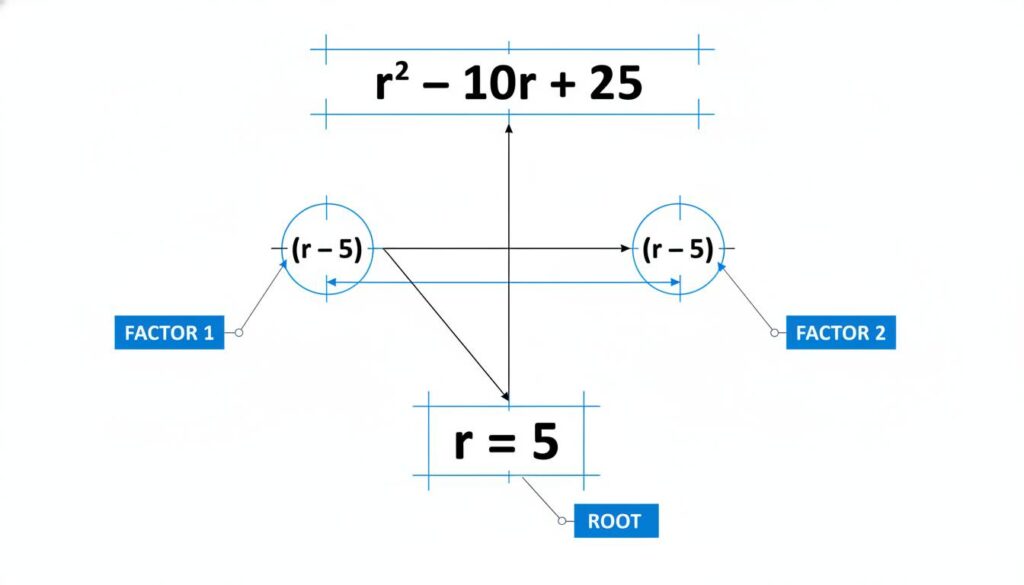
Technical Diagram: A simple math diagram showing the factorization of r^2 – 10r + 25. It shows two brackets (r-5) and (r-5) leading to the solution r=5.
The Final Step: Calculating Thickness
We are almost done! The question asked for the thickness of the metal.
What is Thickness?
Thickness is simply the difference between the Outside Radius and the Inside Radius. Think of it as the distance from the outer skin to the inner skin.

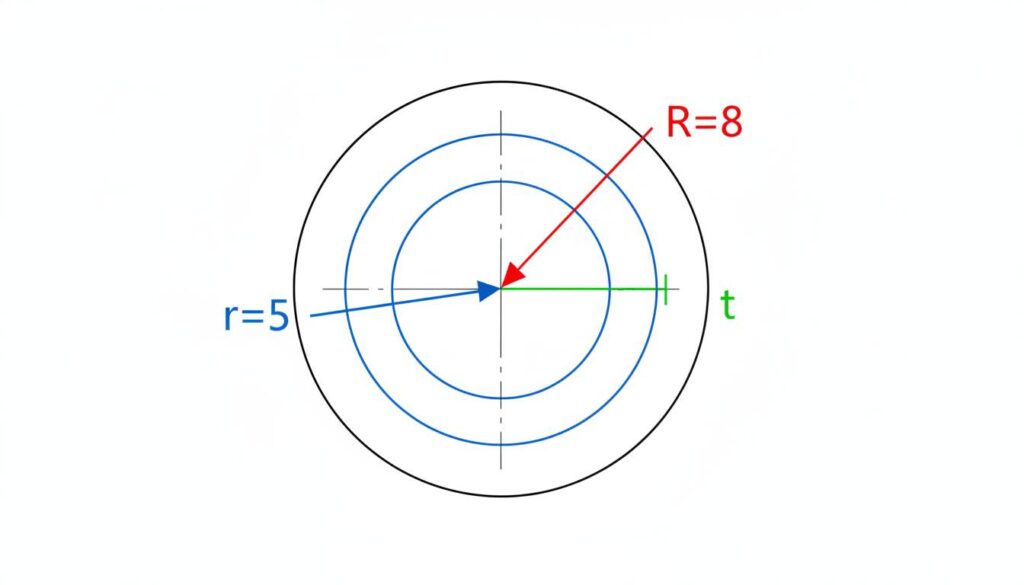
Technical Diagram: A cross-section cut of the cylinder pipe. A red arrow points from the center to the outer edge labeled ‘R=8’. A blue arrow points from the center to the inner edge labeled ‘r=5’. A green bracket indicates the wall thickness labeled ‘t’.
The Calculation


Conclusion
By understanding the geometry of the cylinder—the walls and the rims—we built an equation. We found that the inner radius was 5 cm. This tells us the metal wall is 3 cm thick.
In mechanical engineering, knowing the thickness is vital. It tells us how much pressure the pipe can hold and how much the material will cost!
Final Thought:
If the thickness was smaller (thinner metal), would the Total Surface Area go up or down?
It would actually go down. A thinner rim has less area, and a wider inner tunnel (larger R) has more area, but the math shows the total material used usually decreases as walls get thinner.
