
Table of Contents
- Understanding Extendable Robotic Arms
- Key Components of a DIY Extendable Robotic Arm Kit
- Choosing the Right DIY Extendable Robotic Arm Kit for You
- Step-by-Step Assembly & Initial Setup (General Guide)
- Programming Your Extendable Robotic Arm
- Enhancing and Customizing Your Extendable Arm
- Safety Considerations for Your DIY Robotic Project
Introduction

The world of robotics is more accessible than ever, and for makers and engineers looking to expand their capabilities, a DIY extendable robotic arm kit offers a fascinating challenge. These kits not only provide the satisfaction of building something from scratch but also introduce the practical benefits of increased reach and versatility. This guide will walk you through everything you need to know about choosing, assembling, programming, and even enhancing your own extendable robotic arm, empowering you to tackle tasks that require that extra bit of reach. This comprehensive resource ensures you can confidently build your own robotic arm, making advanced robotics for beginners a tangible reality.
Key Takeaways
- A DIY extendable robotic arm kit offers a unique learning experience in mechanics, electronics, and programming, providing practical benefits like increased reach.
- Key components include structural elements, various motors (servo, stepper, DC, linear actuators), and a control system typically centered around Arduino or Raspberry Pi.
- Choosing the right kit involves assessing your skill level, budget, intended application, and the quality of documentation and community support.
- Assembly requires careful attention to mechanical build, wiring, and initial testing, followed by programming for basic and advanced movements, including understanding kinematics.
- Enhancement options range from upgrading components for greater reach and payload to integrating advanced sensors and enabling autonomous or remote control, expanding your robotic arm for beginners.
- Prioritize safety through proper electrical practices and mechanical precautions to prevent accidents and ensure the longevity of your educational robotic arm.
Understanding Extendable Robotic Arms
What Makes a Robotic Arm ‘Extendable’?
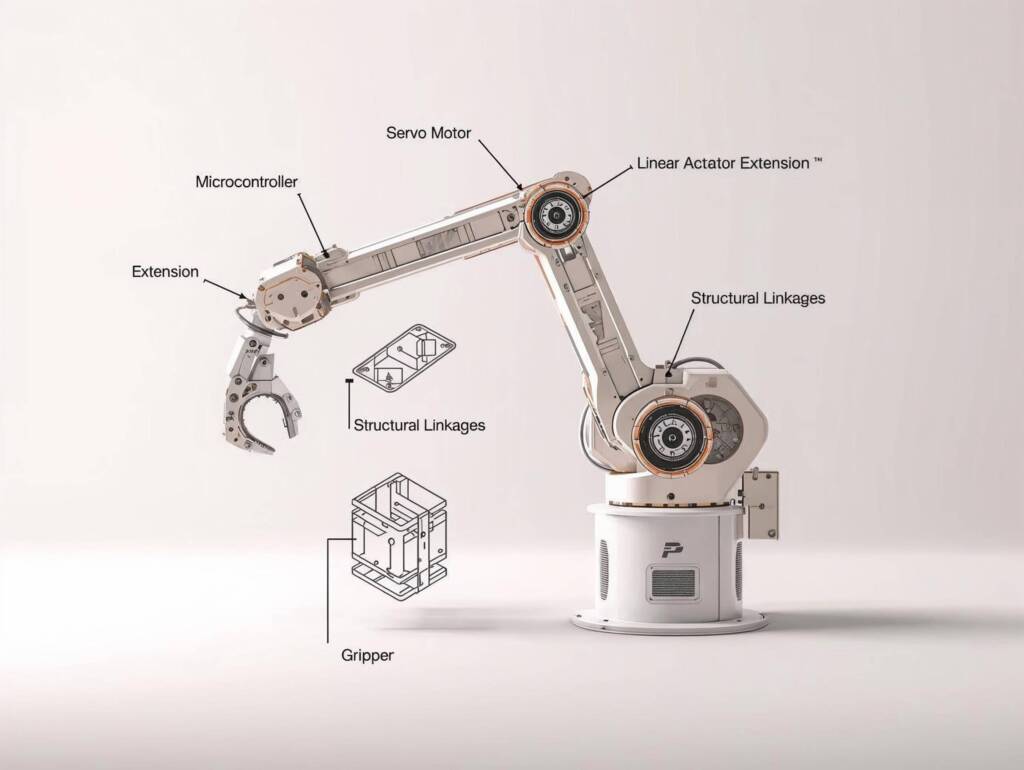
An extendable robotic arm is a sophisticated manipulator engineered to increase its working envelope beyond its static dimensions. Unlike standard fixed-reach arms, these designs incorporate mechanisms that allow for dynamic adjustment of their reach. Common methods include telescopic slides, linear actuators, or the strategic addition of modular joint segments, often in combination. This capability significantly enhances the arm’s utility, enabling it to access objects or perform tasks in areas that would otherwise be out of reach without repositioning the entire base. Understanding these extendable robotic arm features is key to appreciating their versatility.
Benefits of an Extendable Design in DIY Projects
Integrating an extendable design into your DIY robotic arm project offers numerous advantages:
- Increased Reach: Access difficult-to-reach areas without moving the arm’s base, optimizing workflow and placement.
- Greater Versatility: Perform a wider range of tasks, from picking objects at varying distances to detailed inspection in confined spaces.
- Compact Storage: When retracted, the arm occupies minimal space, making it ideal for smaller workspaces or storage.
- Educational Value: Provides an excellent platform for learning about complex mechanical and control systems, particularly for dynamic reach and the intricate robotic arm design.
Where P is the end-effector position, L is link length, E is extension, and θ is the joint angle. This formula illustrates how extension (E) dynamically alters the arm’s reach.
What is Forward Kinematics?
Forward Kinematics is a fundamental concept in robotics that answers the question: “If I know the angles of my robot’s joints, where is the end of its arm?”
The formulas above calculate the final X and Y coordinates ($P_x, P_y$) of the robot’s gripper based on the lengths of its arms ($L_1, L_2$), any extension ($E$), and the angles of its joints ($\theta_1, \theta_2$). This is essential for programming a robot to move to a precise location.
Key Components of a DIY Extendable Robotic Arm Kit
A typical DIY extendable robotic arm kit comprises several critical elements that work in synergy to achieve movement and functionality. Familiarizing yourself with these robot arm components is essential for a successful build.

Structural Elements and Chassis
The foundation of any robotic arm is its structure. Frame materials commonly include lightweight yet rigid options like acrylic, aluminum, or 3D-printed parts (PLA, PETG). Joints and linkages, incorporating bearings, pivots, and fasteners, allow for precise articulation. The unique extension mechanism, vital for an extendable robotic arm, might involve linear rails, telescopic tubing, screw drives, or belt drives, allowing the arm to stretch beyond its initial footprint. This forms the basis of any robust robot arm construction kit.
Actuators and Motors
Actuators are the muscles of your robotic arm. Selecting the right ones is crucial for performance:
- Servo Motors: Predominantly used in hobby kits for precise angular positioning of joints. A servo motor robotic arm offers good control for lighter payloads.
- Stepper Motors: Provide high precision and holding torque, often chosen for linear movements or specific joint control where accuracy is paramount.
- DC Motors: Used with gearboxes for higher torque applications, though they require encoders for precise positioning feedback.
- Linear Actuators: Specifically designed for the direct extension mechanism, delivering controlled push/pull force.
Control System and Electronics
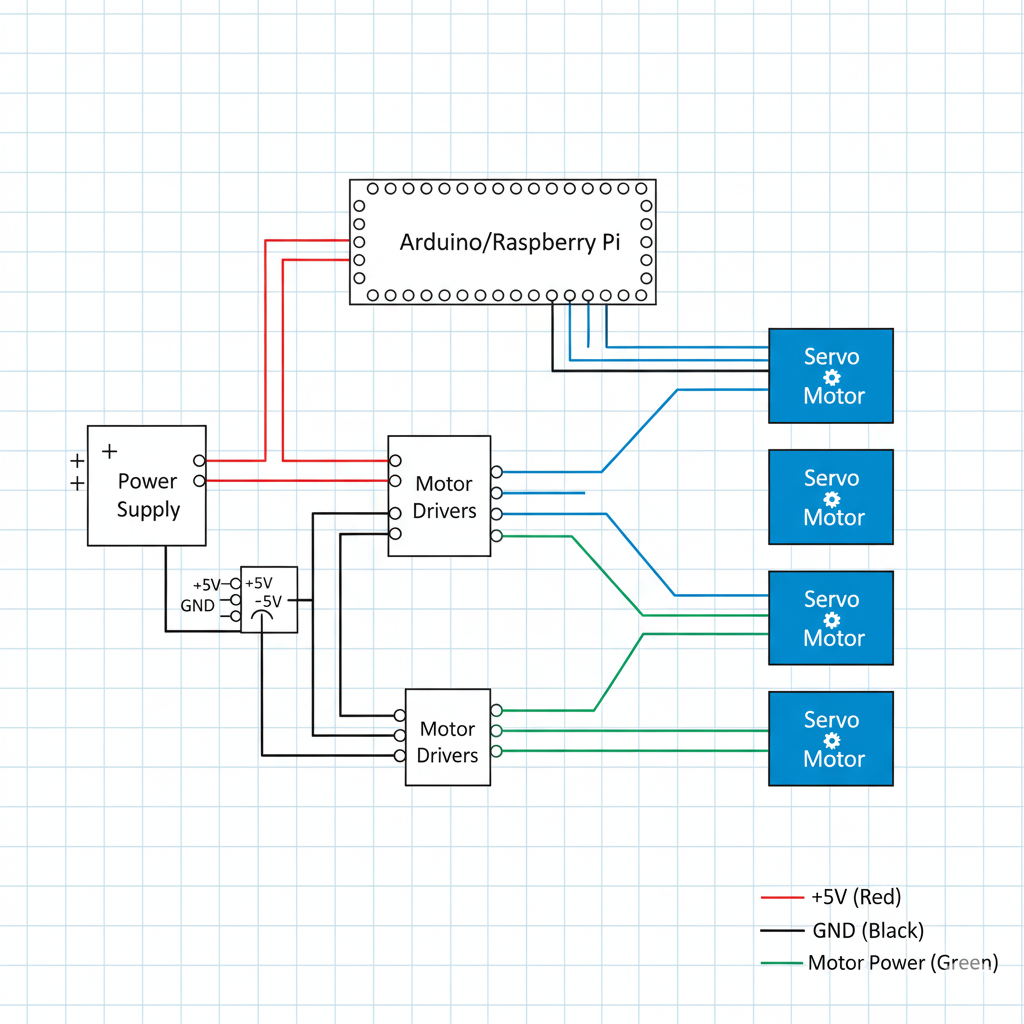
The ‘brain’ of your robotic arm is its control system. This typically includes a microcontroller board such as an Arduino (Uno, Mega) or Raspberry Pi, or an ESP32, which processes commands and coordinates movements. Motor drivers (shields or dedicated modules) are necessary to control the speed and direction of the motors. Proper wiring and connectors are vital for power, data, and sensor integration, ensuring a reliable robotic arm electronics kit. Finally, a stable power supply is paramount to ensure adequate voltage and current for all components.
Choosing the Right DIY Extendable Robotic Arm Kit for You
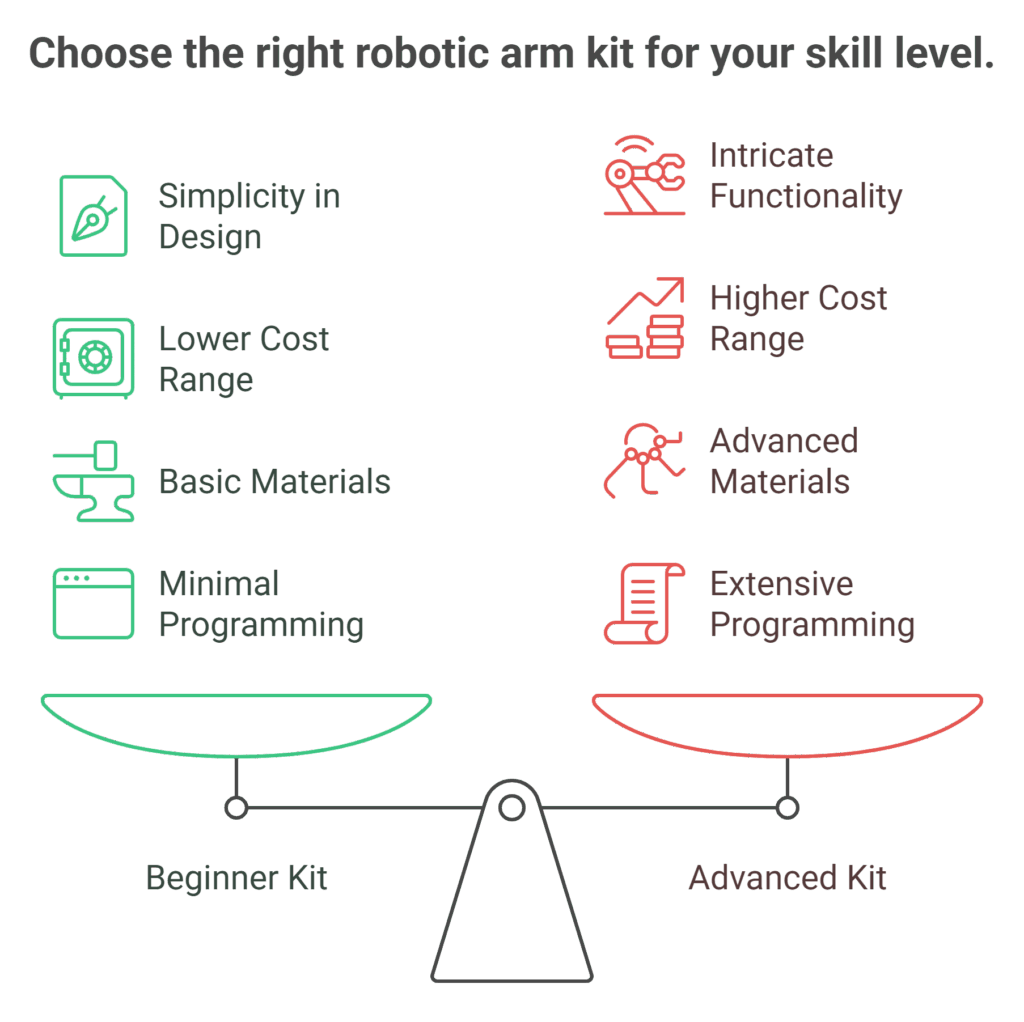
Selecting the ideal DIY extendable robotic arm kit depends heavily on your aspirations and resources. Consider these factors before making your decision.
Skill Level and Experience
- Beginner Kits: Often feature pre-assembled modules, clear instructions, and basic programming, making them perfect for robotics for beginners or a robotics for kids kit.
- Intermediate Kits: Involve more complex assembly, open-source hardware/software, and require some foundational electronics knowledge.
- Advanced Kits: Offer high customizability, demanding a deeper understanding of mechanics, electronics, and coding for a truly open source robotic arm.
Budget Considerations
Your budget will significantly influence the kit’s complexity and material quality:
- Entry-level Kits (under $100): Typically smaller, with fewer degrees of freedom and plastic components, ideal for simple robotic arm project ideas.
- Mid-range Kits ($100-$500): Feature better materials, more powerful motors, and are often compatible with platforms like an Arduino robotic arm kit or Raspberry Pi robotic arm kit.
- High-end Kits ($500+): Boast industrial-grade components, advanced control, higher load capacity, and robust extension mechanisms, suitable for a robotic manipulator kit.
Intended Application
What do you want your robotic arm to do? This dictates its required payload and precision:
Educational/Hobby: Learning the basics of robotics, simple pick-and-place, or drawing. A STEM robotic arm kit is excellent here.
- Light Industrial/Prototyping: Repetitive tasks, light assembly, quality control checks, or even a home automation robotic arm.
- Specific Tasks: Sorting, inspection in confined spaces, or remote manipulation requiring a robotic arm with extension.
Software, Documentation, and Community Support
The ecosystem around your kit is just as important as the hardware:
- Open-Source Software: Provides flexibility for customization and advanced control, a hallmark of a good customizable robot kit.
- Quality Documentation: Clear instructions and tutorials are crucial for a smooth build process and for understanding robotic arm kit assembly.
- Active Community: Online forums and GitHub repositories are invaluable for troubleshooting, sharing robotic arm project ideas, and finding inspiration for your DIY robotic arm project.
Step-by-Step Assembly & Initial Setup (General Guide)
- Unboxing and Inventory Check: Begin by verifying all components against the kit’s bill of materials. Organize parts methodically to streamline the assembly process, and familiarize yourself with the main structural elements of your DIY extendable robotic arm kit.
- Mechanical Assembly: Carefully follow the manufacturer’s provided step-by-step instructions. Assemble the base, main arm segments, and joints. Integrate the extension mechanism, such as linear slides or telescopic arms, and mount motors to their designated positions, ensuring smooth movement of all articulated robotic arm kit parts.
- Wiring and Electronics Integration: Connect servo or stepper motors to their respective drivers. Wire these motor drivers to your chosen microcontroller (e.g., Arduino). Connect the end effector, such as a gripper arm kit, and any sensors. Always ensure proper power supply connections, strictly observing polarity to prevent damage.
- Initial Power-Up and Basic Functionality Test: Double-check all connections before applying power. Upload basic test code to the microcontroller. Carefully test each joint’s movement and the extension mechanism’s operation. Observe for unexpected movements, unusual noises, or overheating components, which could indicate a wiring error in your robotic arm electronics kit.
Programming Your Extendable Robotic Arm
Programming is where your DIY extendable robotic arm truly comes to life. It’s an exciting phase that transforms static hardware into a dynamic tool.
Introduction to Robotics Control
At the heart of robotic arm programming are fundamental concepts:
- Degrees of Freedom (DOF): Understanding the arm’s movement capabilities, with each joint contributing a DOF.
- Forward Kinematics: Calculating the end-effector’s position based on given joint angles. This is fundamental to predicting where your robot arm will go.
- Inverse Kinematics: The more complex, but often essential, process of determining the required joint angles to reach a desired end-effector position. This is crucial for task-oriented control of a programmable robotic arm.
Basic Programming with Arduino/Raspberry Pi
For many hobbyists and students engaged in STEM robotics projects, Arduino and Raspberry Pi are popular choices:
- Arduino IDE: Utilize libraries like ‘Servo.h’ for straightforward servo motor robotic arm control. This platform is excellent for an Arduino robotic arm kit due to its simplicity.
- Python on Raspberry Pi: Leverage GPIO pins and motor control libraries for more complex routines and integration, making it a powerful platform for a Raspberry Pi robotic arm kit.
- Creating Sequences: Develop sequences of movements for specific tasks, such as ‘pick, extend, place, retract,’ which are common robotic arm project ideas.
Calibrating and Fine-Tuning Movements
Precision requires meticulous calibration. Establish physical limits for each joint and the extension mechanism. Adjust motor speeds and acceleration for smooth, precise motion, which is vital for an educational robot arm. Iterative testing is key to achieving the desired accuracy and repeatability for your programmable robotic arm kit.
Enhancing and Customizing Your Extendable Arm
Once you’ve mastered the basics, the true potential of your customizable robot kit emerges through enhancements and customization.
Interactive Beam Bending Visualizer
Deflection: 0.00 mm
Explore how different materials and forces affect beam deflection. This simplified model helps understand structural integrity for your DIY robotic arm kit.
How to Make a Beam Stronger:
1. Use a Stiffer Material: As you can see in the simulator, steel deflects far less than aluminum or plastic under the same load.
2. Increase Thickness (Height): This is the most effective way to increase strength. Doubling the thickness makes the beam eight times stiffer!
3. Shorten the Length: A shorter beam is significantly stronger and more rigid than a longer one.
Increasing Reach and Payload Capacity
To push the boundaries of your robotic arm with extension, consider:
- Upgrading Actuators: Switch to stronger motors or linear actuators for increased power.
- Reinforcing Structure: Upgrade structural components, perhaps using metal instead of plastic, for greater stability and payload capacity.
- Modular Additions: If the design permits, add additional modular segments for even greater extension, transforming it into a more robust modular robotic arm kit.
Advanced End Effectors and Sensor Integration
The end effector is where the arm interacts with its environment:
- Custom Grippers: Design and 3D print custom grippers or tools for specialized tasks, expanding the functionality beyond a basic gripper arm kit.
- Sensor Integration: Integrate proximity sensors, force sensors, or cameras for vision-based control, enabling more intelligent interactions.
- Quick-Change Tools: Implement mechanisms for quick attachment and detachment of various tools.
Autonomous Operation and Remote Control
For advanced functionality, delve into:
- Computer Vision: Use tools like OpenCV with Raspberry Pi for object detection and tracking, making your desktop robotic arm kit smarter.
- Autonomous Tasks: Develop complex task sequences for fully autonomous operation, turning your mini robotic arm kit into a sophisticated system.
- Wireless Control: Implement wireless control via Bluetooth, Wi-Fi, or custom interfaces for remote manipulation, ideal for a robotic arm for hobbyists or robotic arm for makers.
Safety Considerations for Your DIY Robotic Project
Safety is paramount in any DIY project, especially when working with moving parts and electronics. A responsible approach ensures both your well-being and the longevity of your robot arm construction kit.
Electrical Safety Best Practices
Working with electricity demands vigilance:
- Proper Wiring: Use appropriate wire gauging and insulation for all power lines.
- Overcurrent Protection: Implement fuses or circuit breakers to protect against overcurrents, which can cause component damage or fire.
- Stable Power: Ensure you are using stable and correctly rated power supplies for all components in your robotic arm electronics kit.
- Avoid Shorts: Always double-check connections to prevent exposed wires and short circuits.
Mechanical Safety Precautions
Moving parts can pose hazards:
- Pinch Points: Be acutely aware of pinch points and moving parts during operation.
- Stable Base: Secure the arm to a stable base to prevent tipping or unexpected movement.
- Emergency Stop: Implement emergency stop buttons or software routines for immediate shutdown.
- Clear Area: Keep hands, loose clothing, and other obstructions away from moving components during robotic arm programming.
Conclusion
Building a DIY extendable robotic arm from a kit is an incredibly rewarding endeavor, offering a hands-on learning experience that combines mechanics, electronics, and programming. From selecting the perfect kit to the final calibration and even advanced customization, this guide has provided a comprehensive roadmap. Embrace the challenge, enjoy the process, and soon you’ll have a versatile robotic assistant ready to extend its reach and perform tasks with precision. Share your creations and continue exploring the vast possibilities of DIY robotics! Ready to elevate your engineering career? Explore our curated selection of DIY extendable robotic arm kits and start building your project today!
Frequently Asked Questions
What is the average cost range for a good quality DIY extendable robotic arm kit suitable for hobbyists?
For hobbyists, a good quality DIY extendable robotic arm kit typically ranges from $150 to $400. This price variation depends on factors such as the materials used (e.g., plastic vs. aluminum), the number of degrees of freedom, and the sophistication of the extension mechanism. Entry-level kits might be less, while more advanced or robust kits will be at the higher end of this range for a DIY extendable robotic arm kit.
Can I upgrade a non-extendable robotic arm kit to have extendable features?
While challenging, it is often possible to modify some non-extendable robotic arm kits to incorporate extendable features. This usually involves adding linear actuators or designing and integrating telescopic segments. However, such an upgrade requires significant mechanical design expertise, structural reinforcement to handle the increased loads, and custom programming beyond what a standard kit build offers. It’s a more advanced project for those comfortable with significant modifications to their DIY extendable robotic arm kit.
What programming languages are commonly used for a DIY extendable robotic arm kit?
For a DIY extendable robotic arm kit, the most common programming languages depend on the chosen microcontroller. For Arduino-based kits, C++ (often referred to as Arduino C) is primarily used, leveraging libraries for motor control. For Raspberry Pi-based kits, Python is a popular choice due to its ease of use and extensive libraries for GPIO control and robotics. More advanced projects might also incorporate C# or Java for PC-based control interfaces. Mastering these languages is key to programming your DIY extendable robotic arm kit.
How important is payload capacity when choosing a DIY extendable robotic arm kit?
Payload capacity is extremely important when choosing a DIY extendable robotic arm kit, as it directly impacts what tasks the arm can perform. It refers to the maximum weight the arm can lift and manipulate at its full extension without compromising performance or damaging components. For simple educational tasks, a low payload is acceptable, but for practical applications like picking heavier objects or using heavier tools, a kit with a higher payload capacity is essential. Always match the kit’s payload to your intended use for the DIY extendable robotic arm kit.
