What is Fluid Power?
Imagine you are trying to lift a heavy car. You definitely cannot do it with your bare hands. But, if you go to a mechanic’s shop, you will see them lift a car easily by just pressing a button or pumping a handle. How is that possible? They are using Fluid Power.
Fluid Power is a way of pushing, lifting, or moving heavy objects by using a fluid under pressure. In engineering, a “fluid” isn’t just water; it can be a liquid (like oil) or a gas (like air).
Think of Fluid Power as “liquid muscle.” Instead of using gears, chains, or electricity to move a robot arm or a dump truck, we use pipes filled with fluid. When we push the fluid at one end, it moves something at the other end.
Inquiry Challenge
Think about a garden hose. When you turn the water on, the hose stiffens and jumps. If you put your thumb over the end, the water sprays out harder. How does this relate to the idea of “pressurized fluid” creating a force?
The Secret Science: Pascal’s Principle
To understand how fluid power works, we need to look at a rule discovered by a scientist named Blaise Pascal a long time ago.
Pascal’s Law states: If you push on a fluid trapped in a closed container, that pressure goes equally in all directions.
The Syringe Analogy
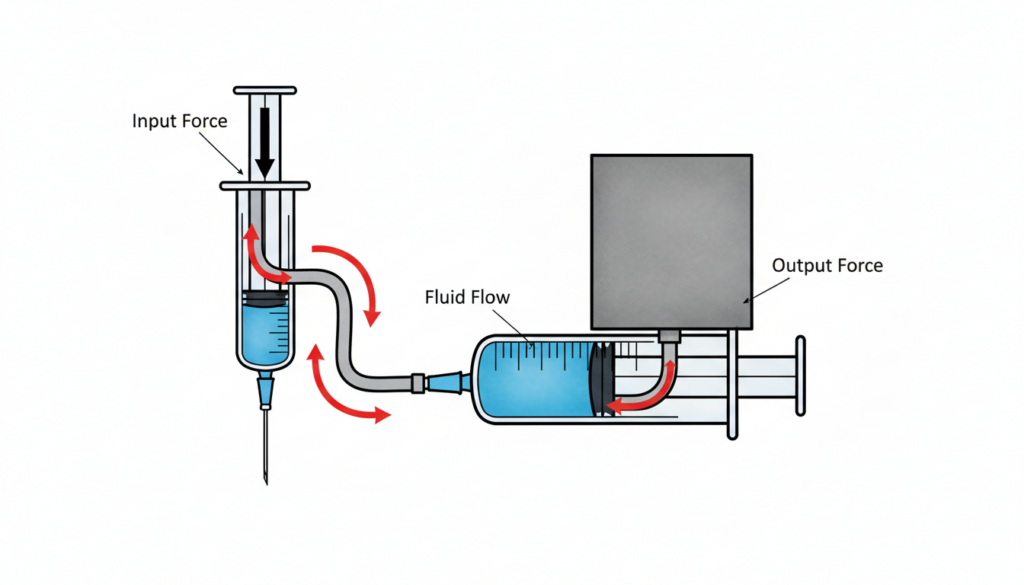
Imagine you have two syringes connected by a clear plastic tube filled with water.
- Syringe A is small (thin).
- Syringe B is large (fat).
If you push the plunger of the small Syringe A, the water flows through the tube and pushes the plunger of the large Syringe B up. Here is the magic trick: You only have to push gently on the small syringe to lift a heavy weight on the big syringe.
We can express this with a very simple math formula:
Force=Pressure×Area
Or:
F=P×A
This means if we make the Area (A) of the second cylinder bigger, the Force (F) it produces gets much bigger, even if the Pressure (P) stays the same. This is how a small person can lift a giant truck using hydraulics!
Inquiry Challenge
If you have a small syringe connected to a giant syringe, you get a lot of strength (force). But, do you think you have to push the small syringe a long distance to make the big syringe move just a little bit? Why or why not?
The Two Types of Fluid Power
Fluid power is divided into two main families based on what kind of fluid they use.
1. Hydraulics (Liquid Power)
- Fluid used: Oil (usually special mineral oil).
- Characteristics: Liquids are hard to squish. If you fill a bottle with water and try to squeeze it, the water won’t shrink. This makes hydraulics very strong and precise.
- Where we see it: Construction diggers, car brakes, barber chairs.
2. Pneumatics (Gas Power)
- Fluid used: Compressed Air.
- Characteristics: Air is squishy (compressible). Think of a balloon; you can squeeze it and it bounces back. This makes pneumatics fast, bouncy, and safe (because air doesn’t make a mess if it leaks).
- Where we see it: Bicycle pumps, dentist drills, the “whoosh” sound on bus doors opening.
Inquiry Challenge
If you were building a robot to pick up an egg without breaking it, would you use Hydraulics (strong and stiff) or Pneumatics (bouncy and cushiony)? Why?
Mechanism: How a Hydraulic System Works
Let’s look at the parts of a basic hydraulic machine. It works very much like the human body’s circulatory system.
- The Reservoir (The Tank): This is like a bucket that holds the oil. It’s where the fluid rests when it isn’t working.
- The Pump (The Heart): The pump takes oil from the tank and pushes it into the system. It creates the flow of fluid.
- The Valves (The Traffic Lights): These are controls that tell the fluid where to go. When you pull a lever on a machine, you are opening a valve to let the fluid through.
- The Actuator (The Muscle): This is the part that actually moves. It is usually a cylinder (a metal tube with a rod inside) that extends or retracts to push or pull things.
- Piping (The Veins): These are the hoses that connect everything together.

Inquiry Challenge
In the human body, the heart pumps blood. In a hydraulic system, the pump moves oil. What happens to the machine if the “veins” (hoses) get a hole in them? How is that similar to a cut on your finger?
Case Study: The Excavator (The “Digger”)
To see this in real life, let’s look at an Excavator—those big yellow machines used to dig holes for swimming pools or buildings.
If you look closely at the arm of an excavator, you will see shiny silver metal rods sliding in and out of yellow tubes. These are the Hydraulic Cylinders.
How it works:
- The driver pulls a lever in the cabin.
- This opens a valve.
- The pump (powered by a loud diesel engine) forces oil into the bottom of the cylinder.
- The pressure pushes the silver rod OUT.
- This pushes the bucket UP to scoop the dirt.
When the driver wants to dump the dirt, they push the lever the other way. The oil goes to the other side of the cylinder, and the rod pulls back IN.
Because the oil cannot be squished, the arm stays perfectly still even when holding tons of heavy rocks. If this machine used air (Pneumatics), the heavy rocks might make the arm bounce up and down!
Inquiry Challenge
Excavators are very strong, but they move slowly. Race cars are very fast, but they can’t lift dirt. Based on what we learned about force and pressure, why do you think the excavator moves slowly? (Hint: Think about the syringe analogy—small push, big lift).
Advantages and Disadvantages
Why do engineers choose fluid power instead of just using electric motors?
Advantages
- Super Strength: A small hydraulic motor can lift much more than an electric motor of the same size.
- Safety: Pneumatic (air) tools don’t use electricity, so they can’t shock you or cause sparks. This is great for working near water or gas.
- Simplicity: There are fewer moving parts (like gears) to break.
Disadvantages
- Messy Leaks: If a hydraulic hose breaks, oil spills everywhere. It is slippery and bad for the environment.
- Noise: Pneumatic systems need an air compressor, which can be very loud.
- Fire Hazard: Hydraulic oil can catch fire if it gets too hot.
Inquiry Challenge
Imagine you are designing a submarine. Would you prefer to use a system that uses air (pneumatics) or oil (hydraulics) to steer the rudder? Remember, the submarine is deep underwater where the water pressure is crushing from the outside.
Conclusion
Fluid Power Engineering is all about using the physics of liquids and gases to make our lives easier. Whether it is the brakes stopping your school bus (Hydraulics) or the tool tightening the wheels on a race car (Pneumatics), we rely on pressurized fluids every day. By understanding that fluids can transmit force, we can build machines that make us stronger than superheroes.
