1. What is a Hydraulic System?
Imagine you are trying to lift a car. You can’t do it with your bare hands, right? It’s too heavy. But if you use a hydraulic jack, you can lift that heavy car just by moving a small handle up and down. How is that possible?
Welcome to the world of Fluid Power. A hydraulic system is a machine that uses liquid (usually oil) to push, lift, or move heavy things. Think of the liquid inside the machine as a “liquid muscle.” When we push the liquid in one place, it moves to another place and pushes back even harder.
In engineering, we don’t draw pictures of the actual pumps and pipes every time we want to design a machine. That would take too long! Instead, we use a secret code called Circuit Symbols. These are simple shapes like circles, squares, and lines that represent the real parts.
In this lesson, we are going to learn the alphabet of this secret code, draw a simple map (circuit), and understand how the “liquid muscle” works.

Inquiry Challenge
Think About It:
If you squeeze a water balloon on one side, what happens to the other side? How is this similar to how we might use liquid to move a machine part?
2. The Reservoir: The Home Base
Every journey starts at home. In a hydraulic system, the “home” for the oil is called the Reservoir (or the Tank).
Function
The reservoir does three main jobs:
- Storage: It holds the oil when it isn’t being used.
- Cooling: As oil moves around, it gets hot (just like you get hot when you run). The tank gives the oil a place to rest and cool down.
- Cleaning: It lets dirt settle to the bottom and air bubbles rise to the top, so the oil stays clean.
The Symbol
The symbol for a reservoir looks like a simple open box or a “U” shape.
- Standard Symbol: A rectangle open at the top.

Inquiry Challenge
Critical Thinking:
Why do you think we need a tank? What would happen if the oil just stayed inside the pipes forever without ever going back to a container to rest?
3. The Pump: The Heart of the System
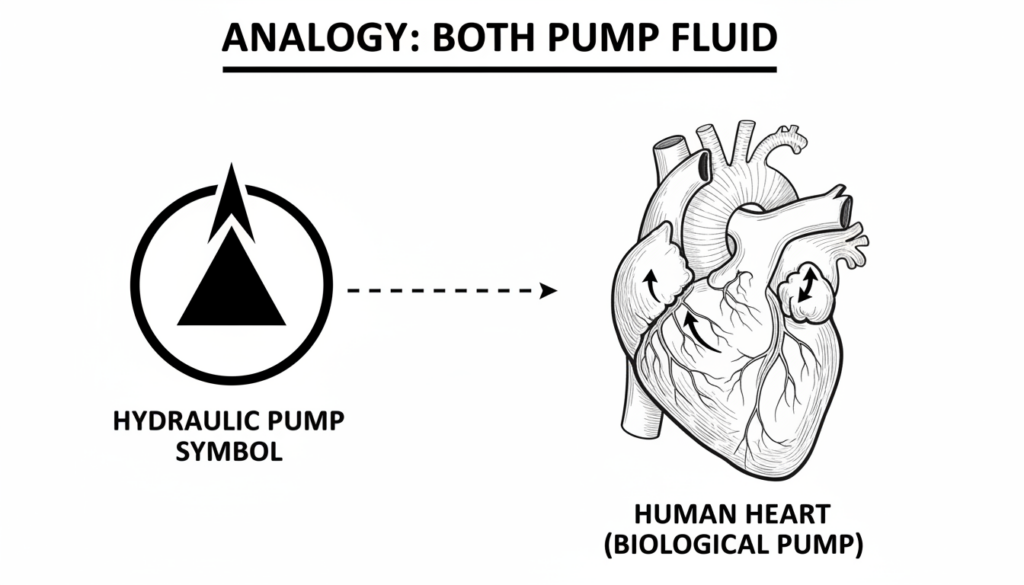
If the oil is the blood of the machine, the Pump is the heart.
Function
The pump’s job is to take the oil from the tank and push it into the system.
- Important Note: Many people think the pump creates pressure. Actually, the pump only creates flow (movement). Pressure is only created when the flowing oil meets resistance (like a heavy weight it has to lift).
Think of a garden hose. The tap (pump) makes the water flow. But the pressure that sprays the water far only happens when you put your thumb over the end (resistance).
The Symbol
The symbol for a pump is a circle.
- Standard Symbol: A circle with a small triangle (arrow) inside pointing outwards. This arrow shows the direction the oil is leaving.
Inquiry Challenge
Check Your Understanding:
If the pump is running, but the oil is flowing through a pipe that has no end and no weight to lift, is there high pressure or just high flow? Why?
4. The Valves: The Traffic Controllers
Once the oil leaves the pump, it needs to know where to go. This is where Valves come in. They are like the traffic lights and police officers of the system. We use two main types in a simple circuit.
A. Pressure Relief Valve (The Safety Guard)
Imagine the pump keeps pushing oil, but the cylinder is stuck. The pressure would build up until a pipe bursts! The Pressure Relief Valve is a safety door. If the pressure gets too high, this valve opens and sends the oil straight back to the tank to prevent an explosion.
- Symbol: A square with an arrow that is usually disconnected, but connects if pushed by a spring.
B. Directional Control Valve (The Steering Wheel)
This valve decides if the machine goes “Up” or “Down,” “Left” or “Right.” It has a lever you can pull.
- Lever Pushed: Oil goes to the bottom of the cylinder (Machine goes UP).
- Lever Pulled: Oil goes to the top of the cylinder (Machine goes DOWN).
- Symbol: Three squares connected together. Inside the squares are arrows showing crossing paths or straight paths.

Inquiry Challenge
Scenario:
You are riding a bicycle. You use the handlebars to steer (Directional Valve). But what acts as the “Pressure Relief Valve” on a bike if you go too fast over a bump? (Hint: What absorbs the shock so the bike doesn’t break?)
5. The Actuator: The Muscle
Finally, the oil reaches the part that actually does the work. This is called the Actuator. In our simple circuit, we will use a Cylinder.
Function
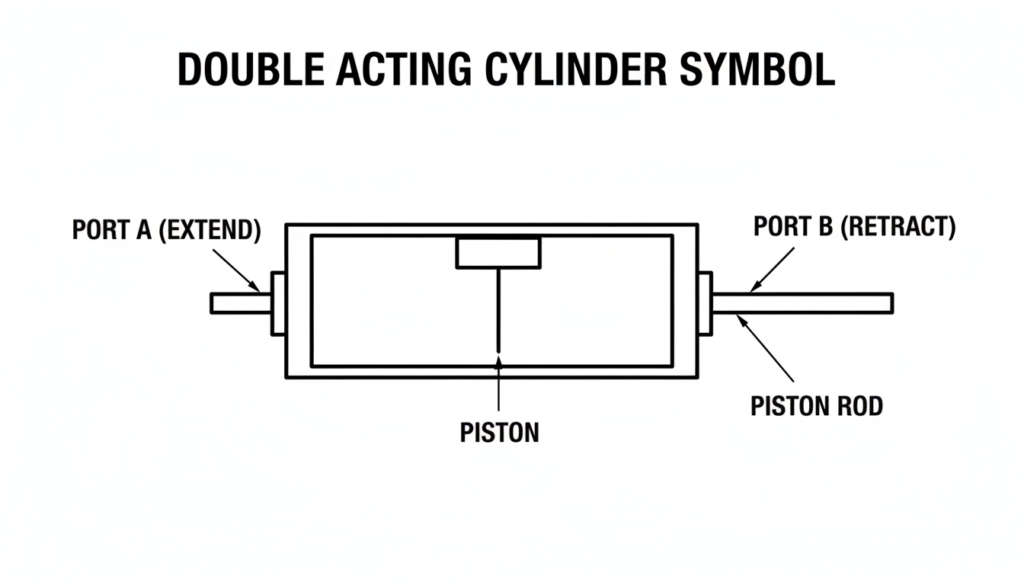
The cylinder converts the fluid power back into mechanical power.
- Extension: Oil pushes the piston out (Lifting).
- Retraction: Oil pushes the piston back in (Lowering).
It looks like a bicycle pump. It has a barrel (the tube) and a rod that slides in and out.
The Symbol
- Standard Symbol: A rectangle representing the barrel, with a T-shaped line inside representing the piston and rod.
Inquiry Challenge
Observation:
Look at a screen door closer or the trunk of a hatchback car. Can you spot the cylinder? Which part is the “barrel” and which part is the “rod”?
6. Drawing the Full Circuit
Now, let’s connect all these symbols to create a Simple Hydraulic Circuit. This is the map engineers use.
The Path of the Oil (The Story)
- Start: Oil sits in the Reservoir.
- Move: The Pump sucks oil up and pushes it out.
- Safety Check: The oil passes the Relief Valve. If pressure is okay, it keeps going.
- Decision: The oil reaches the Directional Valve. The operator pulls the lever.
- Action: The valve sends oil to the Cylinder. The cylinder extends and lifts a load.
- Return: The “used” oil on the other side of the cylinder is pushed out, goes back through the valve, and travels down the return line back to the Reservoir.
The Diagram
Below is how we draw it. Notice how we use straight lines to connect the symbols. These lines represent the Pipes or Hoses.
- Solid Lines: Working lines (pipes carrying oil).
- Zig-Zag Lines: Springs (inside valves).
- Bottom: Reservoir symbol.
- Above Reservoir: Pump symbol connected to a motor (M).
- Right of Pump: Pressure Relief Valve connected to the line, draining back to tank.
- Above Pump: A 4-port, 3-position Directional Control Valve (square symbols).
- Top: A Double Acting Cylinder.
Lines connect Pump to Valve, Valve to Cylinder, and Valve back to Tank.]
Why This Matters
This simple loop is the same logic used in:
- Excavators: Digging holes.
- Car Brakes: Stopping your car.
- Barber Chairs: Lifting you up for a haircut.
- Theme Park Rides: Making the ride move smoothly.
Inquiry Challenge
Synthesis:
If you wanted the cylinder to move faster, which part of the circuit would you need to change? The size of the cylinder, or the speed of the pump? Why?
7. The Magic of Math: Why Liquid?
You might wonder, “Why use messy oil? Why not just use air?”
The secret is that liquids are Incompressible. This means you cannot squeeze liquid into a smaller space. If you push 1 liter of oil into a pipe, exactly 1 liter must come out the other end instantly. This makes hydraulics very stiff and strong.
We use a simple relationship to measure how strong our “muscle” is:
Force=Pressure×Area
- Force (FF): How much weight we can lift (measured in Pounds or Newtons).
- Pressure (PP): How hard the pump is pushing (measured in PSI or Bar).
- Area (AA): How big the piston in the cylinder is.
The Big Secret: If you want to lift a heavier rock, you don’t always need a bigger pump. You just need a wider cylinder (larger Area). A wider cylinder gives the oil more space to push against!
Inquiry Challenge
Math Connection:
If you have a pressure of 100 pounds pushing on a surface area of 2 square inches, what is the total Force? (100×2=?)
8. Summary and Safety
Recap
- Reservoir: The bathtub (Storage).
- Pump: The heart (Flow).
- Valves: The traffic cops (Direction and Safety).
- Cylinder: The muscle (Work).
- Pipes: The veins (Transport).
A Note on Safety
Hydraulic systems are very strong. The oil inside is under high pressure. Never disconnect a hose while the pump is on, and never search for a leak with your finger (the oil can be sharp like a needle!). Always respect the machine.
By understanding these simple symbols, you can now read the “map” of almost any heavy machine you see on a construction site!
Inquiry Challenge
Final Reflection:
We used the analogy of the human body (Heart, Muscle, Veins) to explain hydraulics. Can you think of a different analogy? How is a hydraulic system like a water gun fight?
