Introduction to Fluid Power
Imagine you are riding a bicycle. To move forward, your feet push the pedals, the chain moves, and the back wheel turns. This is a mechanical connection. The parts touch each other directly.
But what if you could turn the wheels without solid parts touching? What if you could use a liquid, like oil, to push the wheels? This is the magic of Hydrodynamic Transmission.
In an automobile, this system sits between the engine and the wheels. It uses the energy of moving fluid (usually oil) to transmit power. It is the heart of most automatic cars.
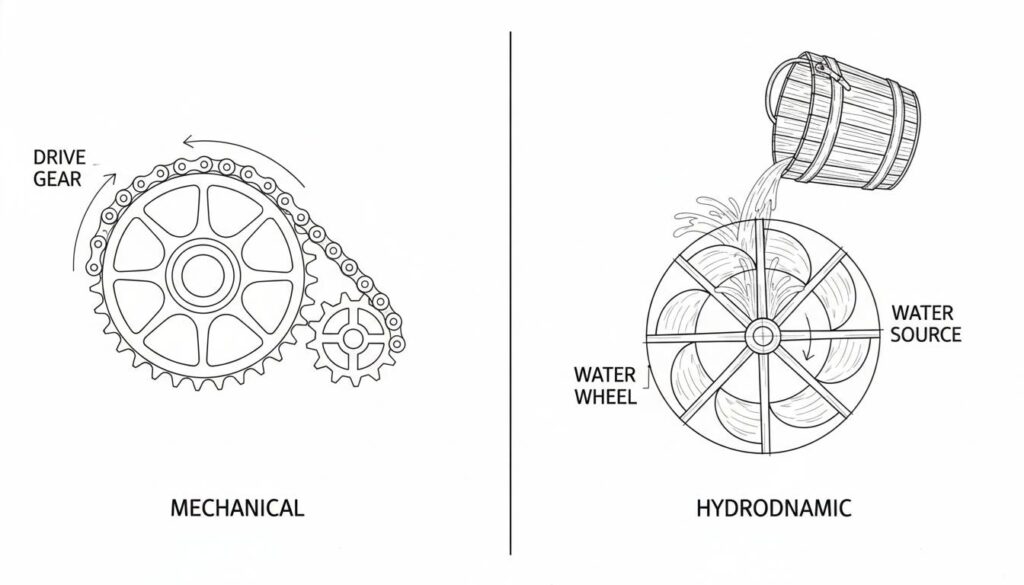
Technical Diagram: A simple split-screen illustration. Left side: A bicycle chain connecting two gears (labeled ‘Mechanical’). Right side: A bucket of water being poured onto a water wheel, making it spin (labeled ‘Hydrodynamic’). If we use liquid to move the car instead of solid gears, what happens when the car stops at a red light? Does the engine have to stop too, or can the liquid just “slip” by?
The Core Concept: The “Two Fans” Analogy
To understand how this works, we don’t need complex math. We just need two electric fans.
The Experiment
Imagine you have two desk fans.
- Fan A is plugged into the wall.
- Fan B is unplugged.
- You place them face-to-face, very close to each other.
When you turn on Fan A, it blows air. That moving air hits the blades of Fan B. Even though Fan B is unplugged, it starts to spin!
Applying it to Cars
In a car, we swap the air for transmission fluid (oil) because oil is heavier and pushes harder than air.
- Fan A is the Pump (Impeller). It is connected to the engine.
- Fan B is the Turbine. It is connected to the wheels.
- The housing is filled with oil.
When the engine spins the Pump, it throws oil at the Turbine. The Turbine catches the oil and spins the wheels.

Technical Diagram: A 3D diagram showing two fans facing each other inside a sealed glass box filled with blue liquid. The left fan is labeled ‘Pump (Engine)’ and is spinning fast. The right fan is labeled ‘Turbine (Wheels)’ and is starting to spin. Why do you think we use oil instead of water in a car transmission? Think about what happens to water when it gets very hot (boiling) or very cold (freezing).
The Components of Hydrodynamic Transmission
There are two main types of devices used in cars: the Fluid Coupling and the Torque Converter.
Fluid Coupling
This is the simplest form. It looks like a donut cut in half.
- The Pump (Impeller): This is the “throwing” side. As it spins, centrifugal force (like a spinning carnival ride) throws oil outward.
- The Turbine (Runner): This is the “catching” side. The oil hits it and pushes it around.
Limitation: A fluid coupling can transfer power, but it cannot multiply force. It is like a direct 1:1 connection that slips a little bit.
The Torque Converter
Modern automatic cars use a Torque Converter. It is a Fluid Coupling with one extra, very special part: the Stator.
The Stator: The Secret Weapon
In a normal fluid coupling, the oil hits the Turbine and bounces back. This bouncing oil splashes against the Pump and slows it down. It is inefficient.
The Stator is a small wheel that sits between the Pump and the Turbine. It acts like a traffic cop. It redirects the bouncing oil so that it helps push the Pump faster instead of slowing it down.
The Result: The engine gets a boost! This allows the car to accelerate quickly from a stop. This is called Torque Multiplication.
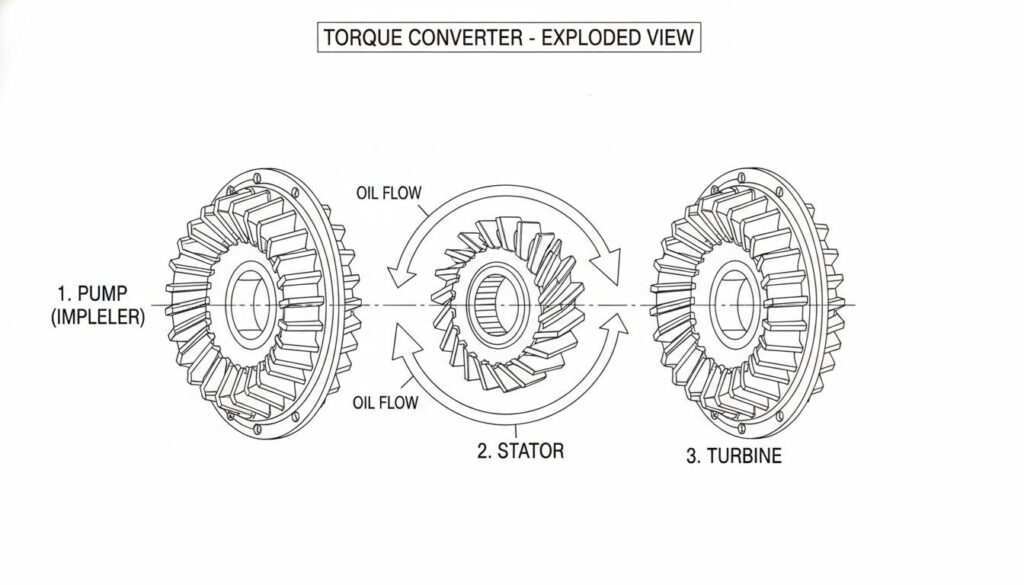
Technical Diagram: An exploded view of a Torque Converter. Show three main parts separated: 1. The Pump (Impeller), 2. The Stator (small wheel in the middle), 3. The Turbine. Arrows show the flow of oil going from Pump -> Turbine -> Stator -> back to Pump. Imagine you are spraying a hose at a water wheel. If the water bounces off the wheel and hits you in the face, it pushes you back. If you had a shield that reflected that water back at the wheel, would it help the wheel spin faster?
Why Use Hydrodynamic Transmission?
1. Smoothness
Because there is no solid metal connection, there are no jerky movements. The fluid absorbs shocks. It feels like stirring honey—smooth and consistent.
2. Anti-Stall
In a manual car (stick shift), if you stop the wheels without disconnecting the engine, the engine dies (stalls).
In a hydrodynamic system, if you hold the brakes, the Turbine stops spinning, but the Pump keeps spinning. The fluid just churns inside. The engine stays running even when the car is stopped.
3. Automatic Multiplication
The Torque Converter automatically gives you more pushing power (torque) when the car is starting from a stop, exactly when you need it most.
Summary
Hydrodynamic transmission uses the energy of moving fluid to power a car.
- The Pump throws the fluid (powered by the engine).
- The Turbine catches the fluid (powers the wheels).
- The Stator redirects the fluid to make the system stronger (Torque Multiplication).
It creates a smooth ride and prevents the engine from stalling at red lights.
We know this system is smooth. But do you think it is 100% efficient? Does the “catching” fan ever spin exactly as fast as the “throwing” fan, or is some energy lost in the fluid?
