This lesson covers the fundamentals of mechanical power systems, torque, rotational speed, and power transmission. We will explore how machines move energy using gears, belts, and chains.
What is a Mechanical Power System?
A mechanical power system is a group of parts that work together to move energy. It takes energy from a source (like an engine or a motor) and moves it to where it is needed (like the wheels of a car).
Think of a bicycle. Your legs provide the energy. The pedals, chain, and gears are the power system. They take the push from your legs and turn the back wheel. Without this system, the bike would not move.
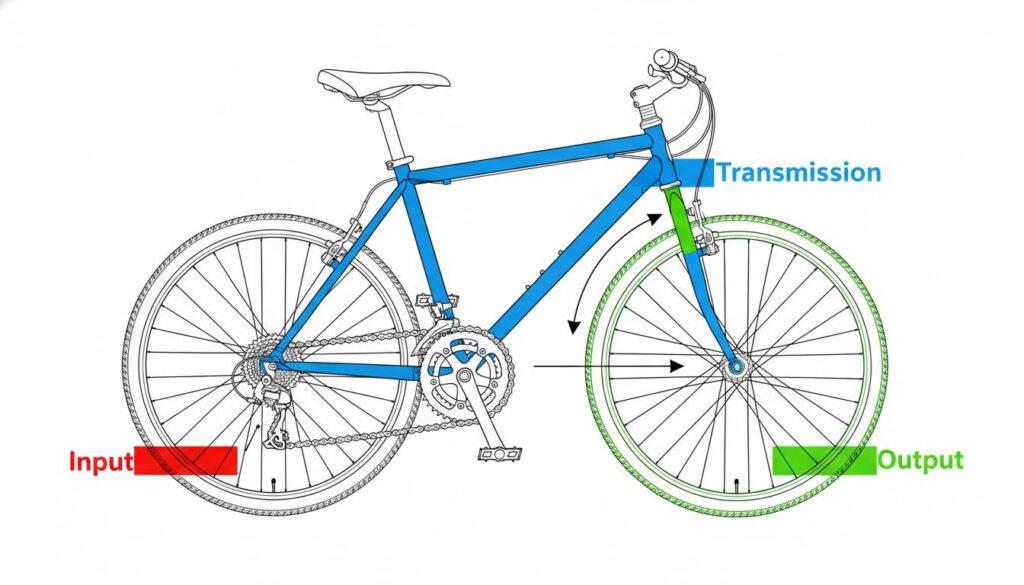
Technical Figure: A simple 2D diagram of a bicycle. Highlight the pedals (Input), the chain and gears (Transmission), and the rear wheel (Output) in different bright colors to show the flow of power.
The Three Main Parts
Every mechanical power system has three jobs:
- Input: Where the power starts (Example: An electric motor).
- Transmission: How the power travels (Example: Gears or chains).
- Output: Where the work gets done (Example: A spinning fan blade).
Look at a standard household fan. Can you identify the Input (what makes it spin), the Transmission (what connects the motor to the blades), and the Output (what actually moves the air)?
The Ingredients of Power
To understand how machines work, you need to know two special words: Torque and Speed.
Torque: The Twisting Force
Torque is a twisting force. It is not just a push; it is a push in a circle.
Imagine opening a heavy door.
- If you push near the handle, it is easy. You have high torque.
- If you push near the hinges, it is very hard. You have low torque.
Torque is what gets heavy things moving. A tractor needs a lot of torque to pull a heavy plow.
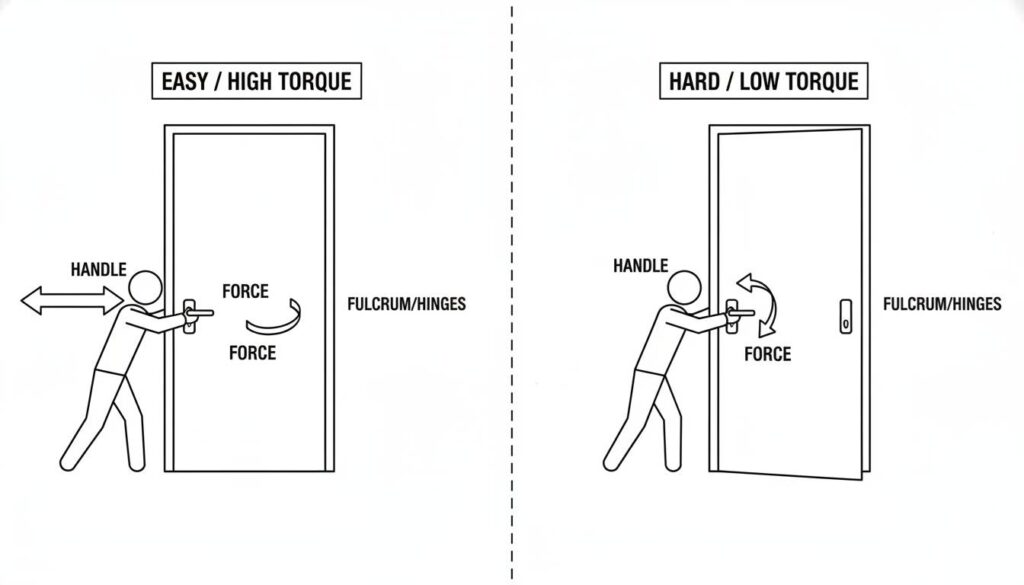
Technical Figure: A split illustration showing a person pushing a door. On the left, they push near the handle (Easy/High Torque). On the right, they push near the hinges (Hard/Low Torque). Use arrows to show the force.
Speed: How Fast It Spins
In mechanical systems, we measure speed in RPM. This stands for Revolutions Per Minute. It counts how many times a part spins around in one minute.
- High RPM: A dentist’s drill spins very fast.
- Low RPM: A Ferris wheel spins very slowly.
The Power Equation
Power is a mix of Torque and Speed.
Power = Torque × Speed
You can have high torque and low speed (like a bulldozer).
Or you can have low torque and high speed (like a race car engine).

Technical Figure: A visual comparison. Left side: A bulldozer pushing a huge rock (Label: High Torque, Low Speed). Right side: A Formula 1 car speeding down a track (Label: Low Torque, High Speed).
Imagine you are using a screwdriver to put a screw into hard wood. Do you need your hand to move very fast (Speed), or do you need to twist very hard (Torque)? Why?
Transmitting Power: The Connectors
We use different parts to move power from the input to the output. These are called transmission elements.
Gears
Gears are wheels with teeth. The teeth lock together. When one gear turns, it pushes the other gear to turn. Gears are very strong. They do not slip. You find them in cars, clocks, and drills.
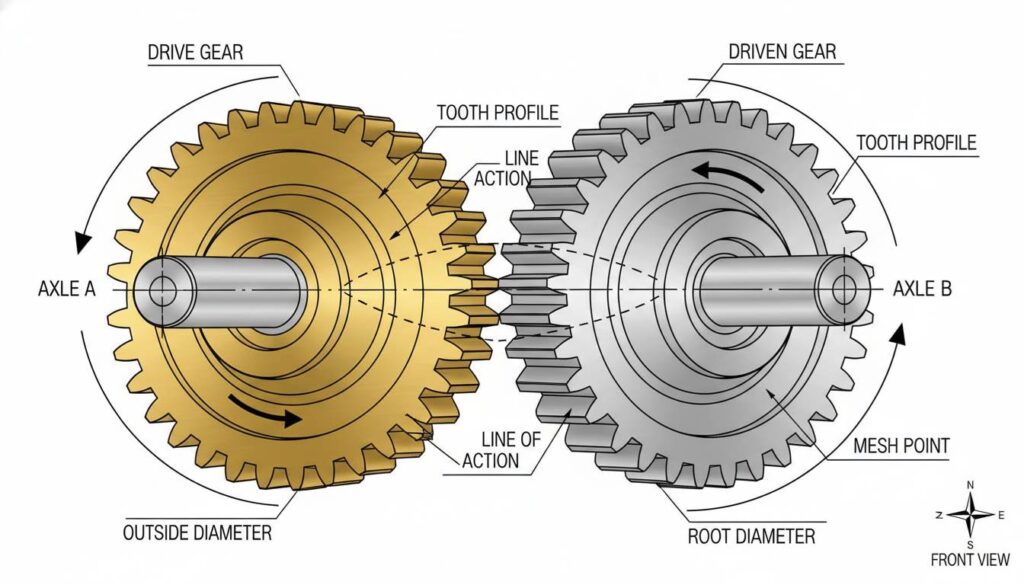
Technical Figure: Close-up 3D render of two metal spur gears meshing together. The teeth are clearly interlocking. One gear is gold, the other is silver.
Belts and Pulleys
A pulley is a wheel with a groove. A belt is a rubber loop that goes around two pulleys. When one pulley turns, the belt pulls the other pulley.
Belts are quiet and smooth. If the machine gets stuck, the belt can slip. This protects the motor from breaking. You find these in washing machines.
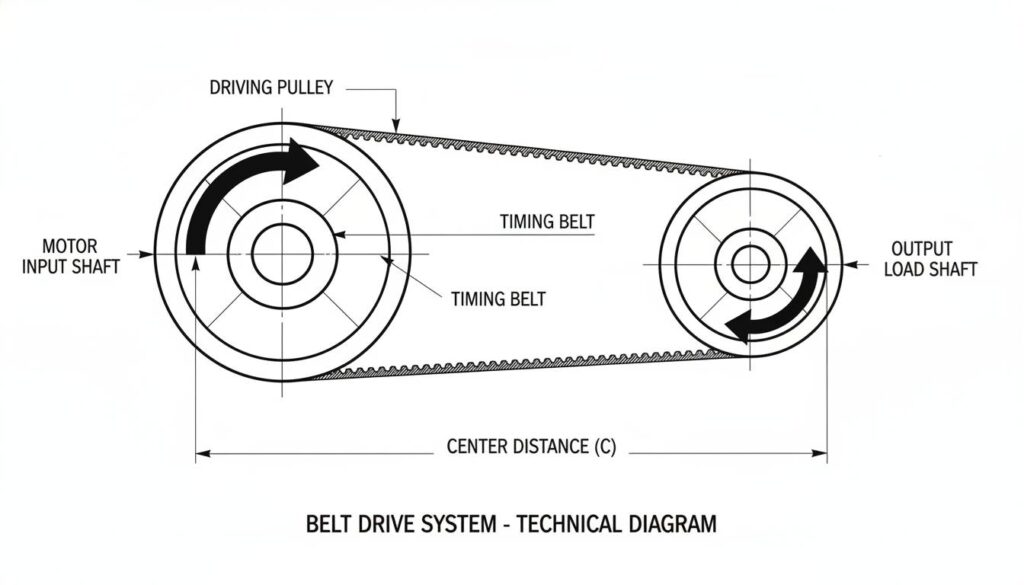
Technical Figure: Diagram of a belt drive system. Two pulleys connected by a black rubber belt. Show an arrow indicating the direction of rotation for both pulleys.
Chains and Sprockets
This is exactly like a bicycle. A sprocket is a gear with teeth designed to fit into a chain. The chain connects two sprockets.
Chains are strong like gears, but they can connect parts that are far apart like belts. They are noisy and need oil.
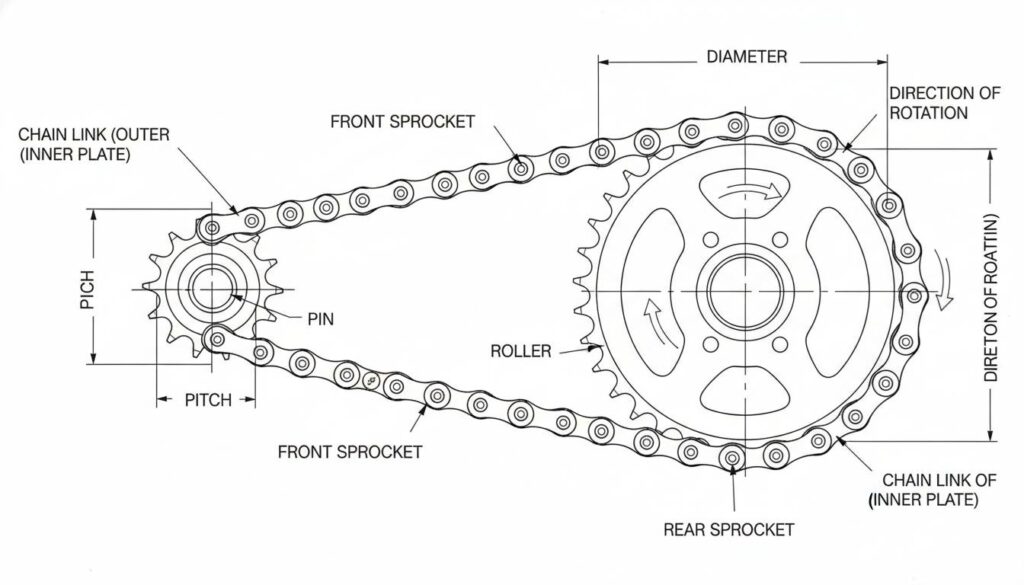
Technical Figure: A side view of a bicycle chain wrapped around two sprockets. Show the metal links of the chain engaging with the teeth of the sprockets.
Why do you think a motorcycle uses a chain instead of a smooth rubber belt? Think about how much power a motorcycle engine has compared to a washing machine.
Changing the Output: Gear Ratios
We can use gears to trade speed for torque. This is called a Gear Ratio.
Speed vs. Strength
Imagine a small gear driving a big gear.
- The Small Gear (Driver): Has 10 teeth.
- The Big Gear (Driven): Has 20 teeth.
The small gear has to spin twice to make the big gear spin once.
Result: The big gear spins slower, but it pushes with twice the torque. It is stronger.
The Reverse
Now imagine a big gear driving a small gear.
- The Big Gear (Driver): Has 20 teeth.
- The Small Gear (Driven): Has 10 teeth.
One turn of the big gear makes the small gear spin twice.
Result: The small gear spins faster, but it has less torque. It is weaker.
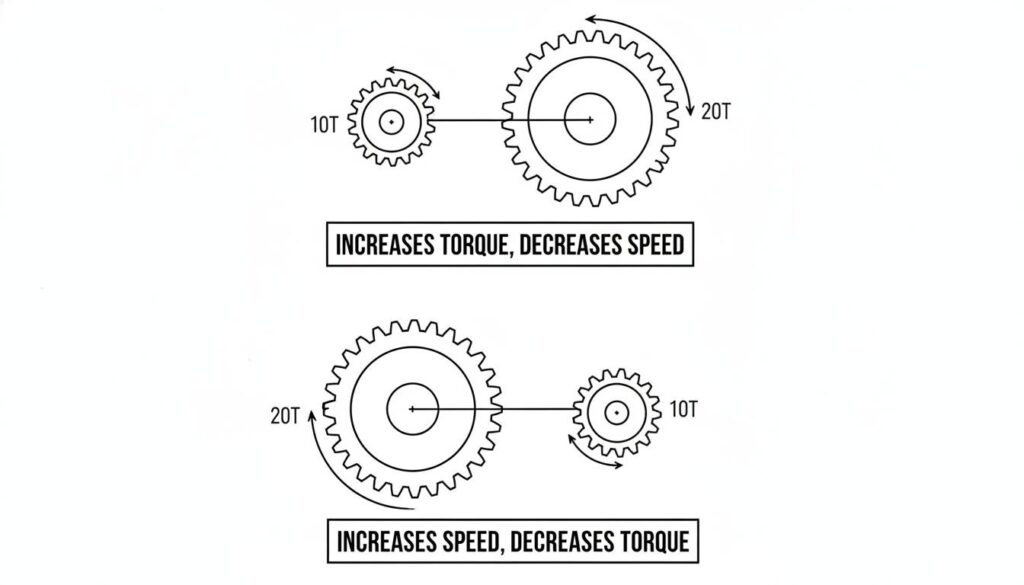
Technical Figure: A diagram showing gear ratios. Top: A small gear (10 teeth) turning a large gear (20 teeth) with a label “Increases Torque, Decreases Speed”. Bottom: A large gear (20 teeth) turning a small gear (10 teeth) with a label “Increases Speed, Decreases Torque”.
When you ride a bike up a steep hill, you switch gears. Do you switch to a setting that makes your feet spin fast (easy pedaling) or slow (hard pedaling)? Does this give you more speed or more torque?
