
What is a Phosphoric Acid Fuel Cell?
Think of a battery. A battery stores energy, but eventually, it dies. You have to recharge it or throw it away.
Now, imagine a battery that never dies. As long as you keep feeding it fuel, it keeps making electricity. That is a Fuel Cell.
A Phosphoric Acid Fuel Cells (PAFC) is a specific type of fuel cell. It is like a power plant that fits in a large box. It uses hydrogen gas as fuel. It is very popular for powering big buildings like hospitals, schools, and shopping malls.
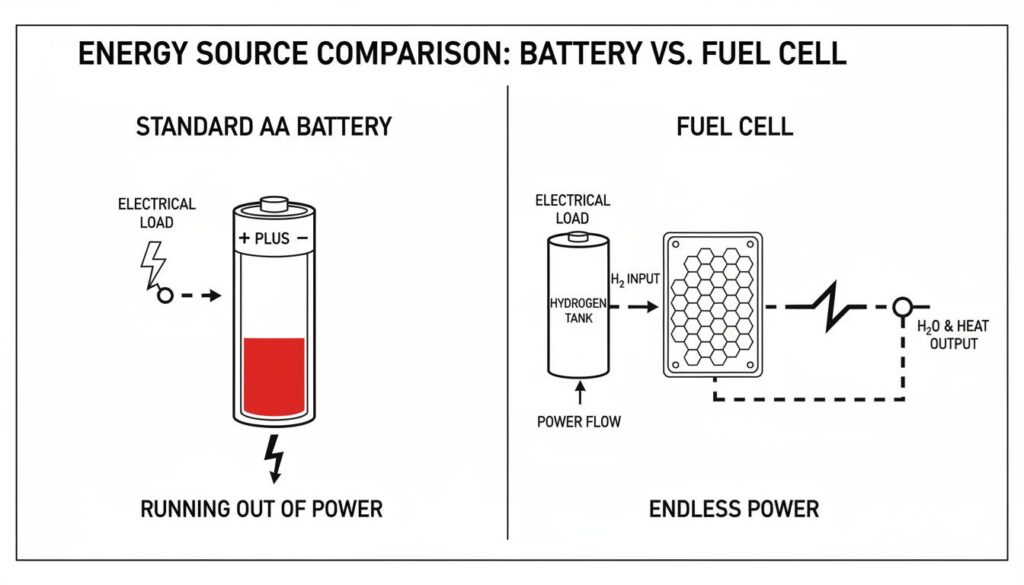
Technical Figure: A simple split-screen comparison illustration. On the left, a standard AA battery running out of juice (red bar). On the right, a boxy Fuel Cell connected to a hydrogen tank with a continuous lightning bolt symbol showing endless power.
The “Sandwich” Structure
A PAFC looks like a sandwich. It has three main layers.
- The Anode (The Negative Side): This is where the fuel (hydrogen) enters.
- The Electrolyte (The Filling): This is the special part. It is made of liquid Phosphoric Acid.
- Fun Fact: Phosphoric acid is the same ingredient that gives some sodas (like cola) their tangy taste! In a fuel cell, it is much stronger and held inside a sponge-like material.
- The Cathode (The Positive Side): This is where air (oxygen) enters.

Technical Figure: A 3D cross-section diagram of a PAFC “sandwich”. Label the top layer ‘Anode’, the middle porous layer ‘Phosphoric Acid Electrolyte’, and the bottom layer ‘Cathode’. Show hydrogen entering the top and air entering the bottom.
If a battery stores energy like a water bottle stores water, a fuel cell is like a water tap. As long as the pipe (fuel line) is connected, the water (electricity) flows. Why do you think we use fuel cells for hospitals instead of just batteries?
How Does It Work?
The magic happens when we push hydrogen into the cell. We want to make electricity. Electricity is just the flow of electrons.
Step 1: The Break Up
Hydrogen gas (H2) flows into the Anode. The Anode is coated with a precious metal called Platinum.
Platinum is a catalyst. A catalyst is a helper. It grabs the hydrogen atoms and splits them apart.
- The Hydrogen splits into Protons (positive charge) and Electrons (negative charge).
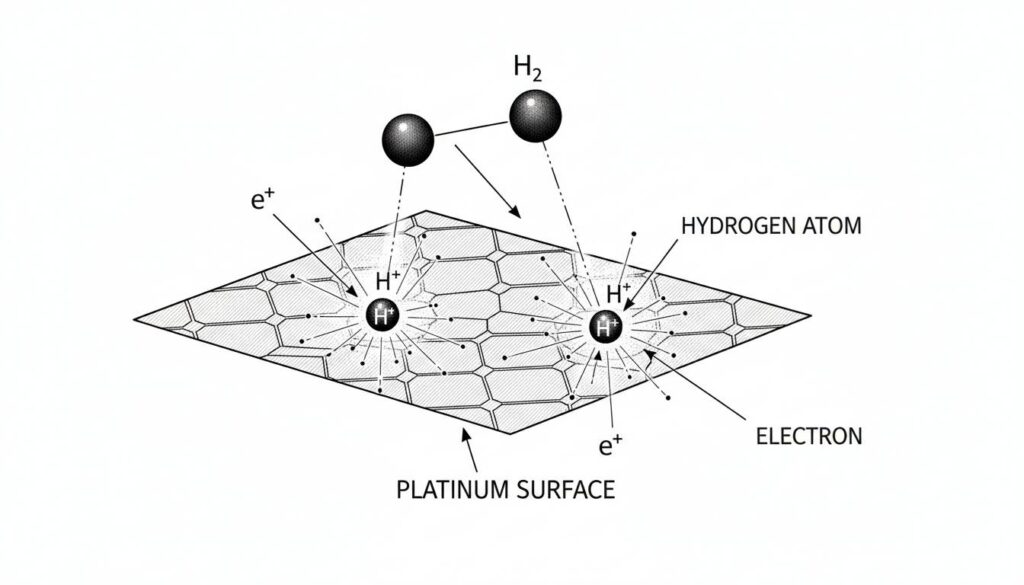
Technical Figure: A close-up zoom illustration at the molecular level. Show a Hydrogen molecule (two joined spheres) hitting a Platinum surface and breaking into two separate protons and two glowing electrons.
Step 2: The Detour
This is the most important part. The protons and electrons want to get to the other side (the Cathode), but they have to take different paths.
- The Protons: They are allowed to swim straight through the Phosphoric Acid in the middle.
- The Electrons: They are blocked! The acid will not let them pass. They are forced to travel through an outside wire.
When electrons flow through that wire, they create electricity. This wire connects to your lightbulb, your computer, or an electric motor.

Technical Figure: A schematic diagram showing the flow path. Red arrows (Protons) swim through the center liquid layer. Yellow arrows (Electrons) travel up and around through an external wire, lighting up a lightbulb, before returning to the bottom layer.
Step 3: The Reunion
The electrons finish their work and arrive at the Cathode. The protons swim through the acid and also arrive at the Cathode.
Here, they meet Oxygen from the air.
- Protons + Electrons + Oxygen = Water (H2O).
The only exhaust coming out of this machine is pure water and heat. No black smoke. No pollution.
The electrons are forced to take the “long way” around through the wire. Imagine if the acid let the electrons swim through the middle too. Would the lightbulb turn on? Why or why not?
Efficiency and Heat
Engines get hot. Usually, heat is wasted energy. But PAFCs are smart.
Combined Heat and Power (CHP)
A Phosphoric Acid Fuel Cell runs hot. It operates at about 200°C (400°F). That is hot enough to bake a cake!
Instead of letting this heat escape, engineers capture it.
- The fuel cell makes electricity for the lights.
- The heat is used to boil water for the building’s heating system or showers.
This is called Cogeneration or CHP. It makes the PAFC very efficient. It uses almost 85% of the energy in the hydrogen fuel.
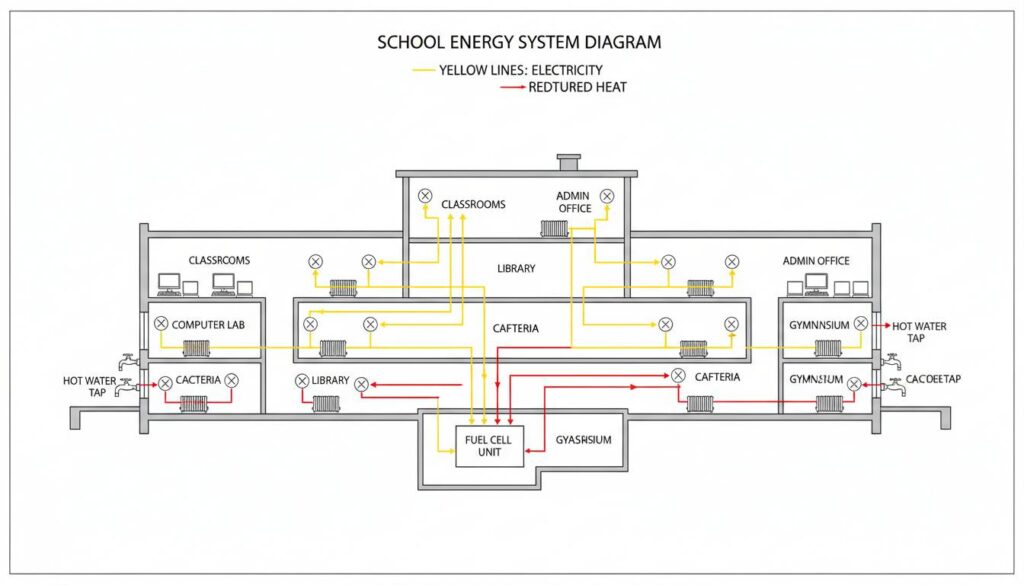
Technical Figure: An infographic of a building (like a school). Show a fuel cell unit in the basement. Show yellow lines (electricity) going to lights and computers. Show red lines (captured heat) going to radiators and hot water taps.
Pros and Cons
Nothing is perfect. Let’s look at the good and the bad.
The Good (Advantages)
- Reliable: They are very stable. They can run for years without stopping.
- Quiet: There are no exploding pistons like in a car engine. It is just a chemical reaction.
- Clean: The exhaust is water vapor.
- Tolerant: Some fuel cells break if the hydrogen isn’t 100% pure. PAFCs are tough. They can handle “dirty” hydrogen that has a little bit of carbon monoxide in it.
The Bad (Disadvantages)
- Heavy and Big: These are large units. You cannot put one in a regular car or a phone. They are too heavy.
- Expensive: Remember the Platinum catalyst? Platinum is more expensive than gold. This makes the fuel cell cost a lot of money.
- Slow Start: Because they run at 200°C, they take a long time to warm up. You cannot just turn the key and go immediately.
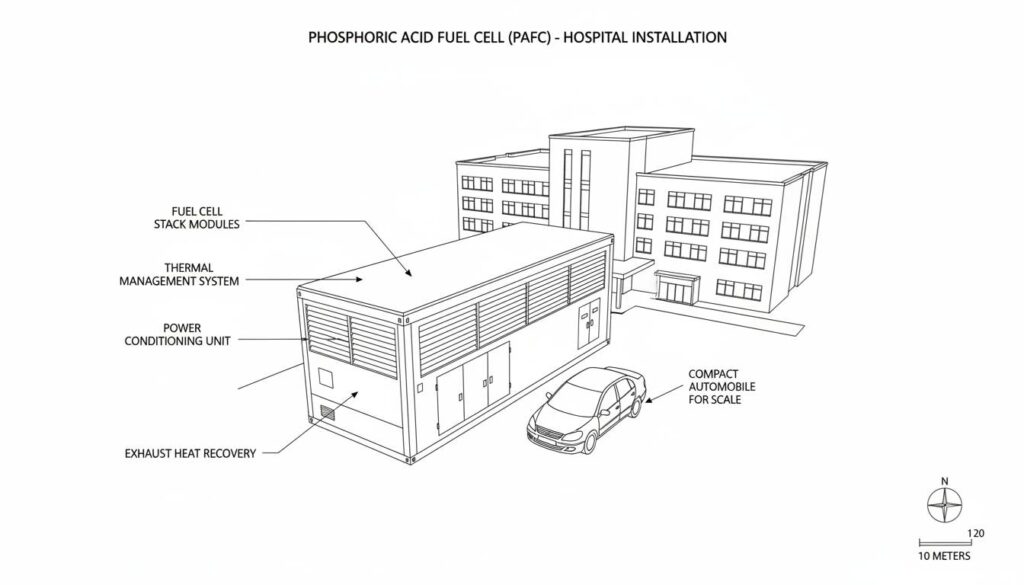
Technical Figure: A large, stationary PAFC unit installed next to a hospital. It looks like a large metal shipping container with vents. Contrast this with a small car to show scale (the unit is much bigger than a car).
PAFCs are heavy and take a long time to warm up. Why does this make them bad for a personal car, but excellent for a hospital or a city bus that runs all day?
