What is Pneumatics?
Pneumatics is a way to move machines using air. But not just the air around you. We use compressed air.
Think about a balloon. When it is empty, it is floppy. When you blow air into it, it gets hard. If you let go of the nozzle, the air rushes out and the balloon flies across the room. That is pneumatic power. You squeezed air into a small space, and it wants to get out. We use that energy to do work.
In engineering, we trap this air and force it to push heavy things, lift robot arms, or close the doors on a bus.
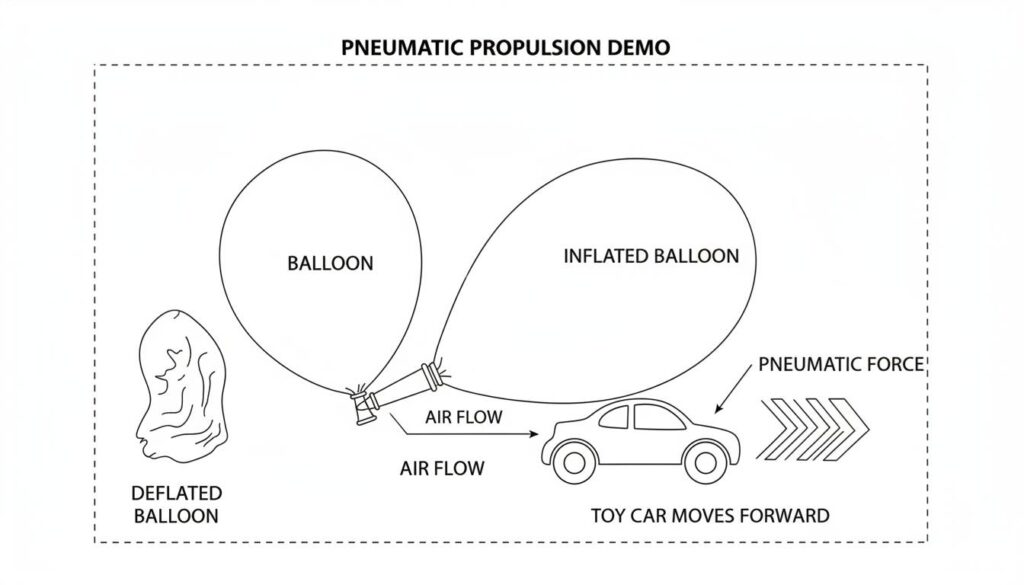
Technical Figure: A simple cartoon illustration comparing a deflated balloon to an inflated balloon. Arrows show air rushing out of the inflated balloon to push a toy car forward, illustrating basic pneumatic force.
The “Squishy” Science of Air
Air is a gas. Gases are “squishy.” In engineering terms, we say air is compressible.
Imagine a sponge. You can squeeze a big sponge into a tiny ball. Air is the same. You can take a lot of air and force it into a small metal tank. The air pushes back against the walls of the tank. This pushing force is called pressure.
Imagine you have a bicycle pump. You put your thumb over the end of the hose and push the handle down.
- Can you push the handle down a little bit?
- What do you feel against your thumb?
- If you let go of the handle, what happens?
Hint: Think about the air acting like a spring.
The Main Parts of a Pneumatic Power Systems
A pneumatic system is like a team. Every player has a job. Here are the four main players.
The Compressor (The Muscle)
The compressor is a pump. Its job is to take the air from the room and squash it. It packs the air tightly together. This creates high pressure.
Think of the compressor like you blowing up a beach ball. You are the pump. You are forcing air inside.

Technical Figure: A technical diagram of a piston air compressor. Show a piston moving up inside a cylinder, squeezing blue dots (representing air molecules) into a tight space.
The Receiver (The Storage)
Once the compressor squashes the air, we need a place to keep it. We put it in a Receiver. This is just a strong metal tank. It holds the air until we are ready to use it.
If the compressor is the muscle, the receiver is the battery. It stores the energy.
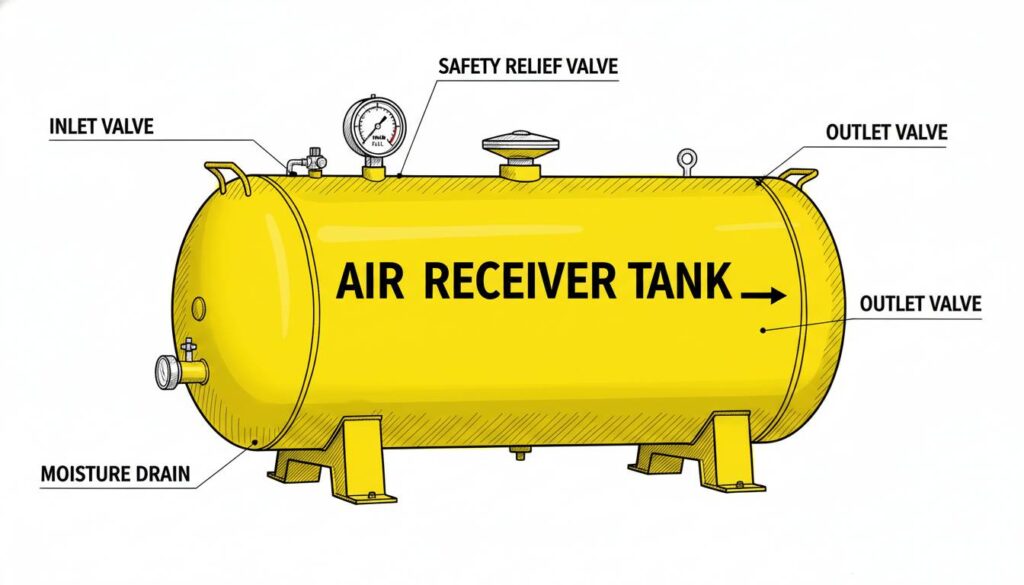
Technical Figure: A photo-realistic illustration of a large, horizontal yellow air tank (receiver) in a workshop setting. Show a pressure gauge on the side indicating ‘Full’.
The Valves (The Brains)
We have stored energy in the tank. Now we need to control it. We use valves.
A valve is like a light switch or a faucet. It tells the air where to go.
- Open the valve: Air flows through.
- Close the valve: Air stops.
- Switch the valve: Air goes to a different pipe.
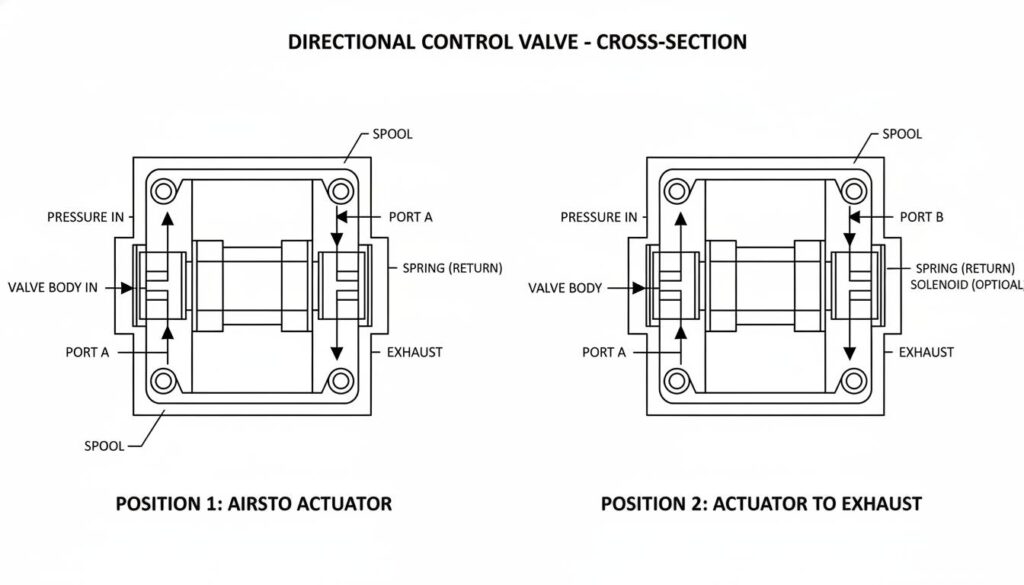
Technical Figure: A cross-section diagram of a directional control valve. Show a spool inside shifting left and right to block or open different pathways for the air flow.
The Actuator (The Mover)
This is the part that actually does the work. The most common type is a Pneumatic Cylinder.
A cylinder is a tube with a disc inside it called a piston. The piston is attached to a rod.
- Air rushes into the bottom of the tube.
- It pushes the piston up.
- The rod moves out.
This is exactly how a syringe works. If you push the plunger, liquid comes out. In pneumatics, we push air in to make the plunger move out.

Technical Figure: A clear 3D cutaway of a pneumatic cylinder. Show compressed air (colored blue) entering one side and pushing a piston and rod (colored silver) outward to the right.
Look at the doors on a city bus. When the driver pushes a button, the doors hiss and swing open.
- What sound do you hear? (The hiss).
- What is making that sound?
- Which part of the system (Compressor, Tank, Valve, or Actuator) is actually pushing the door open?
How It Works: The Step-by-Step Path
Let’s trace the journey of the air. Imagine we are building a machine to crush a soda can.
Step 1: Compression
The electric motor turns on. The compressor sucks in air and squeezes it. The air gets hot and angry.
Step 2: Storage
The air sits in the receiver tank. It waits there under high pressure.
Step 3: Control
You press a button. This opens the valve. The valve creates a path from the tank to the crusher.
Step 4: Action
The air rushes through a hose into the cylinder. It slams the piston down. The piston crushes the soda can.
Step 5: Exhaust
You let go of the button. The valve switches. The air inside the cylinder is released back into the room. This is the “Pshhh!” sound you hear.
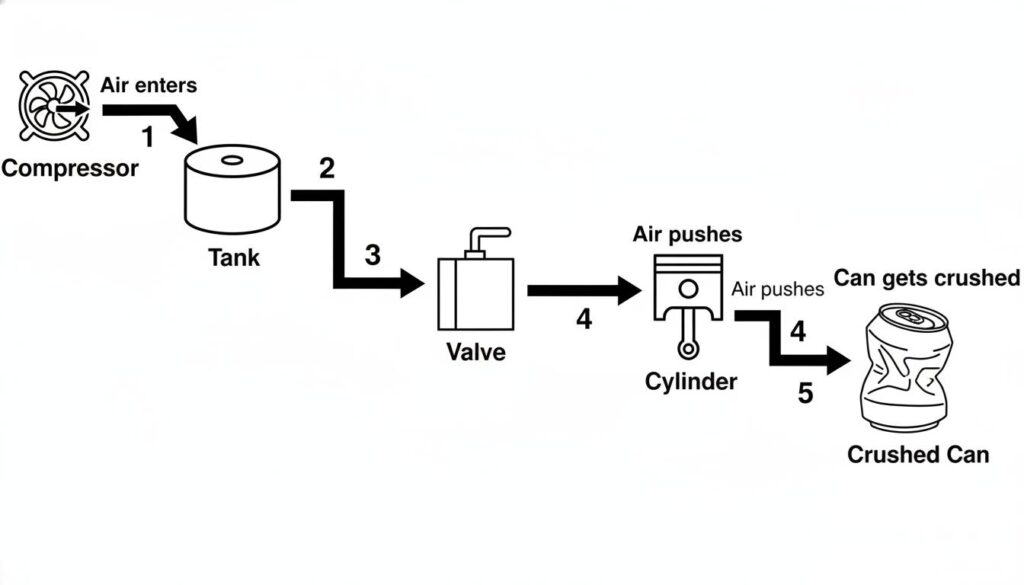
Technical Figure: A flowchart diagram with simple icons. Arrow 1: Air enters Compressor. Arrow 2: Air goes to Tank. Arrow 3: Air goes through Valve. Arrow 4: Air pushes Cylinder. Arrow 5: Can gets crushed.
Pneumatics vs. Hydraulics
You might have heard of Hydraulics. Hydraulics use liquid (oil) instead of air. What is the difference?
The “Spring” Factor
- Pneumatics (Air): Air is bouncy. If you push a pneumatic cylinder halfway, it might bounce a little. It is fast but not super precise.
- Hydraulics (Oil): You cannot squeeze oil. It is rock hard. If you stop a hydraulic cylinder, it stops exactly there. It is very strong and precise.
Analogy:
- Pneumatics: Jumping on a trampoline.
- Hydraulics: Jumping on a concrete floor.
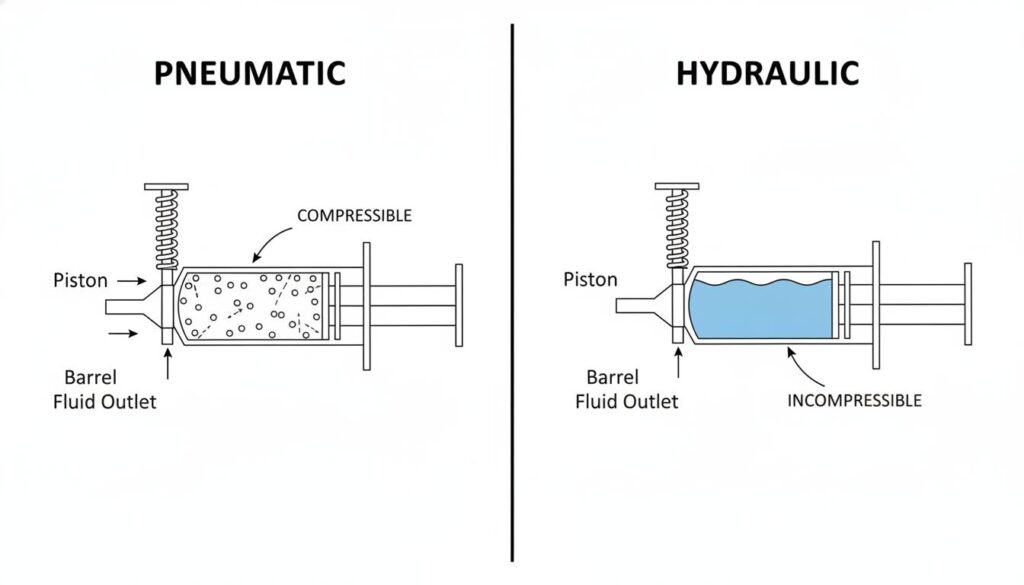
Technical Figure: A split comparison image. Left side labeled ‘Pneumatic’: A syringe filled with air being compressed (springy). Right side labeled ‘Hydraulic’: A syringe filled with blue water that cannot be compressed (solid).
Think about a heavy excavator digging up dirt. It needs to hold a heavy bucket of rocks perfectly still in the air.
- Should it use Pneumatics (Air) or Hydraulics (Oil)?
- Why? Remember the “bouncy” rule.
Why Do We Use Pneumatics?
If hydraulics are stronger, why do we use air?
1. It is Clean
If a pneumatic pipe leaks, only air comes out. It doesn’t make a mess. If a hydraulic pipe leaks, oil goes everywhere. This is why food factories use pneumatics. You don’t want oil on your cookies!
2. It is Fast
Air moves very quickly. Pneumatic machines can stamp, grab, and move things much faster than hydraulic machines.
3. It is Safe
Air does not catch on fire. It is safe to use in hot places.
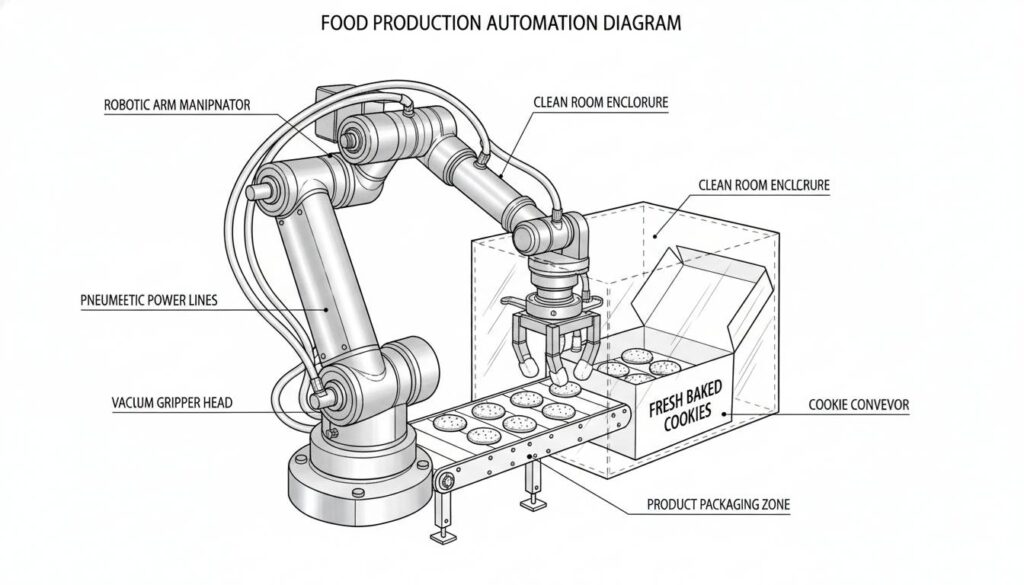
Technical Figure: An illustration of a robotic arm in a food factory placing cookies into a box. The robot arm has pneumatic tubes attached, highlighting the clean environment.
