The Basic Idea: Turning the Crank
Most power systems do the exact same thing. They try to spin a magnet inside a coil of wire. When you spin a magnet inside wire, you get electricity. This device is called a Generator.
Think of a bicycle dynamo. When you pedal, the wheel spins a little cylinder. That cylinder makes the light turn on.
- The Goal: Spin the turbine shaft.
- The Difference: How we push that shaft.
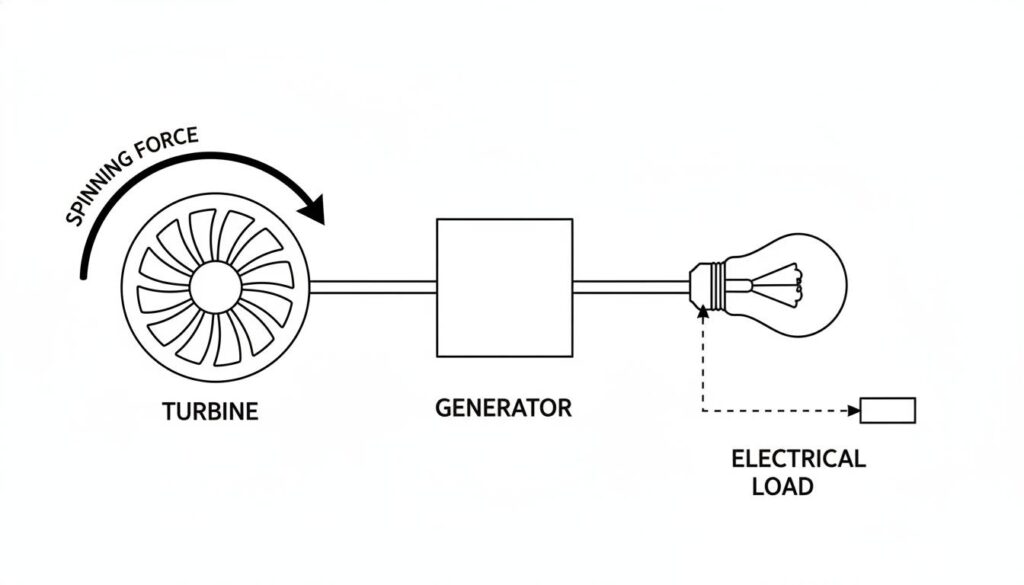
Technical Figure: A simple 2D diagram showing a generic ‘Turbine’ connected to a ‘Generator’ connected to a ‘Lightbulb. An arrow labeled ‘Spinning Force’ points to the turbine blades.
Thermal Power Systems (Steam Power)
This is the most common way to make electricity. It uses heat.
How It Works
Imagine a tea kettle. When the water boils, steam shoots out the spout. If you put a pinwheel in front of that steam, the pinwheel spins.
- The Boiler: We burn fuel (coal, oil, or gas) to make a fire. This fire boils water in a big tank.
- The Steam: The water turns into high-pressure steam. It wants to escape.
- The Turbine: The steam shoots through a machine with many blades (like a fan). This pushes the blades and makes the shaft spin.
- The Condenser: We cool the steam back into water so we can pump it back to the boiler and start again.

Technical Figure: A schematic diagram of a Thermal Power Plant. Left side: Furnace/Boiler with fire. Middle: Steam pipe leading to a Turbine. Right: Generator. Bottom: Condenser cooling the steam back to water and a pump sending it back to the boiler.
If we didn’t turn the steam back into water (condense it), what would happen to our boiler eventually? Would we run out of water?
Hydroelectric Power Systems (Water Power)
This system does not use fire. It uses gravity.
How It Works
Think of a water wheel in a river. The moving water pushes the paddles.
- The Dam: We build a big wall to hold back a river. This creates a lake high up.
- The Penstock: This is a big pipe that lets water fall down from the top of the dam to the bottom.
- The Turbine: At the bottom, the falling water hits a propeller. Because the water is heavy and moving fast, it spins the propeller very hard.
- The Generator: The propeller turns the generator.
Why Height Matters
The higher the dam, the faster the water falls. Faster water means more power. This is like dropping a ball. If you drop it from higher up, it hits the ground harder.

Technical Figure: Cross-section diagram of a Hydroelectric Dam. Shows water level high on the left. A pipe (penstock) goes down through the dam wall. Water hits a turbine at the bottom. Water exits into a river on the right.
Why do you think we need a dam? Why can’t we just put the turbine in a slow-moving flat river?
Nuclear Power Systems
Nuclear power is very similar to Thermal Power. It is a steam engine. The only difference is how we boil the water.
The Heat Source: Fission
Instead of burning coal, we use a metal called Uranium.
- Fission: We shoot tiny particles at the Uranium atoms. The atoms split apart.
- Heat: When atoms split, they release a massive amount of heat.
- Steam: We use this heat to boil water.
- Turbine & Generator: The steam spins the turbine, just like in a coal plant.
Safety Control
We use “Control Rods.” These are like the brakes on a car. If the atoms get too hot, we lower the rods to slow down the splitting.
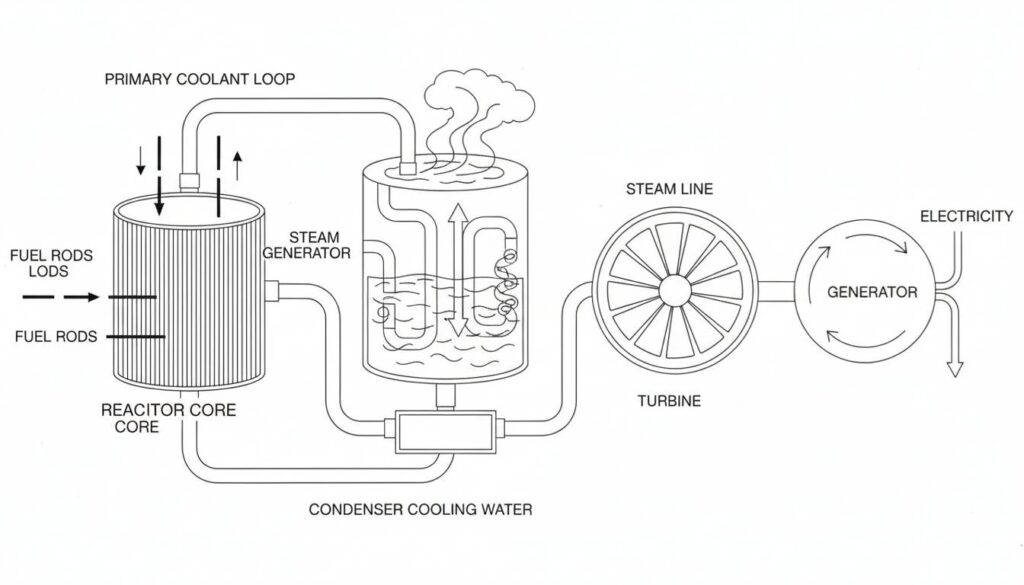
Technical Figure: Diagram of a Nuclear Reactor. Shows the Reactor Core with fuel rods and control rods. A pipe loop carries heat to a separate water tank (Steam Generator). Steam goes to a turbine and generator.
Nuclear plants don’t produce smoke like coal plants. Based on how they work, what is the only thing that comes out of their cooling towers? (Hint: It’s white and fluffy).
Internal Combustion Engines (ICE)
This is the power system in most cars. It doesn’t usually make electricity for houses; it makes mechanical power to turn wheels.
The 4-Stroke Cycle
Imagine a cannon. If you put gunpowder in a cannon and light it, the cannonball shoots out. An engine is a cannon that fires thousands of times a minute, but the “cannonball” (the piston) is tied to a crank, so it comes back.
- Intake (Suck): The piston moves down and sucks in air and gas.
- Compression (Squeeze): The piston moves up and squeezes the mix tightly.
- Power (Bang): A spark plug makes a spark. The gas explodes. This pushes the piston down hard. This is the power!
- Exhaust (Blow): The piston moves up and pushes the smoke out.
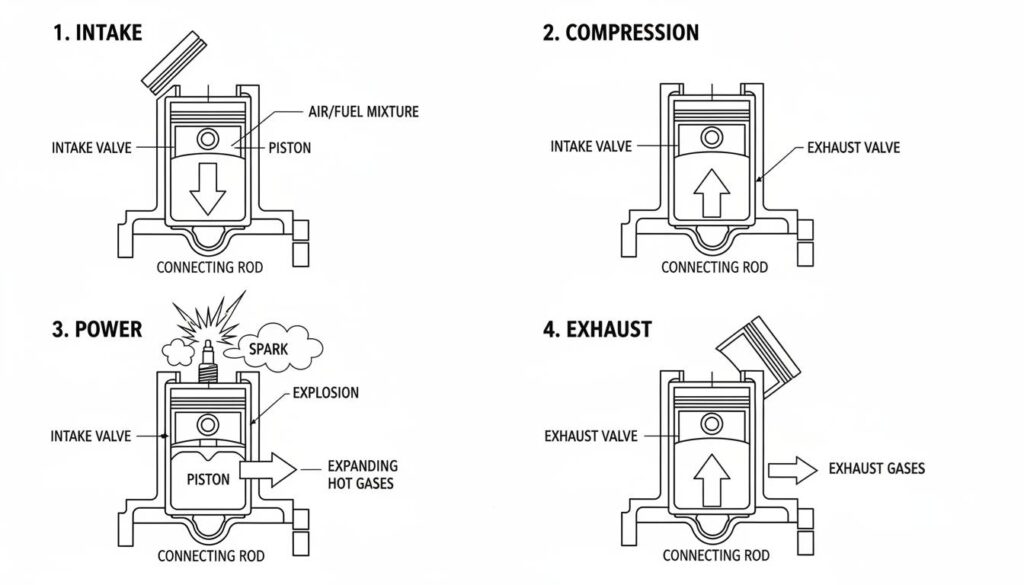
Technical Figure: A sequence of 4 diagrams showing a piston in a cylinder. 1. Valve open, piston goes down (Intake). 2. Valves closed, piston goes up (Compression). 3. Spark happens, explosion pushes piston down (Power). 4. Exhaust valve open, piston goes up (Exhaust).
Why do we need to squeeze (compress) the air and gas before we light it on fire? Think about a loose pile of gunpowder vs. gunpowder packed tight in a firecracker.
Renewable Systems: Wind and Solar
These systems are different because they don’t always use steam.
Wind Turbines
This is the simplest one. It is exactly like a fan, but in reverse.
- Fan: You use electricity to move air.
- Wind Turbine: Moving air creates electricity.
The wind pushes the big blades. The blades spin a shaft connected to a generator.
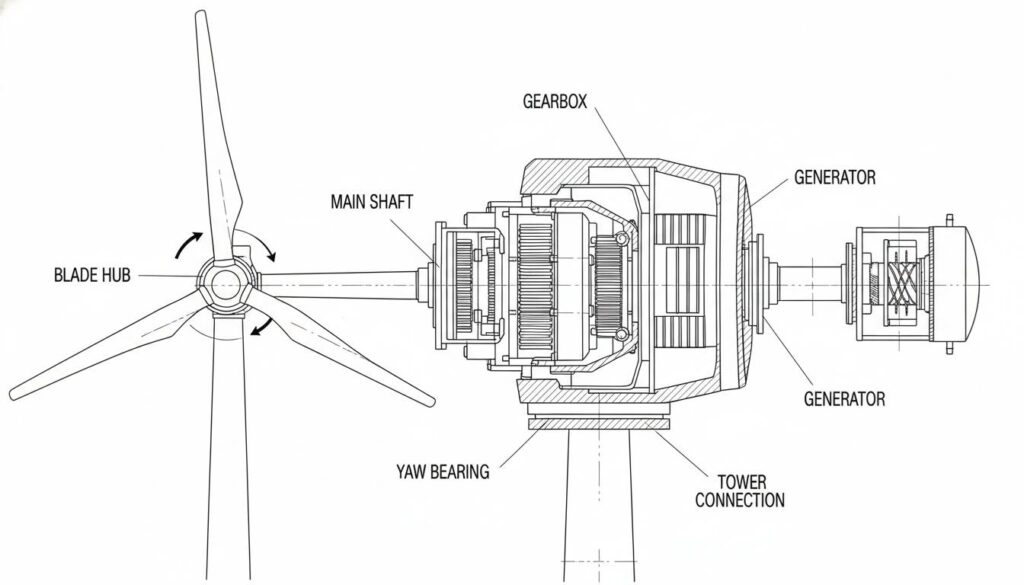
Technical Figure: Diagram of the inside of a Wind Turbine head (nacelle). Shows the large blades on the left, a gearbox in the middle, and a generator on the right.
Solar Power (Photovoltaic)
This has no moving parts!
- The Panel: Made of special silicon crystals.
- The Reaction: When sunlight hits the crystal, it knocks electrons loose.
- The Flow: These loose electrons flow through wires. That flow is electricity.
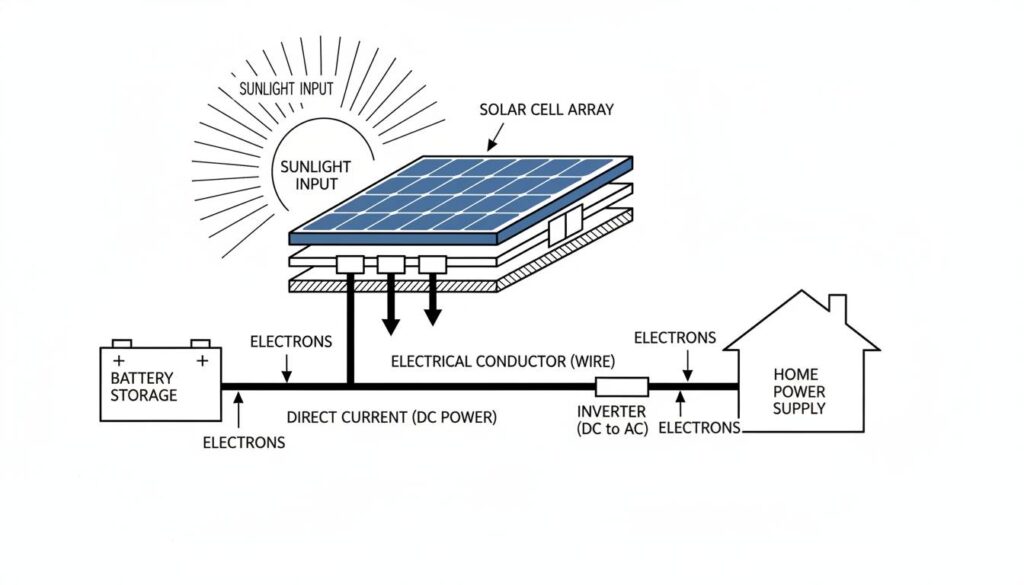
Technical Figure: Diagram of a Solar Panel. Sunlight rays hit the blue panel surface. Arrows show electrons moving from the panel into a wire, leading to a battery or house.
Wind and Solar are clean, but they have one big problem compared to Nuclear or Coal. What happens at night or on a calm day?
