
What is Hydrodynamic Power?
Imagine you want to push a heavy box, but you cannot touch it. You could use a water hose. If you spray water hard enough at the box, the water hits it and pushes it forward.
This is the basic idea of Hydrodynamic Power.
In Mechanical Engineering, we don’t always use solid metal gears or chains to connect an engine to wheels. Sometimes, we use a moving fluid (usually oil). We use the speed of the fluid to transfer energy from one machine to another.
The “Two Fans” Analogy
To understand this, think of two electric fans.
- Plug in the first fan (Fan A) and turn it on. It blows air.
- Place a second fan (Fan B) facing Fan A. Do not plug Fan B in.
- The air from Fan A hits the blades of Fan B.
- Fan B starts to spin, even though it has no electricity.
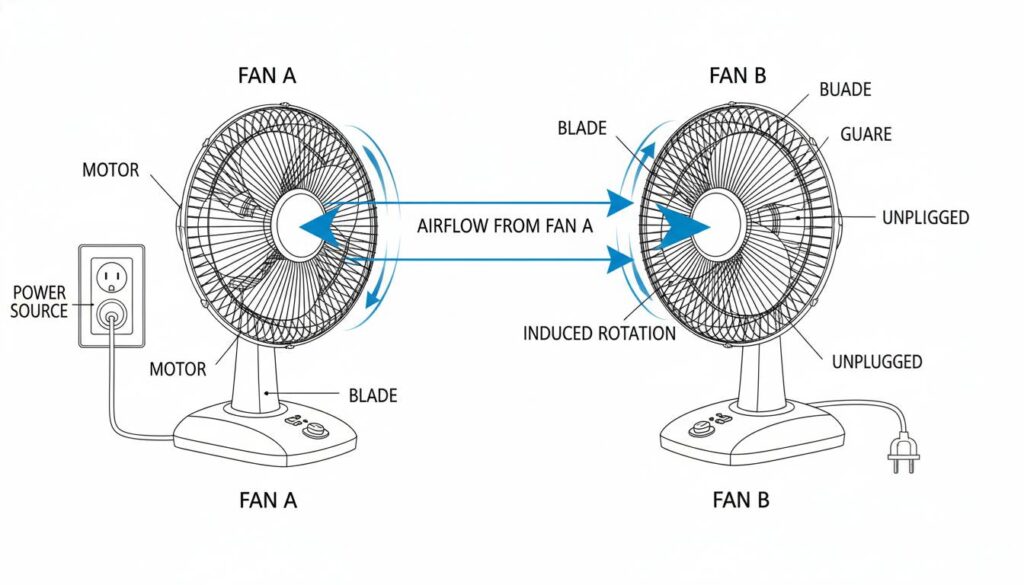
Technical Figure: A simple illustration of two desk fans facing each other. The left fan is plugged into a wall socket and spinning, blowing air (indicated by blue arrows) toward the right fan. The right fan is unplugged but spinning due to the air hitting it.
In this example:
- Fan A is the Pump (connected to the power source).
- The Air is the Fluid (the medium transferring power).
- Fan B is the Turbine (connected to the load/output).
In a hydrodynamic system, we put these fans inside a sealed metal case and use thick oil instead of air. Oil is heavier than air, so it pushes much harder.
If Fan A is spinning at 1000 RPM (rotations per minute), do you think Fan B will spin at exactly 1000 RPM, or slightly less? Why might some energy get lost in the air gap?
The Fluid Coupling
The simplest hydrodynamic device is called a Fluid Coupling. It is used in some conveyor belts and industrial machines. It acts like a clutch that never wears out because the parts never touch.
How It Works
A fluid coupling has two main bowl-shaped parts with blades inside them.
- The Impeller (Pump): This is connected to the engine. As the engine spins, the impeller spins. It flings oil outward, just like a spinning wet dog flings water.
- The Runner (Turbine): This is connected to the machine you want to move. It catches the oil flung by the impeller. The force of the oil hitting the blades makes it spin.
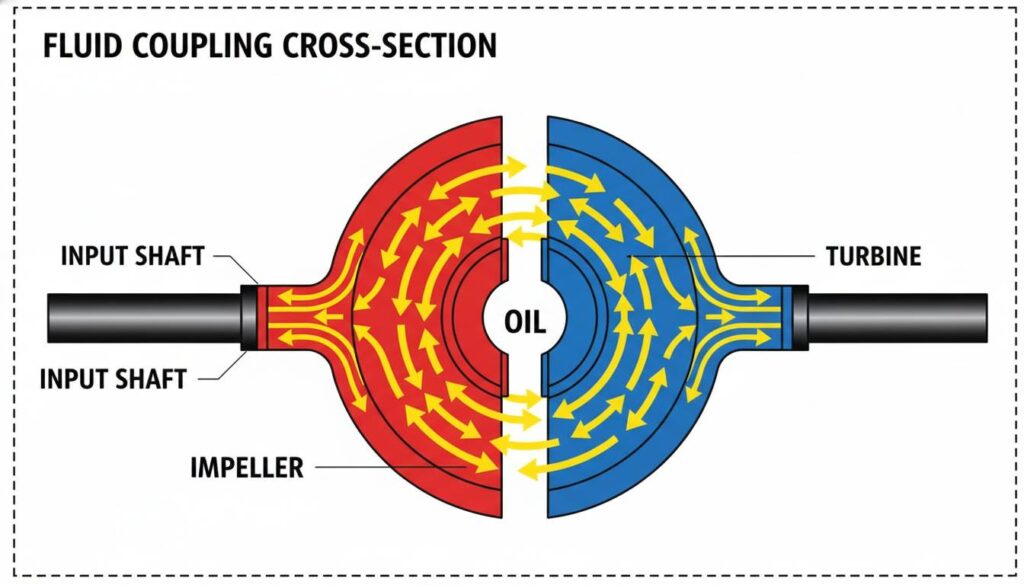
Technical Figure: A cross-section 3D diagram of a fluid coupling. The left half is red (Impeller) and connected to an input shaft. The right half is blue (Turbine) and connected to an output shaft. Arrows show yellow oil flowing from the outer edge of the red part into the blue part, and circling back through the center.
Why Use It?
- Smooth Starts: The engine can start easily because the oil slips a little bit at first. It doesn’t jerk the machine.
- Vibration Dampening: Since there is no metal-to-metal contact, engine vibrations don’t travel to the rest of the machine.
The Torque Converter
The fluid coupling is great, but it has a weakness. It cannot increase the twisting force (torque). It can only transfer what the engine gives.
To fix this, engineers created the Torque Converter. This is what is inside most automatic cars. It does everything a fluid coupling does, but it also multiplies the force.
The Three Main Components
A torque converter adds a third part to the mix.
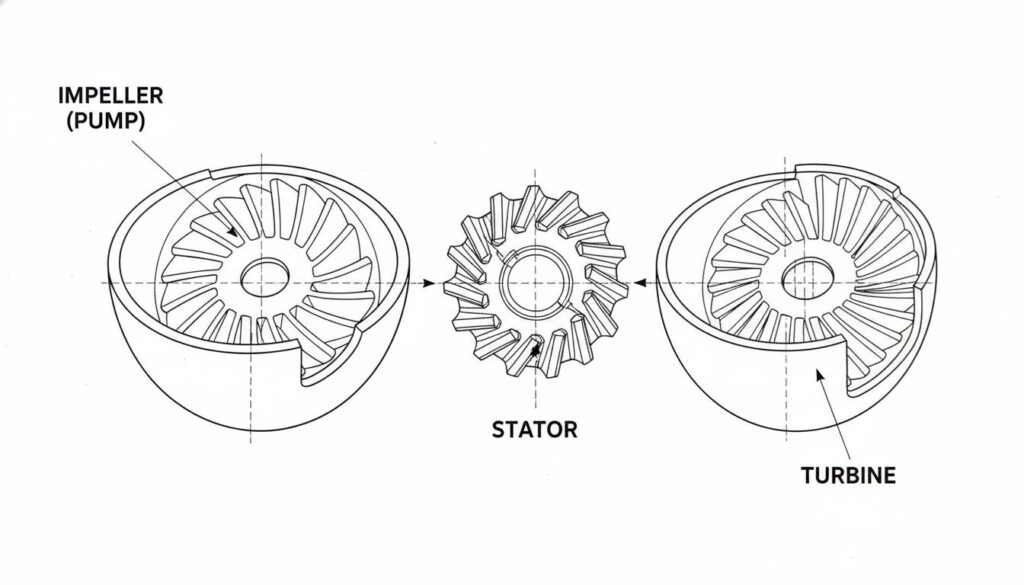
Technical Figure: An exploded view of a torque converter showing three distinct components in a line: The Impeller (Pump), the Stator (small wheel in the middle), and the Turbine. Labels point to each part.
The Impeller (The Thrower)
This is the pump. It is bolted directly to the engine. When the engine spins, the impeller spins. Its curved blades throw fluid to the outside edge.
The Turbine (The Catcher)
This sits opposite the impeller. It is connected to the transmission (and eventually the wheels). The moving fluid hits the turbine blades and forces it to spin.
The Stator (The Redirector)
This is the magic part. It sits in the very center, between the impeller and the turbine.
When oil leaves the turbine, it is moving in the wrong direction. It is splashing back against the impeller, trying to slow it down. The Stator has angled blades that catch this returning oil and redirect it.
Instead of fighting the impeller, the stator makes the oil hit the impeller from behind, helping it spin faster. This adds extra push. This is how we get Torque Multiplication.
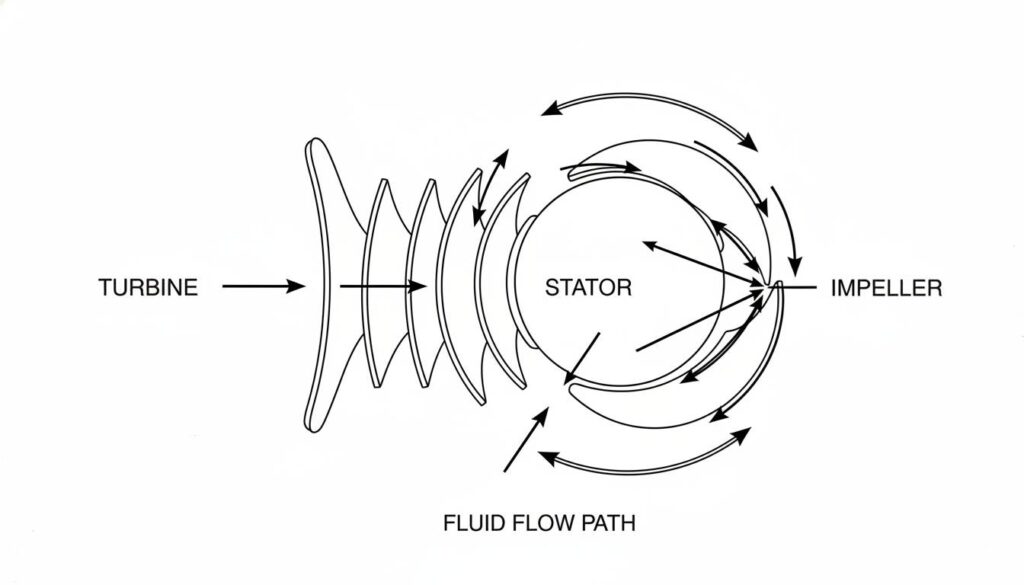
Technical Figure: A 2D schematic diagram showing the path of fluid flow. Arrows show fluid leaving the Turbine, hitting the curved blades of the Stator, and being redirected at a sharp angle to hit the Impeller blades in a helpful direction.
Imagine you are sliding down a slide. If at the bottom, the slide curved up and threw you right back to the top of the ladder, you wouldn’t have to climb up. How does the Stator act like that curved slide to save energy?
Fluid Flow Patterns
To understand how the oil moves inside, we look at two types of flow.
Vortex Flow
Imagine a donut. Vortex flow is the oil moving in a circle around the cross-section of the donut. It goes from the Impeller -> Turbine -> Stator -> Impeller. This happens fast when the car is starting to move.
Rotary Flow
This is the whole donut spinning. As the car gets up to highway speed, the oil and the metal parts all spin together in the same direction.
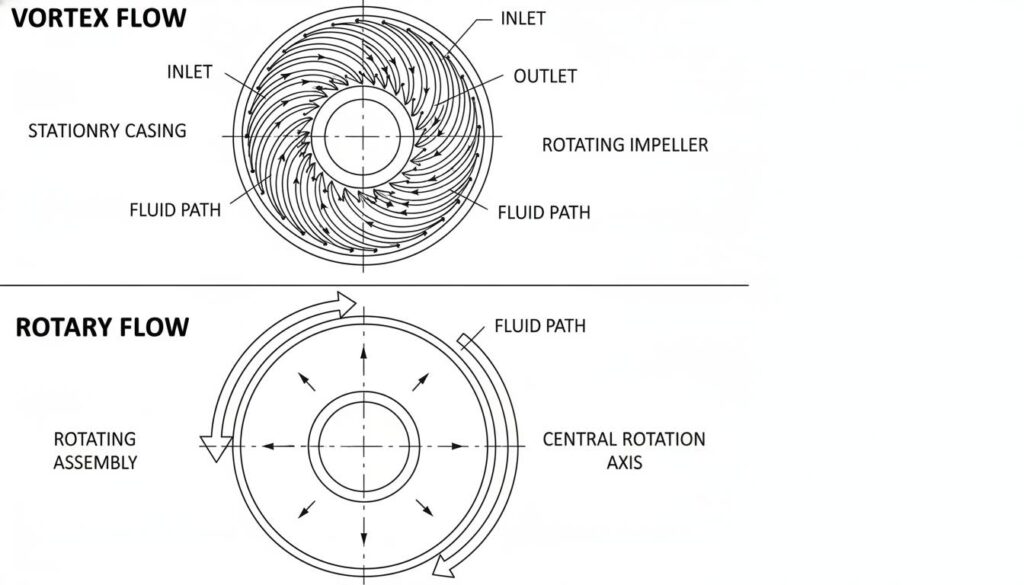
Technical Figure: A diagram comparing Vortex Flow and Rotary Flow. The Vortex Flow image shows arrows spiraling inside a donut shape. The Rotary Flow image shows the entire donut shape spinning around a central axis.
Advantages and Disadvantages
Why we like Hydrodynamic Systems (Pros)
- No Stalling: You can stop your car at a red light while the engine is running. The turbine stops (wheels stop), but the impeller keeps spinning (engine runs). The oil just slips past.
- Smooth Acceleration: No jerky gear changes.
- Low Maintenance: No clutch plates to burn out.
The Downsides (Cons)
- Slip: The turbine always spins slightly slower than the impeller. This means we lose some energy.
- Heat: All that slipping creates friction in the fluid, which makes the oil get very hot.
- Fuel Economy: Because of the lost energy (slip), these systems use more fuel than direct gears.
Technical Figure: A bar chart comparing “Energy Efficiency”. A “Direct Gear” bar is at 98%, while a “Hydrodynamic Drive” bar is at about 85-90%, illustrating the energy loss due to fluid slip.
Modern cars have a “Lock-up Clutch” that connects the pump and turbine together physically once the car is on the highway. Why do you think engineers added this feature based on the “Cons” list above?
