
Focus Keyword: Hydraulic Power Systems, Fluid Power Advantages, Hydraulic Disadvantages, Mechanical Engineering Basics
What is a Hydraulic System?
Hydraulics is the science of moving liquids to create power. Imagine a syringe filled with water. If you push the plunger, the water shoots out. If you connect that syringe to a tube, the water pushes whatever is at the other end of the tube.
In engineering, we use this simple idea to lift massive objects. We use oil instead of water because oil doesn’t rust the metal parts.
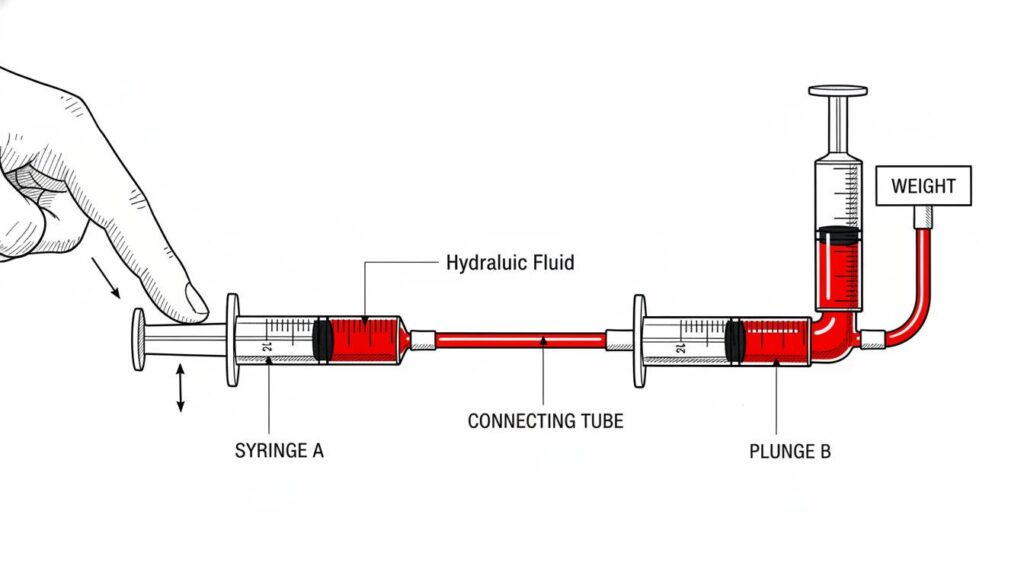
Technical Figure: A simple 2D diagram showing two syringes connected by a clear tube filled with red liquid. One syringe is being pushed down by a finger, and the plunger of the other syringe is rising up, lifting a small weight. Label the liquid ‘Hydraulic Fluid’.
The Core Concept: Liquids Don’t Squish
The most important rule in hydraulics is that liquids are incompressible. This means you cannot squeeze a liquid into a smaller space.
If you have a pipe full of oil and you push one end, the other end moves instantly. It acts like a solid steel rod, but it can bend around corners because it is inside a hose.

Technical Figure: A split-screen comparison illustration. On the left, a container of gas (air) being compressed by a piston (molecules getting closer). On the right, a container of liquid (oil) where the piston cannot move down because the molecules are already packed tight. Label left ‘Compressible (Pneumatic)’ and right ‘Incompressible (Hydraulic)’.
If you filled a brake line in a car with air instead of brake fluid, what would happen when you pressed the pedal? Would the car stop instantly, or would the pedal feel “spongy”?
Advantages of Hydraulic Systems
Engineers love hydraulics for heavy-duty jobs. Here is why they are so useful.
High Force Output (Super Strength)
Hydraulics are incredibly strong. A small motor can pump oil to create enough force to lift a dump truck or an airplane’s landing gear. This is because of force multiplication.
Think of it like a lever. You put in a little effort, and you get a huge result. A hydraulic system can generate tons of force with very compact machinery.
Technical Figure: A technical illustration of a hydraulic press. A small piston on the left is being pushed down by a hand. A large piston on the right is lifting a heavy car. Arrows show the flow of fluid from the small side to the large side.
Accuracy and Control
Hydraulics are smooth. When you watch an excavator digging a hole, the arm moves steadily. It does not jerk or shake.
- Start and Stop: You can start, stop, and reverse the motion instantly under a heavy load.
- Variable Speed: You can move the machine fast or very slow just by changing how much oil flows.
Design Flexibility
Mechanical gears and shafts are rigid. They have to be in a straight line. Hydraulic power travels through hoses.
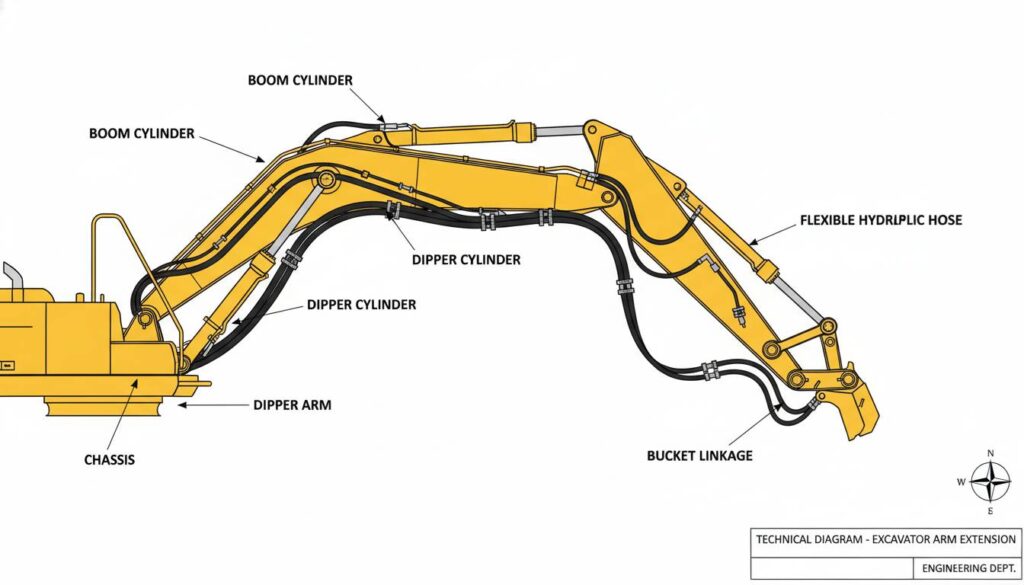
You can route a hose around a corner, up a wall, or through a tight space. This allows engineers to put the power source (the pump) far away from the working part (the piston).
Technical Figure: A diagram of an excavator arm. Highlight the flexible black hoses running along the yellow metal arm joints. Show how the hoses bend as the arm extends.
Look at a bicycle chain. It has to go in a straight line from the pedals to the wheel. How would a bicycle look if it used hydraulic hoses instead of a chain? Could you change the shape of the bike frame more easily?
Disadvantages of Hydraulic Systems
Nothing is perfect. While hydraulics are strong, they have some serious downsides.
The Mess Factor (Leakage)
Hydraulic fluid is oil. If a seal breaks or a hose cracks, the oil leaks out.
- Dirty: It makes a mess on the floor or the ground.
- Slippery: It creates a safety hazard for workers.
- Pollution: If it leaks outside, it can hurt the soil and water.
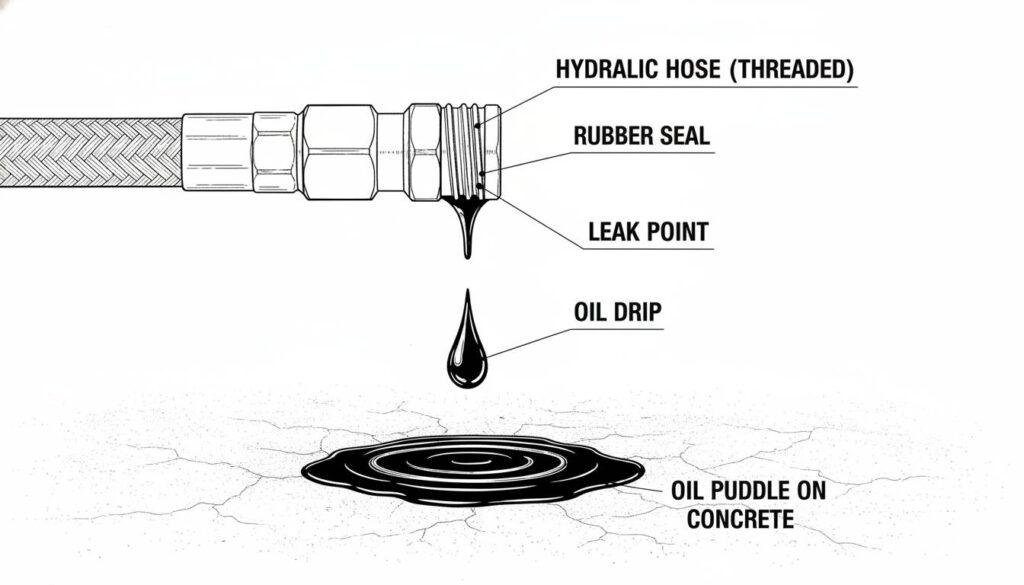
Technical Figure: A close-up illustration of a hydraulic hose fitting with a drip of oil coming out. A small puddle of dark oil is forming on the concrete floor below.
Fire Hazards
Most hydraulic fluids are petroleum-based (made from oil). If the system gets too hot, or if a high-pressure leak sprays a fine mist of oil near a spark, it can catch fire. This is a major safety risk in factories.
Noise and Heat
Hydraulic pumps are loud. If you stand next to a garbage truck while it is crushing trash, you hear a loud whining sound. That is the hydraulic pump.
Also, moving oil around under high pressure creates friction. Friction creates heat. Hydraulic systems often need radiators (coolers) to keep the oil from boiling, just like a car engine.
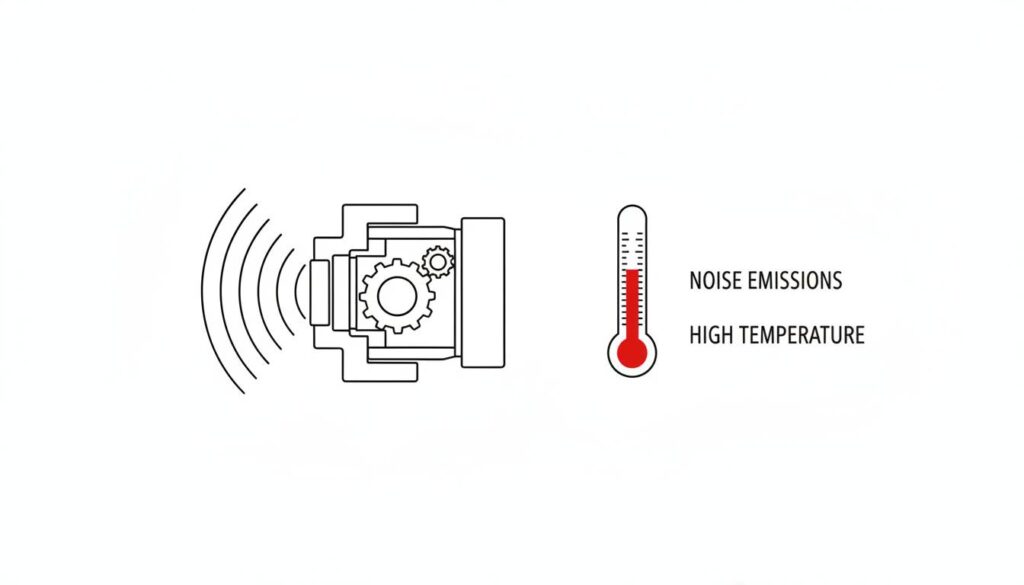
Technical Figure: An icon-style illustration showing a hydraulic pump with ‘sound wave’ lines radiating from it to indicate noise, and a thermometer icon next to it showing a high temperature (red level).
Speed Limitations
Hydraulics are strong, but they are not usually very fast. If you need a robot to move its arm back and forth 100 times a second, you use an electric motor, not hydraulics. The oil takes time to flow through the pipes.
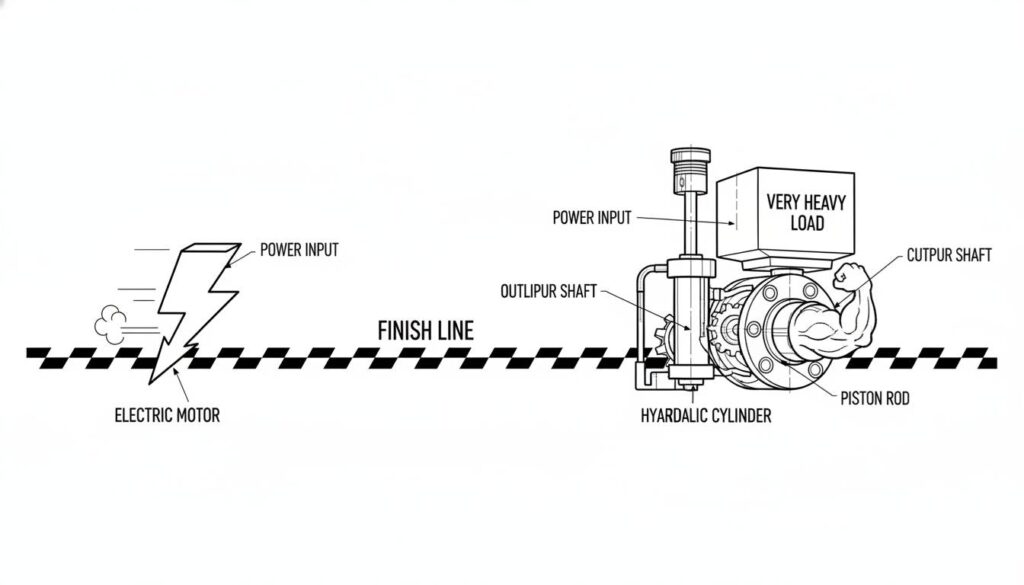
Technical Figure: A race comparison illustration. An electric motor (represented by a lightning bolt symbol) crossing a finish line first. A hydraulic cylinder (represented by a piston) carrying a very heavy weight, crossing the line second but looking strong.
If you were building a robot to perform surgery on a human eye, would you use hydraulics? Consider the risk of leaks and the need for tiny, fast movements.
Summary Table
| Feature | Advantage | Disadvantage |
| Strength | Can lift massive loads easily. | |
| Flexibility | Hoses can bend around corners. | |
| Cleanliness | Leaks are messy and bad for nature. | |
| Safety | Oil is flammable (can burn). | |
| Control | Smooth and precise movement. | |
| Speed | Slower than electric motors. |
