
Introduction
Perovskite solar cells have emerged as one of the most disruptive photovoltaic technologies of the past decade, achieving power conversion efficiencies that rival and surpass established thin-film technologies within a remarkably short time frame.
While early progress was dominated by organic–inorganic hybrid lead halide perovskites, concerns related to thermal instability and environmental degradation have motivated the development of all-inorganic cesium halide perovskite solar cells (IPSCs).

All-inorganic perovskites, typically described by the chemical formula CsPbX₃ (X = Cl, Br, I), offer improved thermal robustness, enhanced resistance to moisture, and favorable optoelectronic properties.
This article provides a comprehensive technical overview of all-inorganic cesium halide perovskite solar cells, covering structural characteristics, fabrication strategies, stability challenges, lead-free alternatives, and future research directions.
Fundamentals of All-Inorganic Perovskite Materials
Recommended Solar Energy Books:
All-inorganic perovskites adopt the ABX₃ crystal structure, where:
• A-site: cesium (Cs⁺)
• B-site: lead (Pb²⁺) or alternative metal cations
• X-site: halide anions (Cl⁻, Br⁻, I⁻)
Replacing organic cations with cesium significantly enhances thermal and chemical stability, making these materials well suited for operation under harsh environmental conditions.
Key optoelectronic advantages include:
• High absorption coefficients
• Tunable bandgaps via halide composition
• Long carrier diffusion lengths
• Low exciton binding energies
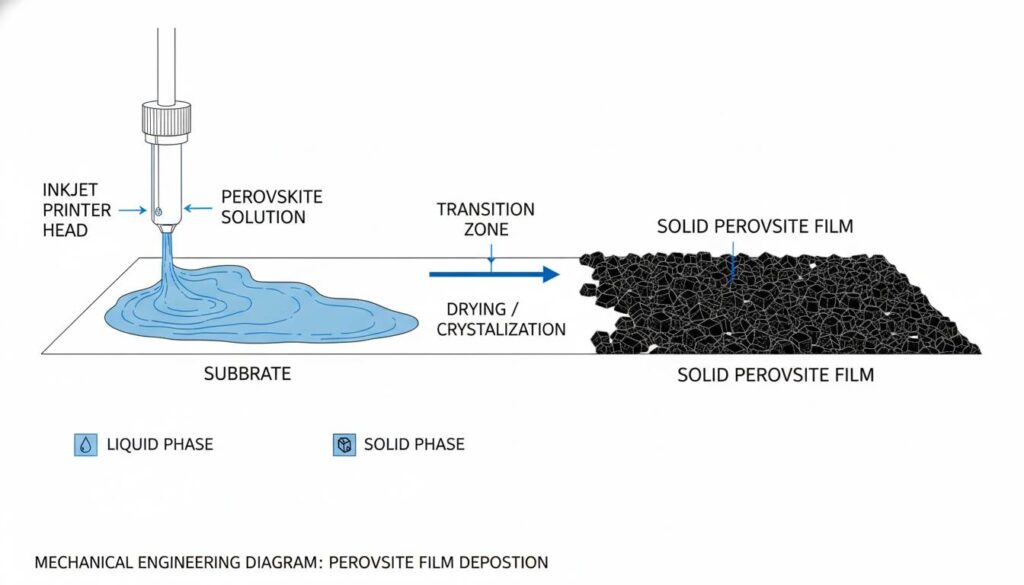
A close-up macro shot of a perovskite film being printed. The liquid is drying into a solid, black, crystalline film, showing the transition from solution to solid state.
Why All-Inorganic Cesium Halide Perovskite Solar Cells Matter
The biggest challenge in solar energy right now is keeping panels efficient for 20 or 30 years. Organic components in older perovskite cells tend to break down when they get hot, which is ironic because solar panels need sunlight to work. All-Inorganic Cesium Halide Perovskite Solar Cells solve this by removing the heat-sensitive parts entirely.
Technical Foundations:
• Thermal Stability: They can withstand temperatures that would destroy hybrid organic cells.
• Moisture Resistance: They are less likely to rot or degrade when exposed to humidity in the air.
• High Absorption: They are excellent at soaking up sunlight and turning it into electricity, even in thin layers.
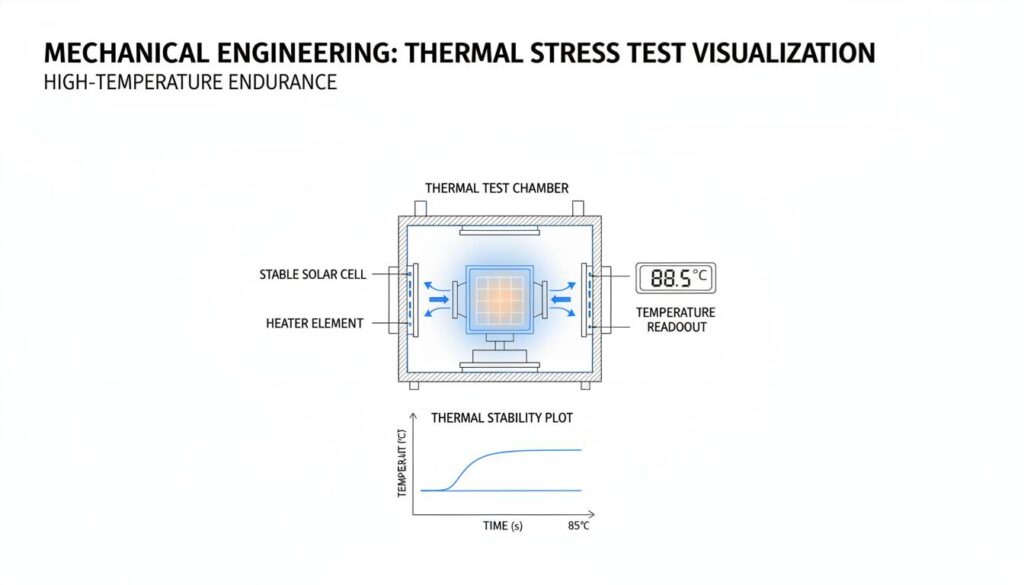
A thermal stress test visualization. A solar cell is placed inside a heat chamber with a thermometer showing high temperatures (85°C+). The cell remains intact and glowing, symbolizing thermal stability.
Benefits Customers and Users Love
When this technology hits the mainstream market, it will offer advantages that go beyond just making electricity. Because the materials are stable and versatile, they can be used in places where heavy, rigid silicon panels just don’t fit.
Top 5 Benefits:
• Longer Lifespan: They don’t degrade as quickly in hot climates.
• Lower Cost Potential: They can be printed using simple chemical solutions rather than expensive silicon processing.
• Flexibility: These materials can be coated onto flexible plastics, not just heavy glass.
• Tunable Colors: They can be made semi-transparent or different colors for architectural use.
• High Voltage: They produce a good amount of voltage, which is great for powering electronics.
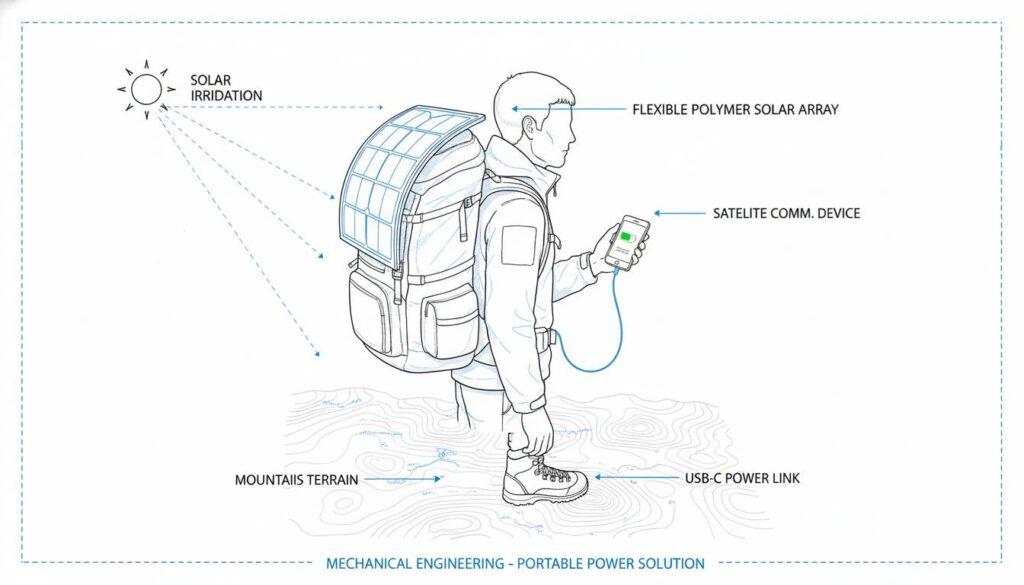
A lifestyle shot of a hiker with a flexible solar panel attached to their backpack. The panel is curved and lightweight, charging a smartphone. The sun is shining bright, emphasizing the outdoor utility.
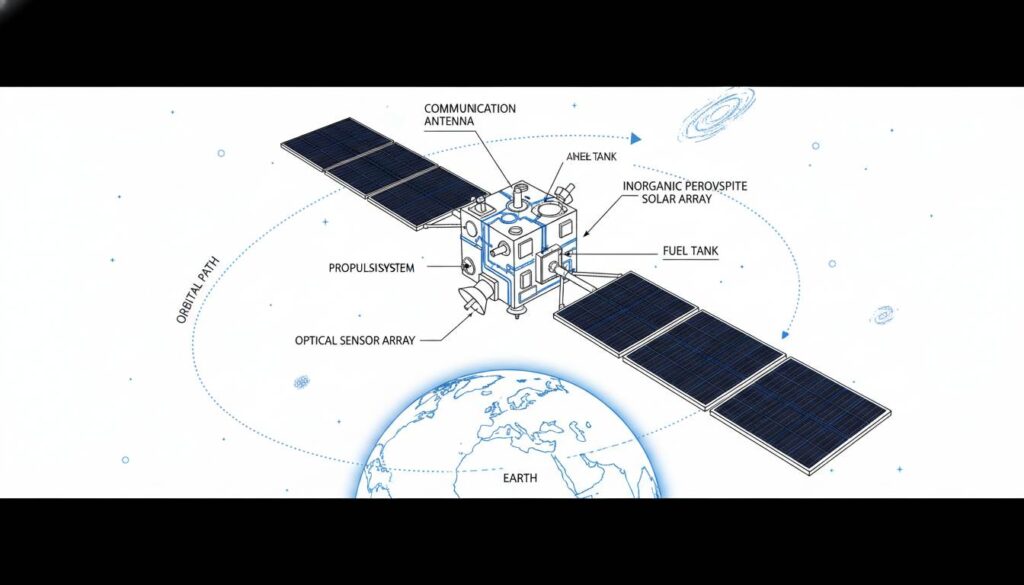
An illustration of a satellite in orbit. The solar wings are made of a thin, dark film of inorganic perovskite. The background is the darkness of space with the earth below.
Structural Characteristics and Phase Behavior
Cesium lead halide perovskites exhibit multiple crystallographic phases, including:
• Cubic (α-phase)
• Tetragonal (β-phase)
• Orthorhombic (γ-phase)
Among these, the cubic phase is generally associated with superior optoelectronic performance. However, maintaining phase stability at room temperature remains a major challenge, particularly for iodide-rich compositions.
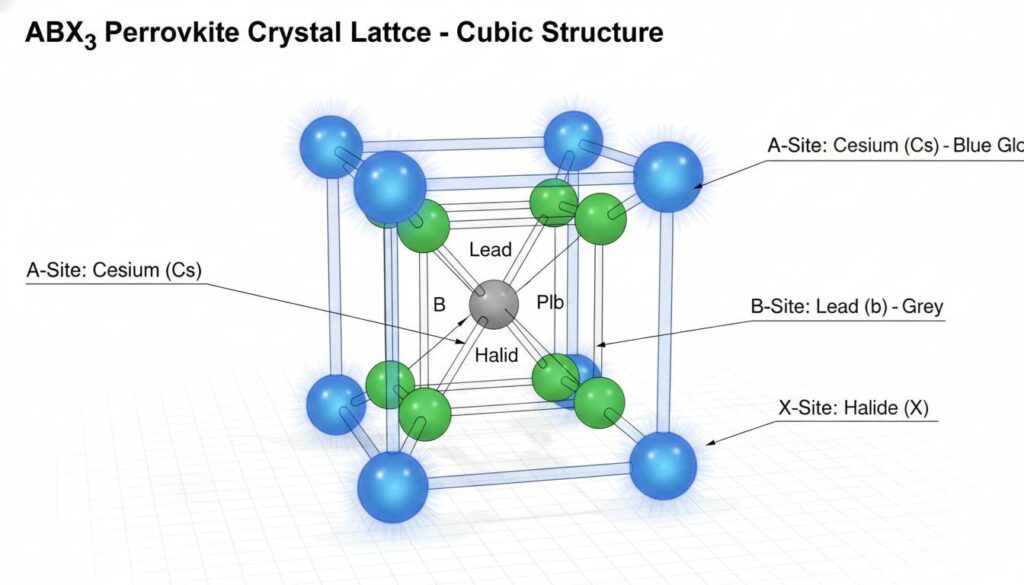
3D render of the ABX3 perovskite crystal lattice structure. The ‘A’ site atoms are glowing blue (Cesium), ‘B’ site atoms are grey (Lead), and ‘X’ site atoms are green (Halide), forming a perfect cubic cage.
Phase transitions are influenced by:
• Temperature
• Halide composition
• Strain and defect density
• Interface and surface energy
Fabrication Techniques for All-Inorganic Perovskite Solar Cells
Solution-Based Processing
Solution processing methods remain attractive due to their low cost and scalability.
Common approaches include:
• One-step spin coating
• Sequential deposition
• Antisolvent engineering
These techniques enable rapid crystallization but often suffer from:
• Poor phase control
• High defect densities
• Limited film uniformity
Vacuum Deposition Techniques
Vacuum-based methods such as:
• Thermal evaporation
• Co-evaporation
offer superior control over:
• Film thickness
• Stoichiometry
• Crystallinity
Although more expensive, vacuum deposition yields high-quality films with improved reproducibility and device stability.
Hybrid Fabrication Approaches
Hybrid methods combine solution and vacuum processes to balance:
• Material quality
• Manufacturing cost
• Large-area uniformity
These approaches are increasingly explored for industrial scalability.
Professional Workflows:
• Solution Processing: Mixing chemicals in a liquid and spinning them onto a glass plate (Spin Coating).
• Vacuum Deposition: Evaporating the materials in a vacuum chamber to let them settle gently onto a surface.
• Phase Stabilization: Adding special additives to stop the crystal from changing into a non-working shape (yellow phase) at room temperature.
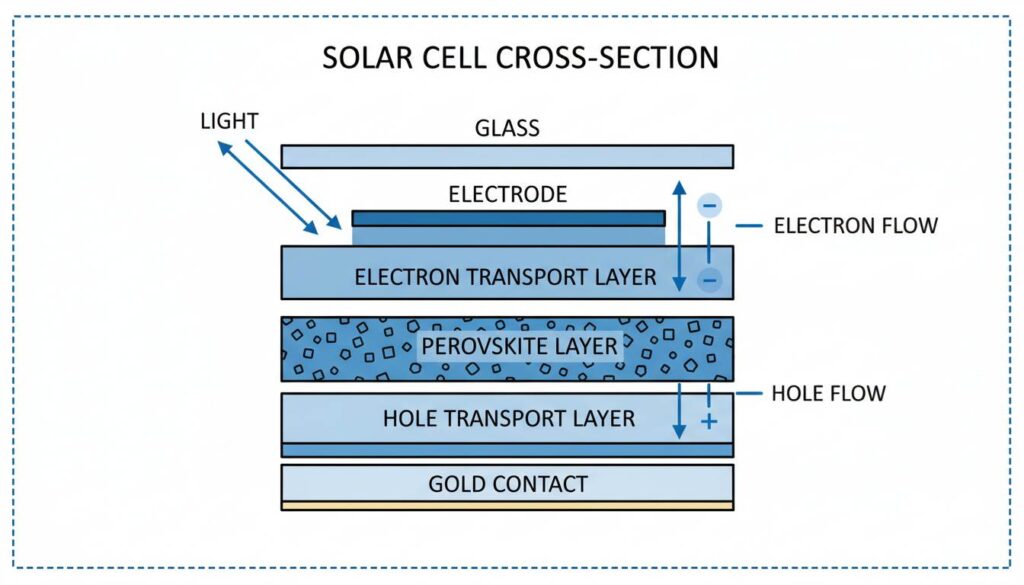
Related Concepts:
• Tandem Solar Cells: Stacking a perovskite cell on top of a silicon cell to catch different parts of the light spectrum.
• Lead-Free Alternatives: Replacing Lead (Pb) with Tin (Sn) or Bismuth (Bi) to make the cells non-toxic.
• Encapsulation: Sealing the cells in glass or plastic to keep moisture out completely.
• Interface Engineering: Putting special molecules between layers to help electricity flow smoother.
A comparative illustration showing a “Tandem Cell.” The top layer is semi-transparent perovskite absorbing blue light, and the bottom layer is silicon absorbing red light. A spectrum of light enters from the top.
Performance-Limiting Challenges
Phase Instability
A central limitation of cesium halide perovskites is their tendency to undergo phase transitions under ambient conditions, particularly for CsPbI₃.
Phase instability leads to:
• Reduced carrier mobility
• Increased recombination losses
• Long-term performance degradation
Defect Formation and Non-Radiative Recombination
Defects such as:
• Halide vacancies
• Grain boundaries
• Surface traps
act as non-radiative recombination centers, limiting open-circuit voltage and fill factor.
Strategies for Performance Enhancement
Composition Engineering
Bandgap and stability tuning can be achieved by:
• Halide mixing (Br/I or Cl/Br systems)
• Partial cation substitution
This approach improves phase stability while maintaining favorable optical absorption.
Additive Optimization
Additives introduced during film formation can:
• Control crystallization kinetics
• Reduce defect density
• Improve grain size and orientation
Interfacial Modification
Interface engineering between the perovskite absorber and charge-transport layers reduces:
• Interfacial recombination
• Energy-level mismatches
• Charge extraction barriers

Lead-Free All-Inorganic Perovskite Alternatives
Environmental and health concerns associated with lead have driven the exploration of lead-free perovskite compositions, including:
• Tin-based perovskites
• Bismuth-based perovskites
• Antimony-based perovskites
While these materials improve sustainability, they currently suffer from:
• Lower carrier mobility
• Increased defect densities
• Reduced power conversion efficiency
Further materials optimization is required to achieve performance parity with lead-based systems.
Large-Area and Flexible IPSCs
Recent progress has enabled:
• Scalable deposition on large substrates
• Integration onto flexible and lightweight platforms
These developments expand application potential in:
• Building-integrated photovoltaics
• Aerospace systems
• Portable and wearable electronics
The intrinsic thermal stability of all-inorganic perovskites makes them particularly attractive for extreme environmental conditions.
Beyond Photovoltaics: Emerging Applications
In addition to solar energy conversion, all-inorganic perovskites show promise in:
• X-ray and gamma-ray detectors
• Image sensing devices
• Light-emitting diodes
• Radiation-hard optoelectronics
These multifunctional capabilities broaden the technological relevance of perovskite materials beyond photovoltaics.
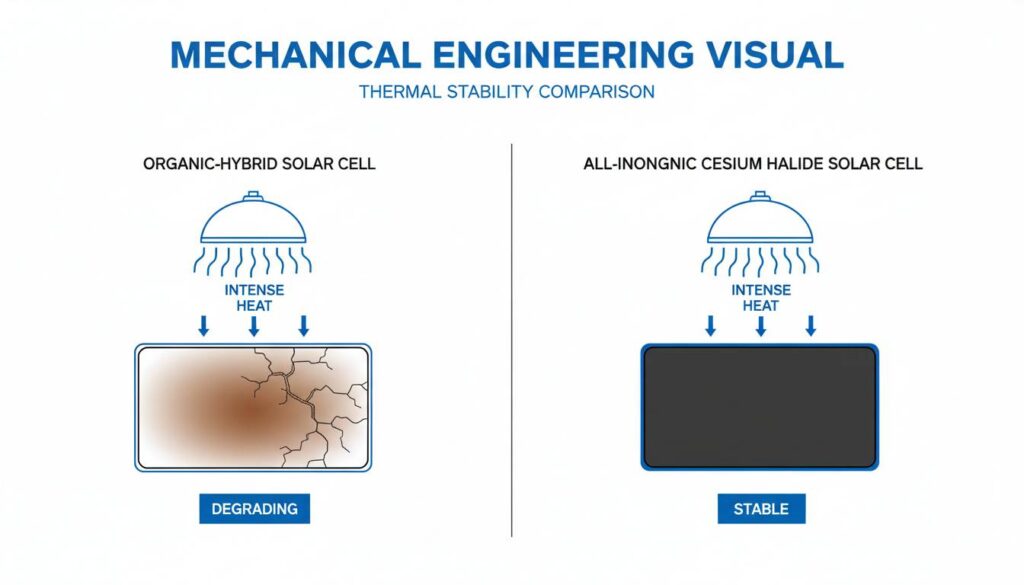
Split-screen comparison. On the left, a standard organic-hybrid solar cell is degrading and turning brown under a heat lamp. On the right, an All-Inorganic Cesium Halide cell remains pristine and black under the same intense heat.
Future Outlook and Research Opportunities
To advance all-inorganic perovskite solar cells toward commercialization, future research should prioritize:
• Long-term phase stabilization strategies
• Defect-tolerant material design
• Scalable, low-cost fabrication techniques
• Environmentally benign, lead-free compositions
Interdisciplinary collaboration between materials science, chemistry, physics, and engineering will be essential to address these challenges.
FAQ
1. Why are they called “All-Inorganic”?
They are called this because they do not contain any organic (carbon-based) cations like methylammonium. They only use inorganic elements like Cesium, Lead, and Iodine.
2. Is the lead in these cells dangerous?
Lead is toxic, which is a concern. However, the amount of lead used is very small compared to things like car batteries. Scientists are also working on recycling programs and lead-free versions.
3. Can I buy these solar panels for my house yet?
Not quite yet. While they work great in the lab, companies are still figuring out how to manufacture them in massive sizes without losing quality. They are likely a few years away from Home Depot.
4. What is the “Phase Instability” problem?
Sometimes, the crystal structure wants to relax into a shape that doesn’t conduct electricity (often called the “yellow phase”). Scientists use additives to force it to stay in the active “black phase” so it keeps making power.
Conclusion
All-inorganic cesium halide perovskite solar cells represent a promising evolution of perovskite photovoltaics, offering enhanced thermal and environmental stability without sacrificing optoelectronic performance. While challenges related to phase stability, defect control, and lead toxicity remain, significant progress has been achieved through composition engineering, additive optimization, and interface design.
With continued advances in materials chemistry and device engineering, all-inorganic perovskite photovoltaics are well positioned to play a critical role in next-generation solar and optoelectronic technologies.

Great content! Keep up the good work!