What is ECM?
Imagine you want to cut a piece of metal that is harder than a diamond. If you use a saw, the saw breaks. If you use a drill, the drill melts. What do you do?
You use Electrochemical Machining (ECM).
Think of ECM as “reverse electroplating.” In electroplating, we use electricity to add metal to an object (like gold-plating a ring). In ECM, we use electricity to remove metal. It dissolves the metal atom by atom.
The Basic Setup
To understand the good and bad points of ECM, you need to know the setup:
- The Tool (Cathode): This is shaped like the hole you want to make. It is negative (-).
- The Workpiece (Anode): This is the metal you are cutting. It is positive (+).
- The Electrolyte: A saltwater solution that flows between them very fast.
The tool never touches the workpiece. Electricity flows through the saltwater, and the workpiece simply dissolves away.

Technical Diagram: A simple 2D schematic diagram of the ECM process. Show a tool (labeled Cathode -) moving down towards a workpiece (labeled Anode +). Show blue fluid (Electrolyte) flowing in the gap between them. Show the workpiece dissolving into the fluid.
Main Advantages of ECM
Why do engineers love this process? Here are the big wins.
1. Hardness Does Not Matter
This is the biggest advantage. In traditional machining (like drilling), the tool must be harder than the material. In ECM, we are using chemistry, not force.
- You can cut soft aluminum.
- You can cut super-hard titanium.
- Result: The cutting speed is the same for both! It is like cutting butter versus cutting frozen ice cream—to ECM, it’s all just atoms.
2. No Tool Wear
In a normal drill, the drill bit gets dull because it rubs against the metal. In ECM, the tool never touches the workpiece. There is always a gap filled with water.
- Result: One tool can make thousands of parts without needing replacement.
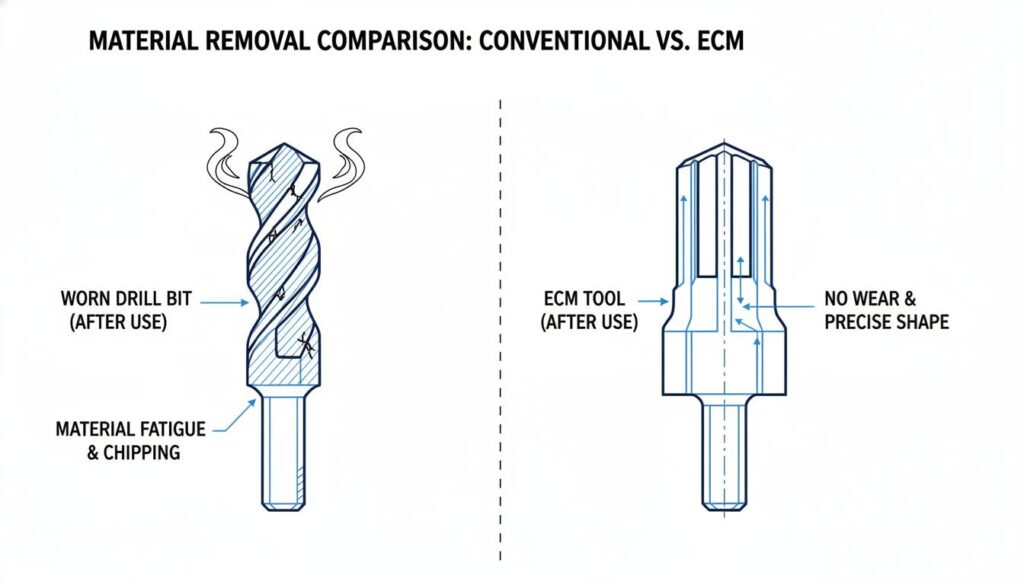
Technical Diagram: A split comparison illustration. On the left, a standard drill bit that is worn down, chipped, and smoking. On the right, an ECM tool that looks shiny, new, and perfect after use.
3. No Heat Damage
Regular saws create friction. Friction creates heat. Heat can warp or weaken metal. Since ECM has no friction, the metal stays cool.
- Result: The metal keeps its original strength.
4. Mirror-Like Finish
Drills leave scratch marks. ECM dissolves the surface evenly.
- Result: The finished part is smooth and shiny, like a mirror. You don’t need to polish it afterwards.
Think About It:
If the tool never touches the metal, how does the electricity get from the tool to the workpiece?
Hint: Think about what is flowing in the gap between them.
Main Disadvantages of ECM
ECM is powerful, but it isn’t perfect. Here is why we don’t use it for everything.
1. High Cost
ECM machines are very expensive to buy. Also, they use a huge amount of electricity.
- The Problem: Your electric bill will be massive compared to using a standard drill.
2. Only Works on Conductors
This is a chemistry rule. To move electrons, the material must conduct electricity.
- The Problem: You cannot use ECM on wood, plastic, or ceramic. It only works on metals.
3. The “Sludge” Problem
When the metal dissolves, it doesn’t disappear. It turns into a muddy waste called sludge.
- The Problem: You have to filter this sludge out of the water and dispose of it safely. It can be messy.
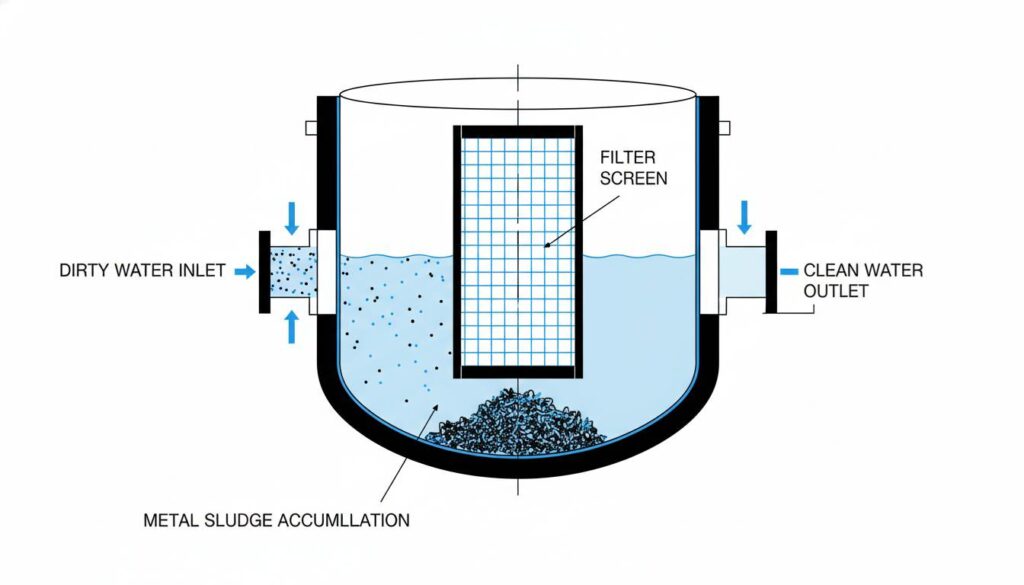
Technical Diagram: A technical illustration of a filtration tank. Show dirty water entering one side, passing through a filter screen, and clean water coming out the other side. Show a pile of “metal sludge” collecting at the bottom.
4. Corrosion Risk
The electrolyte is usually salt water. Salt water causes rust.
- The Problem: If you don’t clean the machine and the part immediately after cutting, everything will rust.
Critical Thinking:
If you wanted to cut a shape out of a block of hard plastic, could you use ECM? Why or why not?
Real-World Applications
Where do we actually use this technology?
1. Aerospace (Jet Engines)
Jet engine parts, like turbine blades, are made of “Superalloys.” These metals are designed to survive extreme heat, making them incredibly hard to cut with saws.
- Use: ECM cuts the complex curved shapes of the blades and drills tiny cooling holes in them.
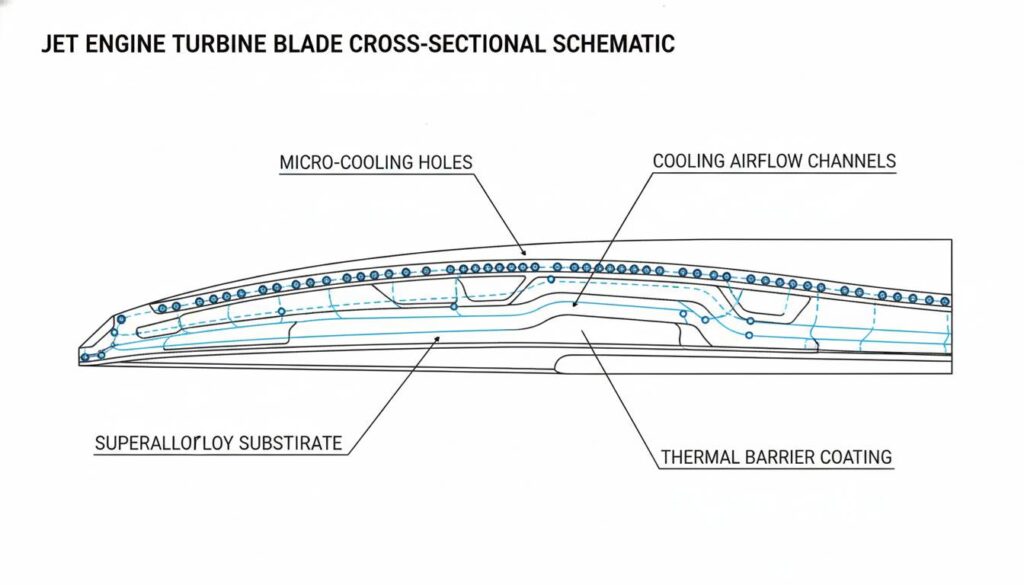
Technical Diagram: A close-up technical drawing of a jet engine turbine blade. Show tiny, intricate cooling holes drilled along the edge of the blade.
2. Medical Implants
Artificial hip joints and knee replacements must be perfectly smooth. If they are rough, they will hurt the patient.
- Use: ECM creates the complex 3D shape and leaves a polished surface that is safe for the human body.
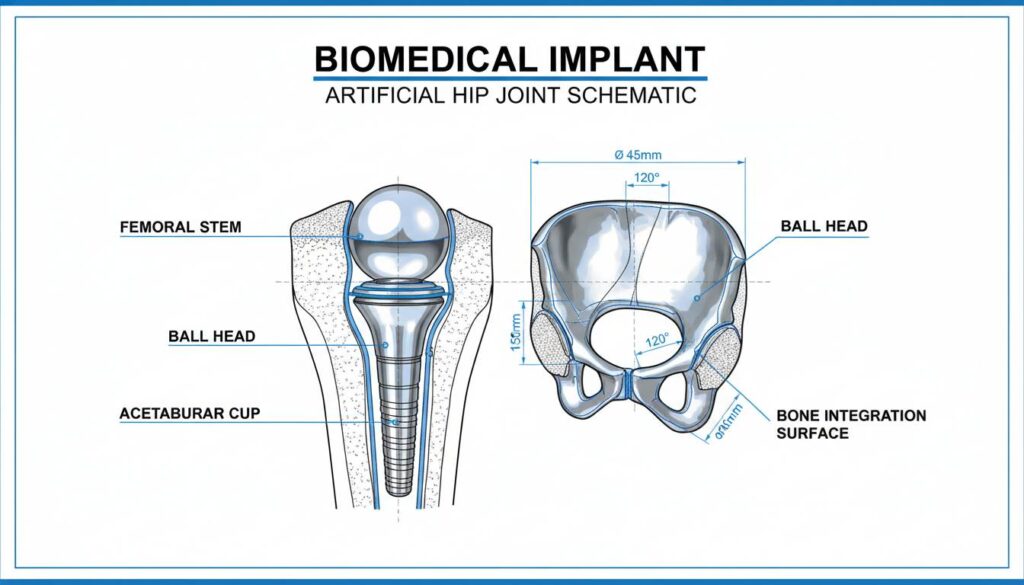
Technical Diagram: An illustration of a metallic artificial hip joint. The surface should look highly polished and chrome-like. Label it “Biomedical Implant”.
3. Automotive Industry
Cars need fuel injectors with microscopic holes to spray gas into the engine.
- Use: ECM drills these tiny holes perfectly without leaving any jagged edges (burrs) that could clog the engine.
Latest Developments in ECM
Technology moves fast. Here is what is new in the world of ECM.
1. Micro-ECM
Engineers are shrinking the process. We can now use ECM to make parts smaller than a human hair.
- Application: Making tiny gears for micro-robots or parts for computer hard drives.

Technical Diagram: A microscopic view comparison. Show a human hair strand next to a tiny, complex metal gear made by Micro-ECM to show scale.
2. Pulse ECM (PECM)
Instead of leaving the electricity on all the time, new machines turn the power ON and OFF thousands of times per second.
- Benefit: This allows the dirty water to flush out better during the “OFF” time. It makes the cut much more precise.
3. Eco-Friendly Electrolytes
Old electrolytes were harsh chemicals. Scientists are developing new salt mixtures that are safer for the environment and easier to clean up.
Future Engineering:
Why is “Micro-ECM” becoming more popular? Look at the device you are reading this on (phone or laptop). Are the parts inside getting bigger or smaller over time?
