
What is EDM?
Imagine you want to cut a piece of super-hard steel. A saw might break. A drill might get dull. But what if you used lightning?
Electrical Discharge Machining (EDM) is a way to cut metal using electricity. We don’t touch the metal with a tool. Instead, we use thousands of tiny electrical sparks. These sparks are very hot. They melt and vaporize tiny bits of the metal.
Think of it like using a tiny, super-hot laser beam that turns on and off thousands of times a second. Each time it turns on, it bites off a piece of metal.
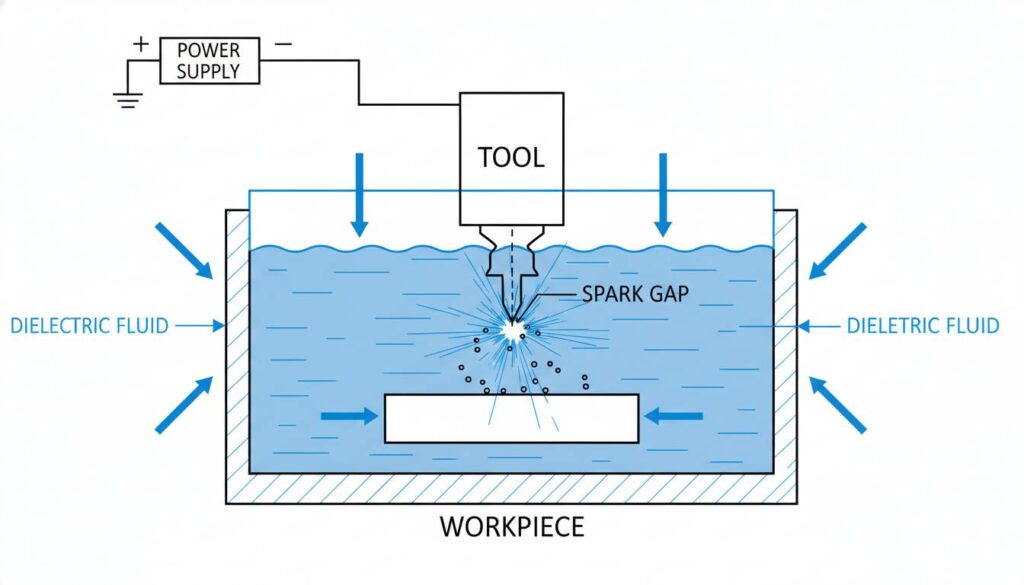
Technical Diagram: A simple 2D schematic diagram of the EDM process. Show a tool electrode (labeled ‘Tool’) above a workpiece (labeled ‘Workpiece’). Draw a bright jagged spark connecting them. Show them submerged in a tank of blue liquid.
Metal Removal Rate (MRR)
What is MRR?
Metal Removal Rate (MRR) is simply the speed of the cut. It measures how much metal we “eat away” in a specific amount of time.
- High MRR: We are cutting very fast. We remove a lot of metal quickly.
- Low MRR: We are cutting slowly. It takes a long time to remove the metal.
In math terms, we measure this in cubic millimeters per minute ( ). It is just volume divided by time.
How to Increase MRR (Cutting Faster)
To cut faster, we need bigger, hotter sparks. Here is how we do it:
1. Increase the Current (Amps)
Current is the “muscle” of electricity.
- More Current: The spark is stronger and hotter. It melts a bigger chunk of metal.
- Less Current: The spark is weak. It melts a tiny speck of metal.
Analogy: Imagine digging a hole.
- Low Current: Using a teaspoon. It takes forever.
- High Current: Using a big shovel. You dig the hole very fast.

Technical Diagram: A comparison diagram showing two sparks. On the left, label ‘Low Current’ with a thin, weak spark making a small dent. On the right, label ‘High Current’ with a thick, bright spark making a large dent in the metal.
2. Increase Pulse On-Time
The “Pulse On-Time” is how long the spark stays on.
- If the spark stays on longer, heat goes deeper into the metal.
- More metal melts.
- MRR goes up (faster cutting).
Think About It:
If we use a huge “shovel” (High Current) to dig our hole fast, will the walls of the hole be smooth or rough?
Surface Finish
What is Surface Finish?
Surface Finish is how smooth or rough the metal feels after we cut it.
When an EDM spark hits the metal, it leaves a tiny crater. It looks like the surface of the moon, but microscopic.
- Rough Finish: The craters are big and deep. It feels like sandpaper.
- Smooth Finish: The craters are tiny and shallow. It feels like glass or polished steel.
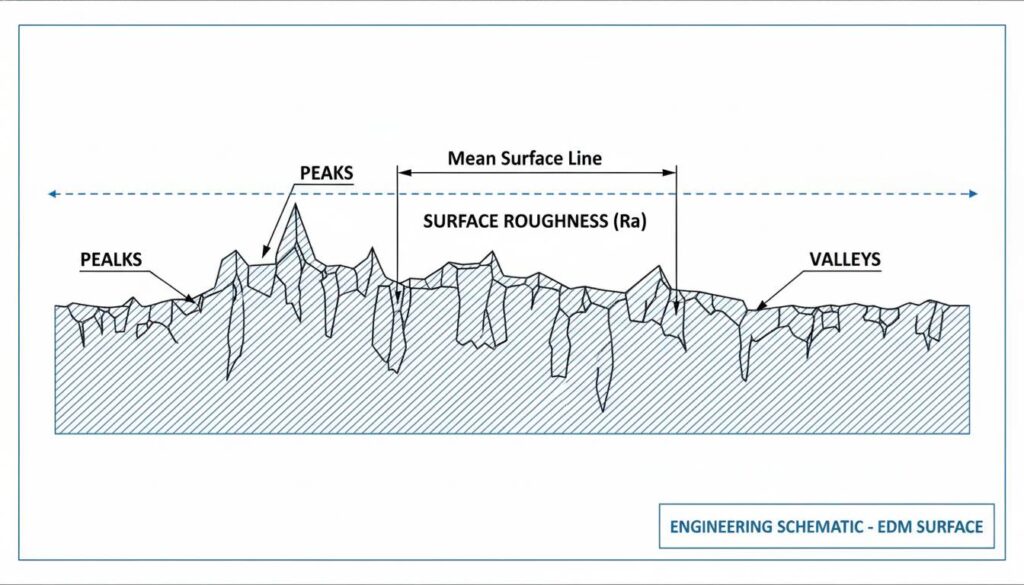
Technical Diagram: A cross-section close-up illustration of a metal surface after EDM. Show a jagged, cratered surface texture. Label the peaks and valleys to represent ‘Surface Roughness’.
Factors Affecting Surface Finish
1. Spark Energy (Current)
This is the opposite of MRR.
- High Current (Big Sparks): Creates big explosions. This leaves big, deep craters. The surface is rough.
- Low Current (Small Sparks): Creates tiny explosions. This leaves tiny, shallow craters. The surface is smooth.
2. Spark Frequency
Frequency is how often the sparks happen.
- For a smooth finish, we want high frequency (many sparks per second) but low energy.
- This is like sanding wood with fine sandpaper. You make many tiny scratches instead of a few big gouges.
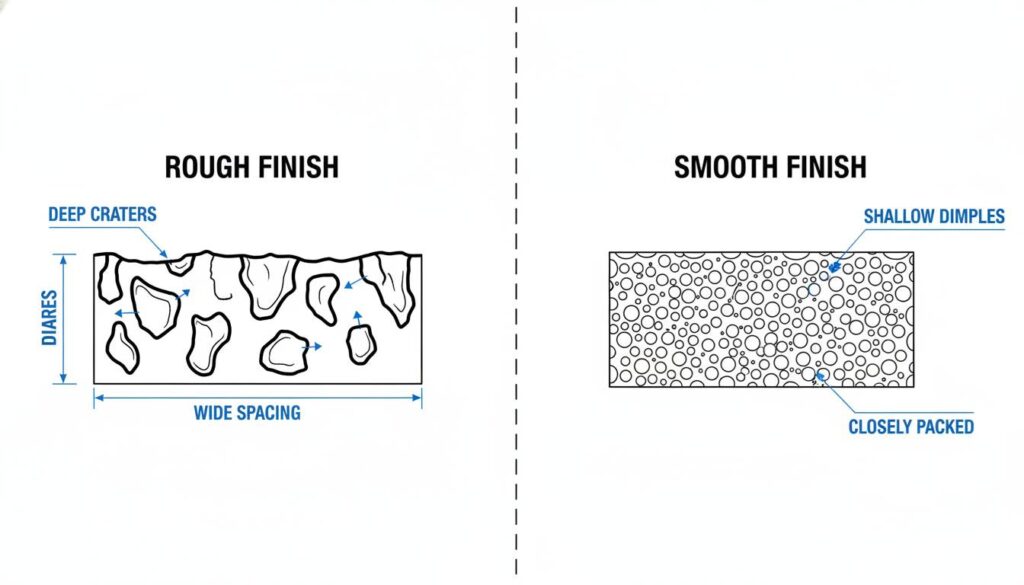
Technical Diagram: A split diagram. Left side labeled ‘Rough Finish’ showing deep, wide craters. Right side labeled ‘Smooth Finish’ showing very small, shallow dimples close together.
Think About It:
Why would a car engine part need a smooth finish? What happens if two rough metal parts rub against each other? (Hint: Think about friction and heat).
The Big Trade-Off: Speed vs. Quality
In EDM, you usually cannot have everything at once. There is a trade-off.
Roughing Cuts
- Goal: Remove metal as fast as possible.
- Settings: High Current, Long Pulse On-Time.
- Result: High MRR (Fast), but Rough Surface (Ugly).
Finishing Cuts
- Goal: Make the part look good and fit perfectly.
- Settings: Low Current, Short Pulse On-Time, High Frequency.
- Result: Low MRR (Slow), but Smooth Surface (Beautiful).
The Strategy:
Engineers usually do a “Roughing Cut” first to remove most of the metal. Then, they change the settings and do a “Finishing Cut” to smooth out the edges.
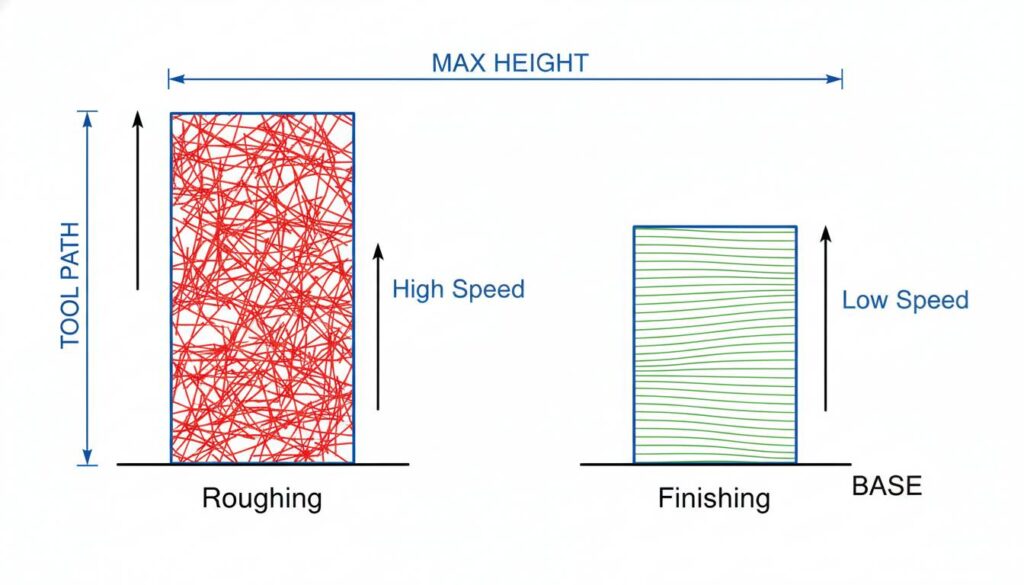
Technical Diagram: A bar chart comparison. Bar 1 labeled ‘Roughing’ is tall (High Speed) but colored red (Rough). Bar 2 labeled ‘Finishing’ is short (Low Speed) but colored green (Smooth).
The Role of the Fluid (Dielectric)
The metal and the tool are dipped in a liquid called a dielectric fluid (usually oil or deionized water). This fluid has two jobs regarding MRR and Finish:
- Cooling: It cools the metal so it doesn’t warp.
- Flushing: This is the most important part. When the spark melts the metal, it turns into dust (debris). The fluid must wash this dust away.
- Bad Flushing: If the dust stays in the hole, the spark hits the dust instead of the metal. The cutting stops (Low MRR).
- Good Flushing: The dust is washed away. The spark hits fresh metal every time.
Technical Diagram: A technical illustration showing the gap between the tool and workpiece. Draw arrows representing ‘Dielectric Fluid’ flowing rapidly through the gap, carrying away small black dots (debris/chips).
Summary Table
Here is a simple cheat sheet to remember the rules:
| Setting | If you INCREASE this… | Metal Removal Rate (Speed) | Surface Finish (Smoothness) |
| Current (Amps) | Make it stronger | Increases (Faster) | Worse (Rougher) |
| Pulse On-Time | Make spark longer | Increases (Faster) | Worse (Rougher) |
| Frequency | More sparks/second | Decreases (Slower) | Better (Smoother) |
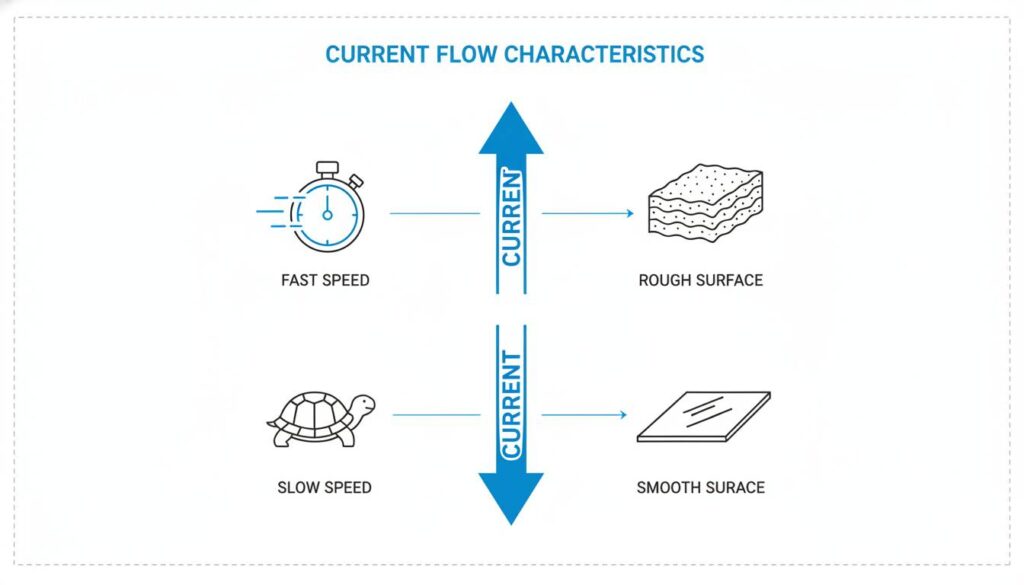
Technical Diagram: An infographic style summary. An arrow pointing UP for ‘Current’ leads to a stopwatch (Fast Speed) and a piece of sandpaper (Rough Surface). An arrow pointing DOWN for ‘Current’ leads to a turtle (Slow Speed) and a mirror (Smooth Surface).
Final Challenge:
You are making a mold for a plastic toy car. The outside of the car needs to be shiny. The inside doesn’t matter.
1. Which settings do you use for the inside of the mold?
2. Which settings do you use for the outside surface?
