
What is Hydraulic Capacitance?
Before we do any math, we need to understand what “Capacitance” means. In the world of hydraulics (moving liquids), capacitance is the ability to store fluid.
Think of a rigid steel pipe. If you pump water into it, the pipe doesn’t stretch. The pressure goes up instantly. This pipe has almost zero capacitance.
Now, imagine a water balloon. When you pump water into it, it stretches. It expands to hold the extra water. The pressure rises slowly because the balloon is making room for the water. This balloon has high capacitance.
In engineering, we use a device called an Accumulator. It acts just like that water balloon. It stores energy by holding extra fluid under pressure.

Technical Figure: A simple diagram showing a hydraulic accumulator. It looks like a tank with a balloon inside. The balloon is being squished by oil entering the tank. Label the oil ‘Fluid’ and the balloon ‘Gas Spring’.
The Simple Formula
We need a simple way to measure this. We look at two things:
- Volume (
 ): How much liquid moves in.
 - Pressure (): How hard the liquid pushes back.
Capacitance ( ) is the change in Volume divided by the change in Pressure.

We can rearrange this to find Volume:

This means: Volume equals Capacitance times Pressure. Keep this formula in your head. We will use it to solve the puzzle.
If you have a very stiff tank (low capacitance) and a very stretchy tank (high capacitance), which one requires more water to raise the pressure by 10 psi? Why?
Hydraulic Lines in Parallel
What Does “Parallel” Mean?
Imagine you have two water tanks sitting side-by-side on the floor. You connect both of them to the same main water pipe. This is a Parallel connection.
When you turn on the water, both tanks fill up at the same time.
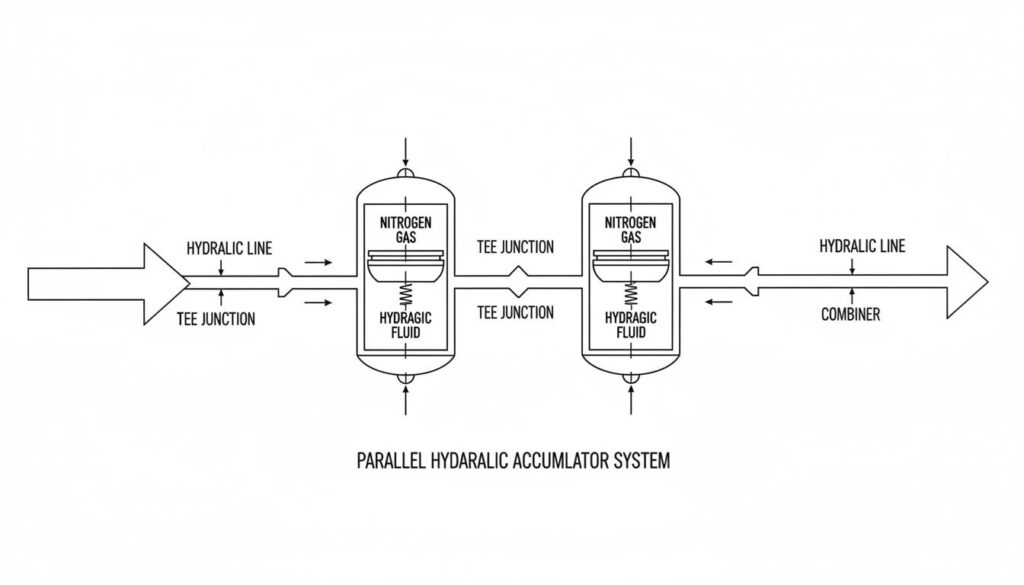
Technical Figure: A schematic diagram of two hydraulic accumulators connected in parallel. The main pipe splits into two branches, with one accumulator on each branch. Arrows show fluid flowing into both simultaneously.
Deriving the Parallel Expression
Let’s figure out the total capacitance ( ).
).
- Pressure Rule: Since both tanks are connected to the same pipe, the pressure is the same for both.

Let’s just call it .
- Volume Rule: The total amount of water stored (
 ) is the water in the first tank plus the water in the second tank.
- Substitution: Remember our formula (
 )? Let’s swap the ‘s for
  .
.

- The Solution: Look at the equation above. Every term is multiplied by . We can cross out from everywhere.

Conclusion: When lines are in parallel, you simply add their capacitances together. You are making a bigger storage tank!
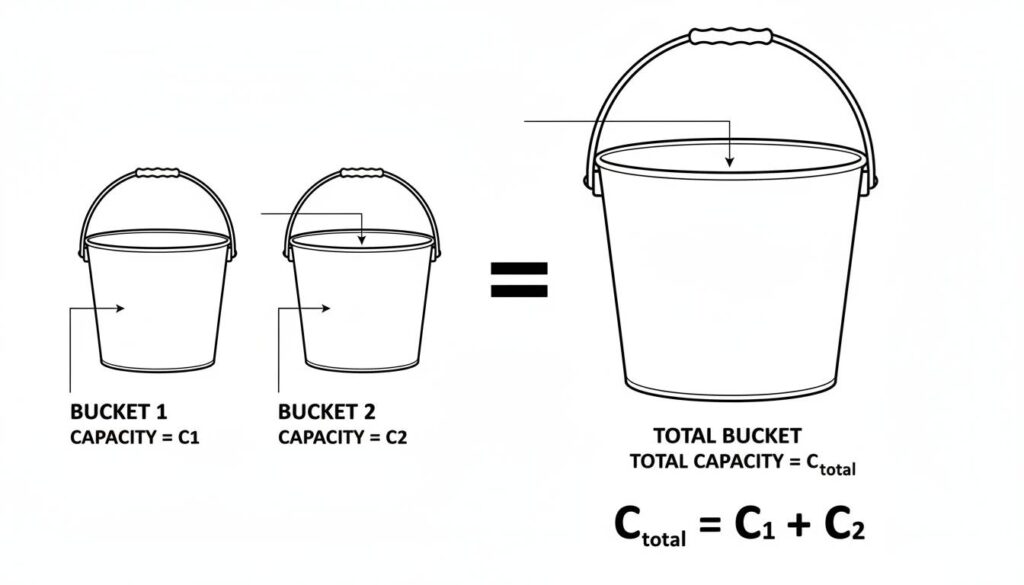
Technical Figure: An illustration comparing two small buckets next to each other versus one giant bucket. The giant bucket represents the sum of the two small ones, illustrating C_total = C1 + C2.
If you connect two batteries side-by-side (parallel), they last longer but the voltage stays the same. How is this similar to our hydraulic tanks in parallel?
Hydraulic Lines in Series
What Does “Series” Mean?
This one is a bit trickier. Imagine a pipe where the fluid has to go through one component to get to the next. Or, imagine stacking two springs on top of each other.
In hydraulics, a “series” connection usually means the pressure drops across one component, and then the remaining pressure drops across the next.
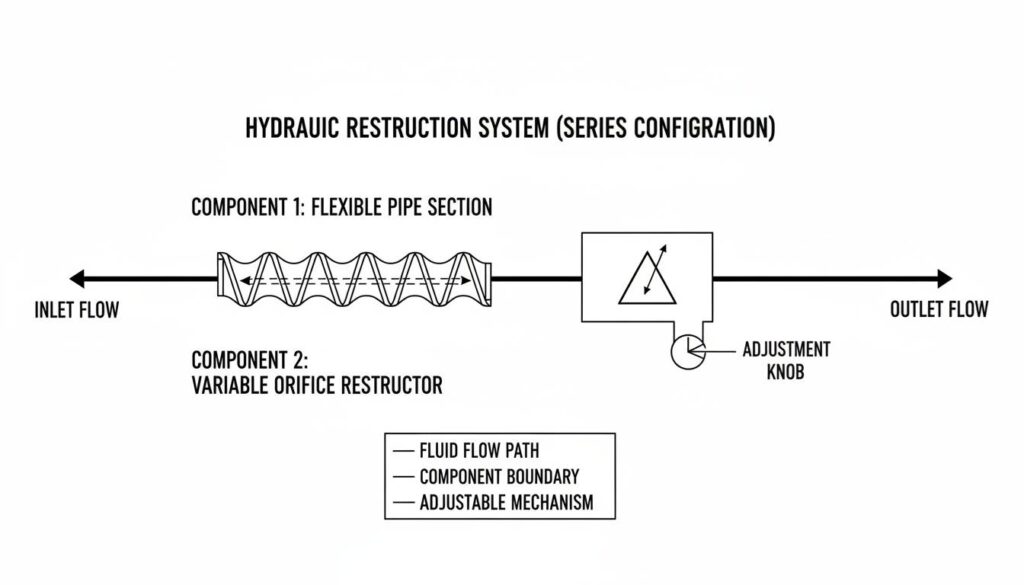
Technical Figure: A schematic diagram of two hydraulic restrictions or flexible pipe sections connected end-to-end (in series). A single line goes through component 1 and then immediately into component 2.
Deriving the Series Expression
Let’s find the total capacitance () for lines in series.
- Volume Rule: In a series line, whatever water pushes into the first part must push into the second part. The flow (displacement) is the same.

Let’s just call it .
- Pressure Rule: The total pressure effort is split. Part of the pressure is used on the first line, and the rest is used on the second.
- Substitution: We know that
 . Let’s swap the ‘s for
  .
.
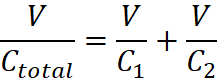
- The Solution: Every term has a on top. We can divide everything by (cross them out).
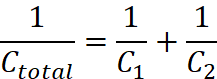
Conclusion: In series, the total capacitance gets smaller. It is the sum of the reciprocals (the fractions).
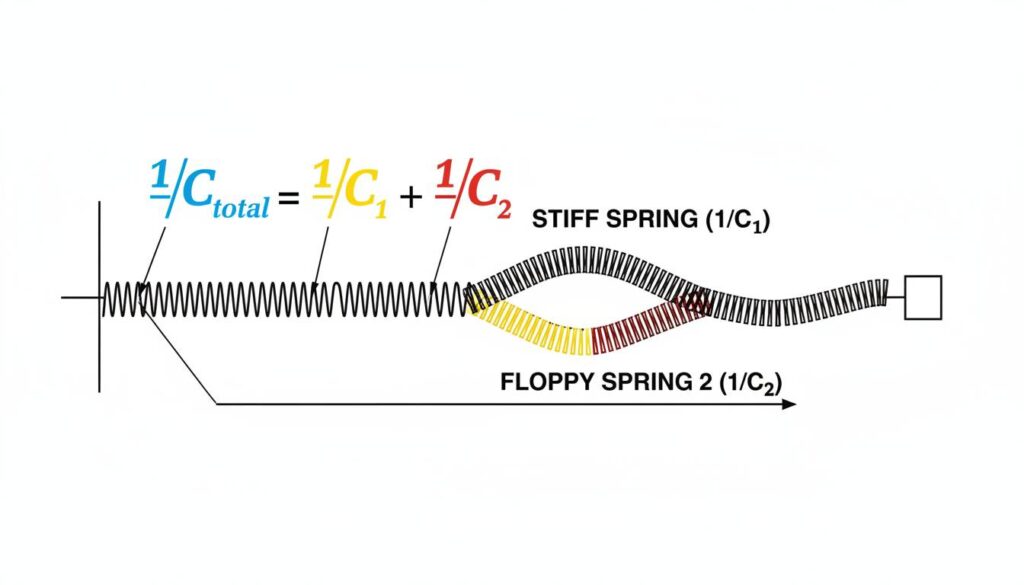
Technical Figure: A math visual aid showing the equation 1/C_total = 1/C1 + 1/C2. Use bright colors to highlight the fractions. Next to it, show a “stiff” spring made by connecting two floppy springs end-to-end.
Why do you think the total capacitance drops in series? Think about “stiffness.” If you stack two springs, does the stack become floppier or harder to compress compared to just one? (Hint: It’s actually floppier, but in hydraulics, we look at pressure drop!)
Summary of Results
Let’s look at our two final answers side by side.
Parallel Connection
- Visual: Side by Side.
- Logic: You are increasing the storage space.
- Formula:

Series Connection
- Visual: End to End.
- Logic: You are splitting the pressure drop.
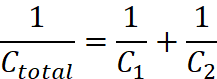
- Formula:
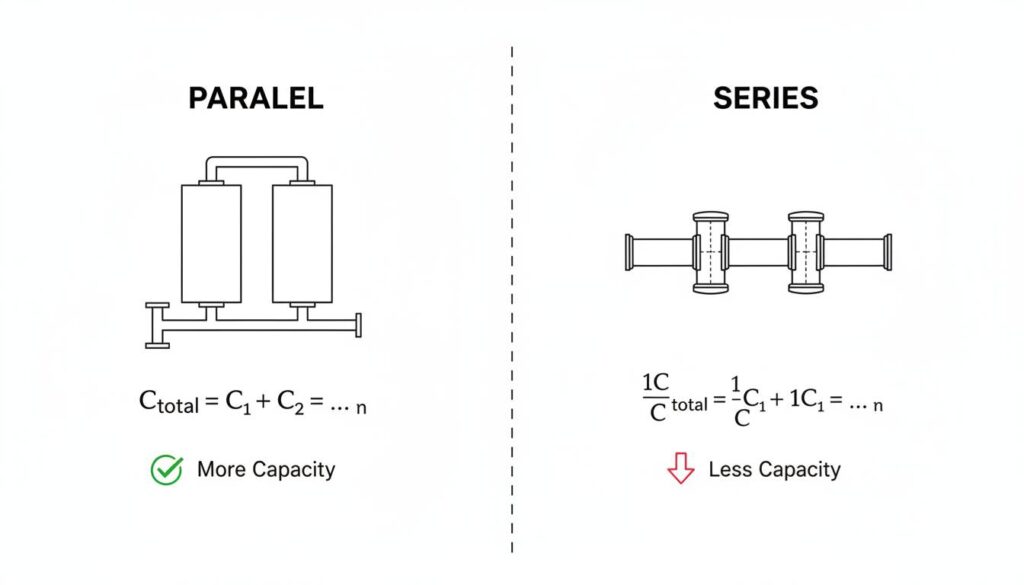
Technical Figure: A comparison chart. Left side: “Parallel” with an icon of two tanks and the addition formula. Right side: “Series” with an icon of inline pipes and the fraction formula. Green checkmarks for “More Capacity” on the left, Red arrow for “Less Capacity” on the right.

Technical Figure: A real-world application collage. Show a heavy excavator arm (hydraulics). Zoom in on the hydraulic lines to show where hoses might be parallel (for power) or series (for control).
