
What is an EDM Spark Generator?
Imagine you want to cut through a piece of super-hard steel. You can’t use a saw because the steel is too tough. Instead, you use lightning.
Electrical Discharge Machining (EDM) uses thousands of tiny electrical sparks to melt away metal. But you can’t just plug the machine into a wall outlet. You need a special system to turn that electricity into rapid-fire sparks. This system is called the Spark Generating Circuit (or Power Supply).
Think of this circuit as a machine gun for electricity. It decides how fast the sparks shoot and how strong they are.
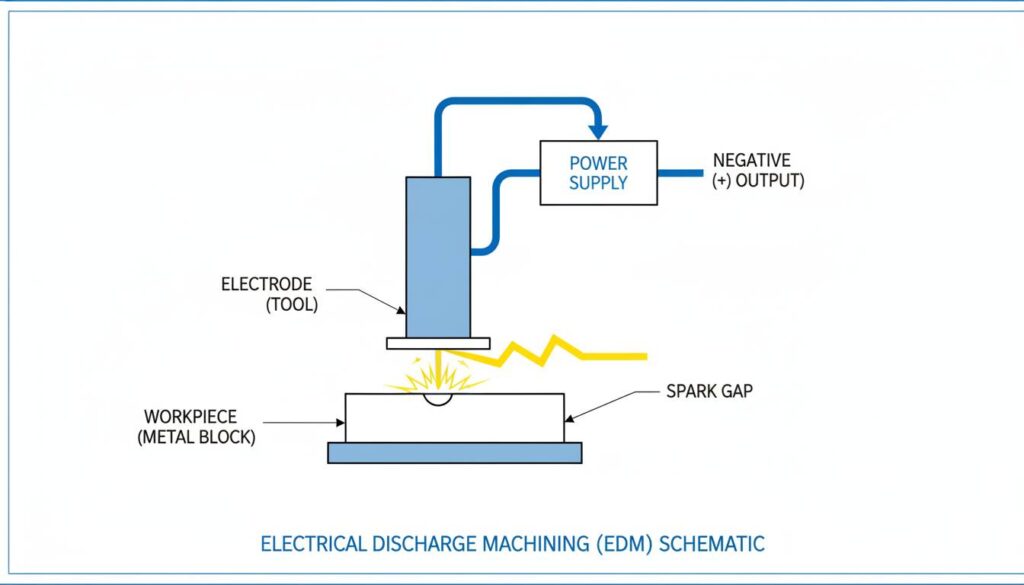
Technical Diagram: A simple cartoon-style diagram showing an EDM machine. An electrode (tool) is close to a workpiece (metal block). A bright yellow spark is jumping between them. The background shows a box labeled ‘Power Supply’ connected to the tool.
The 4 Most Common Spark Circuits
Engineers have invented different ways to make these sparks over the years. Here are the four main types you need to know:
- RC Circuit (Also called the Relaxation Circuit).
- R-C-L Circuit.
- Rotary Pulse Generator Circuit.
- Controlled Pulse Generator Circuit (The modern “Smart” circuit).
Let’s look at how they work.
1. The RC Circuit (Relaxation Circuit)
This is the oldest and simplest type. Think of it like a toilet tank.
- How it works: You have a Resistor (R) and a Capacitor (C).
- The Process:
- Electricity flows through the Resistor (the pipe).
- It fills up the Capacitor (the tank).
- When the tank is full, it dumps all the energy at once. ZAP! That is the spark.
- Then, you have to wait for the tank to fill up again.
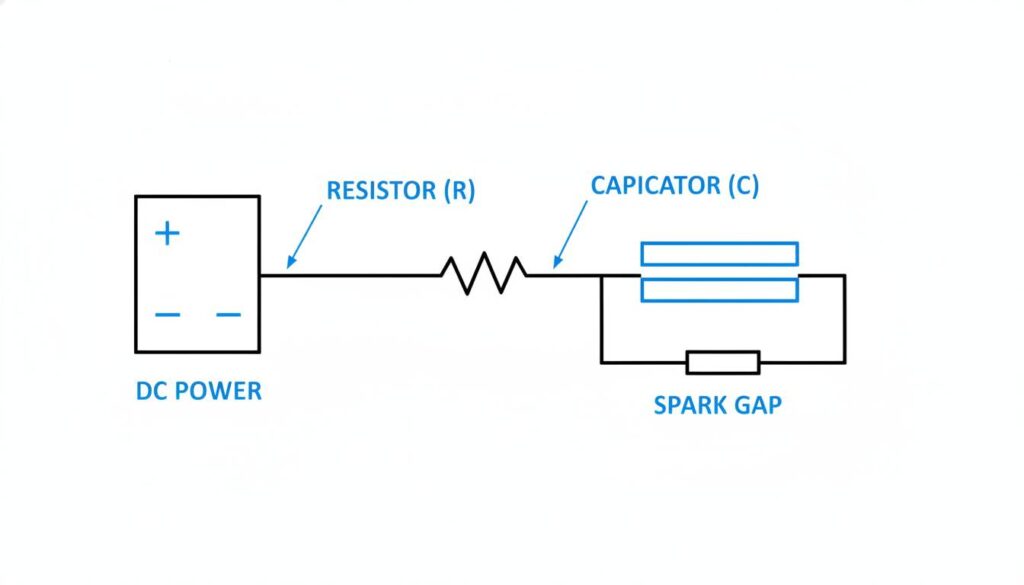
Technical Diagram: A schematic diagram of an RC Circuit for EDM. Show a DC power source on the left, a zigzag line labeled ‘Resistor (R)’, and two parallel plates labeled ‘Capacitor (C)’. The capacitor is connected to the spark gap.
2. The R-C-L Circuit
This is very similar to the RC circuit, but with one extra part: an Inductor (L).
- The Upgrade: An inductor is basically a coil of wire.
- Why use it? In the normal RC circuit, the spark dies out instantly. The Inductor acts like a heavy flywheel. It keeps the electricity pushing for a tiny bit longer. This makes the spark last longer and removes more metal.
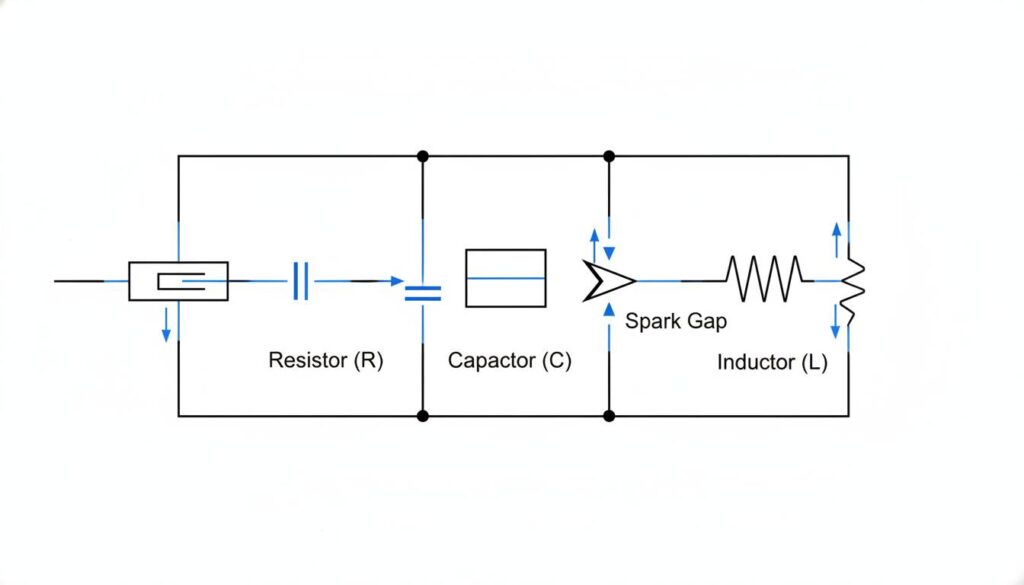
Technical Diagram: A schematic diagram of an R-C-L Circuit. It looks like the RC circuit, but a coiled wire symbol labeled ‘Inductor (L)’ is added in series with the spark gap.
3. Rotary Pulse Generator Circuit
This is a mechanical way to make sparks. Think of a bicycle wheel with a playing card stuck in the spokes.
- How it works: A motor spins a switch.
- The Process: Every time the switch spins past a contact point, it turns the power ON. When it spins past a gap, it turns the power OFF.
- Result: This creates a pulsing effect, turning a steady stream of electricity into separate sparks.
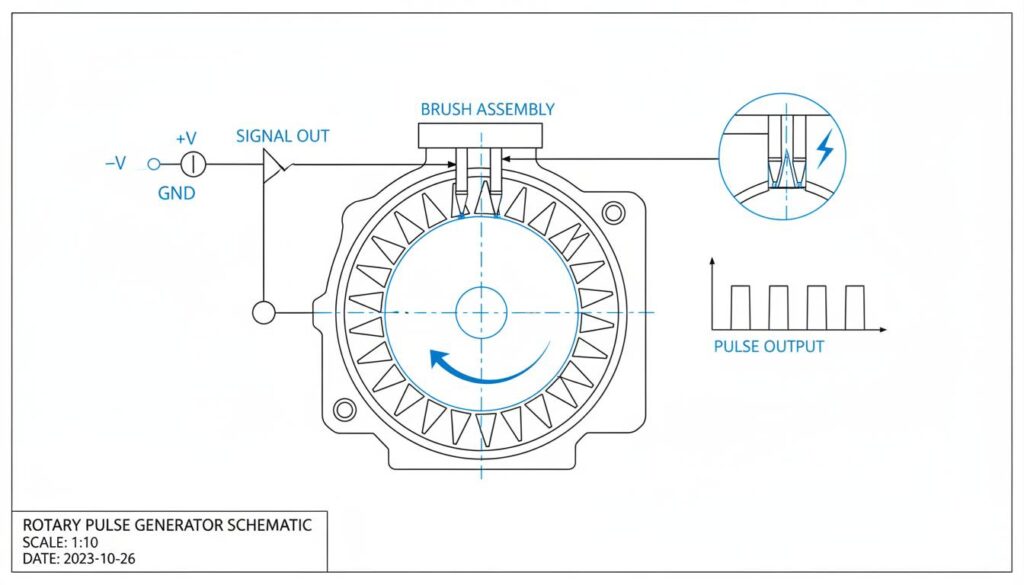
Technical Diagram: A technical drawing of a Rotary Pulse Generator. Show a circular rotor with teeth or contact points spinning. As the teeth touch a stationary brush, a circuit is completed.
4. Controlled Pulse Generator (Transistor Type)
This is the modern way. It uses Transistors. A transistor is a digital switch, like the brain of a computer.
- How it works: Instead of waiting for a capacitor to fill up (like the RC circuit), a computer tells the switch exactly when to open and close.
- The Control: You can say, “Turn on for 1 second, turn off for 1 second.” It is perfect every time. This is what almost all modern machines use.
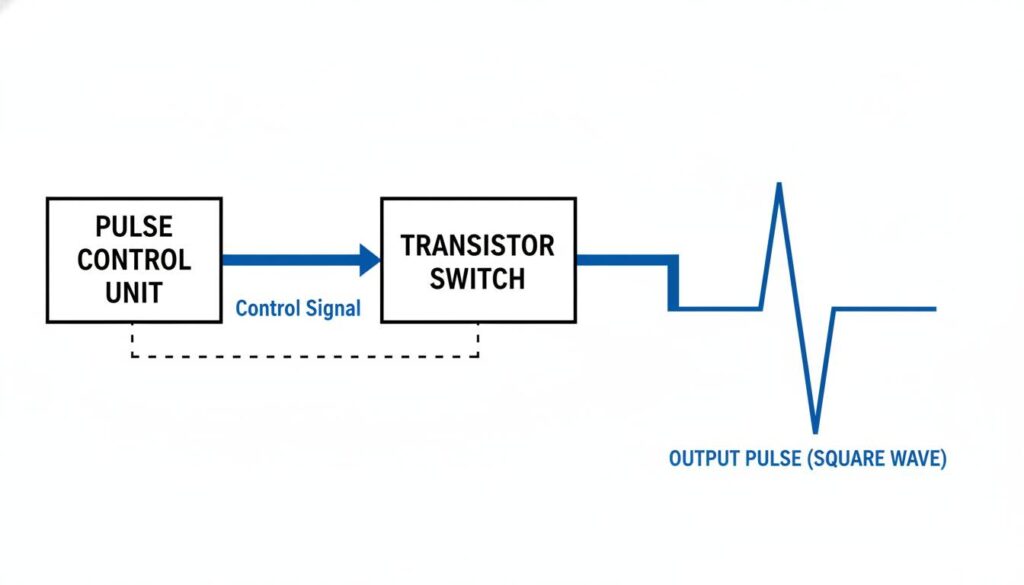
Technical Diagram: A block diagram of a Transistor Pulse Generator. Show a box labeled ‘Pulse Control Unit’ sending signals to a ‘Transistor Switch’. The output is a perfect square wave shape.
Think About It:
If the RC circuit is like a toilet tank that flushes automatically when full, and the Controlled Pulse Generator is like a light switch you control… which one allows you to make sparks faster? Why?
The Drawbacks of the Relaxation Circuit (RC Circuit)
The RC (Relaxation) circuit was the first one invented, but it is rarely used today because it has some big problems.
Drawback 1: It is Too Slow (Low Frequency)
Remember the toilet tank analogy? You cannot flush the toilet again until the tank refills.
- In the RC circuit, the capacitor takes time to charge up.
- While it is charging, no cutting is happening.
- This makes the machine cut very slowly compared to modern types.
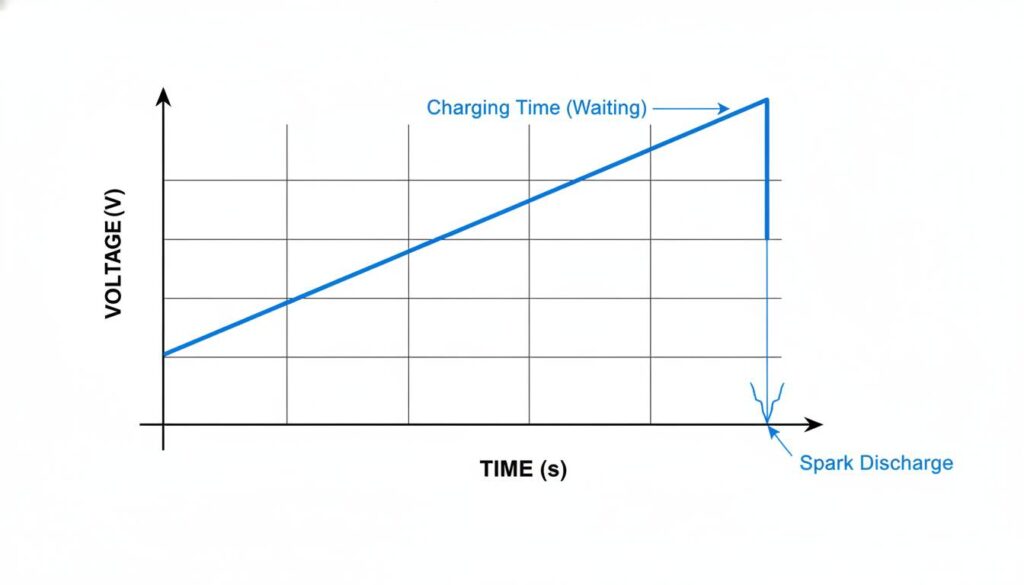
Technical Diagram: A graph showing a ‘Sawtooth Wave’. The line goes up slowly (charging) and drops straight down (spark). Label the slow upward slope as ‘Charging Time (Waiting)’.
Drawback 2: You Can’t Control the Spark Perfectly
With an RC circuit, the spark happens whenever the capacitor gets full enough to jump the gap.
- If the gap between the tool and the metal changes slightly, the spark might fire too early or too late.
- It is unpredictable. You cannot easily change how long the spark lasts (Pulse On-Time).
Drawback 3: High Tool Wear
Because the spark is uncontrolled, it is often “rough.”
- It doesn’t just melt the workpiece (the metal you want to cut).
- It also melts the tool (the electrode).
- If your tool melts away, your final shape will be wrong.
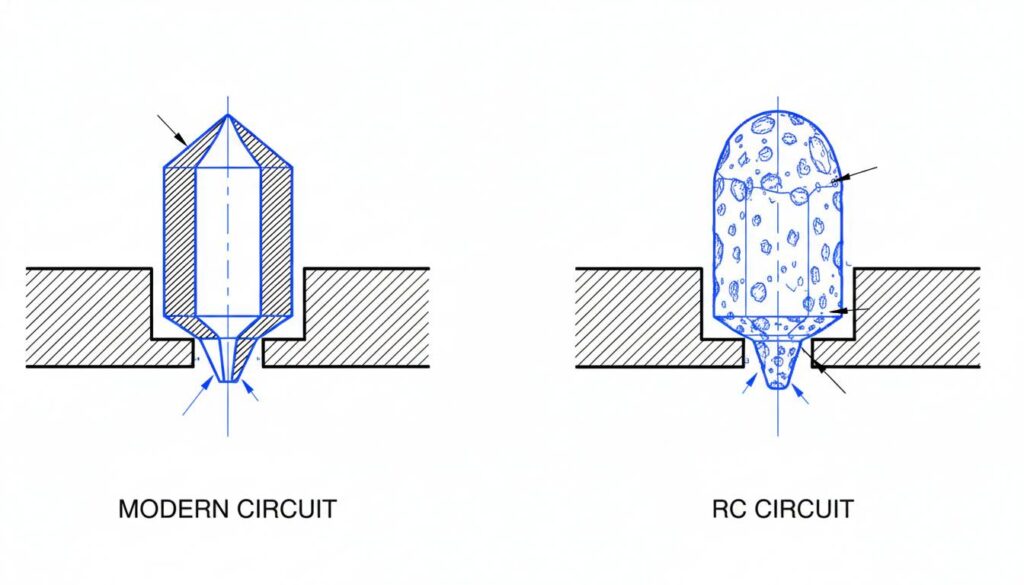
Technical Diagram: A close-up illustration comparing two EDM electrodes. The left one is labeled ‘Modern Circuit’ and looks sharp. The right one is labeled ‘RC Circuit’ and looks pitted, worn down, and rounded at the tip.
Drawback 4: Energy Waste
The Resistor (R) in the circuit does one job: it holds back the electricity to let the capacitor fill up.
- When electricity fights against a resistor, it creates heat.
- This means a lot of the electricity you pay for is just turning into hot air, not cutting sparks.
Review Question:
If you were building a factory to make thousands of car parts every day, would you use an RC Circuit or a Controlled Pulse Generator? Consider speed and the cost of replacing worn-out tools.
