What is Electro Chemical Machining?
Imagine trying to cut a piece of super-hard metal. Usually, you would use a saw or a drill. But what if the metal is too hard? What if you need to make a square hole instead of a round one?
This is where Electro Chemical Machining (ECM) comes in.
ECM is a way to remove metal without ever touching it. We do not use force. We do not use heat. We use electricity and chemistry.
Think of it as “Reverse Electroplating.” In electroplating, you add metal to an object (like gold-plating a ring). In ECM, we do the opposite. We strip the metal away, atom by atom.
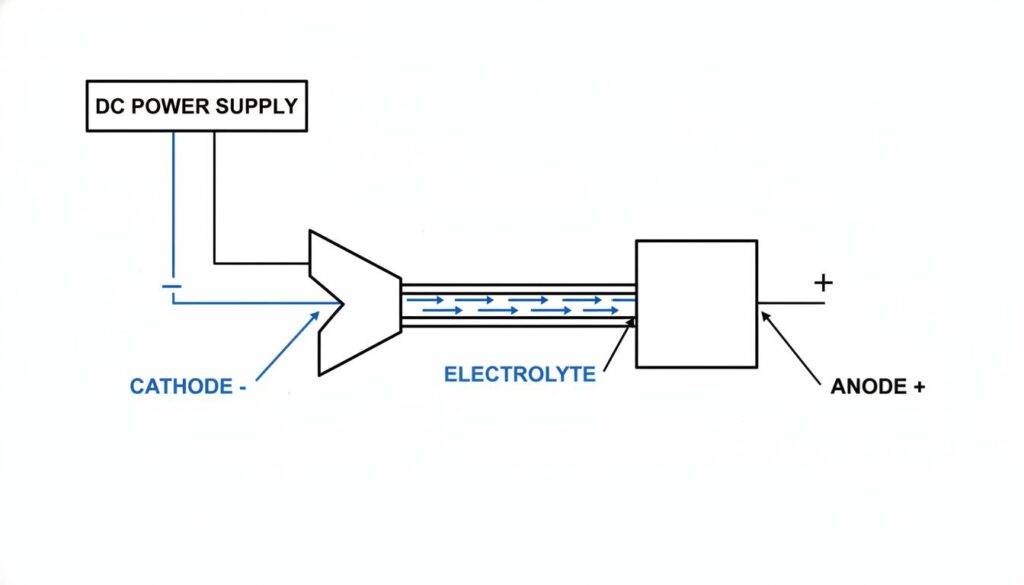
Technical Diagram: A simple 2D schematic diagram of the ECM process. Show a DC power supply connected to a tool (labeled Cathode -) and a workpiece (labeled Anode +). Show a gap between them filled with flowing liquid labeled Electrolyte.
The Four Main Parts
To make this work, you need four specific things.
1. The Workpiece (The Anode)
This is the metal we want to shape. We connect this to the Positive (+) side of a power supply. In chemistry, the positive side is called the Anode.
2. The Tool (The Cathode)
This is the “cutter.” But it isn’t sharp. It is made of copper or brass. We shape this tool to look exactly like the hole we want to make. We connect this to the Negative (-) side of the power supply. This is called the Cathode.
3. The Electrolyte (The Liquid)
We cannot just use air between the tool and the metal. We need a liquid that conducts electricity. We usually use saltwater (brine). This liquid flows very fast between the tool and the workpiece.
4. The Power Supply
We use a DC (Direct Current) battery or power source. It pushes electrons through the system.
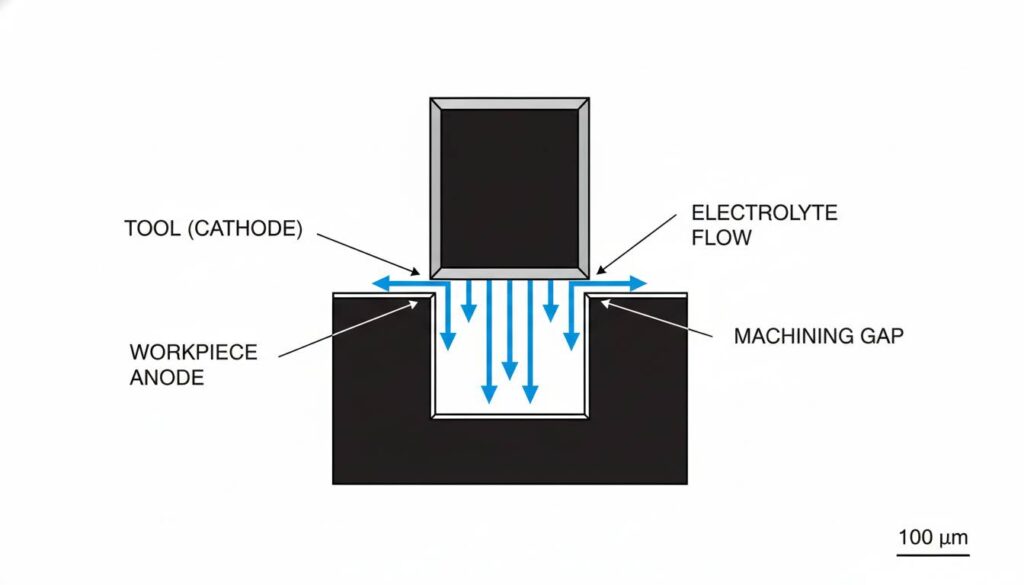
Technical Diagram: Close-up cross-section illustration of the gap between the tool and workpiece. The tool is shaped like a square rod. The workpiece has a square indentation forming. Blue arrows show the flow of electrolyte liquid through the tiny gap.
Think About It:
If we used a saw, the saw blade would get dull over time. In ECM, the tool never touches the workpiece. Do you think the tool gets dull? Why or why not?
How the Process Works (Step-by-Step)
Here is what happens when we turn the machine on.
- Positioning: We bring the Tool (Negative) very close to the Workpiece (Positive). They almost touch, but not quite. The gap is as thin as a human hair.
- Flow: We pump the saltwater (electrolyte) through that tiny gap at high speed.
- Power On: We turn on the electricity.
- Dissolving: Because of the electricity, the metal atoms on the Workpiece (Positive side) lose their grip. They float away into the saltwater.
- Sludge: The metal atoms mix with the water and turn into a sludge (rust). The fast-moving water washes this sludge away immediately.
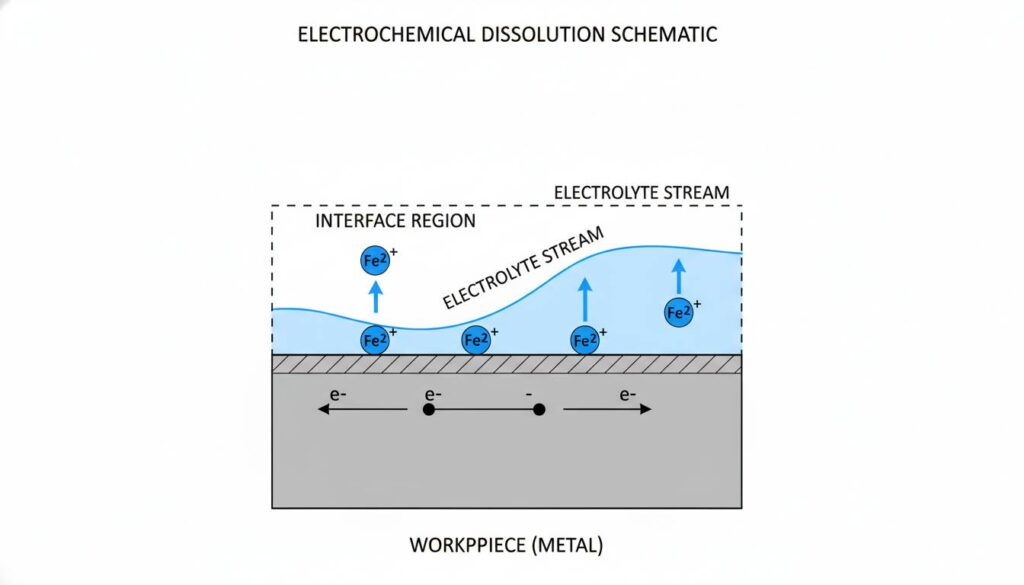
Technical Diagram: A microscopic view diagram showing metal ions (labeled Fe2+) leaving the workpiece surface and entering the electrolyte stream. Show electrons (e-) staying in the metal.
How is a Replica of the Tool Obtained?
This is the “magic” part of ECM. You want to know how we copy the shape of the tool into the metal.
The Mirror Image Concept
The electricity only jumps across the shortest distance.
Imagine the tool is shaped like a letter ‘V’.
- The tip of the ‘V’ is closest to the metal.
- The electricity jumps from the tip first.
- The metal directly under the tip dissolves.
- As the tool moves down, the sides of the ‘V’ get close to the metal.
- Now, the metal under the sides starts to dissolve.
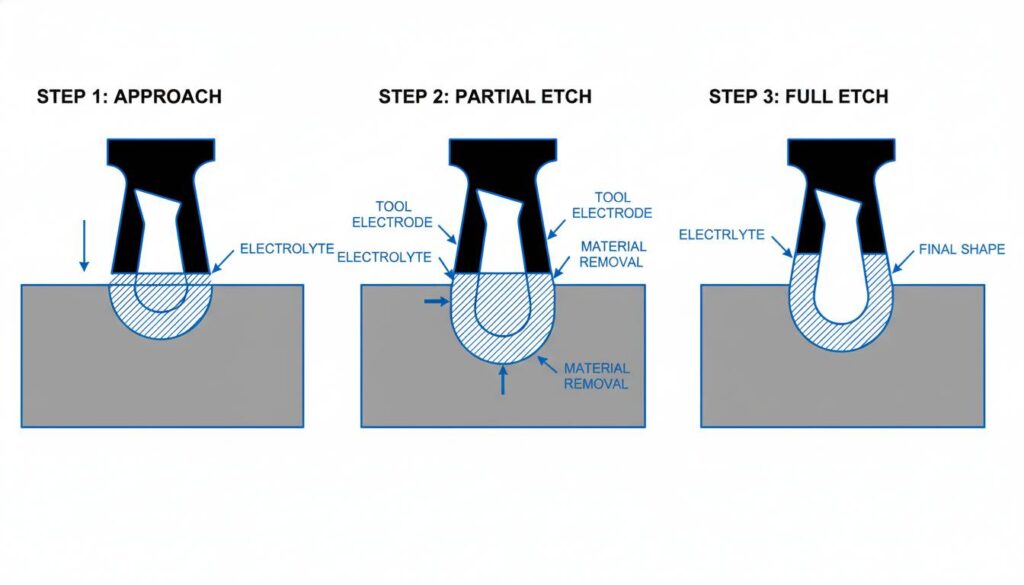
Technical Diagram: A sequence of 3 diagrams showing the progression of ECM. Step 1: A shaped tool approaches a flat metal block. Step 2: The tool sinks halfway in, creating a matching cavity. Step 3: The tool is fully deep, showing the cavity is a perfect negative replica of the tool.
The Result
The metal dissolves only where the tool is close to it.
- If the tool is flat, the bottom of the hole becomes flat.
- If the tool is curved, the hole becomes curved.
The workpiece becomes a negative replica (a mirror image) of the tool. It fits like a key in a lock.
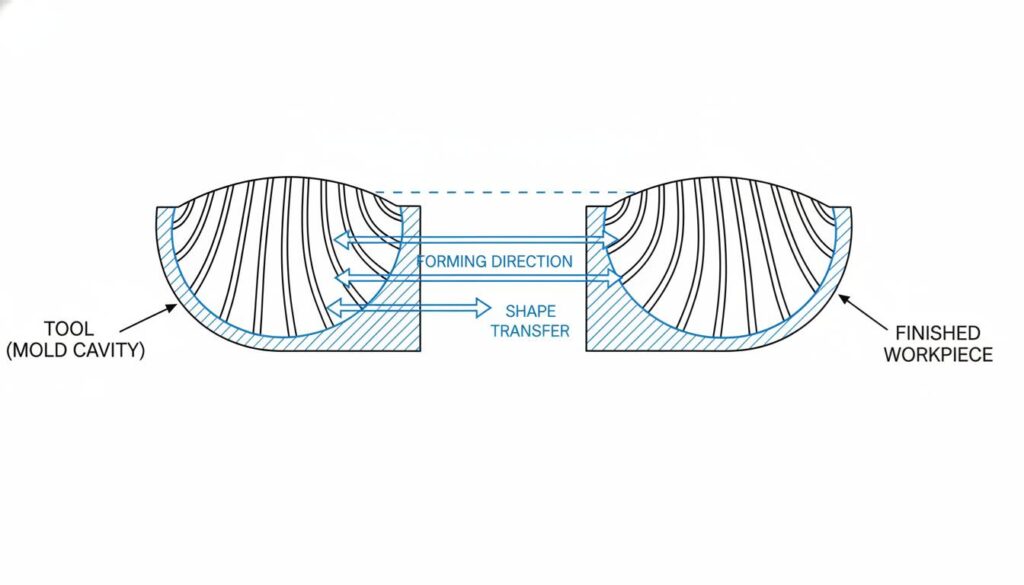
Technical Diagram: Technical illustration of a complex shaped tool (like a turbine blade mold) and the finished workpiece side-by-side. Use arrows to indicate how the convex shape of the tool created the concave shape in the workpiece.Check Your Understanding:If you wanted to make a star-shaped hole in a steel plate using ECM, what shape must your copper tool be?
Why Do We Need the Liquid (Electrolyte)?
The liquid is not just there to conduct electricity. It has two other big jobs.
1. Carrying the Trash
When the metal dissolves, it creates waste (sludge). If this sludge stays in the gap, it will cause a short circuit (sparks). The liquid flows very fast (like a fire hose) to wash the sludge away.
2. Cooling Down
Electricity creates heat. The flowing liquid keeps the tool and the metal cool so they don’t warp.
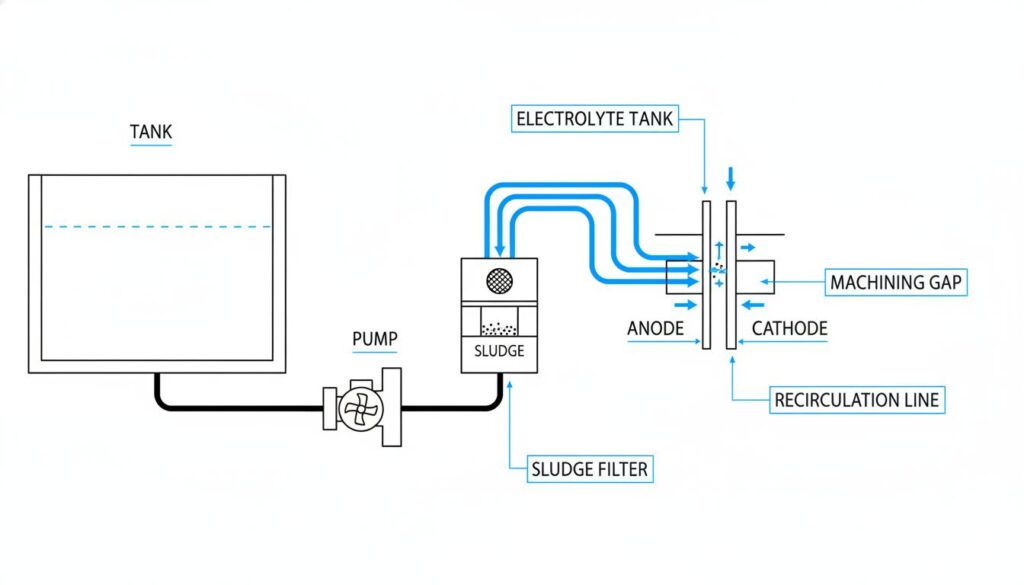
Technical Diagram: Diagram of the electrolyte circulation system. Show a tank, a pump, a filter to catch sludge, and pipes leading to the machining gap.
Advantages and Disadvantages
Why use ECM? (Pros)
- No Wear: The tool never touches the metal, so the tool never wears out.
- Hardness doesn’t matter: It cuts super-hard titanium as easily as soft aluminum.
- Complex Shapes: You can make 3D curved shapes that drills cannot make.
- No Stress: Since nothing hits the metal, the metal doesn’t get bent or stressed.
What is the catch? (Cons)
- Cost: The machine and the electricity are expensive.
- Messy: The sludge is chemical waste and must be disposed of carefully.
- Corrosion: The saltwater can rust the machine if you aren’t careful.
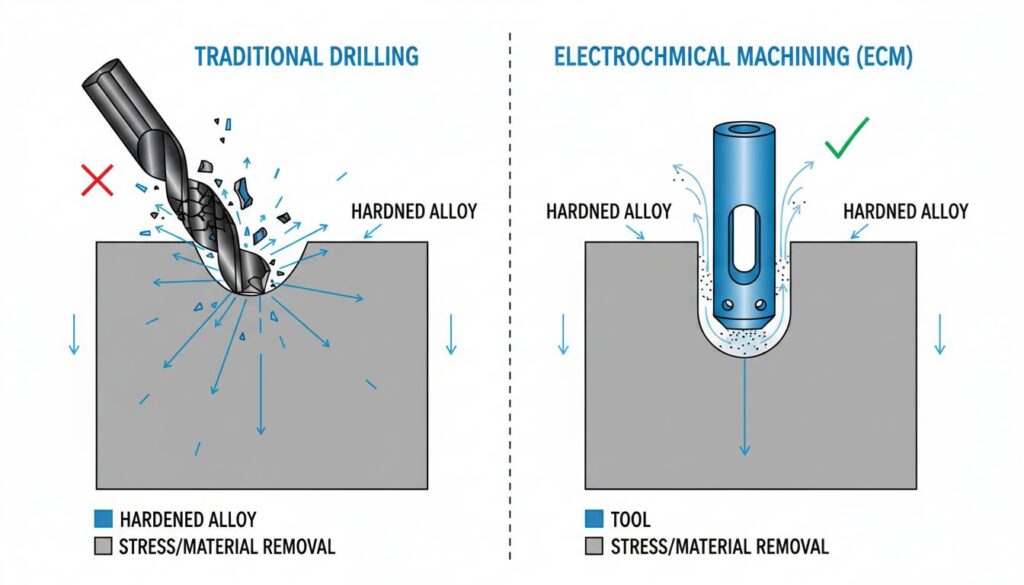
Technical Diagram: A comparison chart visual. Left side: A drill bit breaking on hard metal. Right side: An ECM tool sinking smoothly into the same hard metal.
Final Thought:
ECM uses a lot of electricity. If you were a factory owner, would you use ECM to cut soft wood? Why is that a bad idea? (Hint: Does wood conduct electricity?)
