
What is a Hybrid Vehicle?
A hybrid vehicle is a car that uses two different types of power to move. Think of it like a tandem bicycle (a bike for two people). On a tandem bike, two people pedal to move one bike.
In a Hybrid Electric Vehicle (HEV), the two “pedalers” are:
- An Internal Combustion Engine (ICE): This burns gasoline.
- An Electric Motor: This uses energy stored in a battery.
Sometimes they work together to make the car fast. Sometimes only the electric motor works to save gas. Sometimes the gas engine takes over to charge the battery.
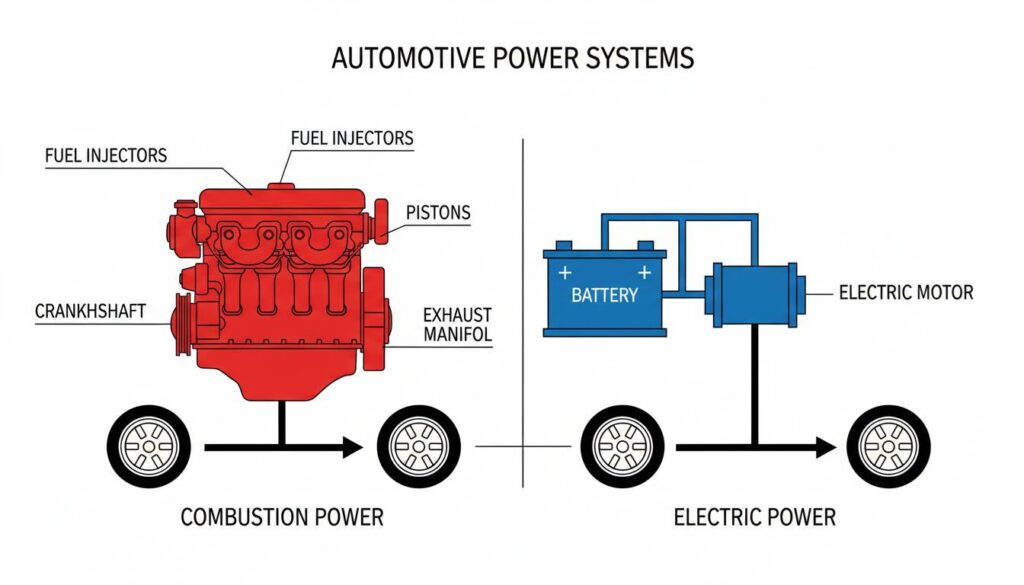
Technical Figure: A simple split-view diagram of a car. On the left side, show a gasoline engine colored red. On the right side, show an electric battery and motor colored blue. Arrows from both point to the wheels, showing they both provide power.
Why Build a Hybrid?
Gasoline engines are strong, but they make pollution (smoke) and waste fuel when sitting in traffic. Electric motors are clean and quiet, but batteries used to be very heavy and didn’t last long.
By combining them, engineers tried to get the best of both worlds:
- The long driving range of gas.
- The clean efficiency of electricity.
Imagine you are running a long race. Sometimes you sprint, and sometimes you jog. If the gas engine is the “sprinter” and the electric motor is the “jogger,” when would you use each one during a drive through a busy city?
The Early Days (1890s – 1910s)
Most people think hybrid cars were invented recently. This is false. Hybrid cars are actually over 100 years old!
The First Hybrid
In 1900, a young engineer named Ferdinand Porsche showed off a car called the Lohner-Porsche Mixte.
It was very different from cars today. It did not have a driveshaft connecting the engine to the wheels. Instead, it had a gas engine that spun a generator. This generator made electricity. The electricity powered motors inside the wheel hubs.
It was the first gas-electric hybrid in history.
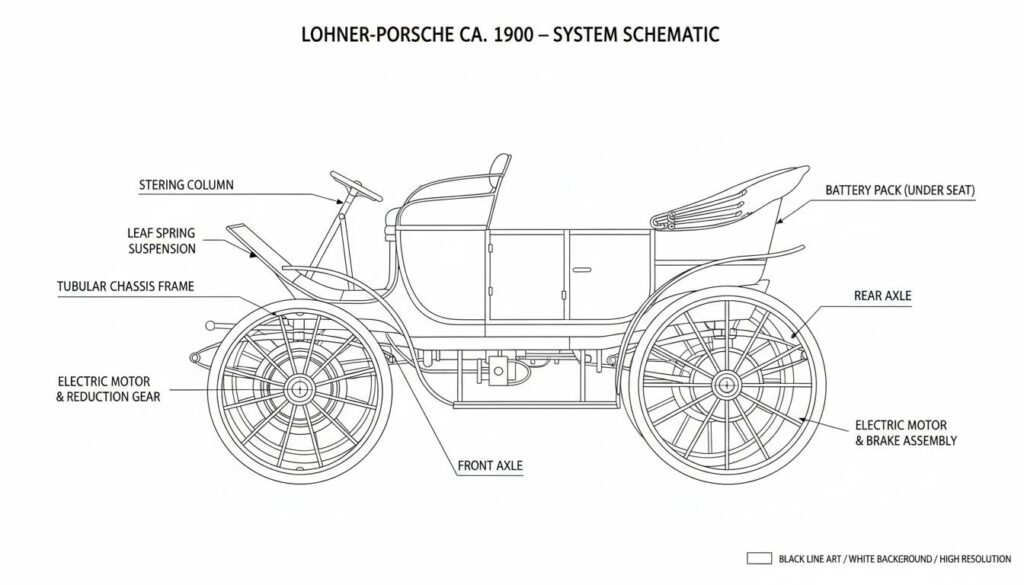
Technical Figure: A black and white historical illustration of the 1900 Lohner-Porsche. It looks like a carriage without horses. Highlight the large wheel hubs where the electric motors were located.
Why Did Hybrids Disappear?
If hybrids existed in 1900, why did we drive only gas cars for the next 90 years?
Two things happened:
- Better Roads: People wanted to drive very far between cities. Gas cars could drive further than electric ones.
- Henry Ford: In 1908, Henry Ford made the Model T. It was a gas car built on an assembly line. It was very cheap.
The electric starter was invented in 1912. Before this, you had to hand-crank a gas car to start it, which was dangerous. Once gas cars became easy to start and cheap to buy, electric and hybrid cars vanished.
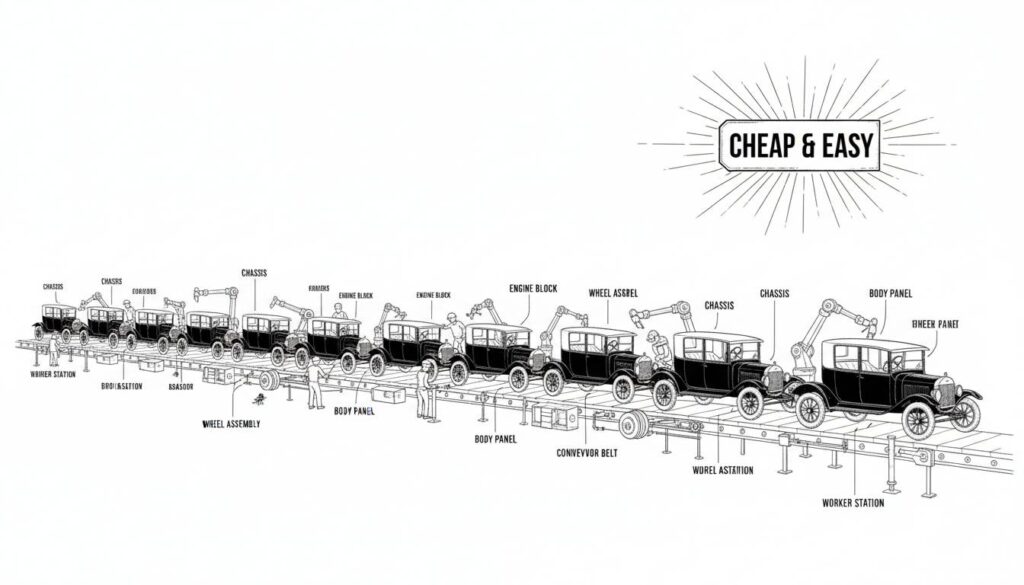
Technical Figure: A vintage photo of a Ford Model T assembly line. Show many identical black cars in a row. In the background, show a price tag graphic that says “Cheap & Easy”.
In 1910, a hybrid car cost much more than a gas car. If you were a family back then, would you pay double the money to save a little bit of fuel, or would you buy the cheap gas car? How does price change what technology we use?
The Silent Years and the Wake-Up Call (1920s – 1970s)
For a long time, gas was cheap. Nobody worried about smoke coming from tailpipes. Cars got bigger, heavier, and faster. They used huge amounts of gasoline.
The Oil Crisis
In the 1970s, the world had an “Oil Crisis.” Suddenly, there wasn’t enough gasoline. Prices went up very high. People had to wait in long lines just to fill up their tanks.
The Pollution Problem
At the same time, scientists noticed that the air in cities was turning brown. This is called smog. The smoke from millions of cars was hurting people’s lungs.
Engineers realized they needed a car that used less gas. They looked back at history and remembered the hybrid.
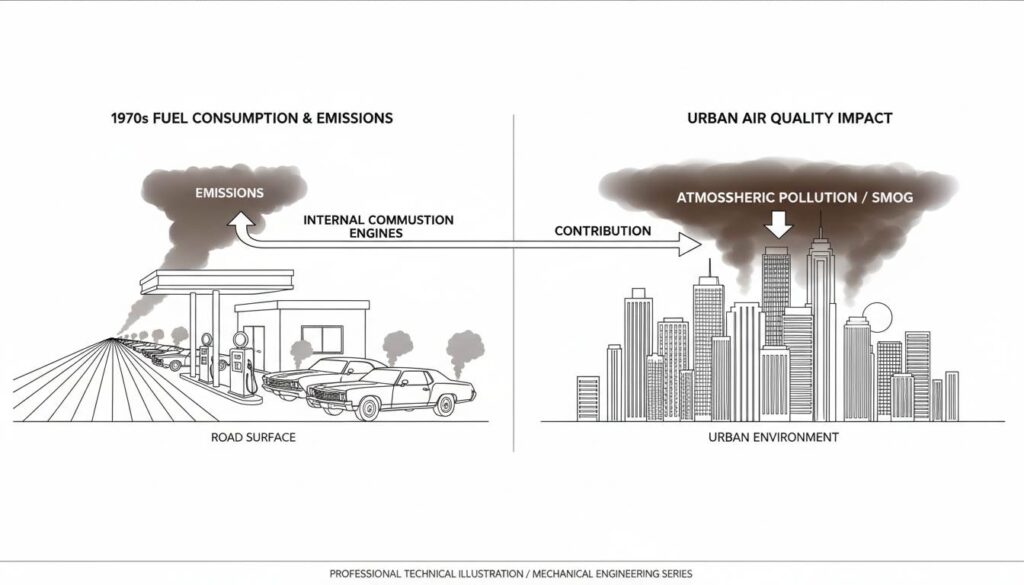
Technical Figure: A split image. Left side: A photo of a 1970s gas station with a long line of cars waiting. Right side: A city skyline covered in a thick brown haze or smog.
The Modern Comeback (1990s – Present)
It took a long time to make batteries better. Finally, in the late 1990s, technology caught up with the idea.
The Toyota Prius
In 1997, Toyota launched the Prius in Japan. “Prius” is a Latin word that means “To go before.”
The Prius was not fast. It was not a race car. But it was very smart. It used a computer to switch between the gas engine and the electric motor automatically.
- Stopped at a light: The gas engine turns off (saves gas).
- Driving slowly: Only the electric motor runs (saves gas).
- Driving fast: Both engines work together.
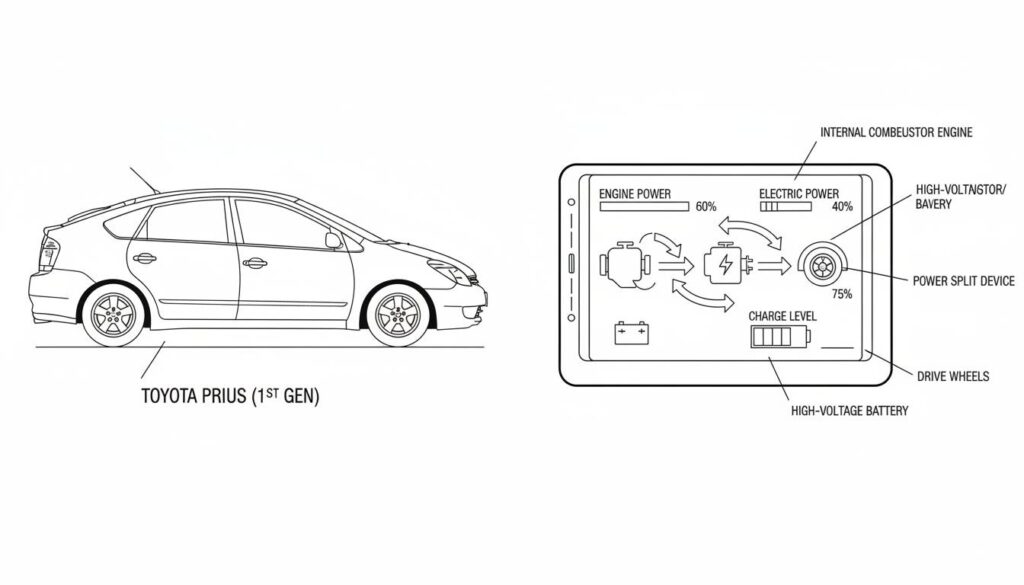
Technical Figure: A photo of the first-generation Toyota Prius (a small sedan). Next to it, a diagram showing the energy flow on a dashboard screen, displaying battery charge and engine power.
The Magic of Regenerative Braking
The coolest part of modern hybrids is Regenerative Braking.
In a normal car, when you hit the brakes, the car creates heat. That energy is wasted.
In a hybrid, when you hit the brakes, the electric motor runs backward. It acts like a generator. It takes the energy from the moving car and turns it back into electricity to charge the battery.
Analogy: Imagine a bicycle with a light generator on the wheel. When you pedal, it’s hard work because you are powering the light. In a hybrid, the car uses the “hard work” of braking to fill the battery.
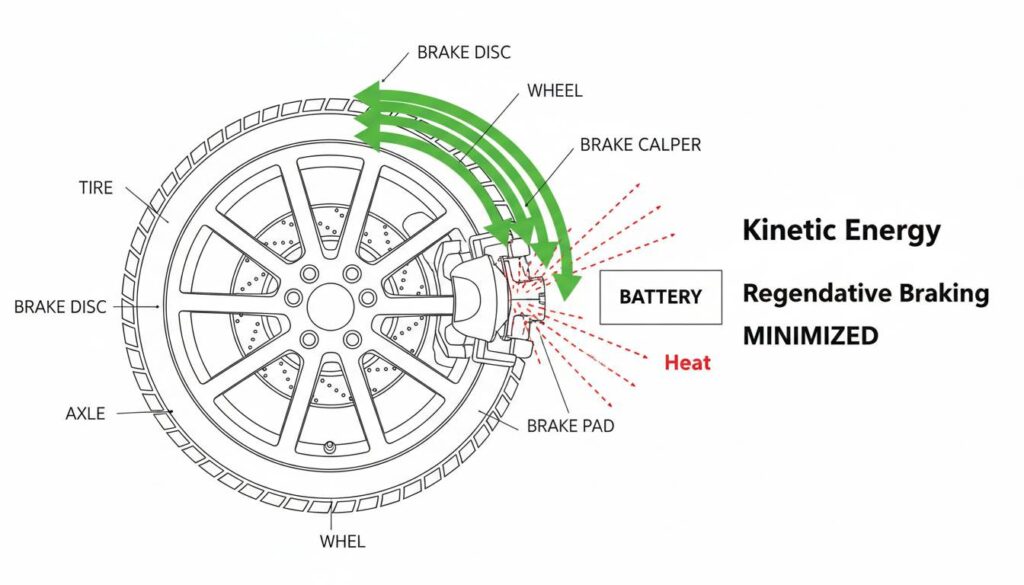
Technical Figure: A technical diagram showing a car wheel and a brake. Use green arrows to show ‘Kinetic Energy’ going from the wheel into a battery, labeling it ‘Regenerative Braking’. Use red arrows to show ‘Heat’ being minimized.
How Hybrids Changed the World
Hybrids proved that we don’t need to burn as much gas. They paved the way for fully electric cars (EVs) like Teslas.
Today, we have different types of hybrids:
- Mild Hybrid
- Full Hybrid
- Plug-in Hybrid (PHEV): You can plug this car into a wall outlet to charge a bigger battery.
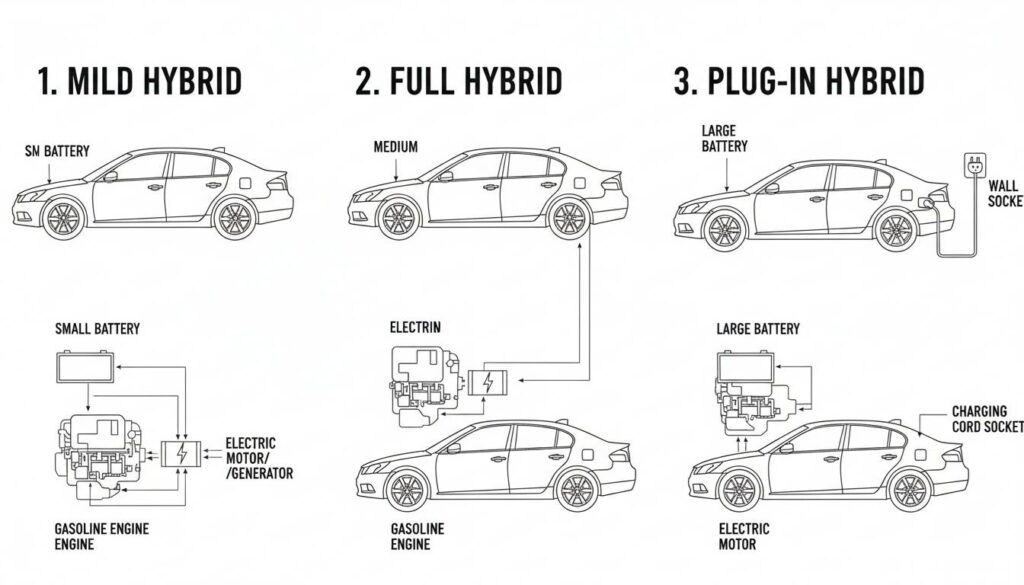
Technical Figure: A comparison chart showing three cars. 1. Mild Hybrid (Small battery). 2. Full Hybrid (Medium battery). 3. Plug-in Hybrid (Large battery with a cord plugged into a wall socket).
Conclusion: History of Hybrid Electric Vehicles
Hybrids were a “bridge” technology. They helped us move from gas cars to electric cars. Do you think we will still drive hybrids in 20 years, or will all cars be 100% electric? Why?
