
The Journey of Electricity
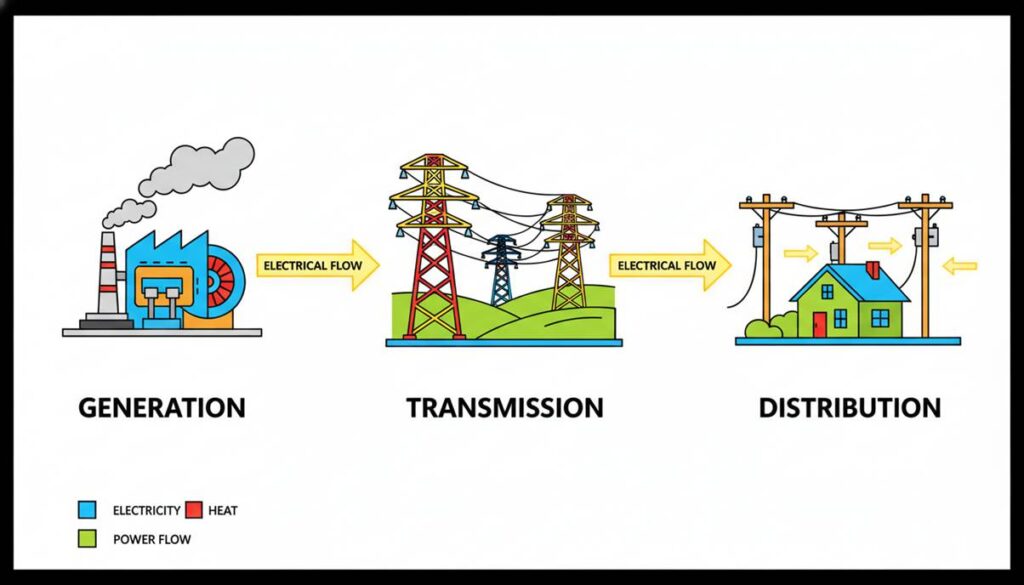
Think about when you flip a light switch. The light turns on instantly. It feels like magic. But it is actually a massive machine working behind the scenes. This machine is called the Electrical Power System or the Grid.
It has one job: To move energy from where it is made to where you need it.
Imagine a pizza delivery system:
- The Kitchen: Where the pizza is cooked (Power Plant).
- The Highway: Fast trucks carrying thousands of pizzas (Transmission Lines).
- Local Streets: Slower drivers bringing one pizza to your door (Distribution Lines).
Step 1: Generation (The Kitchen)
This is where mechanical engineering shines. We have to make the electricity. We do this by spinning a machine called a Generator.
How a Generator Works
Inside a generator, there are huge magnets and coils of copper wire. When you spin the magnets past the wire, electricity flows. It is like using a bicycle pump. You move the handle (mechanical energy), and air pushes out (electrical energy).
To spin these magnets, we use a Turbine. A turbine is like a high-tech fan blade. We push it with:
- Steam: From burning coal, gas, or using nuclear heat.
- Water: Falling from a dam (Hydroelectric).
- Wind: Pushing giant blades.
If we need to spin the turbine faster to make more electricity, what do we need to do to the steam or water pushing it?
Understanding the “Water” in the Wires
Before we move the electricity, you must understand three simple words. Think of electricity like water flowing through a garden hose.
Voltage (The Push)
Voltage is the pressure. It is the pump pushing the water.
- High Voltage: A giant fire hose pump.
- Low Voltage: A weak squirt gun.
- Unit: Volts (V).
Current (The Flow)
Current is the actual water moving through the pipe.
- High Current: A wide river flowing fast.
- Low Current: A dripping tap.
- Unit: Amps (A).
Resistance (The Blockage)
Resistance is anything that slows the water down. Imagine stepping on the garden hose. It is harder for the water to get through.
- High Resistance: A very thin, clogged pipe.
- Low Resistance: A wide, smooth pipe.
- Unit: Ohms (Ω).
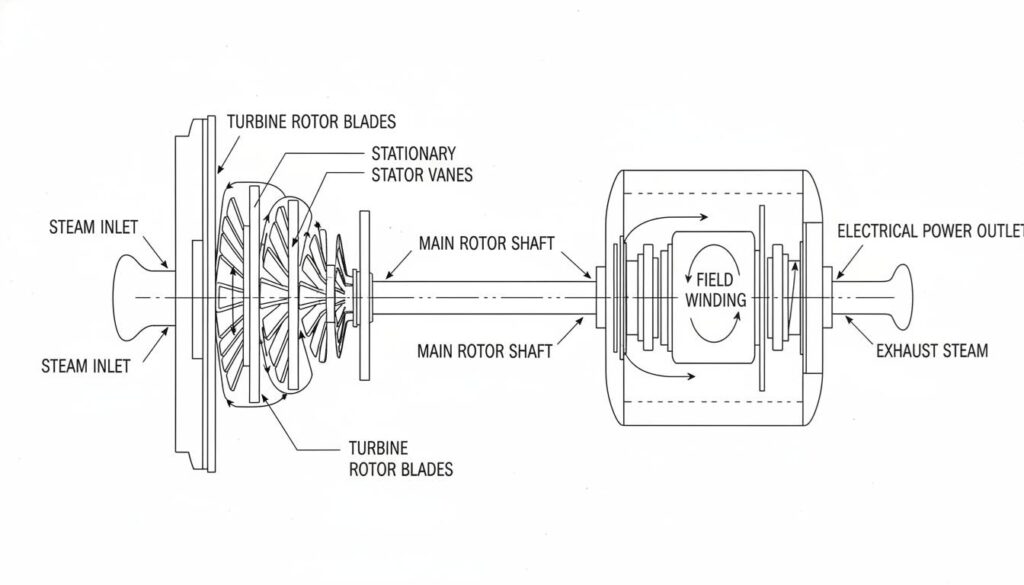
Technical Figure: A cross-section diagram of a steam turbine connected to a generator. Show steam entering, blades spinning, and the shaft turning the magnet inside the generator.
If you have a lot of pressure (Voltage) but you step on the hose completely (High Resistance), does any water (Current) flow? Why or why not?
Step 2: Transmission (The Highway)
Now we have electricity. We need to send it hundreds of miles away.
Why We Use High Voltage
Wires have resistance. They fight the flow of electricity. If we try to push a lot of current (flow) through a long wire, the wire gets hot. We lose energy.
To fix this, we use a Transformer.
- We use a “Step-Up” transformer at the power plant.
- This increases the Voltage (Pressure) extremely high (maybe 400,000 Volts!).
- This lowers the Current (Flow).
Think of it like sending water. Instead of sending a million small buckets (High Current), we shoot one super-pressurized stream (High Voltage). It travels faster and easier.
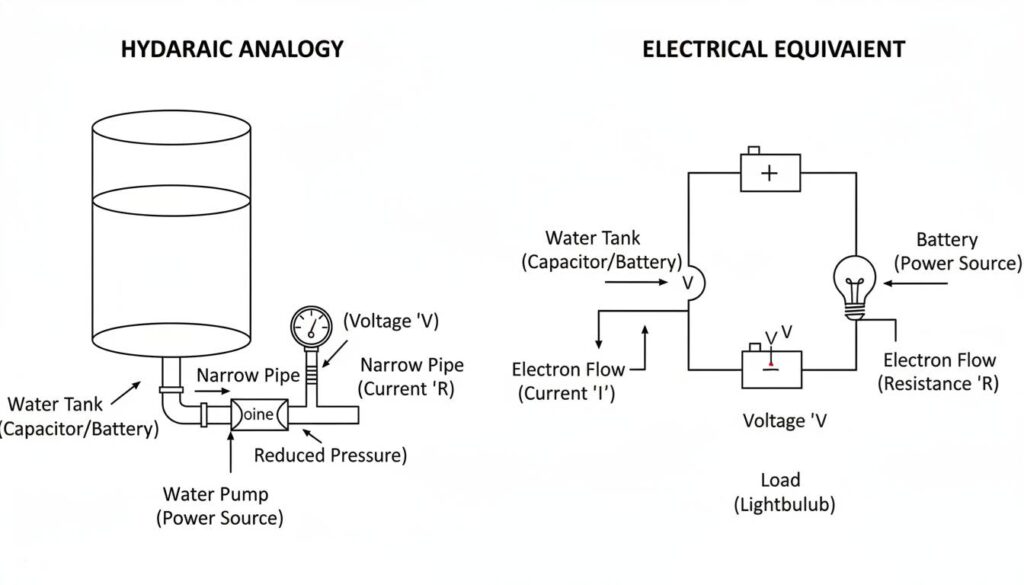
Technical Figure: A split-screen comparison illustration. Left side: A water tank with a pipe, showing Pressure (Voltage), Water Flow (Current), and a narrow section (Resistance). Right side: A battery connected to a lightbulb showing the electrical equivalents.
The Transmission Towers
You see these on the side of the highway. They are tall metal towers holding thick cables. They are high up because the voltage is so strong it could jump to the ground (like lightning) if it were too close.
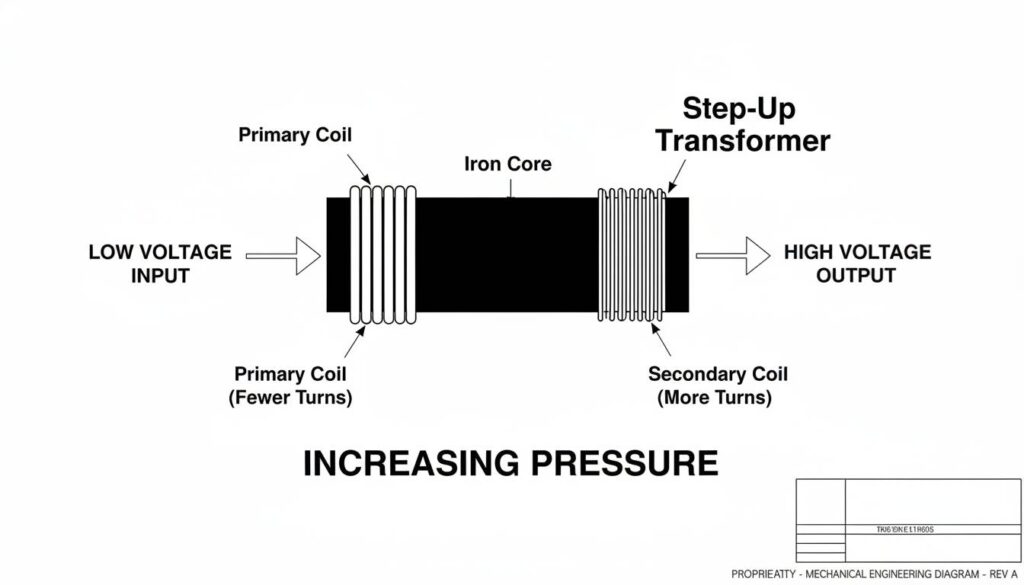
Technical Figure: Illustration of a “Step-Up” transformer. Show low voltage entering one side with thick coils, and high voltage leaving the other side with thin coils. Label it “Increasing Pressure”.
Step 3: Distribution (Local Streets)
The electricity reaches your city. But 400,000 Volts is too dangerous. It would blow up your house. We need to calm it down.
The Substation
The power goes into a Substation. This is a fenced-in yard with big machines. Here, “Step-Down” transformers lower the voltage to about 13,000 Volts.
The Pole Transformer
Look at the wooden telephone poles on your street. You will see a grey cylinder at the top. That is the final transformer.
- It takes the 13,000 Volts.
- It turns it into 120 Volts or 240 Volts.
- This travels down the wire to your house meter.
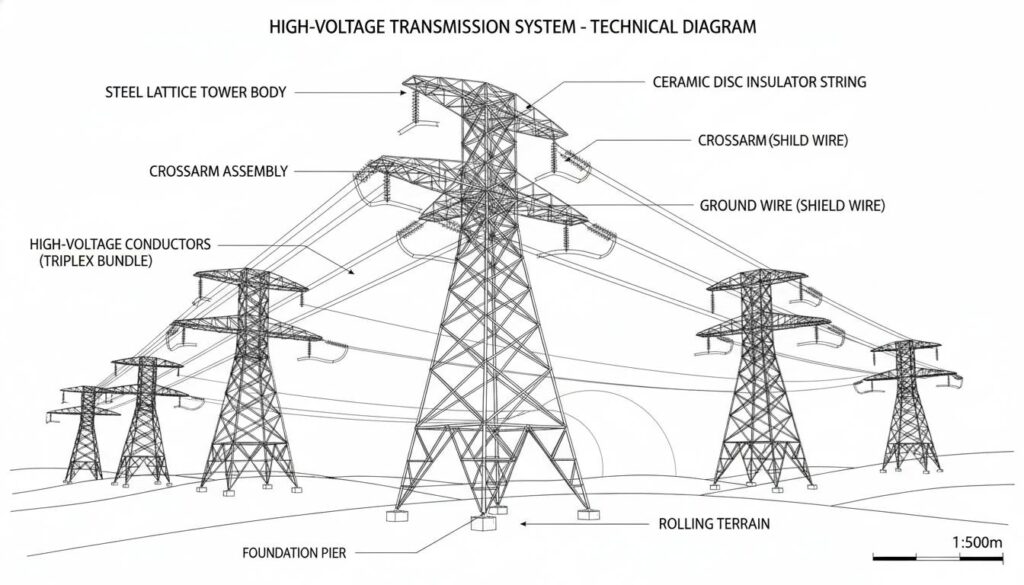
Technical Figure: A realistic drawing of high-voltage transmission lines (large steel lattice towers) crossing a landscape. Show the insulators holding the wires away from the metal frame.
Why do we lower the voltage before it enters your house? Think about the water hose analogy. Would you want a fire hose connected to your kitchen sink?
Summary of the System
- Generation: Spin a magnet with a turbine.
- Step-Up: Increase voltage to travel far.
- Transmission: Move it on big towers.
- Step-Down: Decrease voltage for safety.
- Distribution: Bring it to your outlet.
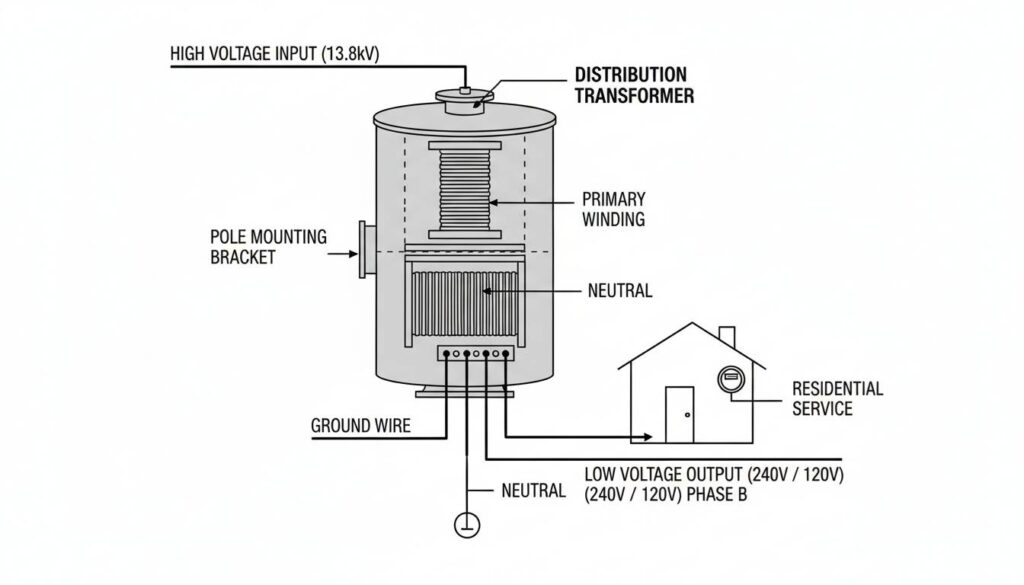
Technical Figure:,A close-up technical illustration of a pole-mounted distribution transformer (the grey cylinder). Show the high voltage wire coming in the top and the low voltage wires going out to a house.
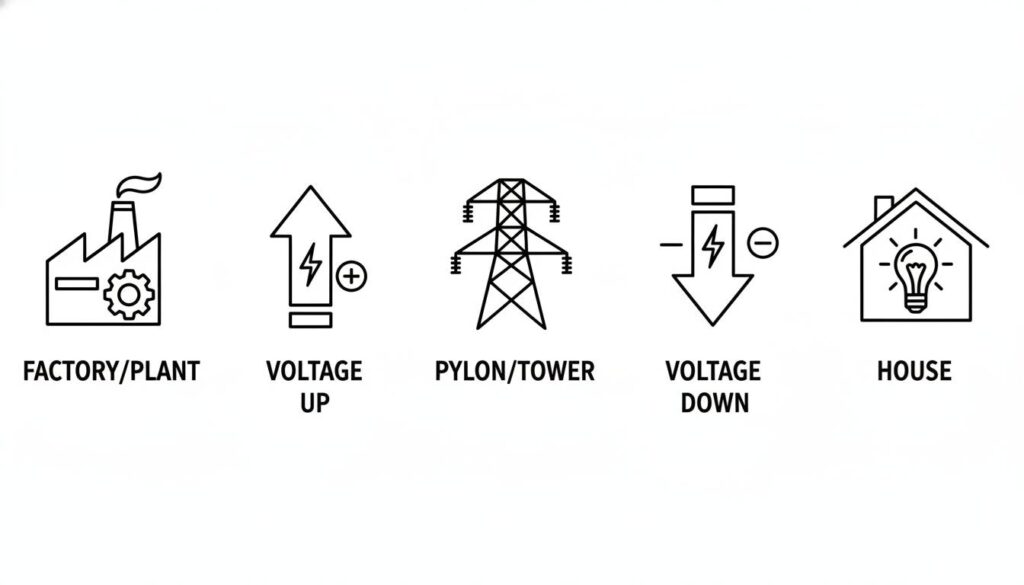
Technical Figure: A simple flowchart icon set. Icon 1: Factory/Plant. Icon 2: Up Arrow (Voltage up). Icon 3: Pylon/Tower. Icon 4: Down Arrow (Voltage down). Icon 5: House with a lightbulb on.
