What is EDM?
Imagine trying to cut a piece of super-hard metal. A normal drill bit might break. A saw might get dull. But what if you could cut that metal using lightning?
That is exactly what Electrical Discharge Machining (EDM) does. It uses thousands of tiny electrical sparks to melt and vaporize material. It is a way to shape metal without ever physically touching it.
Focus Keyword: Electrical Discharge Machining (EDM), EDM Electrodes, EDM Advantages and Disadvantages, EDM Applications, Wire EDM Trends
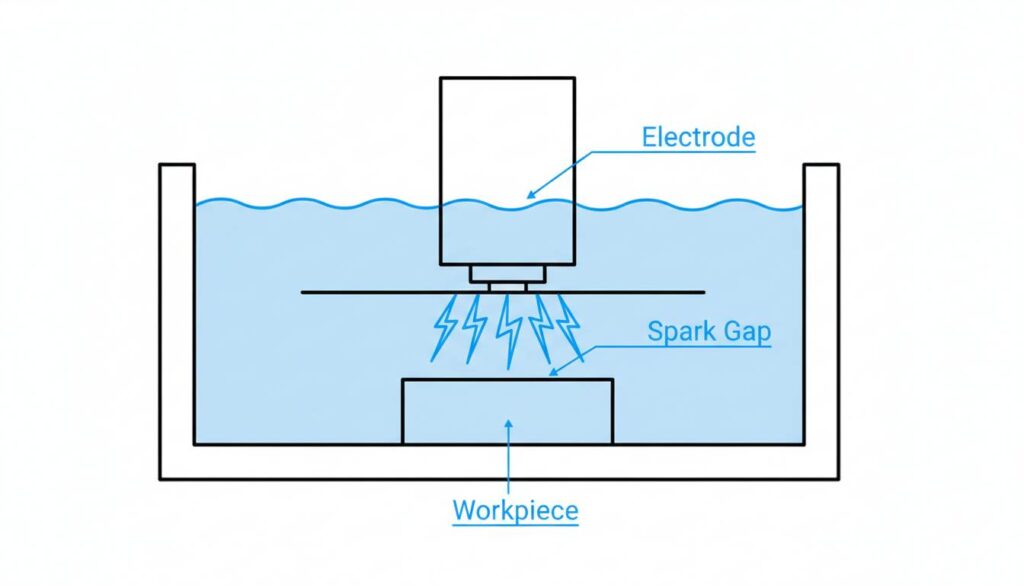
Technical Diagram: A simplified 2D schematic diagram of the EDM process. Show a tool (electrode) above a workpiece. Draw jagged lightning bolts (sparks) jumping across a small gap between them. Label the tool ‘Electrode’, the bottom part ‘Workpiece’, and the gap ‘Spark Gap’. Show them submerged in a tank of liquid.
The Tool: The Electrode
In a normal drill, the tool is a sharp metal bit. In EDM, the tool is called an Electrode.
The electrode is not sharp. It does not spin. It is simply a shape. If you want to make a square hole, you use a square electrode. If you want to make a star-shaped hole, you use a star-shaped electrode.
Think of it like a “cookie cutter,” but instead of pressing down, it burns its way through.
Common Electrode Materials
The electrode must conduct electricity very well. It also needs to resist melting, because the sparks are incredibly hot (up to 12,000°C!). Here are the most common materials used:
1. Graphite (Carbon)
- What is it? The same stuff found in pencil lead, but much harder and compressed.
- Why use it? It is very easy to carve into shapes. It handles high heat very well. It is the most popular choice.
2. Copper
- What is it? The reddish metal used in pennies and wires.
- Why use it? It creates a very smooth finish on the final part. It is great for fine details.
3. Brass
- What is it? A yellow alloy of copper and zinc.
- Why use it? This is mostly used for Wire EDM (we will talk about this in the Trends section). It is usually a long spool of wire.
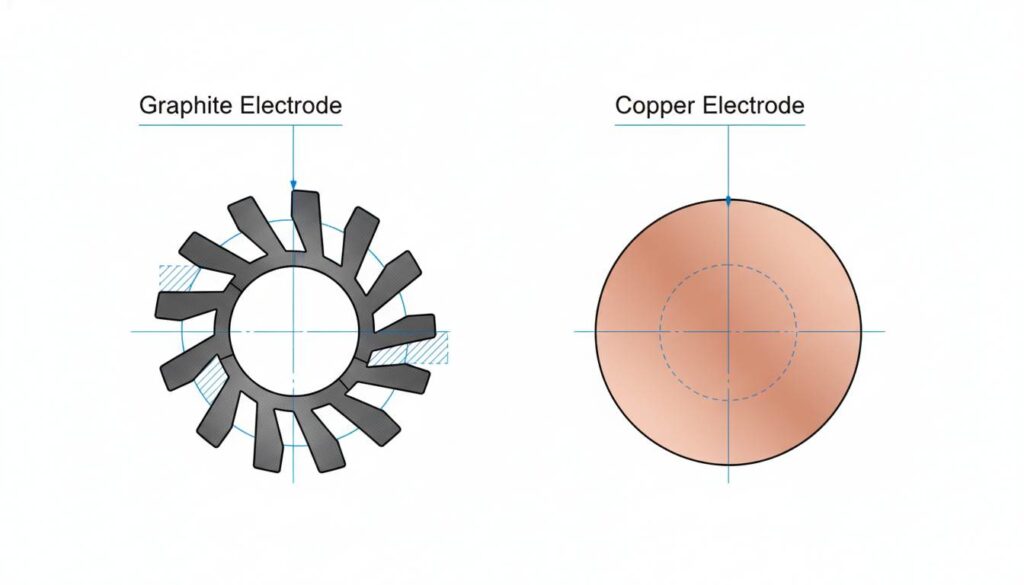
Technical Diagram: A side-by-side comparison photo. On the left, a block of black Graphite shaped like a gear. On the right, a shiny reddish Copper block shaped like a coin. Label them ‘Graphite Electrode’ and ‘Copper Electrode’.
Think About It:
If the electrode creates sparks to melt the metal workpiece, why doesn’t the electrode melt itself?
Hint: It actually does! This is called “wear.” Engineers have to plan for the tool getting smaller as it works.
Advantages of EDM
Why do engineers love this process?
1. It Cuts the Hardest Metals
You can cut hardened steel, titanium, or carbide. If a material conducts electricity, EDM can cut it. It doesn’t matter how hard it is.
2. Complex Shapes
Since the tool doesn’t spin, you can make sharp inside corners. You can make deep, weirdly shaped pockets that a round drill bit could never make.
3. No Physical Contact
The tool never touches the workpiece. There is always a tiny gap for the spark. This means there is no pressure. You can cut very fragile or thin parts without bending or breaking them.
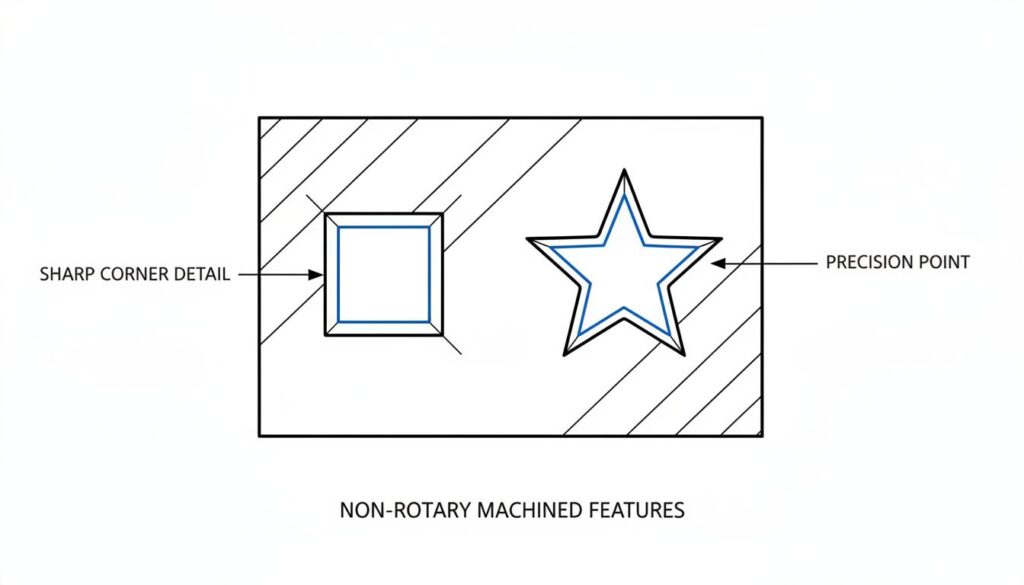
Technical Diagram: A close-up technical illustration of a metal block with a perfect square hole and a star-shaped hole cut into it. Show the sharp corners clearly to emphasize that a round drill couldn’t do this.
Disadvantages of EDM
EDM isn’t perfect. Here is why we don’t use it for everything.
1. It is Slow
Compared to a standard drill or milling machine, EDM is slow. It removes metal grain by grain. It takes patience.
2. Electricity is Required
You can only cut materials that conduct electricity (metals). You cannot use EDM to cut wood, plastic, or glass.
3. Electrode Wear
As mentioned in the Socratic Box, the tool wears out. If you are making a deep hole, you might need two or three electrodes to finish the job because the first one melts away at the tip.
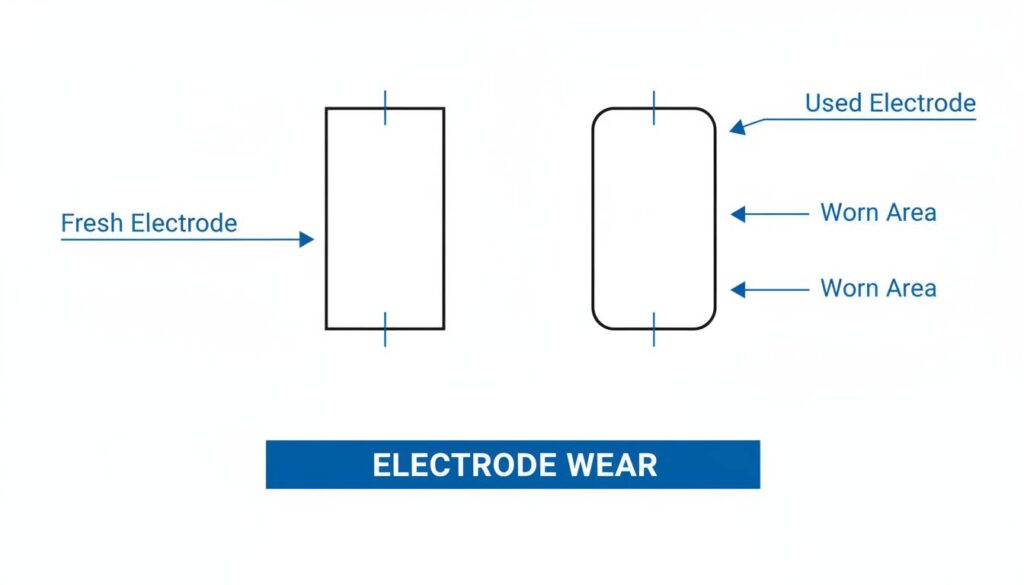
Technical Diagram: A diagram showing ‘Electrode Wear’. Show a fresh electrode with sharp corners on the left, and a used electrode with rounded, worn-off corners on the right. Use arrows to point to the worn areas.
Critical Thinking:
If EDM cannot cut plastic, how do we get plastic parts with complex shapes?
Answer: We use EDM to cut the metal MOLD. Then, we inject plastic into that mold!
Applications: Where is EDM Used?
Mold and Die Making
This is the #1 use. Everything from plastic water bottles to Lego bricks comes from a metal mold. These molds are made of very hard steel and need complex shapes. EDM is perfect for this.
Aerospace (Airplanes and Rockets)
Jet engine parts are made of super-tough alloys that handle high heat. Normal drills can’t scratch them. EDM is used to drill cooling holes in turbine blades.
Medical Tools
Surgeons need tiny, precise tools. EDM can make parts smaller than a human hair.
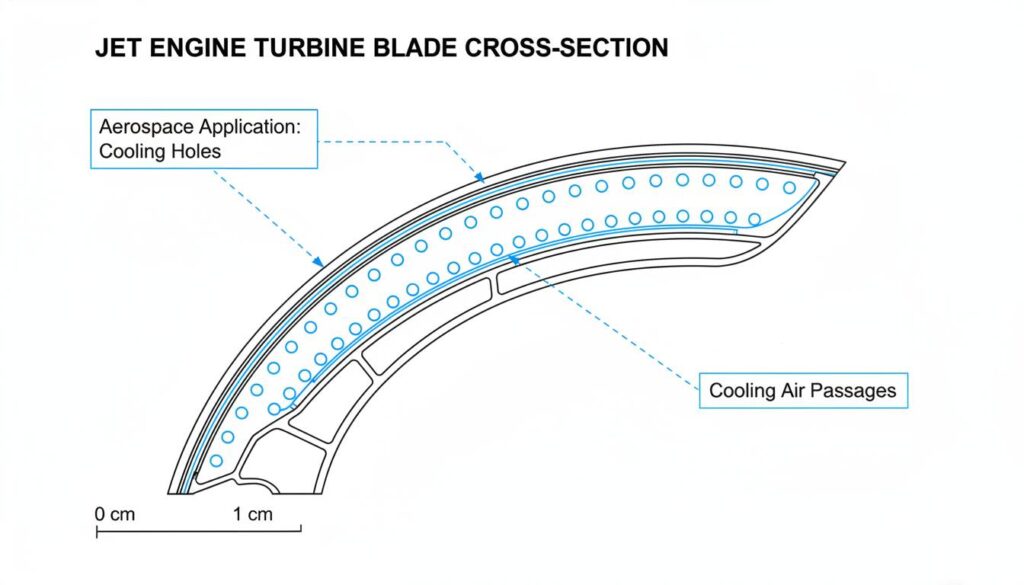
Technical Diagram: A cross-section view of a jet engine turbine blade. Highlight tiny cooling holes drilled into the curved surface. Label this ‘Aerospace Application: Cooling Holes’.
Latest Trends in EDM
1. Wire EDM
Imagine a cheese cutter, but the wire is electrified. A thin brass wire moves through the metal, cutting a precise outline. The wire is constantly moving from a spool, so you always have a fresh cutting tool. This is very popular right now.
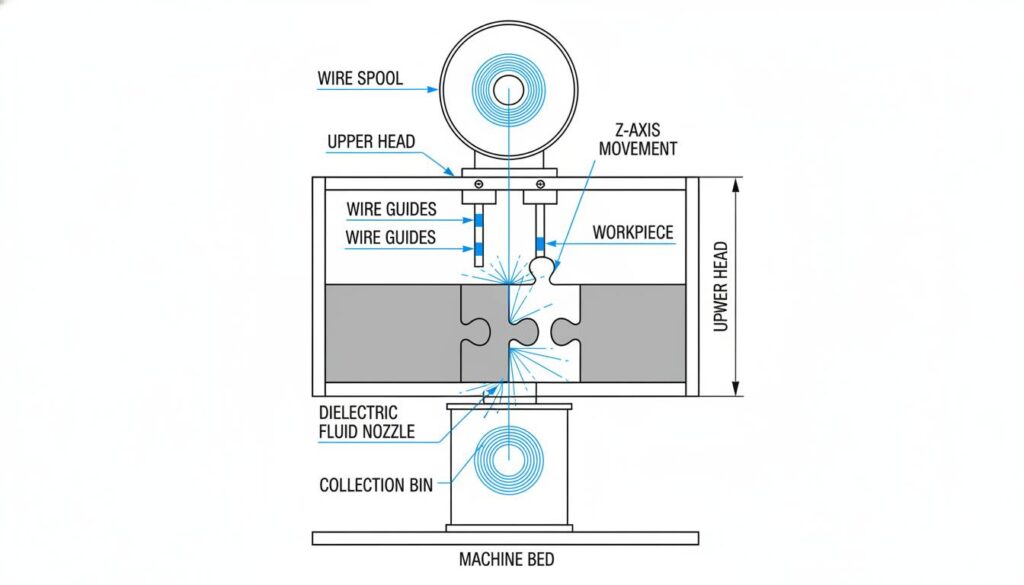
Technical Diagram: A schematic of a Wire EDM machine. Show a spool of wire feeding down through a workpiece and collecting at the bottom. The wire cuts a complex 2D profile (like a puzzle piece) out of a metal plate.
2. Micro-EDM
Technology is getting smaller. We now have EDM machines that use electrodes as small as 0.005 mm. This is used to make microscopic gears for watches or medical robots.
3. Automation (Robots)
Because EDM is slow, nobody wants to stand and watch it. Modern machines have robots that change the electrodes automatically. You can load the machine on Friday, go home, and come back Monday to finished parts.
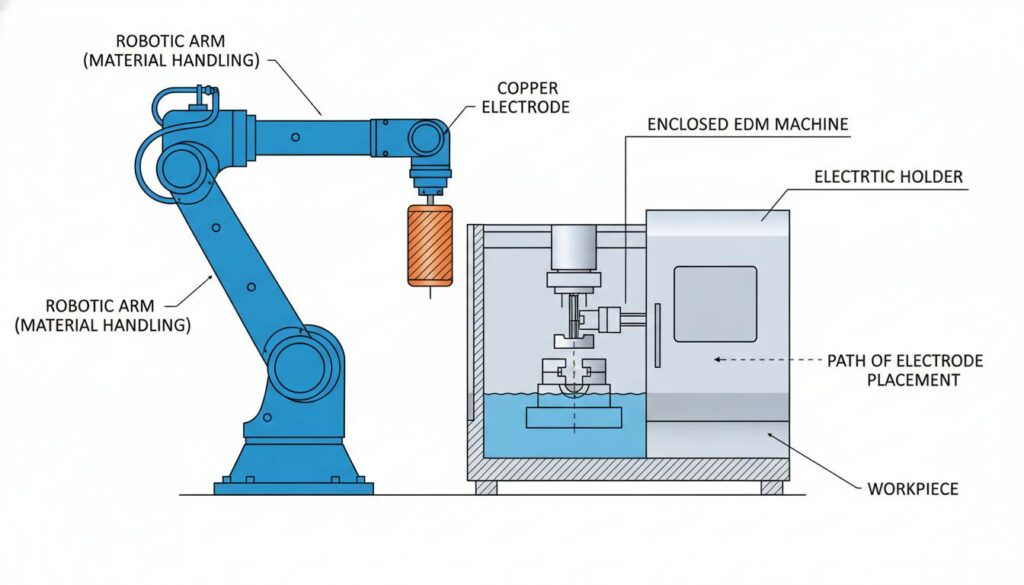
Technical Diagram: A modern factory floor scene. Show a robotic arm placing a copper electrode into an EDM machine holder. The machine looks sleek and enclosed.
Review Question:
If you needed to cut a perfect square hole in a piece of wood, could you use EDM?
Answer: No! Wood does not conduct electricity. You would need a saw or a chisel.
