Introduction: Reaching the Unreachable
When you see companies like Boston Dynamics showing off robots that move like people, you know engineers solved the challenge of reach and balance. But what if you need an arm that can reach very far away? This requires a special kind of engineering that allows the arm to stretch out without losing strength. This field, known as robotics, focuses on creating machines that can perform tasks with precision and endurance far beyond human capability.
This simple, five-step guide on how to design extendable robotic arm systems focuses on the core robot parts and principles you need to build a machine with impressive reach. We will break down the complex mechanics into understandable concepts, ensuring your project has the strength and accuracy to perform useful work.
Elbow Torque Calculator
Visualize the challenge of an extendable arm.
*Torque (T) $\approx$ Mass (M) $\times$ Length (L) $\times$ 9.8 m/s² (simplified).
1. The Core Structure: Articulated Movement
To get long reach, you usually start with an articulated arm. This is an arm built with rotating joints, similar to a human arm. Each joint adds a level of movement, which engineers call a degree of freedom. A simple mechanical arm needs at least three or four degrees of freedom to move up, down, forward, and backward. When designing an extendable arm, you must plan the structure so that these robot parts can slide or telescope out, maximizing the size of the robot’s workspace.

The joint where the arm bends, often called the elbow, needs to be especially strong to handle the weight when the arm is fully stretched. In industrial robots, this core structure is what allows for complex actions like palletizing or precise spot welding. Successfully mastering how to design extendable robotic arm systems starts with a stable, well-calculated mechanical structure that supports the long reach.
2. Choosing the Right Motors and Sensors

The movement in your arm must be accurate. For power, many projects use a simple dc motor, especially for larger, faster movements. However, to achieve precise placement, you need motors that can hold a specific position, like a stepper motor, which moves in small, measured steps. For the most demanding industrial robotics applications, a servo motor is often used for its precise torque and speed control, offering an optimal balance of speed and positioning accuracy. This is a common design choice in the automotive industry.
To know exactly where the arm is, you need sensors. An encoder is a small sensor placed on the motor that counts how many turns the motor has made. This information is constantly sent back to the robot’s brain, allowing the arm to know its exact positioning in space. This sensing capability is critical for making sure the robot can return to the exact same spot repeatedly. This makes the arm a true automaton, performing actions reliably without constant human input.
3. The End Goal: The End Effector and Robot Hand
What does your robot need to grab? The final piece of the mechanical arm is the hand, or the robot hand. This part must be lightweight so the arm can lift a heavier item. The final component of any effective robot system is the end effector. The most common “hand” is a gripper—a simple device with two or three fingers (or sometimes a claw) designed for picking up specific objects, a classic pick and place operation. The amount of weight the arm can lift is called its payload.
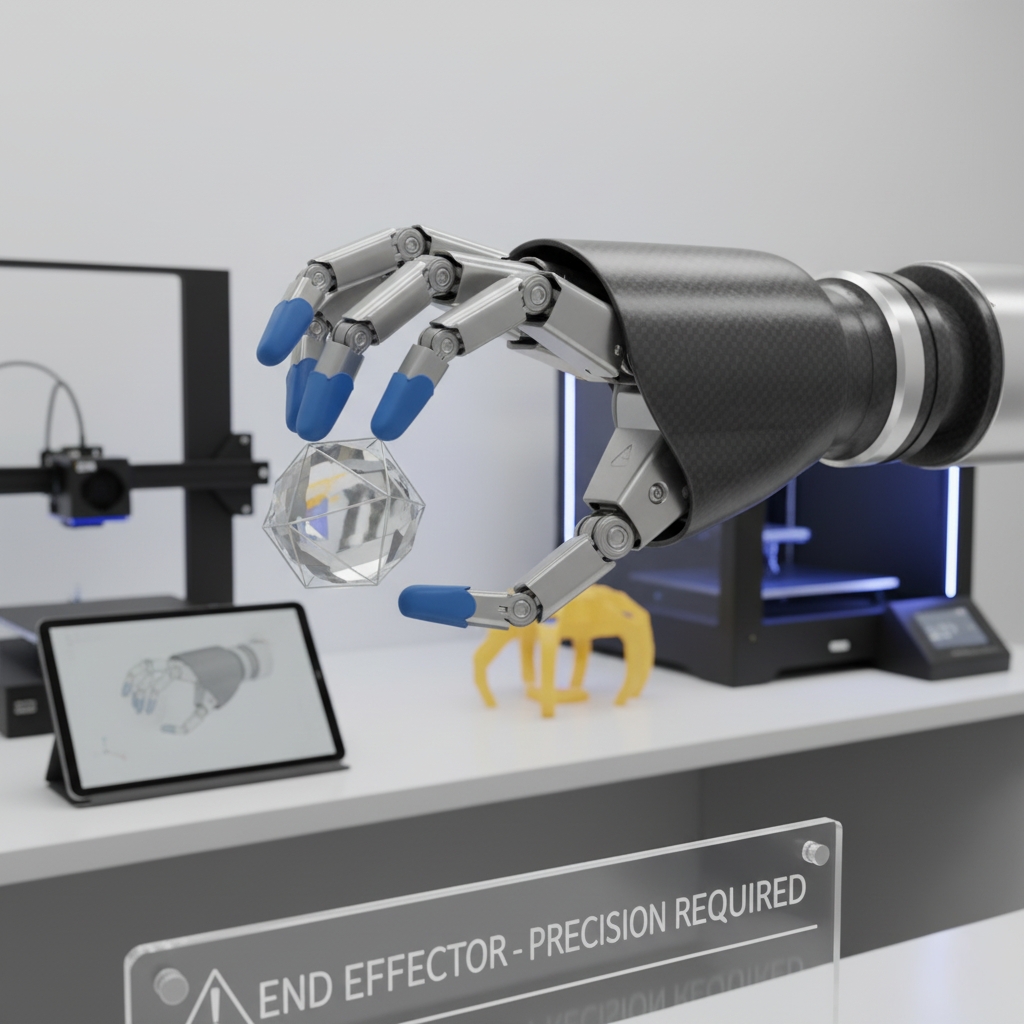
If you are building a prototype, you might create custom hands using a 3d printer design. Designing the hand is just as important as designing the arm itself because the hand’s weight and reach limit what the whole system can do. Many different types of robots use specialized grippers; for instance, a soft, flexible gripper is necessary for handling delicate items, showing high dexterity. This component is critical when figuring out how to design extendable robotic arm systems.
4. Planning for Control and Wiring

When the arm extends, the power and signal wires must travel with it. This is where a long extension cable might be needed, and it must be managed carefully so it doesn’t get pinched or tangled by the sliding parts. Furthermore, designing an extendable arm requires complex calculations that tell the arm how to reach a point in space. This calculation is called inverse kinematics. It is the math the computer uses to figure out, based on where the object is, what angle every single joint must be to touch it. This is the heart of robot control.
The arm must be precisely programmed to execute its task sequence. For simpler projects, a microcontroller like the Arduino Uno can manage these commands, providing an open hardware platform for experimentation. For complex industrial robotic arms, sophisticated proprietary controllers are used. The whole process ensures the arm can move autonomously.
5. Application and Real-World Use
The methods used to design an extendable arm are quite different from the systems used in simple autonomous equipment like a self driving car or stationary manufacturing machinery. Those systems rely heavily on sensors like Lidar and vision systems to navigate. An extendable arm, however, focuses purely on physical reach and strength for tasks like unloading trucks, reaching high shelves in warehouses, or performing remote inspection. The effort put into how to design extendable robotic arm systems ensures that they can perform useful work efficiently, extending the reach of human workers into hard-to-access areas. These machines perform repetitive tasks with a speed and consistency no human being can match. Companies like FANUC and Universal Robots are leaders in providing such high-reach robotic technology solutions for factories globally.

Comparison: Key Motor Types for Robotic Arms
| Motor Type | Best For | Key Advantage | Key Disadvantage |
| DC Motor | Speed, High Power | Simple, Low Cost, High RPM | Low Positional Accuracy (Needs Encoder) |
| Stepper Motor | Precision, Holding Position | Excellent Positional Accuracy, Simple Control | Slower Speed, Can Lose Position Under High Load |
| Servo Motor | Dynamics, High Torque, Accuracy | Closed-Loop Feedback, High Power-to-Weight Ratio | Higher Cost, More Complex Control System |
Conclusion: Expanding the Workspace
Designing an extendable robot arm is a rewarding project focused on overcoming the challenges of reach, strength, and accurate positioning. By choosing the right robot parts, combining an articulated arm structure with precise motors like the dc motor and stepper motor, and mastering the complex inverse kinematics required to control the degree of freedom in the joints, you can successfully build a mechanical arm that expands the functional workspace of your project. The continued development of robotic technology is what pushes the limits of what a machine can do.
Key Takeaways
- Structure is Key: An articulated arm provides the basic structure; plan for telescoping parts to maximize the workspace and reach.
- Precision Power: Use a stepper motor or servo motor for high accuracy, and always pair it with an encoder for crucial feedback (sensing).
- The Final Piece: The end effector (robot hand or gripper) must be lightweight to maximize the arm’s payload capacity.
- Control the Complexity: Inverse kinematics is the math that allows the arm to be accurately programmed to reach any point autonomously.
- Real-World Application: These designs are essential for industrial robots used in repetitive and distant tasks like high-shelf retrieval or material handling.
