What is Hydraulics?
Hydraulics is a way to move heavy things using liquid. Imagine you have a solid steel rod. If you push one end, the other end moves. Hydraulics works the same way, but instead of a solid rod, we use a pipe filled with oil.
Liquids are very strong. You cannot “squish” a liquid into a smaller space. If you fill a pipe with water and push one end, the water pushes out the other end immediately. We use this trick to build powerful machines like excavators, dump trucks, and car brakes.
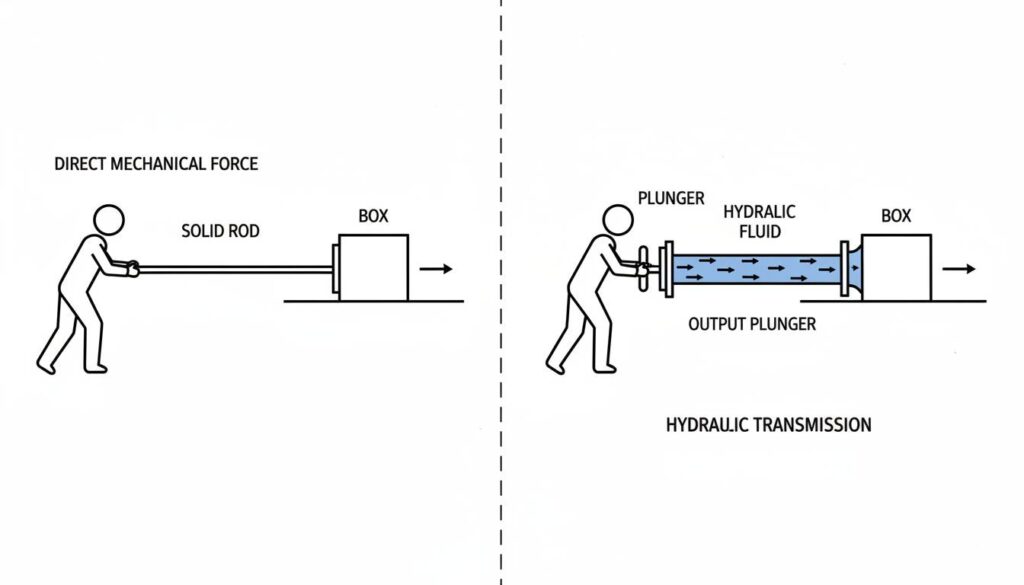
Technical Figure: A split-screen illustration. On the left, a person pushes a solid metal rod to move a box. On the right, a person pushes a plunger into a pipe filled with blue liquid, which pushes a plunger at the other end to move the same box. Label the liquid ‘Hydraulic Fluid’.
The “Cannot Be Squished” Rule
In science, we say liquids are incompressible. This means if you take a bottle full of water and try to squeeze it, the water won’t get smaller. It will try to escape.
Because the liquid won’t shrink, it acts like a solid object when it is trapped in a pipe. This allows us to send power around corners, up, down, or through flexible hoses.
If you filled a syringe with air and put your finger over the tip, you could squish the plunger down a little bit. But if you fill it with water, the plunger won’t move at all. Why do you think that happens?
The Secret to Super Strength: Pascal’s Law
Hydraulics isn’t just about moving things; it is about making you stronger. This is based on a rule called Pascal’s Law.
Pascal’s Law says: Pressure applied to a trapped liquid spreads out equally in all directions.
How Force Multiplication Works
Imagine two syringes connected by a tube.
- Syringe A is small (thin).
- Syringe B is huge (wide).
If you push down on the small syringe, the liquid flows into the big syringe. Because the big syringe has a lot more space (surface area) for the liquid to push against, it pushes up with much more force.
You trade distance for strength. You have to push the small syringe down a long way just to lift the big syringe a tiny bit. But, you can lift a heavy car with just one hand!
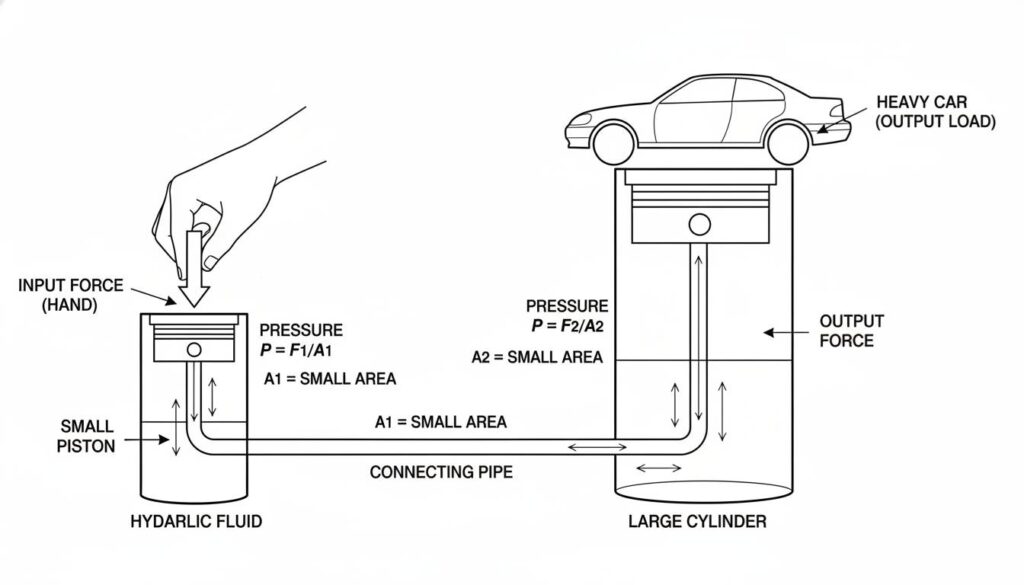
Technical Figure: A diagram showing a hydraulic jack. A small piston on the left is being pushed down by a hand. A tube connects it to a very large piston on the right. A heavy car sits on the large piston. Arrows show the fluid moving from the small side to the large side.
The Math Made Simple
Think of it like a lever or a seesaw.
- Input: You push with 10 pounds of force on the small piston.
- Output: The machine lifts 100 pounds on the big piston.
- The Catch: You have to push your handle down 10 inches to lift the heavy weight only 1 inch.
Imagine you are using a hydraulic car jack. You pump the handle up and down many times, but the car rises very slowly. Why do we have to pump it so many times to lift the car just a few feet?
The Main Parts of a Hydraulic Power Systems
Every hydraulic machine, from a barber’s chair to a giant bulldozer, has the same basic parts. Think of it like the human body.
The Reservoir (The Tank)
This is the storage tank. It holds all the hydraulic oil when it is not being used. It also lets the oil cool down.
- Analogy: This is like a water bottle on your desk.
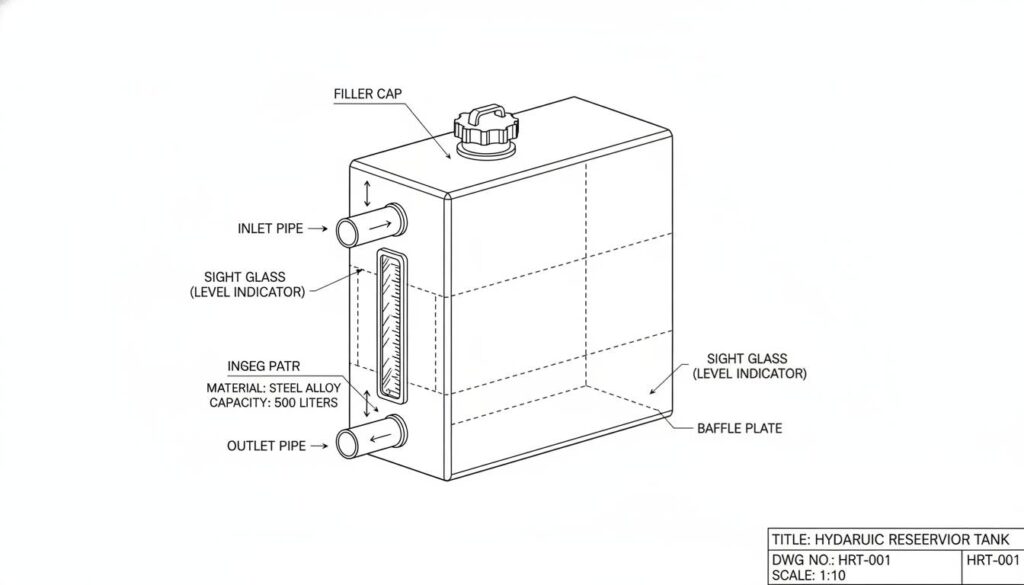
Technical Figure: A technical illustration of a hydraulic reservoir tank. It is a rectangular metal box with a filler cap on top, a sight glass on the side to check the level, and two pipes connected to it (one inlet, one outlet).
The Pump (The Heart)
The pump pushes the oil out of the tank and into the system. It creates the flow. Without the pump, the oil just sits there.
- Analogy: This is like your heart pumping blood through your veins.
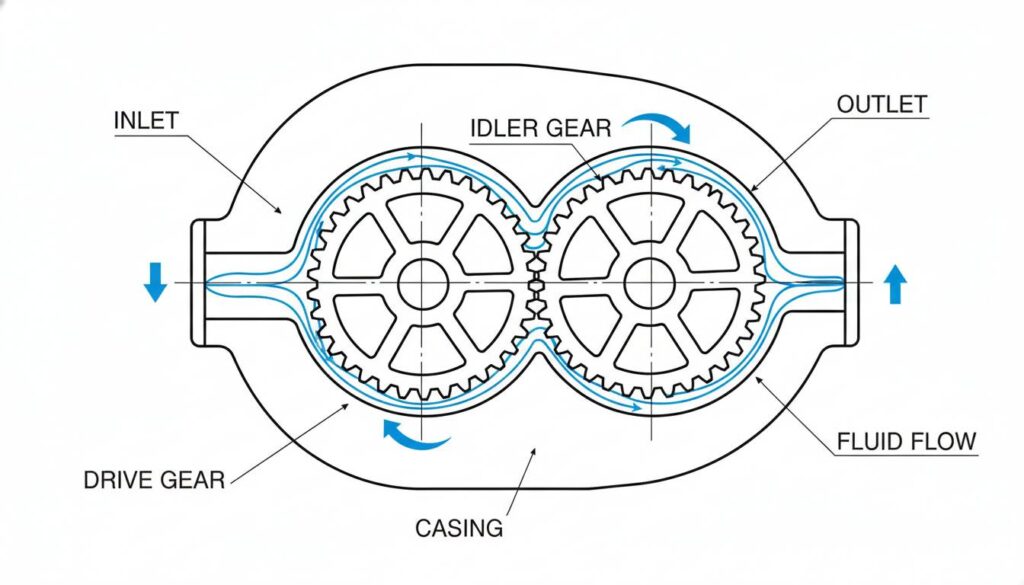
Technical Figure: A cutaway view of a simple gear pump. Two gears are meshed together inside a casing. Blue liquid enters from the left, gets trapped between the gear teeth, and is forced out the right side.
The Valves (The Traffic Lights)
Valves control where the oil goes. They can stop the oil, let it flow, or change its direction. When an excavator driver pulls a lever, they are opening a valve.
- Analogy: These are like faucets or traffic lights controlling the flow of cars.
The Actuators (The Muscles)
This is the part that actually does the work. The most common type is a Hydraulic Cylinder. It is a tube with a piston inside. When oil fills the tube, the piston shoots out.
- Analogy: This is like your bicep muscle contracting to lift your arm.
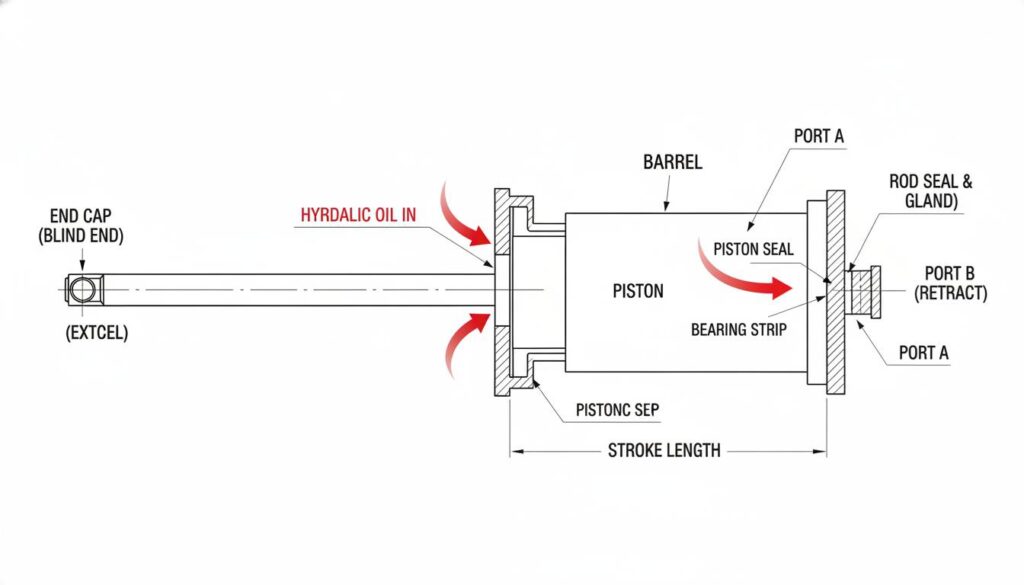
Technical Figure: A detailed diagram of a hydraulic cylinder. Show the metal tube (barrel), the rod extending out, and the piston inside. Use red arrows to show oil entering one side to push the rod out.
The Piping (The Veins)
These are the hoses and metal tubes that connect everything. They must be very strong to handle the pressure without bursting.
If the “Pump” is the heart and the “Piping” represents veins, what part of the human body represents the “Actuator” (the part that moves)?
Why Do We Use Hydraulics?
You might wonder, why not just use gears or electric motors?
1. Huge Power in a Small Package
A small hydraulic motor the size of a melon can lift a truck. Electric motors need to be very large and heavy to lift the same weight.
2. Safety and Accuracy
Hydraulics are smooth. They don’t jerk or snap. If you overload them, a safety valve just opens and lets the oil go back to the tank. The machine stops safely instead of breaking.
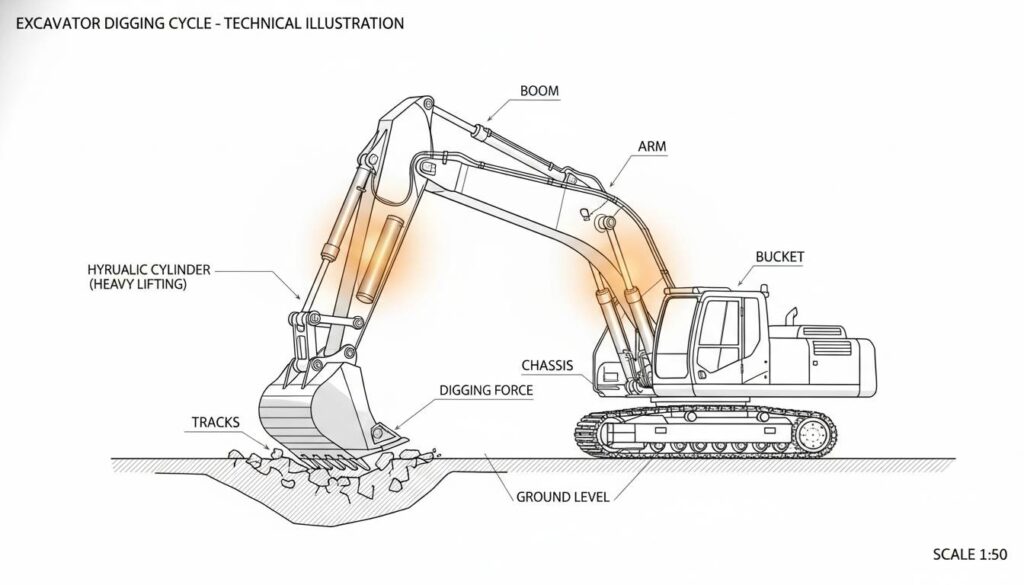
Technical Figure: An illustration of an excavator digging into the ground. Highlight the shiny metal hydraulic cylinders on the boom and arm. Show them glowing slightly to indicate they are doing the heavy lifting.
3. Easy Control
You can control a giant machine with tiny joysticks. It is very easy to make the machine go slow, fast, or hold a heavy rock perfectly still in the air.
Think about a bicycle. It uses a chain and gears (mechanical power). Why don’t we use a chain and gears to lift a dump truck bed? What might happen to the chain if the load is too heavy?
