
The Mission: Drinking a Thick Milkshake
Imagine you are trying to drink a very thick chocolate milkshake through a very thin straw. You have to suck really hard, right?
In engineering, a pump is like your mouth. The suction line is the straw. The hydraulic tank is the cup of milkshake.
Today, we are going to calculate how much “suction” (pressure) is at the inlet of a pump. We need to find out if the pump has to work too hard to pull the oil in.
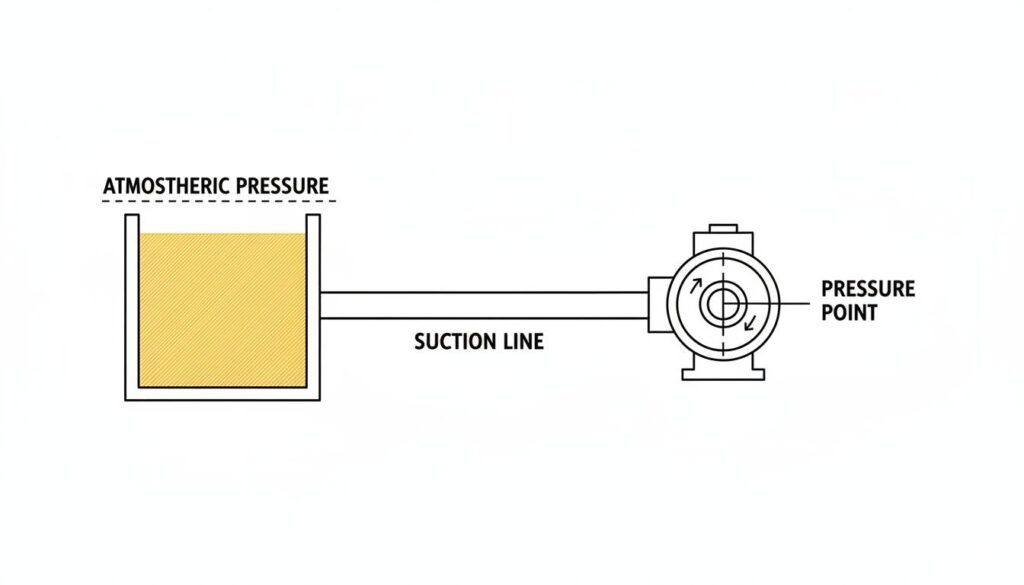
Technical Figure: A simple 2D cartoon diagram showing an open tank of yellow oil on the left, a horizontal pipe connecting it to a pump on the right. Label the tank ‘Atmospheric Pressure’, the pipe ‘Suction Line’, and the pump inlet ‘Pressure Point’.
Step 1: Cleaning Up the Numbers (Unit Conversion)
Before we do any math, we must speak the same language. In science, we use the SI System (meters, seconds, kilograms).
Here is what we know from the problem:
- Flow Rate (
 ): 60 Liters per minute.
 - Pipe Diameter (
 ): 15 millimeters.
 - Pipe Length (
 ): 1 meter.
 - Oil Thickness (Viscosity, ): 0.2 cm²/s.
- Oil Weight (Density, ): 900 kg/m³.
We need to change these into standard units.
Converting Flow Rate
We need cubic meters per second ( ), not Liters per minute.
- 1 minute = 60 seconds.
- 1000 Liters = 1 cubic meter (
 ).
).

Converting Diameter
We need meters, not millimeters.
- 1 meter = 1000 millimeters.
Converting Viscosity
We need meters squared per second ().
- 1 cm² = 0.0001 m².

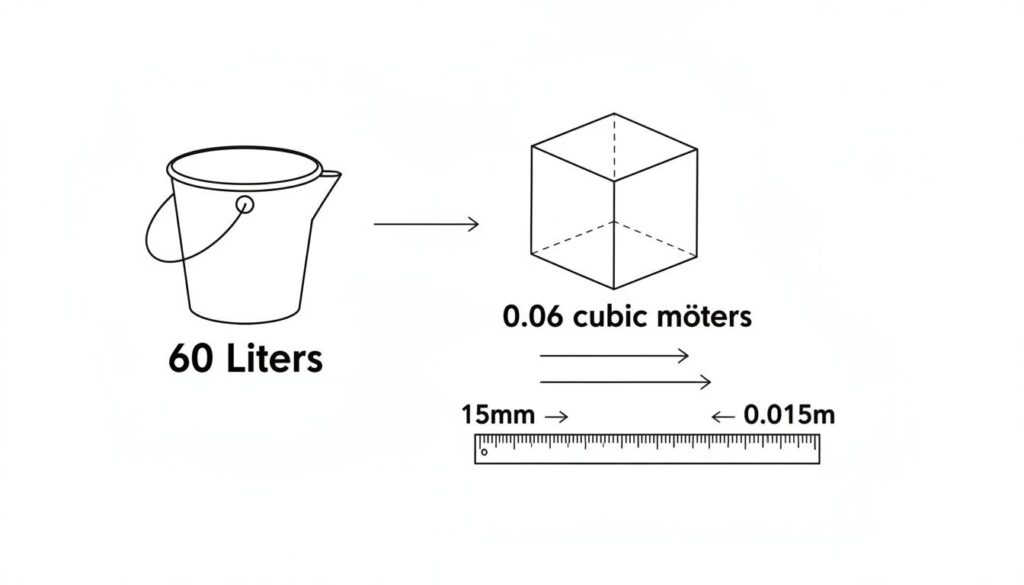
Technical Figure: A visual conversion chart. On the left, a bucket labeled ’60 Liters’. An arrow points to a smaller cube labeled ‘0.001 cubic meters’. Another arrow shows a ruler changing ’15mm’ to ‘0.015m’.
Why do you think we have to convert everything to meters and seconds? What would happen if we tried to multiply Liters by millimeters?
Step 2: How Fast is the Oil Moving?
We need to know the Velocity ( ). This is the speed of the oil inside the pipe.
Think of a garden hose. If you put your thumb over the opening (making it smaller), the water shoots out faster.
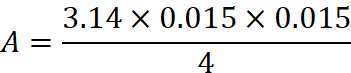
Finding the Area ( )
)
First, we find the area of the circle (the opening of the pipe).
Formula: 

Finding the Velocity ( )
)
Formula: 

The oil is moving at 5.66 meters per second. That is pretty fast!
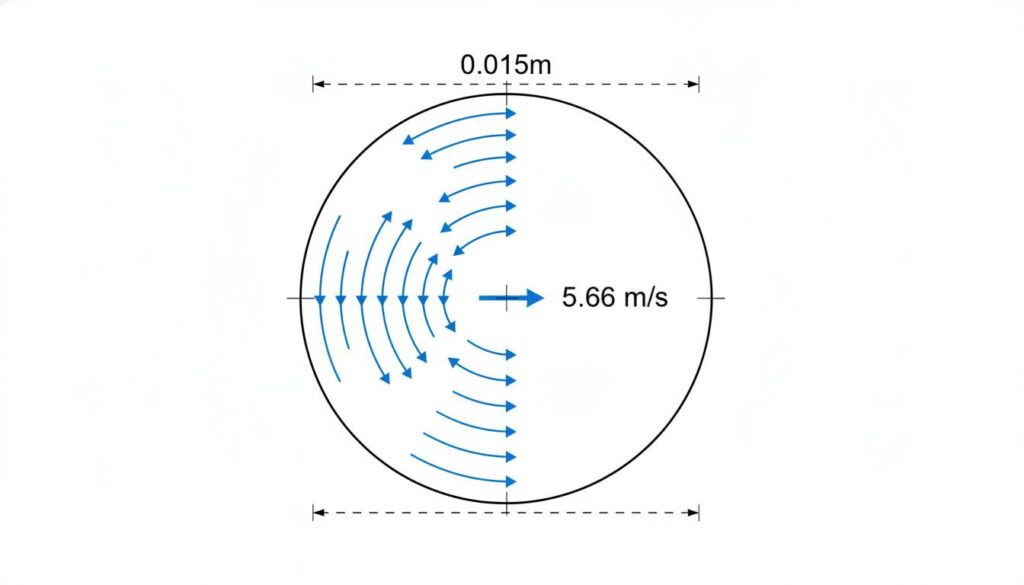
Technical Figure: A cross-section of a pipe. Inside the circle, show blue arrows representing speed. Label the diameter ‘0.015m’ and the speed arrow ‘5.66 m/s’.
Step 3: Is the Flow Smooth or Rough?
Fluids can flow in two ways:
- Laminar: Smooth, like honey pouring slowly.
- Turbulent: Rough and chaotic, like a whitewater river.
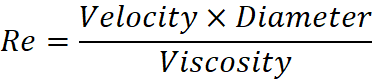
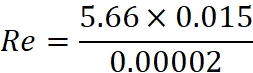
To figure this out, we calculate a special number called the Reynolds Number ( ).
).

The Rule
- If
 is less than 2000, it is Smooth (Laminar).
 - If is more than 4000, it is Rough (Turbulent).
Since 4245 > 4000, our oil flow is Turbulent. It is tumbling around inside the pipe. This causes more friction.
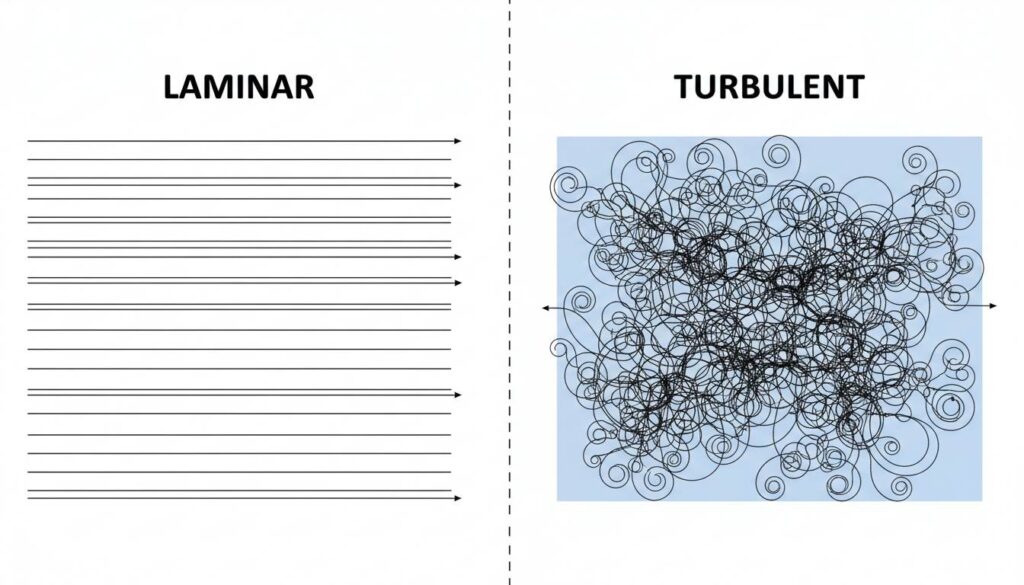
Technical Figure: Split screen illustration. Left side labeled ‘Laminar’ shows straight, parallel lines of fluid. Right side labeled ‘Turbulent’ shows swirling, chaotic lines of fluid. Highlight the Turbulent side.
Step 4: Calculating the Pressure Loss
Now we calculate how much pressure we lose because the oil is rubbing against the pipe walls. This is called Friction Loss.
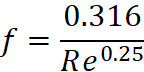
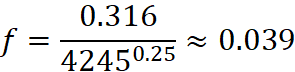
Finding the Friction Factor ()
For turbulent flow in smooth pipes, we use a helper formula (Blasius formula):
The Friction Formula (Darcy-Weisbach)
This tells us how much energy (Head Loss,  ) is lost in meters.

- Gravity () is roughly
 .
.

Let’s break it down:


We lose 4.24 meters of “head” (energy) just fighting friction.
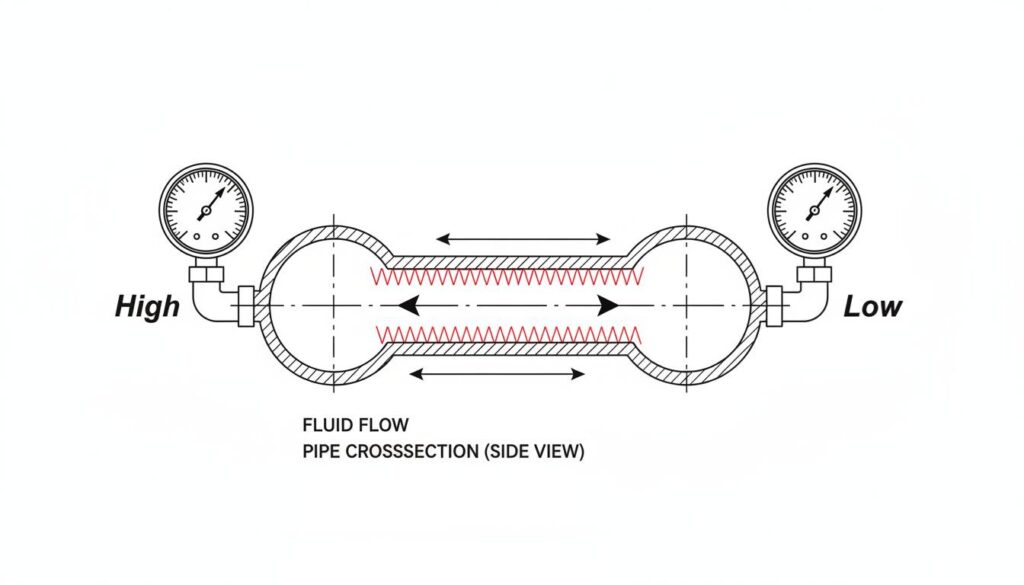
Technical Figure: A side view of the pipe. Show red jagged lines along the inner walls representing friction. Show a pressure gauge at the start reading ‘High’ and a gauge at the end reading ‘Low’.
If the pipe was shorter than 1 meter, would the friction loss be higher or lower? Why?
Step 5: The Final Pressure Calculation
We want the pressure at the pump inlet ( ).
).
The tank is open to the air. We call this 0 Gauge Pressure.
When the pump sucks, it creates a vacuum (negative pressure).
We lose pressure from two things:
- Friction: The 4.24 meters we just calculated.
- Speed (Dynamic Pressure): It takes energy to accelerate the oil from 0 to 5.66 m/s.
Converting Head Loss to Pressure
Pressure ( ) = Density ()
  Gravity (
 ) Height ()
Friction Pressure Drop:

Speed Pressure Drop (Dynamic):

Total Pressure at Inlet
Since the tank is at 0, and the pump is sucking, the pressure will be negative.


We can convert this to kiloPascals (kPa) by dividing by 1000.
Final Answer:
The pressure at the pump inlet is -51.85 kPa.
Technical Figure: A large digital pressure gauge connected to the pump inlet. The screen displays bright red text: ‘-51.85 kPa’. Background is a blurred industrial machine.
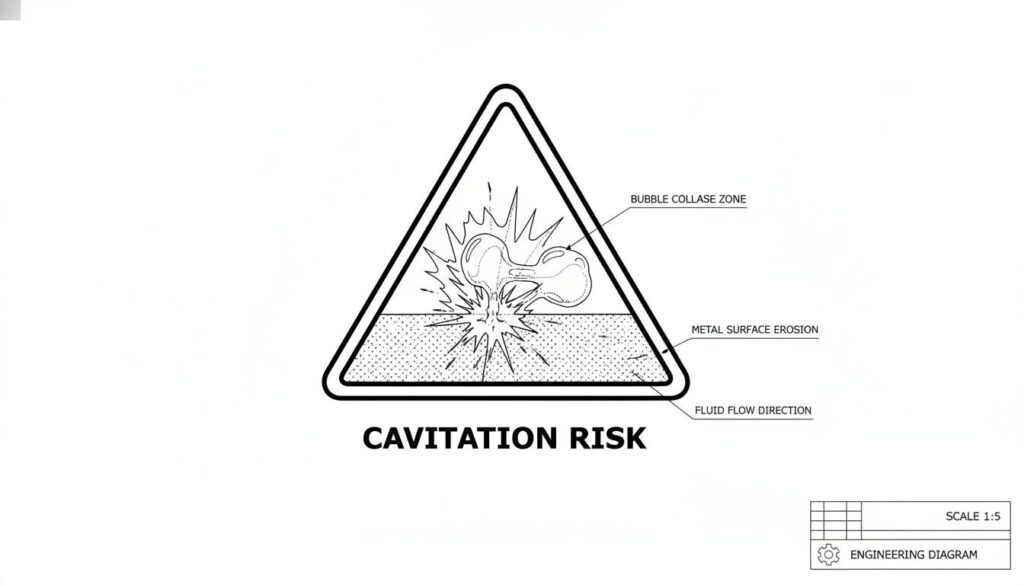
A warning sign triangle. Inside the triangle is a picture of bubbles exploding against metal. Text below reads ‘CAVITATION RISK’.
To fix this low pressure and make it easier for the pump, what is the ONE thing you would change about the pipe? The length or the diameter?
Summary
The pump has to create a vacuum of -51.85 kPa to pull that oil through the pipe.
Why is it so low?
- The pipe is very thin (15mm), causing high speed.
- High speed creates high friction.
- The oil is thick (viscous).
If this number gets too low (too much vacuum), the oil might start to boil and damage the pump. This is called Cavitation.
