
Imagine a giant excavator digging up dirt. Or a garbage truck crushing trash. How are they so strong? They use hydraulics.
Hydraulics is the science of using liquid (usually oil) to push things. Today, we will look at a specific part called a Hydraulic Cylinder. We will calculate how strong it is, how fast it moves, and how much power it uses.
The Mission: Solving the Puzzle
We have a hydraulic cylinder that is extending (pushing out). We need to find five things:
- Force (F): How hard can it push?
- Speed (v): How fast does it move?
- Return Flow (Q): How much oil comes out the other side?
- Hydraulic Power (Nh): The energy put into the system.
- Mechanical Power (N): The energy we get out of the system.
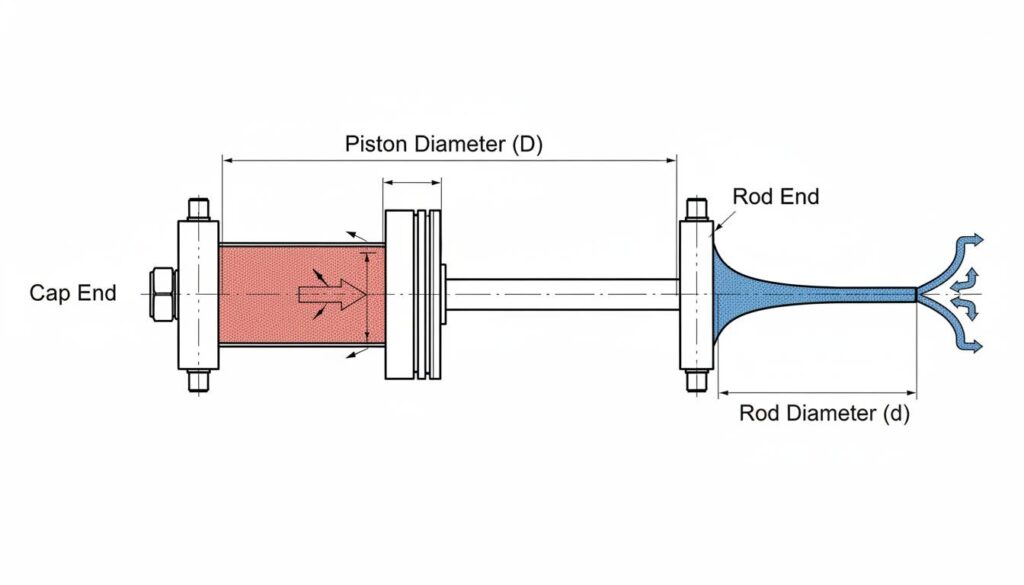
Technical Figure: A simple 2D diagram of a hydraulic cylinder in extension mode. The left side is the ‘Cap End’ filled with red oil pushing the piston. The right side is the ‘Rod End’ with blue oil leaving. Label the Piston Diameter (D) and Rod Diameter (d).
The Given Numbers (Data)
Before we do math, we list what we know. We must convert these “messy” units into standard “clean” units (Meters, Seconds, Newtons) so the math works.
- Pressure (P): 200 bar.
- Think of this as how hard the pump is squeezing the oil.
- Conversion: 1 bar = 100,000 Pascals (Pa).
- P = 20,000,000 Pa (or
 Pa).
Pa).
- Pump Flow Rate (Q_in): 40 Liters per minute (L/min).
- Think of this as how fast the faucet is running.
- Conversion: Divide by 60,000 to get cubic meters per second (
 ).
). - Q_in = 0.000667 .
- Piston Diameter (D): 100 mm.
- Conversion: D = 0.1 meters.
- Rod Diameter (d): 70 mm.
- Conversion: d = 0.07 meters.
Why do we need to convert millimeters to meters and liters to cubic meters?
Hint: If you measure a football field in inches and the ball speed in miles per hour, can you easily calculate how many seconds a pass takes? Standard units make the math match!
Step 1: Calculating the Areas
A cylinder is a tube with a circle inside (the piston). To find force and speed, we need the Area of that circle.
The Piston Area (The Big Circle)
This is the side the oil pushes against to extend the rod.
- Formula: Area =
 (or
(or  ).
). - Calculation:
 .
. - Area Piston (
 ) = 0.00785
  .
.
The Annulus Area (The Donut Shape)
On the other side, the rod takes up space. The oil only touches the ring around the rod. This is called the Annulus.
- First, find Rod Area:
 .
. - Subtract Rod Area from Piston Area.
 .
.- Area Annulus (
 ) = 0.004 .
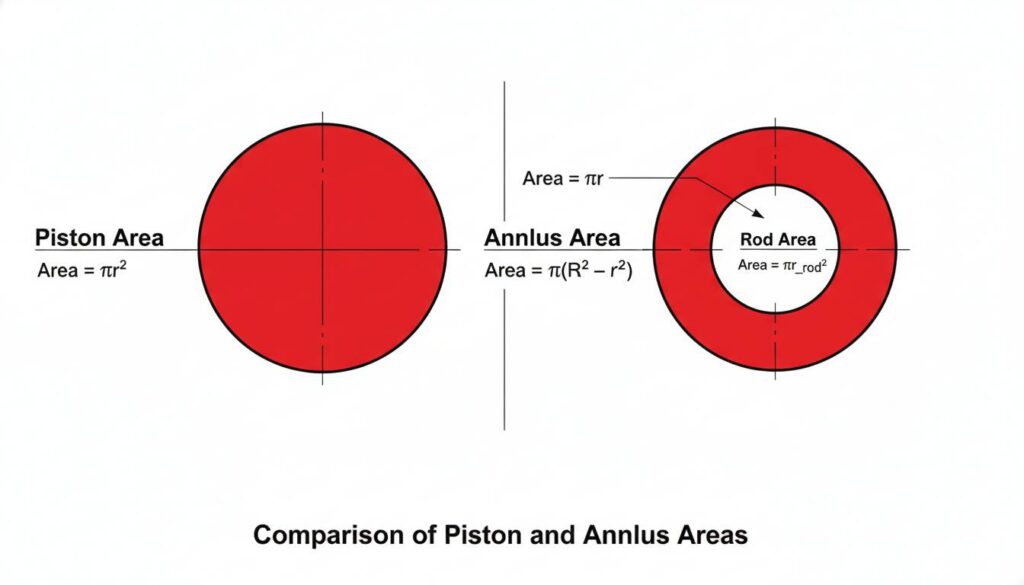
Technical Figure: A visual comparison of two shapes. On the left, a solid red circle representing the Piston Area. On the right, a red ring (donut shape) representing the Annulus Area. Label the center hole of the donut as ‘Rod Area’.
Step 2: Calculating Loading Force (F)
Force is the “push.” In hydraulics, Force comes from Pressure pushing on an Area.
- Formula:

- Analogy: Imagine a woman in stiletto heels stepping on your foot versus an elephant. The heel hurts more because the area is small. Here, we have huge pressure on a big area, creating massive force.
We use the Piston Area because that is where the high-pressure oil is pushing.
- Calculation:
 .
. - Force (F) = 157,000 Newtons.
- (That is roughly equal to lifting 16 small cars!)
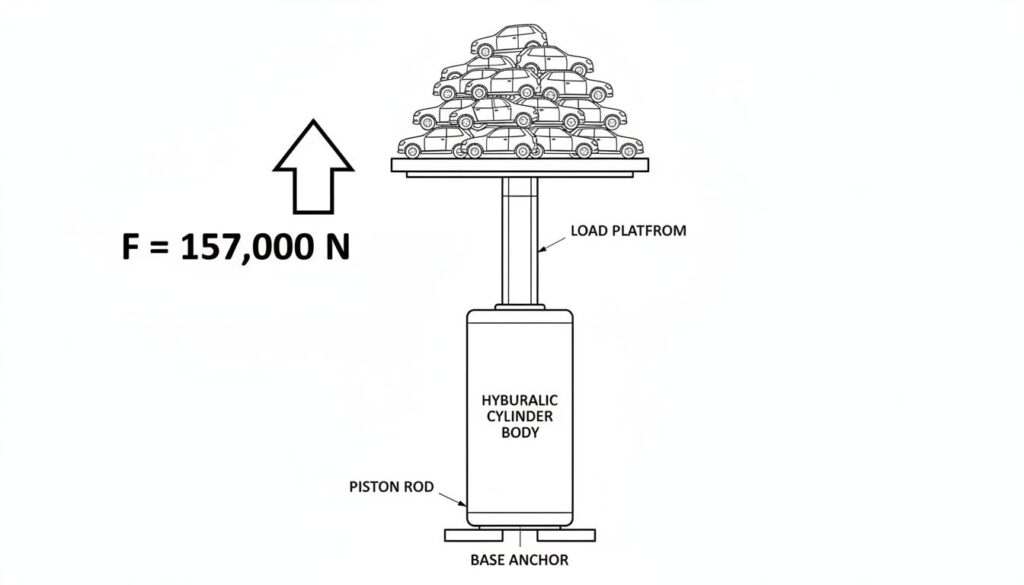
Technical Figure: An illustration showing a heavy weight being lifted by the cylinder rod. An arrow labeled ‘F = 157,000 N’ points upward. Next to it, a pile of 16 small cars to visualize the weight.
Step 3: Calculating Piston Speed (v)
Speed depends on how fast we fill the cylinder with oil.
- Formula:

- Analogy: Think of filling a bathtub. If you turn the tap on full blast (High Q) the water level rises fast. If the tub is very narrow (Small A), the level rises even faster.
We use the Piston Area and the Pump Flow.
- Calculation:
 .
. - Speed (v) = 0.085 meters per second.
- (This is about 8.5 cm per second. Slow and steady.)
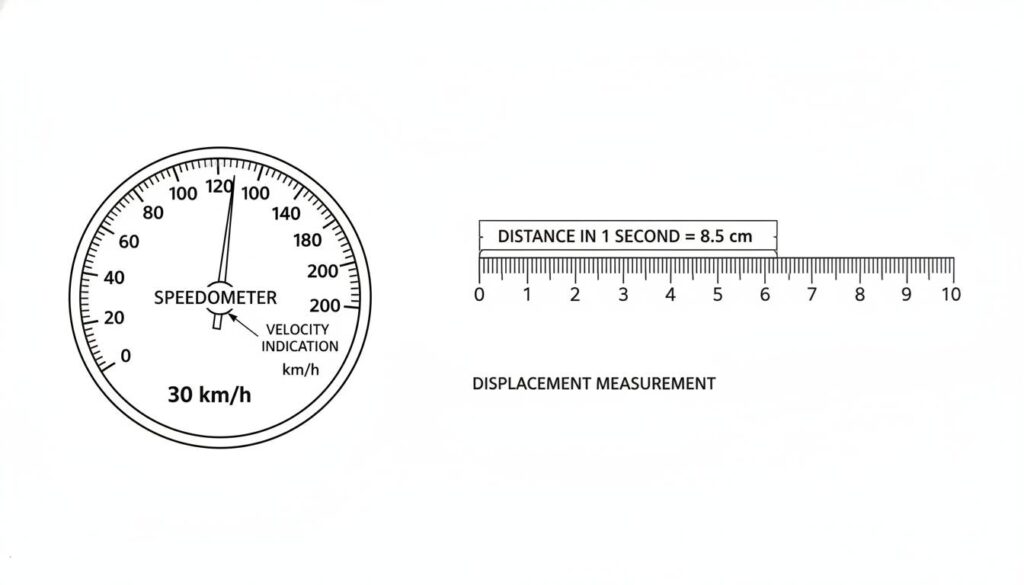
Technical Figure: A speedometer graphic showing the needle pointing to a low speed. Next to it, a ruler showing 8.5cm to represent the distance moved in one second.
Step 4: Calculating Returned Flow Rate (Q_out)
As the piston moves forward, it squishes the oil on the other side (the rod side). This oil has to leave.
Does the same amount come out as went in? No.
Why? Because the rod takes up space! There is less oil on the rod side to push out.
- Formula:
 .
. - Calculation:
 .
. - Returned Flow (Q) = 0.00034 .
- (If we convert back to Liters: This is about 20.4 L/min. Roughly half the oil comes out compared to what went in.)
If 40 Liters go in, but only 20 Liters come out, where did the “missing” space go?
Hint: Look at the metal rod extending out of the cylinder. That solid metal is taking up the volume that used to be occupied by oil!
Step 5: Power Calculations
Power is the rate of doing work. We have two types here:
- Hydraulic Power (
 ): The power the pump gives to the oil.
 - Mechanical Power (
 ): The power the cylinder gives to the load.
Pump Output Hydraulic Power ( )
)
- Formula: Power = Pressure Flow Rate (
 ).
). - Calculation:
 .
. - Hydraulic Power () = 13,340 Watts (or 13.34 kW).
Cylinder Output Mechanical Power ( )
)
- Formula: Power = Force Speed (
 ).
). - Calculation:
 .
. - Mechanical Power () = 13,345 Watts (or 13.35 kW).
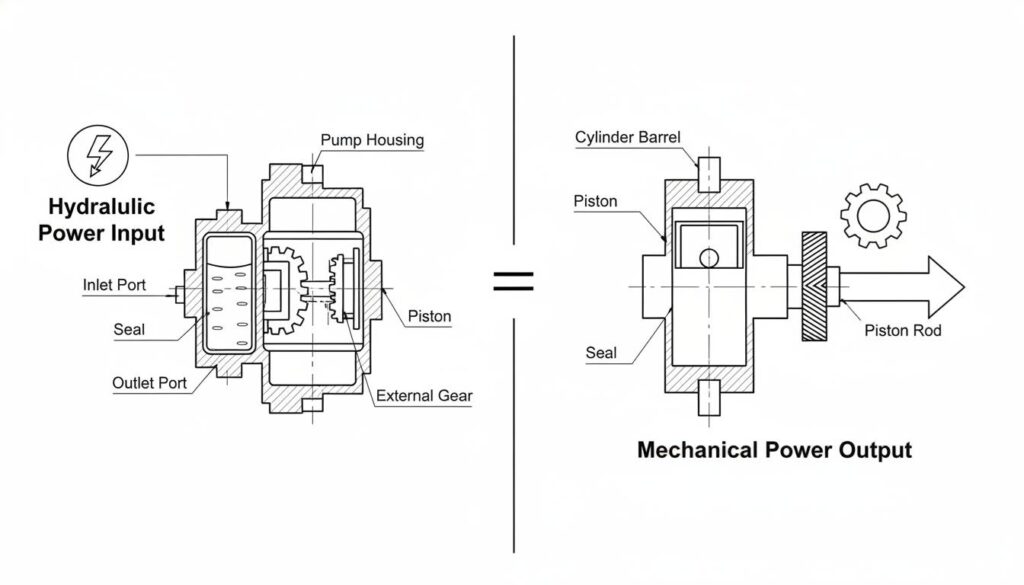
Technical Figure: A split diagram. Left side shows a hydraulic pump with a lightning bolt symbol labeled ‘Hydraulic Power Input. Right side shows the moving cylinder rod with a gear symbol labeled ‘Mechanical Power Output’. An equals sign (=) is between them.
Comments on Results
Look at our two power numbers:
- Hydraulic Power: 13,340 Watts
- Mechanical Power: 13,345 Watts
They are almost exactly the same! (The tiny difference is just because we rounded off the numbers in our calculator).
Why is this important?
The problem told us to “neglect losses.” This means we pretend there is no friction and no leaking. In a perfect physics world, Energy In = Energy Out. The power provided by the liquid pressure is converted perfectly into the movement of the heavy load.
Summary Table
| Parameter | Value | Unit |
| Loading Force (F) | 157,000 | Newtons (N) |
| Piston Speed (v) | 0.085 | m/s |
| Return Flow (Q) | 20.4 | L/min |
| Hydraulic Power | 13.34 | kW |
| Mechanical Power | 13.35 | kW |
