What is Water Jet Machining?
Imagine you are washing a car with a garden hose. If you put your thumb over the opening, the water sprays out faster and harder. Now, imagine a machine that does this, but millions of times stronger.
Focus Keyword: Water Jet Machining, WJM, High-Pressure Water Cutting, Abrasive Jet Machining, Mechanical Engineering Basics
Water Jet Machining (WJM) is a way to cut materials using a stream of water at incredibly high pressure. It is like a “water laser.”
The water moves so fast that it can slice through soft materials like foam, rubber, or even food. If we add sand to the water, it can cut through hard metals like steel and titanium.
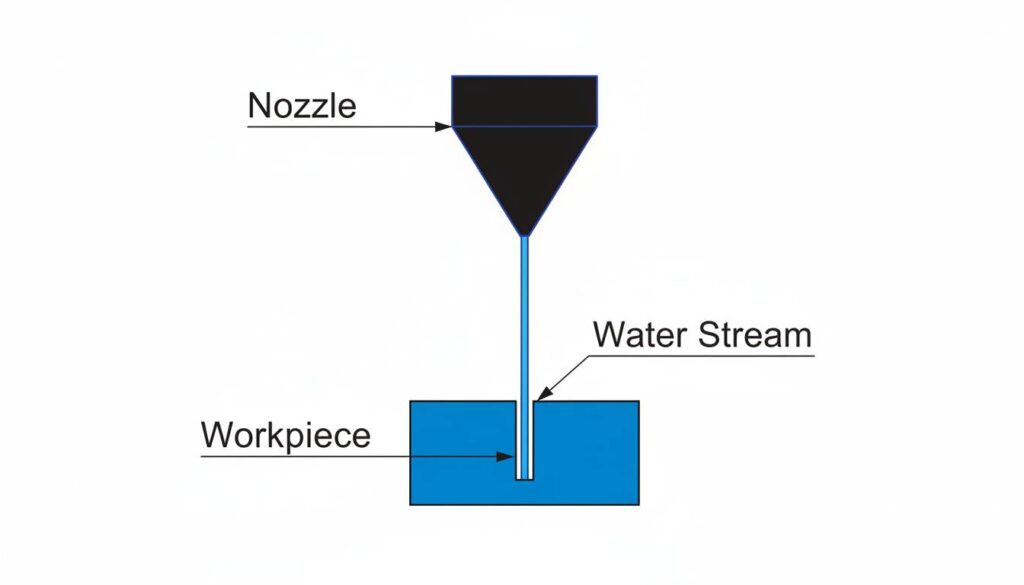
Technical Diagram: A simple 2D schematic diagram showing a water jet cutting head slicing through a piece of blue material. The water stream should look like a thin, straight blue line. Label the ‘Nozzle’, ‘Water Stream’, and ‘Workpiece’.
The Main Principle: Kinetic Energy
How does soft water cut hard metal? It is all about speed.
In physics, moving objects have energy. This is called Kinetic Energy.
If you throw a marshmallow at a wall gently, nothing happens. If you could shoot a marshmallow at 5,000 miles per hour, it would punch a hole in the wall.
In WJM, we squeeze water through a tiny hole. This turns high pressure into high velocity (speed). When this fast water hits the material, it erodes (washes away) tiny bits of the material instantly.
Think About It:
If you have a wide river flowing slowly, it feels gentle. If you force that same amount of river water through a narrow pipe, what happens to the speed of the water? Does it get faster or slower?
The Equipment: The Parts of the Machine
To get water to move that fast, we need special equipment. We cannot just hook it up to a kitchen sink. Here are the main parts.
1. The Hydraulic Pump
This is the motor. It pumps oil to power the machine. It is the first step in creating power.
2. The Intensifier (The Muscle)
This is the most important part. The pump sends oil to the Intensifier. The intensifier’s job is to take that power and boost the water pressure up to 60,000 PSI (Pounds Per Square Inch) or more.
How the Intensifier Works
It uses a simple math trick called a Ratio.
Imagine a big piston connected to a small piston.
- Oil pushes the Big Piston.
- The Big Piston pushes the Small Piston.
- Because the small piston is smaller, the pressure shoots up!
The Math:
If the Big Piston is 20 times larger than the Small Piston, the water pressure will be 20 times higher than the oil pressure.
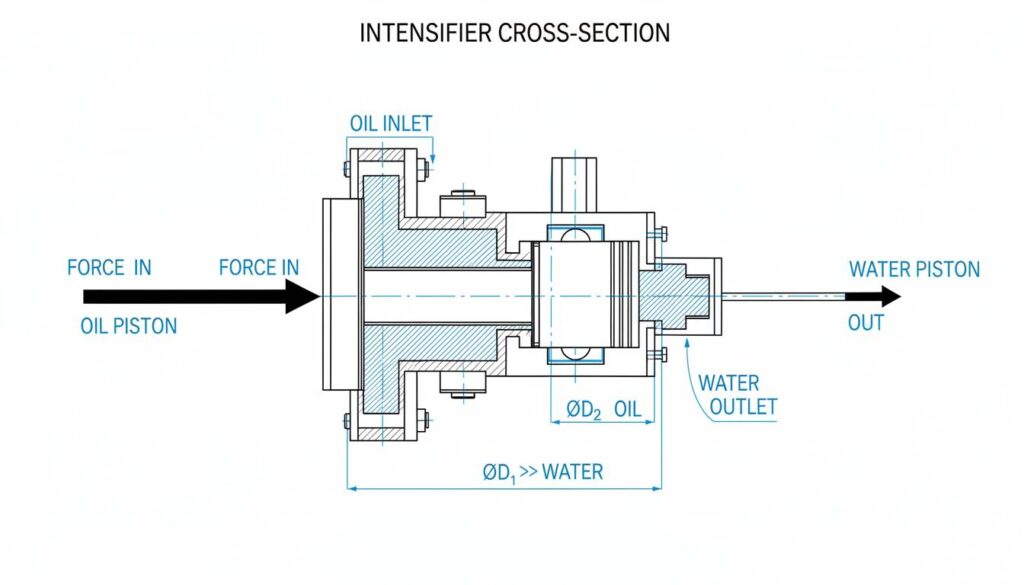
Technical Diagram: A cross-section diagram of an Intensifier. Show a large piston on the left labeled ‘Oil Piston’ pushing a much thinner piston on the right labeled ‘Water Piston’. Use arrows to show force direction.
3. The Accumulator (The Shock Absorber)
Pumps move back and forth. This creates “pulses” in the water, like a heartbeat. We do not want a pulsing cut; we want a smooth cut.
The Accumulator is a strong tank that holds high-pressure water. It acts like a battery or a cushion. It smooths out the flow so the water comes out of the nozzle steadily.
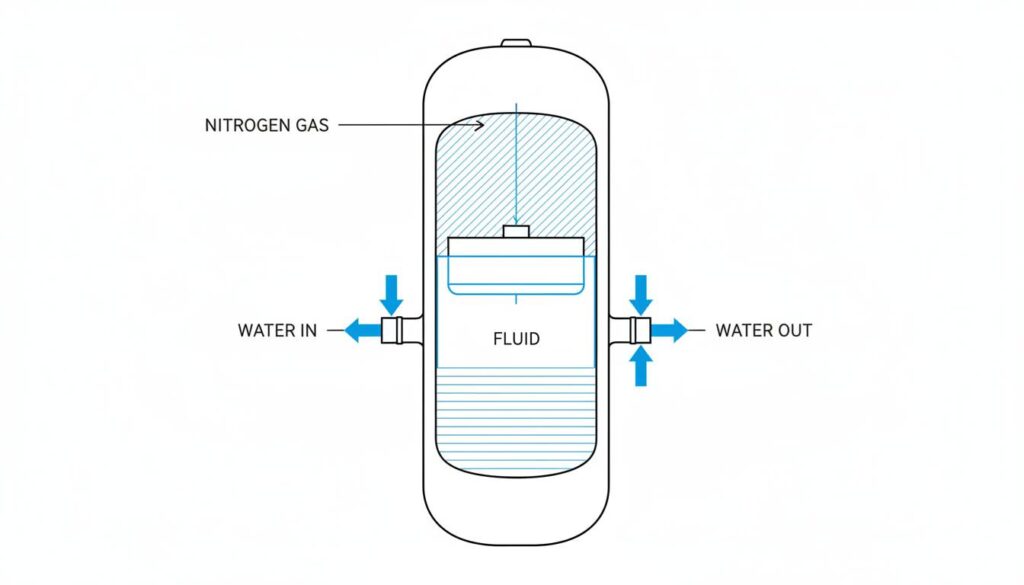
Technical Diagram: A technical illustration of a cylindrical Accumulator. It should look like a tall, thick metal bottle. Show water entering one side and exiting smoothly from the other.
4. The High-Pressure Tubing
We need to get the water from the pump to the cutting head. We use thick stainless steel tubes. These tubes are very strong so they do not burst under the pressure.
5. The Cutting Head and Nozzle
This is the “gun” that aims the water. Inside the nozzle, there is a tiny jewel. It is usually made of Ruby, Sapphire, or Diamond.
Why a jewel? Because jewels are very hard. The water moves so fast it would wear out metal in minutes. The jewel has a tiny hole (orifice) that focuses the water into a needle-sharp beam.
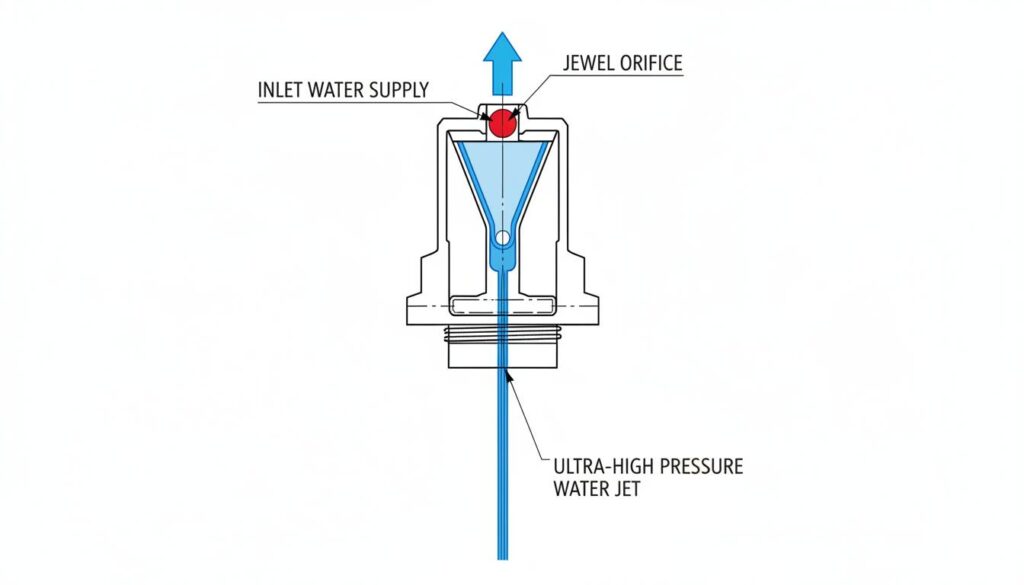
Technical Diagram: A close-up cross-section of a Water Jet Nozzle. Show the ‘Jewel Orifice’ (a small red ruby) at the top, focusing the blue water into a very thin, straight line exiting the bottom.
6. The Catcher
Once the water cuts through the material, it is still moving very fast. We need to stop it safely. The Catcher is a tank underneath the table filled with water and steel balls. It absorbs the energy of the water jet so it doesn’t cut the floor!
Review Question:
Why do we use a jewel (like a diamond or ruby) inside the nozzle instead of just using a piece of steel with a hole in it?
Types of Water Jet Machining
There are two main ways to use this machine.
Pure Water Jet
This uses only water.
- Best for: Soft materials.
- Examples: Cutting diapers, toilet paper rolls, foam for car seats, and frozen food (like fish sticks).
- Benefit: It is very clean and sanitary.
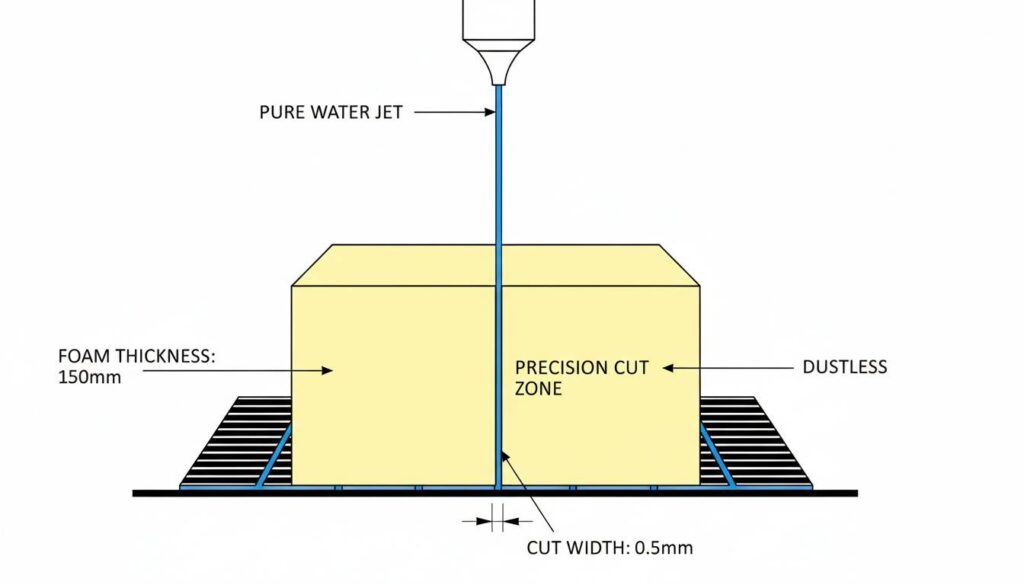
Technical Diagram: A photo-realistic illustration of a Pure Water Jet cutting through a thick piece of yellow foam. The cut should be clean with no dust.
Abrasive Water Jet
This mixes abrasive particles (like garnet sand) into the water stream.
- How it works: The water acts like a magnet, pulling the sand into the stream. The sand acts like “teeth” to chew through the material.
- Best for: Hard materials.
- Examples: Titanium, steel, granite countertops, and bulletproof glass.
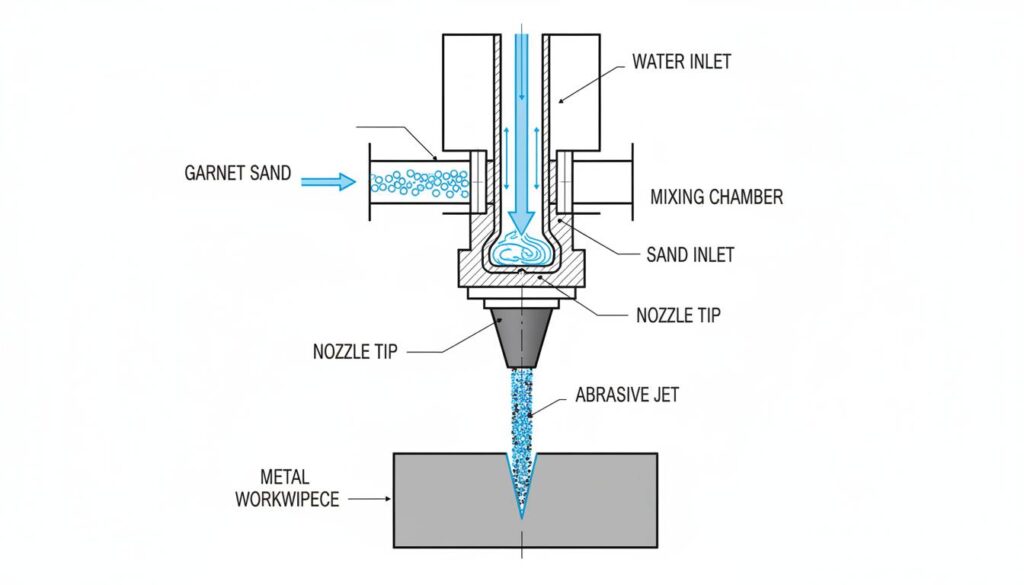
Technical Diagram: A diagram of an Abrasive Nozzle. Show the water stream coming down, a side tube feeding ‘Garnet Sand’ into the stream, and the mixture exiting the tip to cut a grey metal plate.
Advantages: Why Use Water?
1. No Heat (Cold Cutting)
Lasers and plasma cutters burn the material to cut it. This can damage the edges or change the metal. Water jet is a cold process. It does not burn or melt the part.
2. Versatility
One machine can cut almost anything. You just switch from pure water to abrasive water.
3. Environmentally Friendly
It produces no toxic smoke or gas. It is just water and sand.
Final Thought:If you were building a part for a spaceship that cannot handle high heat, would you choose Laser Cutting or Water Jet Machining? Why?
