What is Wire Cut EDM?
Imagine slicing a block of cheese with a thin wire. It cuts smoothly, right? Now, imagine that wire is electrified. Imagine it cuts through hard steel without even touching it. That is Wire Cut EDM (Electrical Discharge Machining).
In this process, we use a very thin metal wire. We charge it with electricity. We bring it close to a metal block. Zap! Thousands of tiny sparks fly between the wire and the block. These sparks are like tiny lightning bolts. They are so hot that they melt and vaporize the metal.
We do this underwater. The water cools things down and washes away the tiny bits of melted metal.

Technical Diagram: A simplified schematic diagram of a Wire Cut EDM machine. Show a spool of wire feeding down through a metal block. Show bright yellow sparks between the thin wire and the metal block. Show the whole cutting area submerged in a tank of blue water.
The “Cheese Cutter” Analogy
Think of the wire as a “thermal saw.”
- The Wire: Usually made of brass. It is very thin (like a human hair).
- The Sparks: These do the cutting. The wire never actually touches the metal.
- The Result: A perfect, clean cut.
Think About It:
If the wire never touches the metal, why doesn’t the wire bend or break like a saw blade would?
Advantages of Wire Cut EDM
Why do engineers love this machine? Here are the main reasons.
1. It Cuts the Hardest Metals
You cannot cut hardened steel with a normal knife or saw. The saw would break. Wire EDM does not care how hard the metal is. If the material conducts electricity, EDM can cut it. It cuts hard steel as easily as soft aluminum.
2. No Stress on the Part
When you use a normal saw, you have to push hard. This can bend thin metal parts. Because the EDM wire never touches the part, there is no pushing force. You can cut very fragile or thin shapes without breaking them.
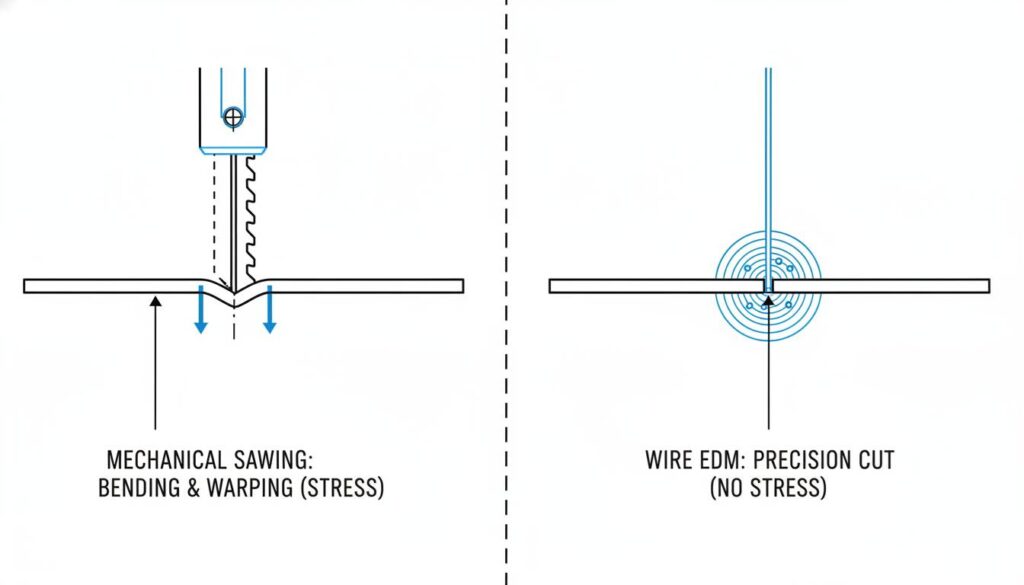
Technical Diagram: A split-screen comparison illustration. On the left, a mechanical saw is cutting a thin metal sheet, causing it to bend and warp. On the right, a Wire EDM wire is cutting the same thin sheet perfectly straight with no bending.
3. Super Precision
Do you need to make a puzzle piece that fits perfectly? Wire EDM is incredibly accurate. It can make cuts with tolerances (errors) smaller than a speck of dust. It leaves a very smooth surface, so you don’t need to polish it later.
4. Complex Shapes
Drills make round holes. Saws make straight cuts. Wire EDM can cut any shape you can draw. It can cut stars, gears, or tiny letters.
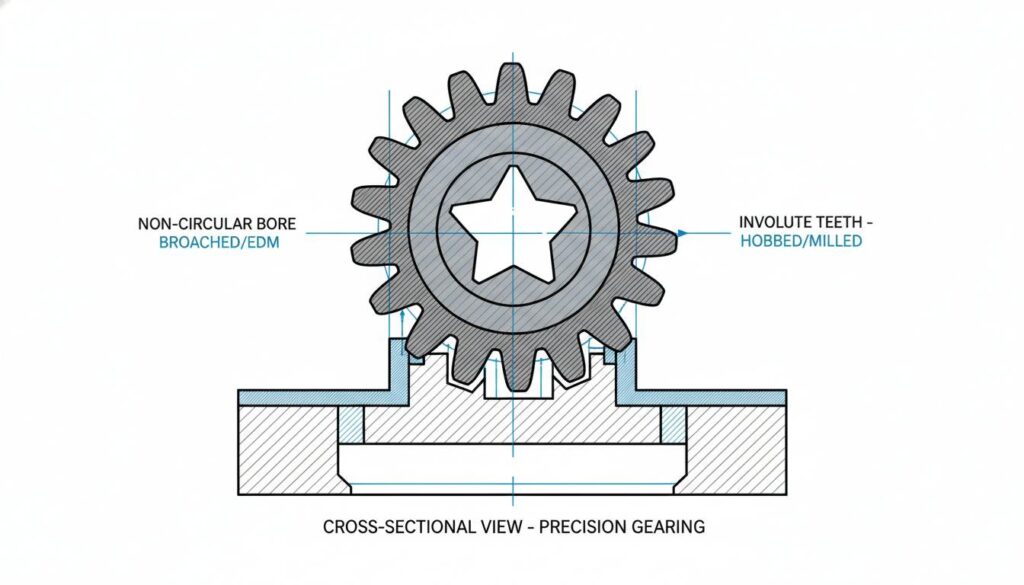
Technical Diagram: A close-up technical illustration of a complex metal gear with intricate teeth and a star-shaped hole in the center, sitting on a machine table, demonstrating a shape that cannot be made with a drill.
Quick Quiz:
Why is Wire EDM better than a regular saw for cutting a very thin, fragile piece of metal?
Disadvantages of Wire Cut EDM
It sounds perfect, but it has some downsides.
1. It is Slow
Wire EDM is not a race car; it is a turtle. Melting metal with sparks takes time. If you need to cut a simple bar quickly, use a saw. If you need precision, wait for the EDM.
2. Only Conductive Materials
This is the biggest rule. The material must conduct electricity.
- Can cut: Steel, Titanium, Copper, Gold.
- Cannot cut: Plastic, Wood, Glass, Ceramic.
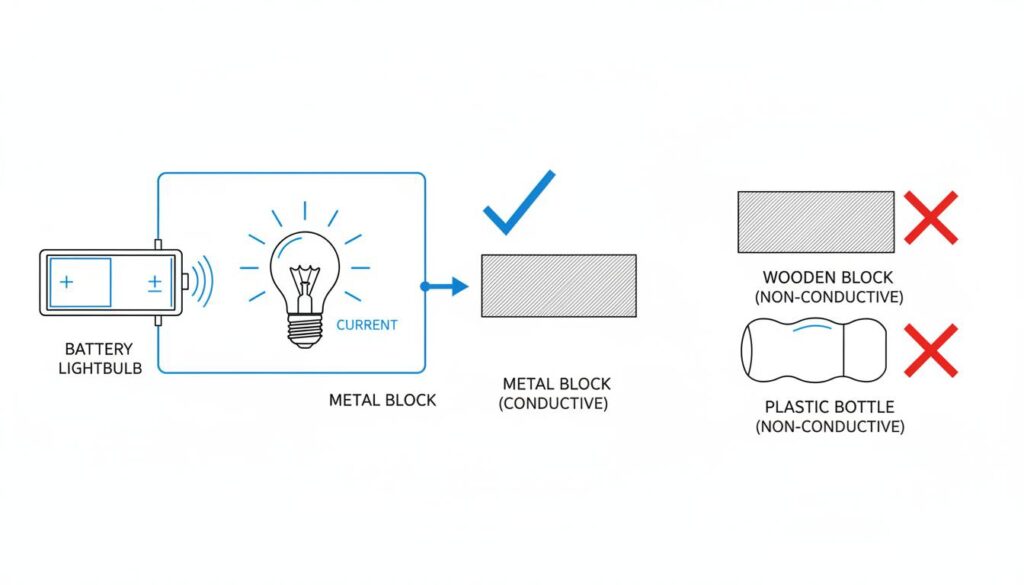
Technical Diagram: An educational diagram showing a battery connected to a lightbulb. Next to it, a checkmark over a metal block (conductive) and a red “X” over a wooden block and a plastic bottle (non-conductive).
3. High Cost
These machines are expensive to buy. Also, they use a lot of electricity. The brass wire is usually used only once and then thrown away, which costs money.
Problem Solving:
You need to cut a precise shape out of a hard plastic block. Can you use Wire Cut EDM? Why or why not?
Applications: Where Do We Use It?
1. Making Molds and Dies
Look at a plastic LEGO brick. It was made by injecting plastic into a metal mold. That metal mold had to be perfect. Wire EDM is used to cut these steel molds with high accuracy.
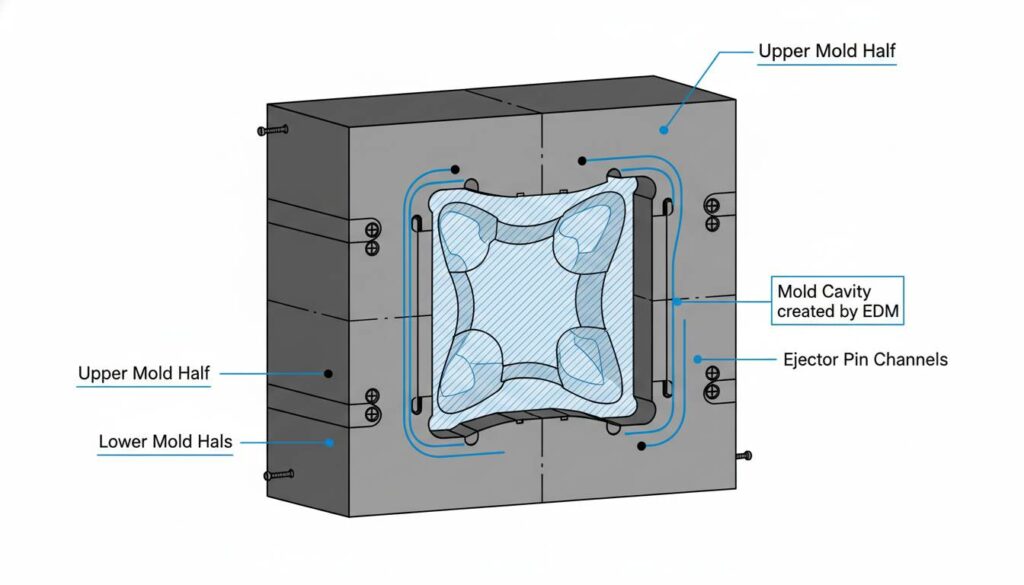
Technical Diagram: A cross-section view of a heavy steel mold used for injection molding. Show the intricate cavity inside the steel block that was carved out, labeled “Mold Cavity created by EDM”.
2. Aerospace Parts
Airplanes and rockets use very hard metals like Titanium. These parts must handle high heat and cannot fail. EDM creates engine parts and turbine blades that are perfect every time.
3. Medical Tools
Surgeons use tiny tools. EDM can cut very small, detailed shapes for surgical instruments and implants (like bone screws) that go inside the human body.
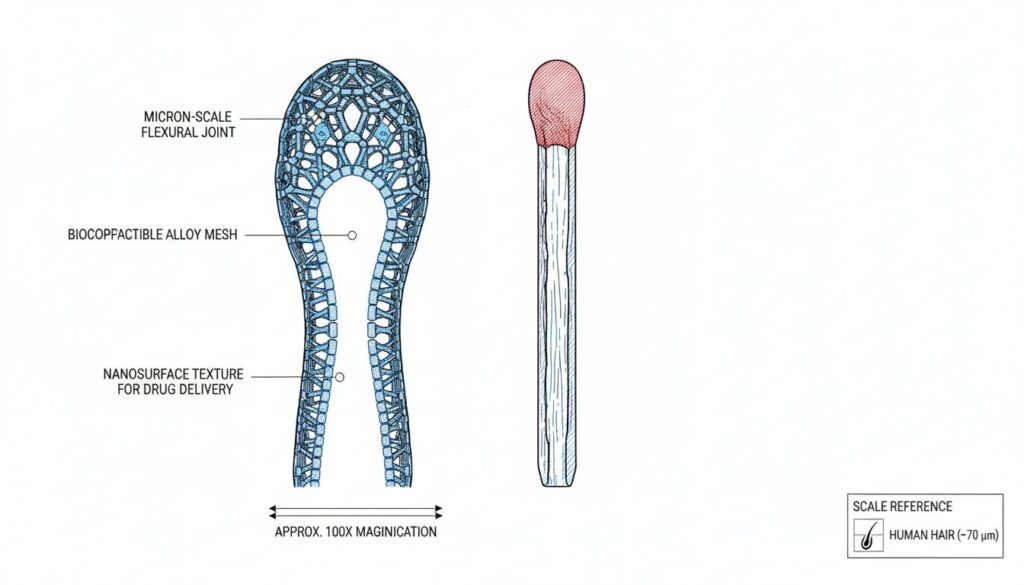
Technical Diagram: A magnified view of a tiny, intricate medical stent or surgical tool tip next to a matchstick for scale, highlighting the microscopic precision.
Latest Trends in Wire Cut EDM
Technology is always moving forward. Here is what is new.
1. Thinner Wires
Engineers are using wires that are thinner than ever before. Some are barely visible to the human eye. This allows for “Micro-EDM,” creating parts for tiny electronics and microscopic robots.
2. Smarter Machines (AI)
New machines have “brains” (Artificial Intelligence). If the wire is about to break, the machine senses it and slows down. If the water gets too dirty, the machine adjusts itself. This lets the machine work all night without a human watching it.
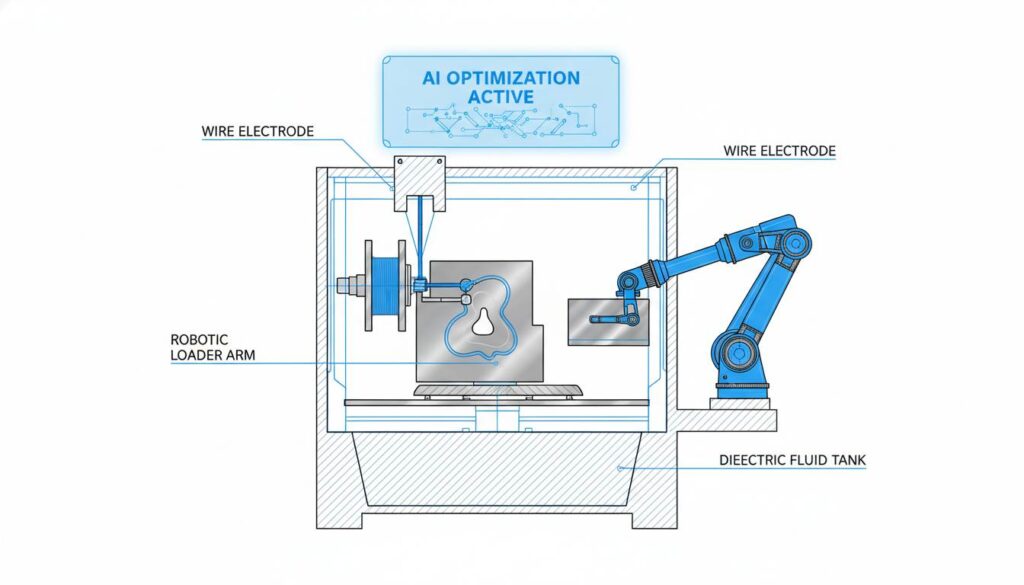
Technical Diagram: A futuristic concept art of a Wire EDM machine with a digital holographic display showing “AI Optimization Active” and a robot arm loading a metal block.
3. Faster Cutting Speeds
While EDM is naturally slow, new power generators are making the sparks hotter and faster. This helps factories make parts quicker than they could ten years ago.
Future Thinking:
If machines can fix their own mistakes using AI, how does that change the job of the person running the machine?
