
What is Hydrostatic Power?
Hydrostatic power is a way to move heavy objects using fluids. You see this every day. Think about a garbage truck crushing trash or an excavator digging a hole. They do not use gears or chains alone. They use “liquid muscle.”
In engineering, we call this Hydraulics.
The main idea is simple: Liquids cannot be squished.
If you fill a plastic bottle with air and step on it, the bottle crushes. The air gets smaller (compresses). But if you fill that bottle with water and put the cap on tight, you cannot crush it. The water pushes back. We use this “push back” to lift cars and move giant robot arms.
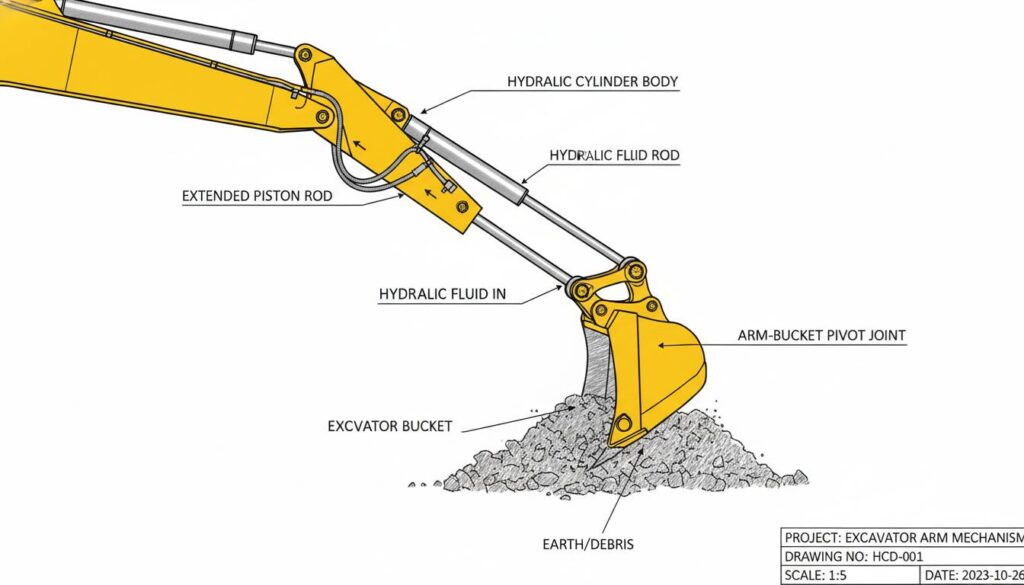
Technical Figure: A bright yellow excavator digging up dirt. Zoom in on the shiny silver hydraulic cylinders on the arm. The cylinders are extended, showing the metal rod pushing the bucket.
The Syringe Analogy
To understand hydrostatics, think of two plastic medical syringes connected by a clear plastic tube. Both are filled with water.
- You push the plunger down on Syringe A.
- The water flows through the tube.
- The plunger on Syringe B moves up.
You pushed here, but the movement happened over there. The water acted like a solid rod connecting them. This is a basic hydrostatic system.

Technical Figure: A simple diagram showing two syringes connected by a clear tube filled with blue liquid. A hand pushes the left plunger down, and the right plunger rises up. Arrows indicate the flow of liquid.
If you filled the syringes with air instead of water, what would happen when you pushed the first plunger? Would the second one move immediately, or would the air just get squished first?
The Golden Rule: Pascal’s Law
Blaise Pascal was a scientist who figured out how liquid pressure works. His law is the most important rule in hydraulics.
Pascal’s Law states:
Pressure applied to a confined liquid is transmitted equally in all directions.
Imagine a water balloon. If you squeeze one side of the balloon, the pressure doesn’t just stay where your hand is. The pressure shoots through the whole balloon. The balloon tries to expand everywhere at once.
In a machine, this means if we pump oil into a pipe, that pressure goes to the end of the pipe instantly. It pushes against the walls of the pipe and the piston at the end with equal strength.
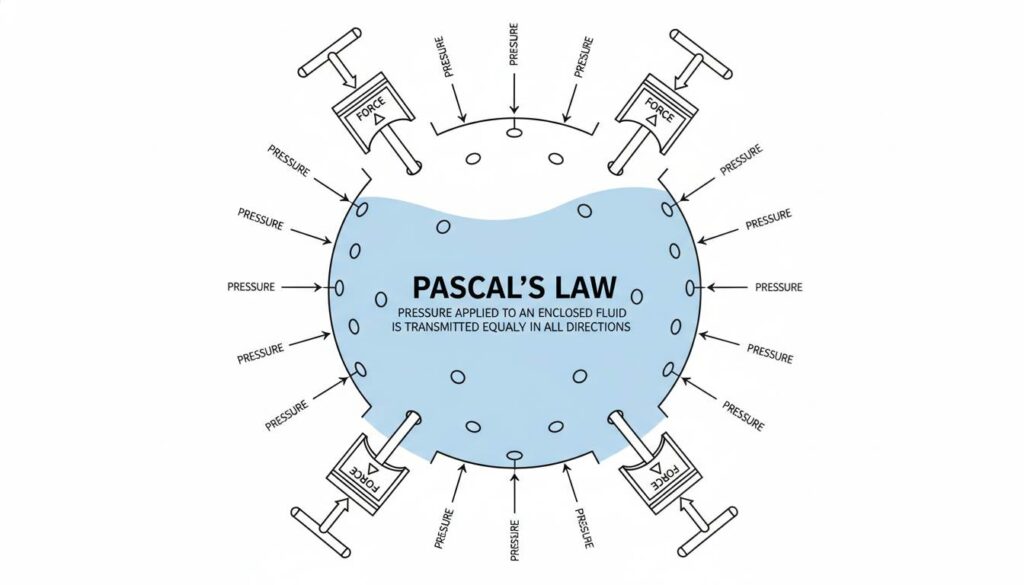
Technical Figure: A 2D diagram illustrating Pascal’s Law. A spherical container filled with blue fluid has small holes all around it. Pistons are pushing on the fluid, and arrows of equal length point outward from every hole, showing equal pressure in all directions.
The Parts of the Hydrostatic Power Systems
A hydrostatic system is like a team. Each part has a specific job.
The Reservoir (The Tank)
This is the storage bucket. It holds the hydraulic fluid (usually oil) when it is not being used. It also lets the oil cool down.
The Pump (The Heart)
The pump moves the oil. It sucks oil from the tank and pushes it into the system.
- Important: The pump creates flow (movement), not pressure. Pressure only happens when the flow meets resistance (like a heavy load it has to lift).
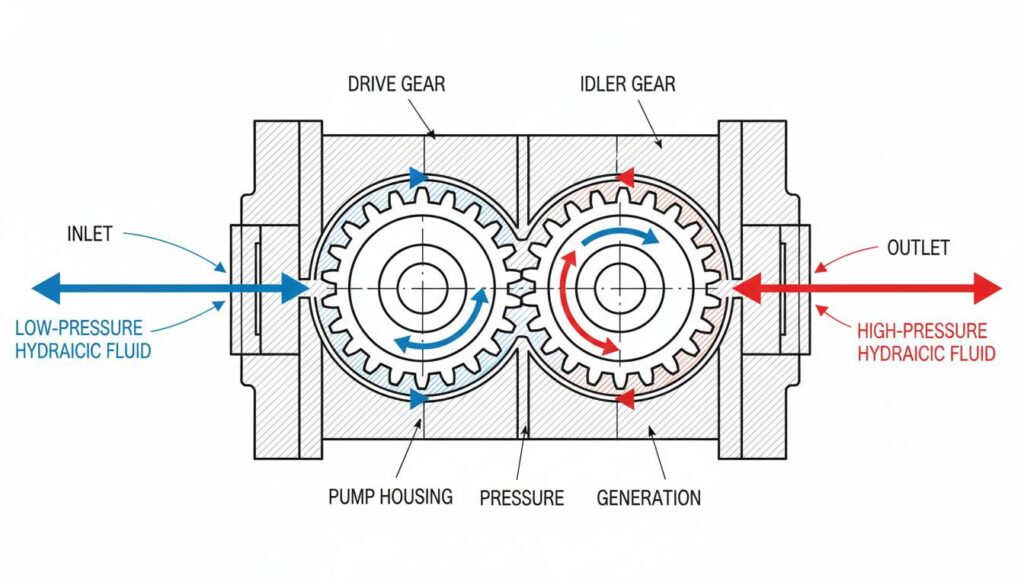
Technical Figure: A cutaway technical illustration of a hydraulic gear pump. Two gears are meshed together inside a metal casing. Blue oil enters one side, gets trapped between the gear teeth, and is pushed out the other side as red, pressurized oil.
The Valves (The Traffic Cops)
Valves tell the oil where to go.
- Control Valve: This is like a switch. It directs oil to extend a cylinder or retract it. When an excavator operator moves a joystick, they are opening and closing valves.
The Actuator (The Muscle)
This is the part that actually moves the load.
- Cylinder: A tube with a piston inside. It moves in a straight line (Linear motion).
- Motor: It spins around (Rotary motion), like the wheels on a lawnmower.
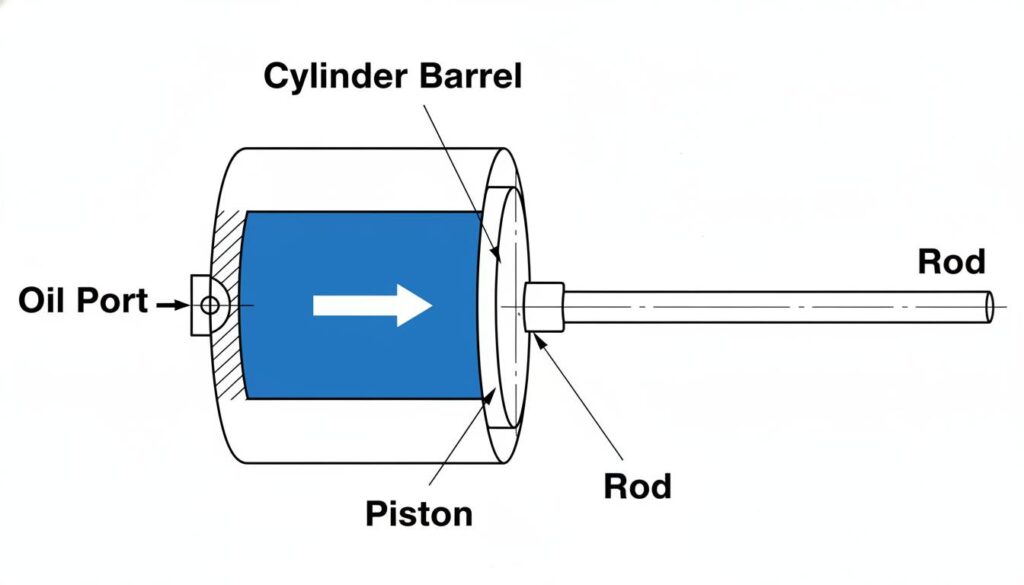
Technical Figure: A cross-section view of a hydraulic cylinder. Inside the metal tube, show the piston head and the rod. Blue oil fills the chamber behind the piston, pushing it to the right. Label the parts: Cylinder Barrel, Piston, Rod, Oil Port.
Think about the human body. If the Pump is the heart and the Actuator is the muscle, what part of the body acts like the Valves (controlling where the blood/energy goes)?
How Force Multiplication Works
This is the “magic” trick of hydraulics. We can use a tiny force to lift a huge weight.
We use a formula: Force = Pressure × Area
Imagine two cylinders connected by a pipe:
- Cylinder A is small (1 square inch area).
- Cylinder B is huge (10 square inches area).
If you push down on the small cylinder with 10 pounds of force:
- The pressure in the liquid becomes 10 psi (pounds per square inch).
- According to Pascal, that 10 psi goes to the big cylinder.
- The big cylinder has 10 square inches of space for the pressure to push against.
The Math:
10 psi (Pressure) × 10 sq in (Area) = 100 pounds of lifting force.
You put in 10 pounds, you got out 100 pounds. You are now 10 times stronger!
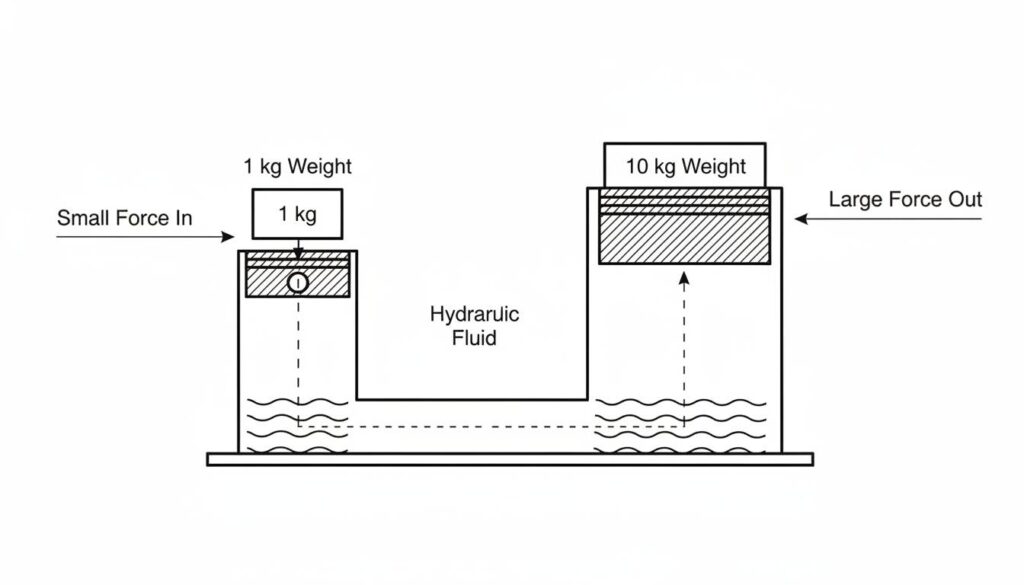
Technical Figure: A diagram of a hydraulic press. On the left, a small piston with a 1kg weight pushes down. On the right, a much wider piston lifts a 10kg weight. The fluid connects them. Text labels show “Small Force In” and “Large Force Out”.
The Trade-off
Nothing is free. Since the big cylinder is 10 times bigger, it moves 10 times slower. To lift the big weight 1 inch, you have to push the small piston down 10 inches. You trade distance for strength.
If you wanted to lift a car very quickly, would you use a narrow cylinder or a wide cylinder? Remember, a wide cylinder is strong, but needs a lot of oil to fill it up.
Advantages and Disadvantages
Why We Use It (Pros)
- Huge Power: Small motors can lift massive buildings.
- Precision: You can move a heavy robot arm by a fraction of a millimeter.
- Safety: If the load is too heavy, a relief valve opens, and the oil just goes back to the tank. The machine doesn’t break.
The Problems (Cons)
- Messy: Hydraulic oil is slimy. If a hose breaks, it leaks everywhere.
- Fire: The oil is flammable. If it gets too hot, it can burn.
- Noise: Hydraulic pumps can be very loud.
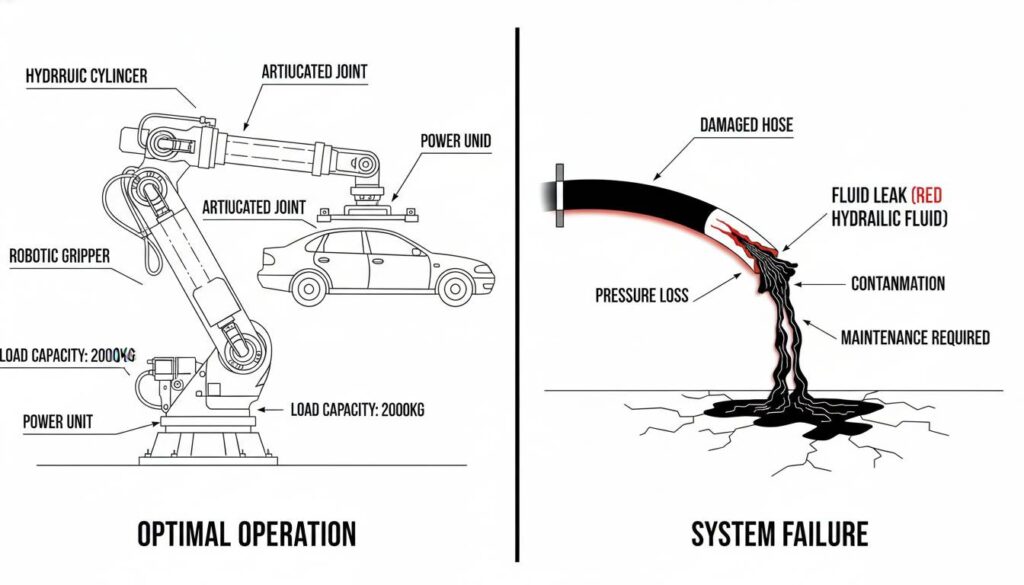
Technical Figure: A split image. On the left, a clean, strong hydraulic robot arm lifting a car. On the right, a hydraulic hose leaking red fluid onto a concrete floor, representing a maintenance issue.
