
What is Hydraulic Fluid?
Hydraulic fluid is the most important part of a hydraulic machine. Think of a hydraulic machine like a human body. The metal parts are the bones. The pumps are the heart. The hydraulic fluid is the blood.
Without this fluid, the machine cannot move. It has three main jobs:
- Transmit Power: It pushes pistons to lift heavy loads.
- Lubricate: It makes metal parts slide easily so they don’t wear out.
- Cool Down: It carries heat away from the pump.

Technical Figure: A simple cross-section diagram of a hydraulic cylinder. Show blue liquid entering one side and pushing a piston to the right. Label the liquid ‘Hydraulic Fluid’ and the moving part ‘Piston.
The Water Analogy
Imagine a garden hose filled with water. If you turn the tap on one end, water shoots out the other end immediately. Hydraulic fluid works the same way. We push liquid at one end of a tube, and it pushes a machine part at the other end.
If hydraulic fluid is like the blood of the machine, what do you think happens if the fluid gets dirty or leaks out? How would the machine “feel”?
Why Do We Need Different Types?
We cannot use just one type of fluid for everything. Different machines work in different places.
- Temperature: Some machines work in freezing snow. Some work in hot deserts.
- Safety: Some machines work near fire. We don’t want the fluid to explode.
- Nature: Some machines work in rivers. If the fluid leaks, it shouldn’t kill the fish.
Because of these needs, engineers classify fluids into three main groups.

Technical Figure: A split screen illustration. On the left, a snowplow working in a blizzard. On the right, a machine working inside a hot steel factory with molten metal. This illustrates different environments.
Group 1: Mineral Oil-Based Fluids
This is the most common type. It is the “standard” choice.
What is it made of?
It is made from petroleum (crude oil). This is the same stuff we use to make gasoline for cars, but it is refined differently.
Characteristics
- Cost: It is cheap to buy.
- Lubrication: It is very slippery. It protects metal parts very well.
- Weakness: It catches fire easily.
You will find this fluid in most excavators, dump trucks, and car jacks.
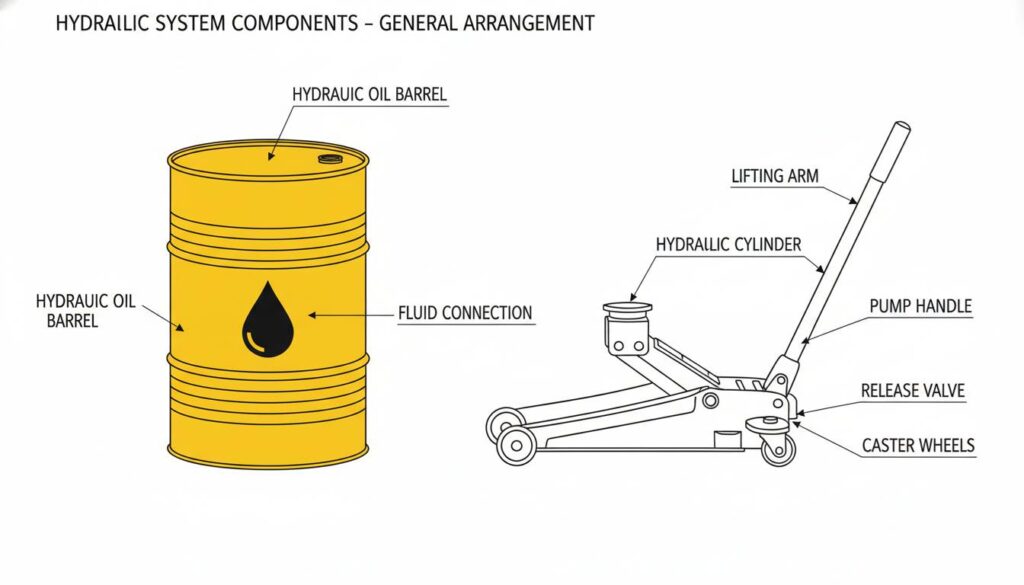
Technical Figure: A standard yellow barrel of hydraulic oil sitting next to a car jack. The barrel has a black oil drop symbol on it.
Mineral oil is flammable (it burns). Why would it be a bad idea to use mineral oil in a machine that pours hot melted metal?
Group 2: Fire-Resistant Fluids
Some machines work in dangerous places like steel mills or underground mines. If a hose breaks and sprays oil on hot metal, regular mineral oil would cause a giant fire.
To stop this, we use Fire-Resistant Fluids. These fluids are hard to burn.
Water-Based Fluids
Water does not burn. So, mixing water with chemicals helps safety.
Water-Glycol
This is a mix of water (about 40%) and glycol (like antifreeze in a car).
- Good: It resists fire well.
- Bad: It cannot handle very high heat because the water will boil away.
Water-Oil Emulsions
This is like salad dressing. We mix oil and water together.
- Oil-in-Water: Mostly water with tiny drops of oil. Very safe against fire, but poor lubrication.
- Water-in-Oil: Mostly oil with tiny drops of water. Better lubrication, but slightly less fire safety.
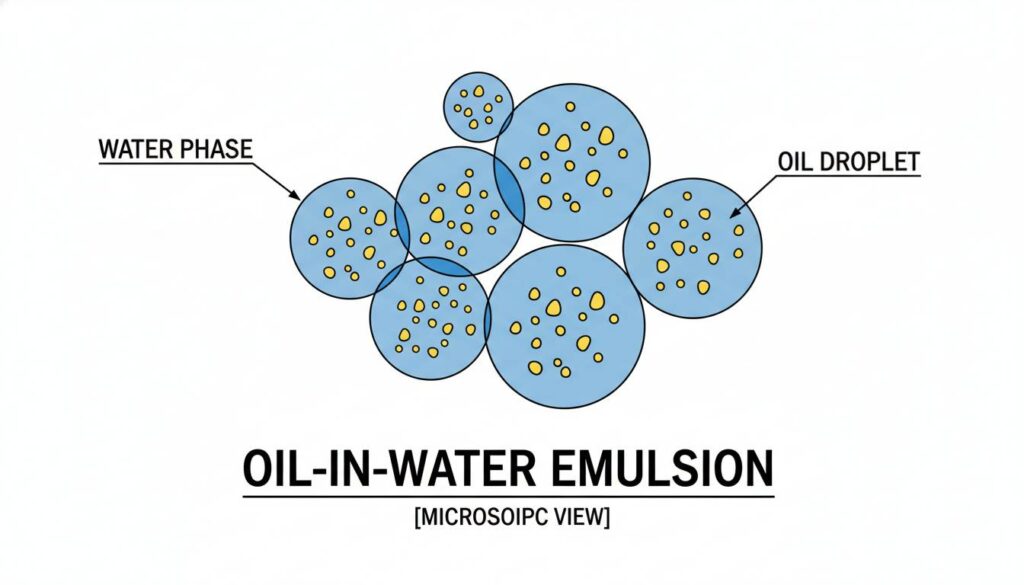
Technical Figure: A close-up diagram showing an emulsion. Show large blue water circles with tiny yellow oil droplets suspended inside them, labeled ‘Oil-in-Water Emulsion’.
Synthetic Fire-Resistant Fluids
These are man-made chemicals. They contain no water and no mineral oil. They are designed in a lab specifically not to burn.
- Pros: Excellent lubrication and fire safety.
- Cons: Very expensive.

Technical Figure: An illustration of a ladle pouring molten steel in a factory. A hydraulic arm controls the ladle. Highlight the hydraulic lines in green to signify safety.
Group 3: Biodegradable Fluids
These are “Green” fluids. We use these for machines that work in nature, like forests, farms, or near the ocean.
Vegetable Oils
These are made from plants like rapeseed (canola) or sunflowers.
- The Big Benefit: If a hose bursts in a forest, the oil spills onto the ground. Bacteria in the soil can eat this oil and clean it up naturally. It does not poison the Earth.
- The Downside: They do not last as long as mineral oil. They can spoil (oxidize) if they get too hot.

Technical Figure: A forestry harvester machine cutting a tree in a green forest. Show a small green leaf symbol on the hydraulic tank of the machine.
Imagine you are a farmer harvesting corn near a river. Why would you choose vegetable-based hydraulic fluid instead of mineral oil?
Important Property: Viscosity
No matter which class of fluid you choose, you must look at Viscosity.
Viscosity is how “thick” the fluid is.
- High Viscosity: Thick like honey.
- Low Viscosity: Thin like water.
Why it matters
- If the fluid is too thick (like cold honey), the pump cannot suck it up. The machine moves slowly.
- If the fluid is too thin (like hot water), it leaks past the seals. The machine loses power.
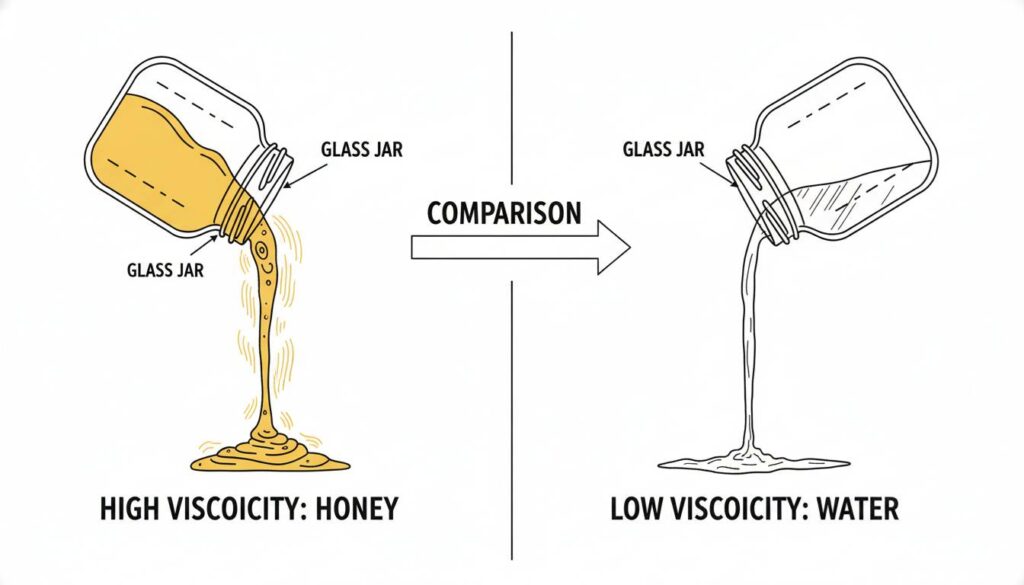
Technical Figure: A comparison illustration. On the left, a jar pouring thick golden honey (High Viscosity). On the right, a jar pouring clear water (Low Viscosity). Label them clearly.
Temperature Changes Viscosity
- Cold weather makes fluid thicker.
- Hot weather makes fluid thinner.
Engineers must pick a fluid that stays “just right” for the weather outside.
On a very cold winter morning, a car engine or hydraulic machine might struggle to start. Based on what we just learned about viscosity, why is that?
